
What should you check before renting an apartment in Malaysia?
When renting an apartment in Malaysia, check the total monthly cost, tenancy terms, building condition, commute, safety, utility setup, and handover evidence before you pay. A cheap rent becomes expensive when the unit has hidden repair issues, unclear deposits, or a tenancy agreement that does not match what was promised.
SPEEDHOME platform records show the most common reason tenants lose part of their deposit at move-out is missing or poor-quality handover photos taken on day one — not the rent itself. Get the photo evidence before your boxes cover the wall.
This checklist covers first-time renters and experienced tenants moving to a new unit. Work through each section before you transfer any money.
What should you check before paying any booking fee?
Confirm the real landlord or authorised agent, the exact unit, total upfront payment, refund terms, and when the tenancy agreement will be signed before sending any money.
Scam and mismatch risk usually appears before signing. PDRM-recorded rental fraud cases jumped from 184 in 2023 to 922 in 2025, with losses around RM2.5 million — most of it paid up front, before any agreement was signed. Do not transfer money because a listing looks attractive. Ask for the full address, unit photos, a viewing arrangement, payment recipient, and written terms for any booking fee.
If the person collecting money refuses to show the unit, avoids written terms, or pressures you to pay immediately, slow down. Treat "pay now or lose the unit" as a red flag, not a sign of a hot deal.
| Before paying | What to confirm | Red flag |
|---|---|---|
| Unit identity | Full address and actual unit number | Only generic building photos shown |
| Payment | Recipient name and stated purpose | Personal account with no written terms |
| Viewing | Physical or verified virtual viewing arranged | Refuses any viewing |
| Agreement | Draft terms and signing timeline provided | No tenancy agreement planned |
How do you judge the real monthly cost?
Look beyond rent: utilities, internet, parking, maintenance charges, commute cost, furniture gaps, and move-in cash all affect affordability. Total monthly cost is what to compare, not the rent figure alone.
Many tenants compare rent only. That misses the real picture. A unit RM150 cheaper per month may cost more overall if it needs paid parking, has a longer commute, or requires you to buy a wardrobe, washing machine, or mattress.
Ask which utilities the tenant pays, whether water and electricity are separately metered, and whether internet is already available at the unit. If the apartment is partly furnished, list exactly what is included and in what condition. Get the furniture list in writing — "fully furnished" disputes are common at move-out.
Plan the move-in cash before you sign, not after. A typical 12-month unfurnished unit on a 2+1 deposit pattern looks like this:
| Move-in cash item | Typical RM (KL/PJ, mid-market unit, RM1,800/mo) |
|---|---|
| First month rent | 1,800 |
| Security deposit (2 months) | 3,600 |
| Utility deposit (TNB + water) | 250–500 |
| Tenancy agreement stamping (LHDN, ad valorem on annual rent) | ~72 |
| Access card, key and remote replacement | 50–150 |
| Moving cost (lorry + helpers, studio–2BR) | 200–500 |
| Initial cleaning and small setup | 100–300 |
| Approximate total move-in cash | ~6,100–6,900 |
Note: deposit can be 2+1, 3+1 or higher — Malaysia has no statutory residential rent-deposit cap. For a fuller pre-rent budget walkthrough including less-common items, see the 10 things to know before renting in Malaysia.
Is there a legal cap on deposit in Malaysia?
No. Malaysia has no statutory residential rent-deposit cap. The deposit amount, deduction rules and return timeline are set by the tenancy agreement, with general contract law as the fallback.
Landlords commonly ask for "2+1" (two months' security plus one month utilities) or "3+1". Three months upfront is not unusual in higher-demand areas like Mont Kiara, Bangsar or KLCC. None of these are regulated by law — they are what the tenancy agreement says.
Practical implications for a 2026 MY renter:
- A 3+1 deposit is legal if you sign for it. It is not a red flag on its own.
- The Residential Tenancy Act (RTA) is still proposed, not yet law, so the tenancy agreement remains the binding document.
- Refund deductions must be tied to actual damage or unpaid bills stated in the agreement — vague "cleaning" or "restoration" claims are disputable.
- LHDN stamping must happen within 30 days of signing, or late penalties apply.
For the deposit-deduction playbook and how to dispute unfair claims, see the tenancy agreement guide.
What should you inspect inside the unit?
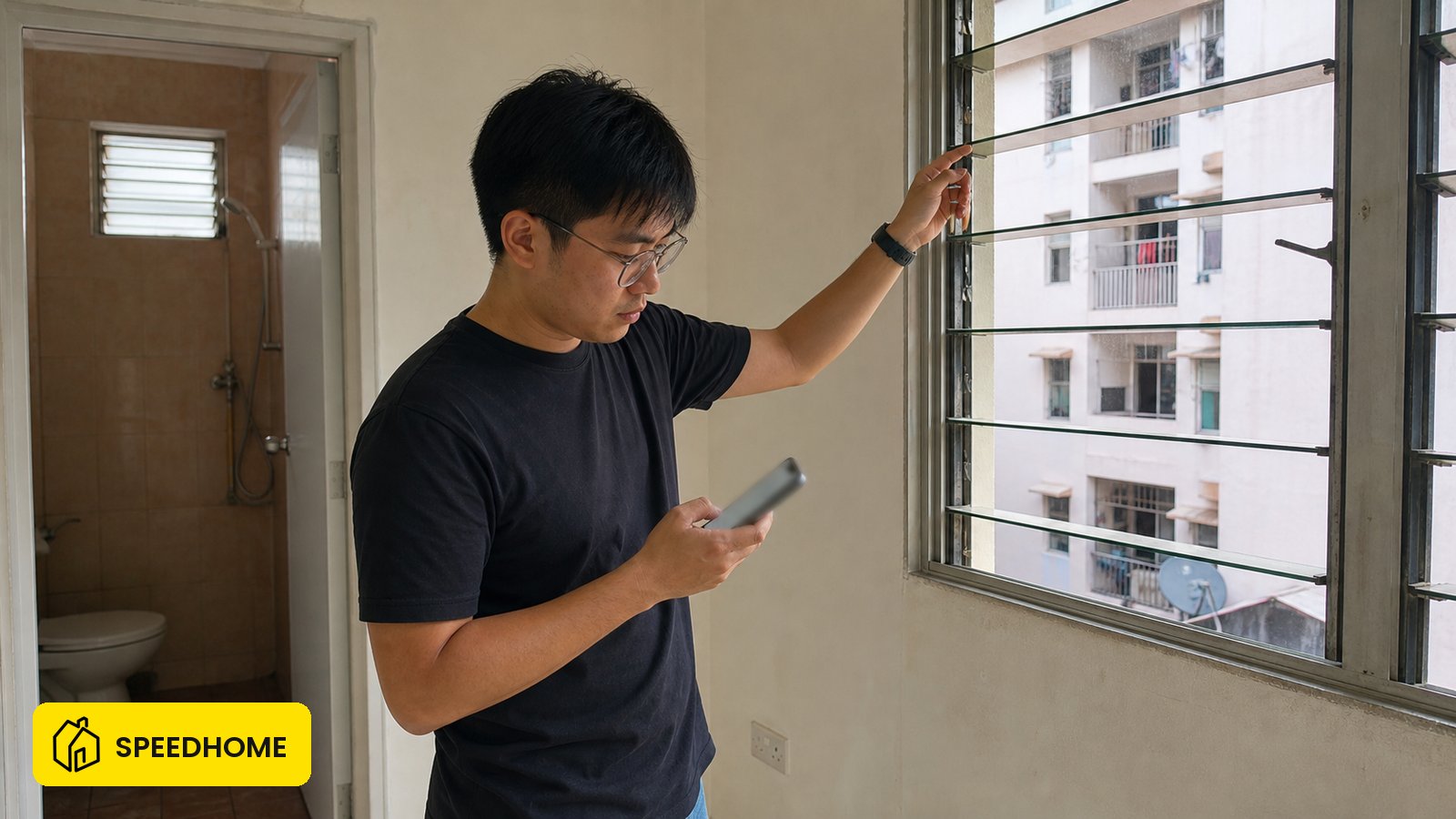
Check water pressure, leaks, air-conditioners, doors, windows, sockets, appliances, pests, and signs of damp before signing. Test items during the viewing, not after move-in.
A viewing is not just to see whether you like the layout. Test the things that become arguments later. Turn on taps, flush toilets, check under sinks, switch on air-conditioners, open windows, and look for stains near ceilings or walls.
If you still want the unit despite minor defects, ask whether they will be repaired before handover and get that promise in writing. Do not assume "fully furnished" means every item is working.
| Area | What to test | Why it matters |
|---|---|---|
| Bathroom | Flush, drainage, water pressure, heater | Repairs disrupt daily life and are disputed at move-out |
| Kitchen | Sink, hob, cabinets, fridge, extractor | High-cost dispute area; note every defect |
| Bedroom | Air-cond, wardrobe, windows, wall stains | Comfort, mould risk and energy cost |
| Electrical | Sockets, lights, DB box, hot-water switch | Safety and repair urgency |
How important is the neighbourhood?
Very important: commute, noise, food access, parking, security, and late-night access affect daily life more than listing photos. Visit the area at the time you will actually use it.
A street that feels fine at 2pm may be noisy at midnight. A condo that looks near public transport may still require a difficult walk or costly Grab ride every day.
Check nearby grocery, clinic, food, laundry, and public transport options. If you drive, inspect parking access and visitor parking. If you work shifts, ask about guardhouse hours and lift availability.
Honest drawbacks to consider: some affordable areas have limited visitor parking, ageing lifts, or inconsistent maintenance. Factor those in rather than discovering them after you sign.
What tenancy agreement terms matter most?
Read the deposit, utility, repair, early termination, subletting, renewal, notice, and handover clauses before you sign. If a promise matters, get it into the agreement.
A tenancy agreement is not just paperwork. It decides what happens when something breaks, when you need to move early, or when the landlord wants the unit back.
As of 2026, Malaysia still has no Residential Tenancy Act in force. Your tenancy agreement is the main document setting out what both sides agreed. Verbal promises about repairs, furniture, parking, or renewal are weak when the relationship turns tense.
| Clause | What to confirm |
|---|---|
| Rent payment | Amount, due date, payment channel, receipt method |
| Tenancy period | Start date, end date, renewal or extension process |
| Deposit or Zero Deposit | What is paid upfront and what can be deducted or claimed |
| Utilities | Who pays which bills, how accounts are handled, final bill process |
| Repairs | How to report defects; who handles which type |
| Early termination | Notice period, replacement-tenant terms, penalty if any |
| Handover | Inventory, photos, keys, access cards, inspection record |
For a detailed guide on what each clause should say, see the tenancy agreement guide.
How should handover be done?
Use a checklist, take dated photos, record meter readings, test keys and access cards, and send defects in writing on or before the first day. The best deposit protection starts at handover.
Photograph the unit condition before your belongings cover the space. Save original files and send a written defect record to the landlord or platform. Record electricity and water meter readings. Confirm the number of keys, access cards, parking cards, and remotes — missing access items are a common deduction source later.
At move-in, document:
- Every room, wall, floor, ceiling and window condition
- All appliances and furniture listed in the inventory
- Pre-existing defects, even minor ones
- Meter readings for electricity and water
- All keys, access cards and remote controls handed over
The same evidence protects you at move-out. Take matching photos from the same angles when you leave.
How should students and first-time renters adapt the checklist?
First-time renters should be stricter on payment proof, house rules, transport, and handover evidence because they have less experience spotting rental problems before they sign.
If you are renting near campus or starting your first job, do not assume every attractive listing is safe. Ask whether cooking is allowed, how many people can stay, whether visitors are permitted, who pays utilities, and whether the landlord allows renewal.
For shared units, check who signs the tenancy agreement. If only one housemate signs, that person may carry the legal burden when others leave.
| Renter type | Extra check | Why it matters |
|---|---|---|
| Student | Housemate and visitor rules | Prevents conflict with landlord or management |
| New worker | Real commute at peak hours | Protects time and daily transport cost |
| Family | Schools, clinic, noise, lift access | Daily routine depends on area fit |
| Outstation tenant | Verified virtual viewing and written documents | Reduces remote-payment risk |
Daily-life details rarely appear in listings but shape whether the home actually works. Spend 15 minutes on-site (or ask the guardhouse / a current tenant) about:
- Lift waiting time at peak hours. Two slow lifts in a 400-unit block is a daily frustration.
- Parcel collection. Is there a secure parcel room or does the guardhouse hold everything? Lost parcels become arguments.
- Late-night food and laundromat access. Important for shift workers and students.
- Public transport safety at night. Walk the route from the LRT/MRT/bus stop at the hour you'll actually travel.
- Mobile signal and Wi-Fi reach. Concrete-and-steel condos often kill signal indoors; check before signing if you work from home.
- Speak to a current resident. A quick "hi, anything you wish you'd known before moving in?" surfaces real issues the listing never will.
What should you ask after viewing but before signing?
Ask for the draft tenancy agreement, item inventory, repair promises, payment schedule, utility arrangement, and exact handover date before you sign. Do not let excitement skip the boring details.
The viewing tells you whether you like the unit. The pre-signing questions tell you whether the rental is manageable.
If the landlord promised a mattress, repainting, cleaning, an extra access card, or appliance replacement, get it in writing. A message thread is better than memory, but a written agreement or signed addendum is stronger.
Ask what happens if the repair is not completed before move-in: will handover be delayed, will rent be adjusted, or will you accept the unit as-is? Clarify this now to avoid last-minute disputes.
When should you walk away from a rental?
Walk away when the payment path is unclear, the landlord refuses written terms, the unit condition is materially different from the listing, or you are pressured to pay before basic verification is done.
Good rentals can move quickly, but speed is different from pressure. A genuine landlord should be able to answer reasonable questions about the unit, payment, agreement, and handover.
Be especially careful if the rent is far below market, the photos look inconsistent, the person cannot prove their authority to rent the unit, or every question is answered with "pay first". Losing a good unit is cheaper than losing a deposit to a bad one.
For warning signs to look for in online listings and unverified social-media listing channels, see the rental scam warning signs guide.
How should you compare two apartments side by side?
Score both units on total cost, commute, condition, contract clarity, safety, and move-in readiness rather than choosing by rent alone. Commute fatigue is often the factor renters regret most.
When two apartments look similar, a structured comparison helps. One may be cheaper but farther from work. Another may cost more but include parking, better furnishing, and fewer repair risks.
A unit that adds 40 minutes each way can affect sleep, work performance, fuel, tolls, and willingness to stay long term — costs that do not appear in the rent figure.
Also compare landlord responsiveness. If the landlord is vague before signing, repairs and deposit return may be harder later.
| Factor | Apartment A | Apartment B |
|---|---|---|
| Total monthly cost | Rent + utilities + parking | Rent + utilities + parking |
| Real commute | Time, cost, reliability at your travel hours | Time, cost, reliability at your travel hours |
| Condition at viewing | Repairs needed before move-in | Repairs needed before move-in |
| Contract clarity | Deposit clause, exit terms, repair clause | Deposit clause, exit terms, repair clause |
Renting with Zero Deposit
Zero Deposit (ZD) replaces the upfront cash deposit on selected eligible SPEEDHOME listings, freeing the deposit cash you would otherwise tie up at move-in. It is a managed rental-risk system, not a financial guarantee product and not a guarantee.
In practice, ZD shifts the deposit cash you would normally hand over at signing into the rental-risk pool, with SPEEDHOME running the screening, agreement, stamping and end-of-tenancy process on the back end. On a 2+1 deposit pattern for a RM1,800/month unit, that is roughly RM5,400 you do not need to find at move-in — useful for first-jobbers, students, and tenants relocating between cities.
What ZD does and does not change:
- Same tenancy agreement, same stamping. The LHDN 30-day stamping deadline still applies. ZD does not exempt the agreement from duty.
- Same handover evidence still matters. Dated photos, meter readings and inventory remain the tenant's protection at move-out — ZD does not auto-cover end-of-tenancy disputes.
- Severe damage is the one weaker scenario. Where a cash deposit could be deducted, ZD relies on SPEEDHOME's claim process. Read the listing's ZD terms before you assume full coverage.
- Eligibility is per-listing. Not every unit on SPEEDHOME is ZD-eligible — landlords opt in. Confirm the ZD tag on the live listing before you plan your budget.
Check Zero Deposit availability and current eligibility directly on SPEEDHOME rentals — filter by your area and confirm the ZD tag is live on the listing you want.
Where to look next
If the unit has cleared the checklist above, the next step is to shortlist verified listings for your area and confirm Zero Deposit eligibility on each one before you commit cash. Three concrete routes for English-speaking renters:
- Browse verified Zero Deposit listings in Kuala Lumpur — filtered live for KL, ZD availability tagged per listing.
- Browse verified Zero Deposit listings in Petaling Jaya and surrounding PJ suburbs — same filter for PJ, Subang Jaya and the Klang Valley south of KL.
- Browse verified Zero Deposit listings in Johor Bahru — same filter for the JB market.
For every listing, re-confirm the ZD tag is live before you plan your move-in budget — eligibility is per-listing and can change as landlords opt in or out. The Malay-language sewa route lives at /my/sewa and the Chinese-language listing route at /zh/rent; use the language switcher at the top of the page if you'd rather browse in BM or ZH.
Frequently Asked Questions
Is a booking fee refundable if I change my mind?
Usually not — a booking fee ("earnest deposit") is what holds the unit while the tenancy agreement is being prepared. Once paid, it is typically only refundable if the landlord cannot deliver the unit as described, or if both sides agree in writing to release it. Get the refund conditions stated in writing before you transfer.
Can a landlord ask for 3 months deposit plus 1 month utilities?
Yes, if you agree and sign. Malaysia has no statutory cap on residential deposit — the tenancy agreement sets the amount. A 3+1 pattern is common in higher-demand KL condos. Push back only if the cash flow is a problem; check whether the listing is Zero Deposit eligible instead.
How long do I have to stamp the tenancy agreement?
Within 30 days of signing. Tenancy instruments executed in Malaysia must be stamped through LHDN's e-Duti Setem within 30 days; late stamping triggers a penalty (RM50 or 10% of deficient duty within 3 months; RM100 or 20% after 3 months — whichever is higher). An unstamped agreement is still legally valid between the parties but cannot be admitted as evidence in court.
Is a virtual tenancy agreement signing legally valid?
Yes, for most residential tenancies. A digital or e-signed tenancy agreement signed via SPEEDSIGN or any LHDN-recognised platform is legally admissible, provided the parties' identities are verified and the agreement is stamped within 30 days. Print and keep a copy; LHDN-stamped PDFs are accepted by the courts.
How long does a landlord have to return my deposit after I move out?
There is no fixed statutory deadline, because the RTA is still proposed and not yet law. The tenancy agreement usually sets a window (commonly 14, 21 or 30 days after handover). If the agreement is silent, raise it in writing before you move out, and request itemised deductions with photo evidence. Disputes under RM5,000 can be filed at the Small Claims division; consumer-framed disputes up to RM50,000 may go to the Tribunal for Homebuyer Claims.
What is the most common mistake first-time renters make in Malaysia?
Skipping the move-in photo record. SPEEDHOME platform records show the majority of deposit disputes that drag on for weeks turn on missing or time-stamped handover photos — not on whether the rent was paid. Photograph every wall, floor, appliance, meter, key and access card on day one, and send the set to your landlord or platform in a single message so the timestamp is on record.