
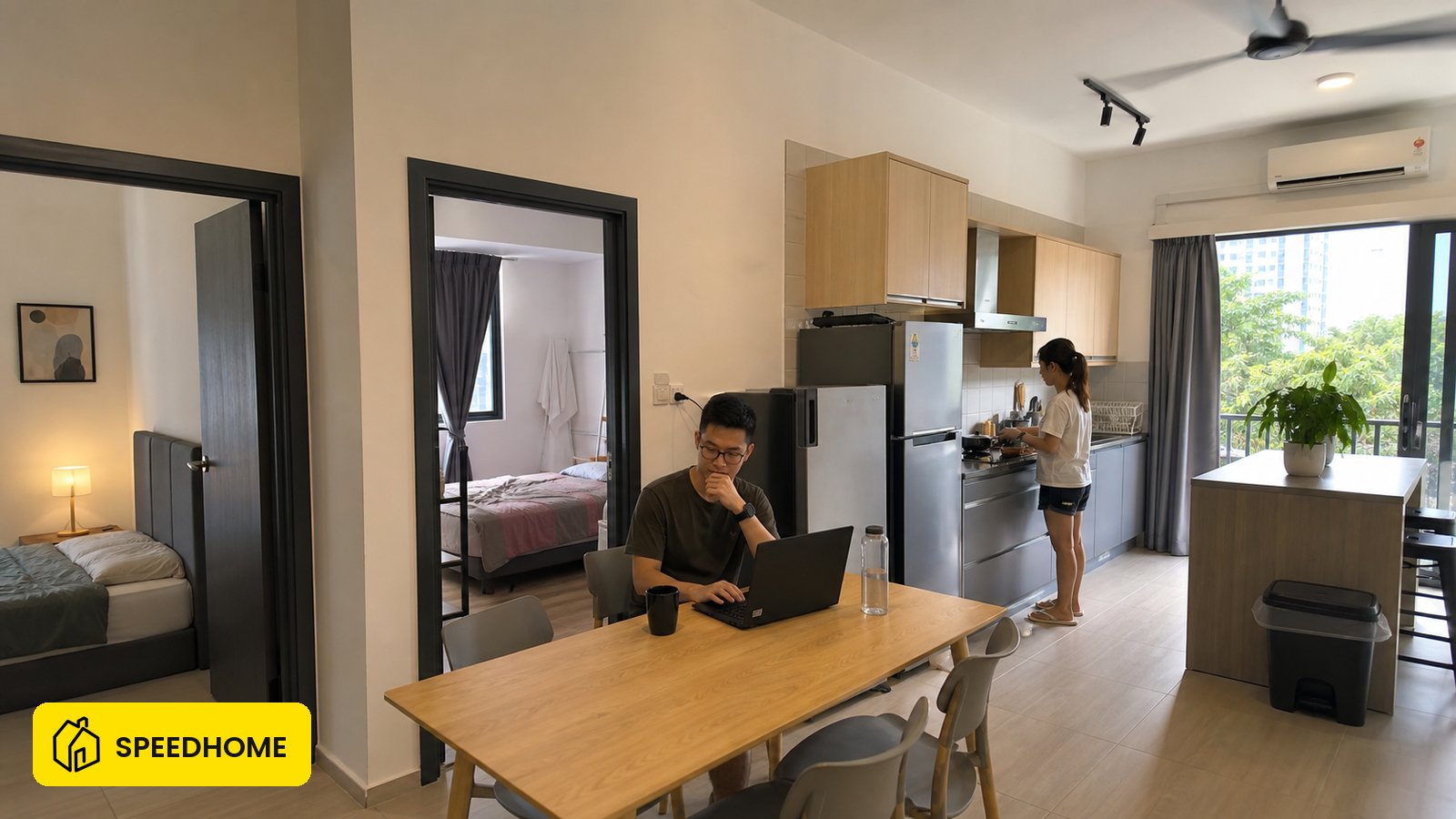
What does co-living mean in Malaysia?
Co-living is a managed shared-rental setup in Malaysia: a private bedroom, shared common areas, a written agreement, and an owner or appointed operator who enforces house rules. Bilik sewa is the broader term for renting a room in a shared home — operator-managed or informal. Co-living listings are more likely than plain bilik sewa listings to carry written subletting consent and a named operator — that is the structural difference the label is supposed to signal.
The label matters less than four practical checks: who signs the agreement, who manages disputes, what utilities and services are bundled, and what happens when a housemate moves out or stops paying.
Co-living is not automatically better than bilik sewa. It wins when management is clear, house rules are written, payments are traceable, and the listing explains what is included. A listing that uses "co-living" only as a nicer label for a crowded room usually fails on all four checks.
Start with the live listing, then check the agreement before paying anything. SPEEDHOME-managed rooms standardise the agreement and complaint route, which is the practical advantage over unverified social-media listing channels: browse room rentals.
Co-living vs bilik sewa: what is the real difference?
A co-living arrangement in Malaysia names a manager and a written rule book; a plain bilik sewa often runs on verbal house rules between the main tenant and sub-tenants. Check who manages, who signs, and who enforces before you pay.
| What to compare | Co-living | Bilik sewa |
|---|---|---|
| Who manages the unit | Owner, operator, or appointed manager | Owner, main tenant, or housemate |
| What you usually rent | Private room plus shared spaces | Private room in a shared home |
| Agreement type | Written tenancy or room agreement, more often | Often verbal or loosely written, especially in sublet cases |
| House rules | Usually more formal | Sometimes written, sometimes informal |
| Utilities | May be included or split | Often split by occupants |
| Cleaning | May be arranged or scheduled | Often shared among occupants |
| Privacy | Depends on room and occupant count | Depends on room and housemate behaviour |
| Complaint route | One accountable party named in the agreement | Often unclear if the main tenant is also a sub-tenant |
| Main risk | Paying for "managed" living without written rules | Informal arrangements that become hard to enforce |
What changes in practice when an operator is on the agreement:
| Practical dimension | Informal sublet (no operator) | SPEEDHOME-managed room |
|---|---|---|
| Eviction exposure if head tenant breaches | All sub-tenants may be asked to leave together | Sub-tenant holds agreement with operator, not head tenant |
| Deposit handling | Held by main tenant, return terms unclear | Held under SPEEDHOME tenancy agreement with stated return process |
| JMB or MCST compliance | Sub-tenant has no standing with management | Operator liaises with JMB or MCST on tenant's behalf |
| Utility billing | Sub-tenant reimburses main tenant | Billed or split through operator's published formula |
| Time-to-recovery in dispute | Often weeks to months, depending on head tenant | Routed through SPEEDHOME's recovery workflow with a defined process and case owner |
Do not decide based on the label alone. Ask for the tenancy agreement or room agreement. If the person collecting rent is not the property owner, ask whether the owner has given written consent for subletting.
For the broader room-rental checklist, read Room Rental and Co-Living in Malaysia.
When does co-living make more sense than a normal room?
Co-living makes sense in Malaysia when the rules, payments, and the named manager or operator are all written down. It suits tenants who want a private room, shared spaces, and one accountable party to call when something breaks.
Co-living is the safer pick in three concrete cases:
- You are new to a Klang Valley neighbourhood and have no existing housemate network.
- Your budget is tight and you cannot absorb a sudden move if the head tenant's own agreement ends.
- The unit sits in a stratified condo or serviced residence where the JMB or MCST house rules override what the main tenant promises.
The trade-off is that you have less say over guests, quiet hours, furniture, and what stays in the common area, because those decisions sit with the operator or the JMB, not with you.
A plain bilik sewa can be better when the owner lives nearby, the housemates already know each other, or the rent arrangement is simple and fully documented in writing. The danger is informality: verbal house rules are easy to forget and hard to prove.
When you are ready to compare options, use SPEEDHOME rentals and filter for the room or unit type that fits your budget.
What should tenants check before paying for co-living or bilik sewa?
Tenants should check the agreement, payment recipient, deposit terms, utility split, guest rules, cleaning duties, and subletting permission before paying. If any answer is vague, pause — shared housing problems start with unclear responsibility, not with the room itself.
Use this checklist before booking a viewing or paying a holding fee:
| Checkpoint | What a safe answer looks like |
|---|---|
| Agreement | Written room agreement or tenancy agreement before move-in |
| Payment | Clear recipient name and traceable payment method |
| Deposit | Amount, purpose, deduction rules, and return process stated in writing |
| Utilities | Included, separately metered, or split by formula |
| Cleaning | Who cleans which area and how often |
| Guests | Day visitors and overnight guests handled in writing |
| Subletting | If the renter is a main tenant, owner consent should be documented |
| Move-out | Notice period and handover checklist stated upfront |
Do not rely on screenshots or promises in chat. If the listing says Zero Deposit, confirm eligibility on the live listing because it applies to participating managed rooms, not every unit on the market.
On Zero Deposit specifically: Zero Deposit trades a cash deposit for SPEEDHOME's managed rental-risk system, which is not the same as insurance and is not a deposit substitute in the legal sense. Tenants should read the live terms before signing, especially the deductible and the damage categories that fall outside the scheme.
What is typically included — and what is not — in a co-living setup?
A co-living room in Malaysia usually bundles the bedroom furniture, wifi, water, and electricity into one bill; cleaning, aircond servicing, and guest rules vary by operator. Bilik sewa more often splits utilities by occupant and leaves furnishing to whoever already lives there.
| Inclusion | Co-living (operator-managed) | Bilik sewa (informal) |
|---|---|---|
| Bedroom furniture | Usually included (bed, wardrobe, desk) | Often partial; depends on main tenant |
| Wifi | Usually included in rent | Often split or paid separately |
| Water | Usually included | Usually split by headcount |
| Electricity | Sometimes included, sometimes metered | Usually reimbursed to main tenant |
| Aircond servicing | Often scheduled by operator | Usually tenant's responsibility |
| Common-area cleaning | Scheduled by operator | Shared among occupants |
| Guest policy | Written house rule | Verbal, varies by housemate |
| Move-out cleaning | Sometimes included | Usually tenant's responsibility |
Check live room listings on SPEEDHOME for current RM ranges in KL, PJ, and other Klang Valley neighbourhoods. Rent varies sharply by building, furnishing, and whether utilities are bundled, so the listing is the only reliable source for a current price.
What if the person renting the room is not the owner?
If the person renting the room in Malaysia is a tenant, the arrangement is subletting and your housing stability depends on a contract you are not party to. Ask for written owner consent before you pay — without it, the main tenant's breach can put you out.
Can a tenant legally sublet a room in Malaysia?
A tenant in Malaysia can legally sublet a room when the tenancy agreement permits it or the owner signs off in writing under the Contracts Act 1950. Without that written consent, the sub-tenant has no direct standing with the owner.
The safest question is simple: "Are you the owner, the appointed agent, or the main tenant?" If the answer is "main tenant", ask for proof that subletting is allowed. You do not need to inspect private owner documents in detail, but you should not move into an arrangement where the main tenant refuses to show any written permission.
This matters because your practical relationship may be with the main tenant, while the property owner controls the unit. If the main tenant breaches the agreement with the owner, everyone in the unit can be affected.
Sublet-related disputes are one of the most common categories of room-rental complaints SPEEDHOME sees, and almost all of them trace back to one missing item: the owner's written consent to sublet.
For the landlord-consent side, read Can a Tenant Sublet in Malaysia?.
JMB, house rules, and shared condos: the layer tenants forget
In a Malaysian stratified condo or serviced residence, the management body (JMB or MCST) sets house rules under the Strata Management Act 2013 that bind every occupant, including sub-tenants. A co-living operator who signs with the management removes a layer of risk you carry alone in an informal bilik sewa.
Two practical differences follow. First, JMB house rules on guests, quiet hours, and short-stay limits can override what the main tenant promises you — so the operator's standing with the management matters. Second, utility billing in stratified buildings often runs through the owner's account; an informal sublet usually means the sub-tenant reimburses the main tenant, which is one more step where disputes start.
The tenant action is to ask, before paying any holding deposit, who the operator's named contact is with the JMB and whether the building's house rules permit the room-rental setup you are about to enter. If the operator cannot name a JMB-facing contact, treat it as a red flag.
For a fuller read on how management bodies interact with tenants, see the JMB and MCST guide for Malaysian strata living before you sign.
What to do if the main tenant disappears
If your main tenant stops responding, leaves the country, or is evicted by the owner, your housing stability depends entirely on whether the owner consented to the sublet in writing. An SPEEDHOME-managed room removes this layer of risk because the agreement is with the operator.
Three steps to take today if you are already in a sublet:
- Save the chat log, payment receipts, and any written consent you were shown.
- Ask the owner or building management in writing whether subletting was authorised.
- Move to a managed listing with a written agreement as soon as your notice period allows.
Browse SPEEDHOME-managed room rentals in KL and across Malaysia
If you are weighing co-living against a plain bilik sewa, compare in writing before you pay: see the agreement, deposit terms, and house rules side by side. SPEEDHOME-managed room rentals publish all three on the live listing, with the named operator who signs the agreement shown on the listing page: browse room rentals on SPEEDHOME.
FAQ
Is co-living the same as bilik sewa?
No — co-living is a managed subset of room rentals with one operator on the agreement and written house rules. Bilik sewa is the broader umbrella term that covers both managed rooms and informal arrangements run by a main tenant. Where the two really diverge is accountability: a managed co-living room has a named signatory you can reach, while an informal bilik sewa may have no one other than the main tenant.
Is co-living legal in Malaysia?
Co-living is lawful in Malaysia when the owner or appointed operator has the right to rent out rooms and the building's house rules allow the arrangement. Two layers decide this: the tenancy agreement (which must permit subletting under the Contracts Act 1950 if a tenant is doing the renting out) and the JMB or management corporation rules of the building under the Strata Management Act 2013, which can restrict short stays, guest access, or how many occupants share a unit.
What happens if my housemate stops paying rent?
In an informal bilik sewa, the main tenant's missed rent becomes the owner's problem, and the owner can ask everyone to leave. In an operator-managed co-living, the operator carries the payment relationship with the owner, so one housemate's missed rent does not put the rest of the unit at risk. This is the practical reason the written agreement matters more than the label.
What should be written in a co-living house rule?
Visitor rules, quiet hours, utility sharing, cleaning duties, common-area use, repair reporting, move-out notice, and deposit deductions should all be written.
Should I rent a room from a main tenant?
Renting from a main tenant is the higher-risk path because your housing stability sits on top of a contract you did not sign. The only safer version is when the main tenant has written permission from the owner to sublet and gives you a separate written agreement that names both the main tenant and the owner as the chain of accountability.