
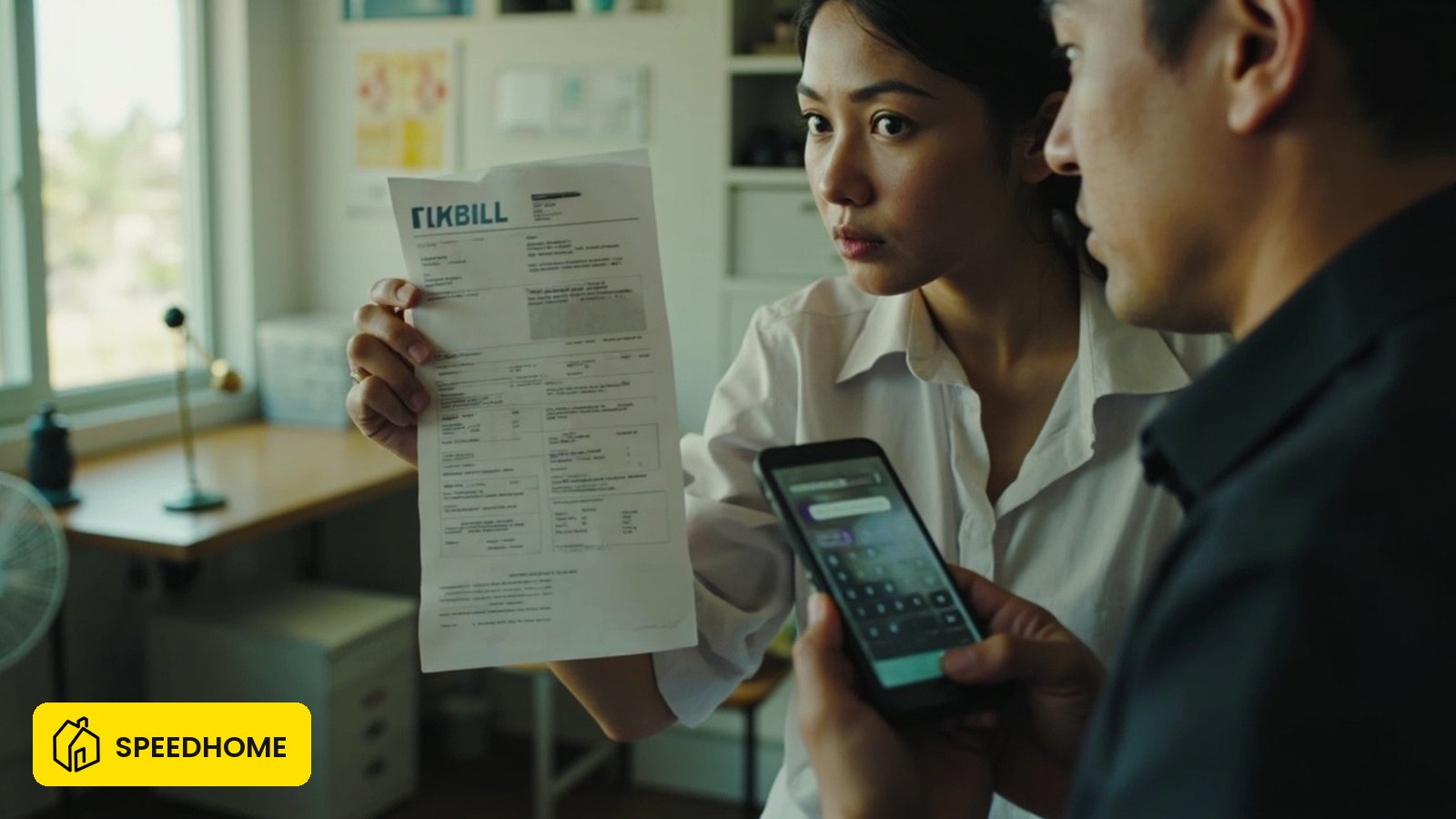
Room rental electricity bill: can a landlord mark up the TNB kWh rate?
No, a Malaysian landlord cannot lawfully charge a room tenant more than the published TNB kWh rate for electricity actually consumed, because the room rental arrangement is a private contract and a surcharge is an undisclosed margin, not a cost. Platform data (2025) shows utility-billing is the leading flag in the first 90 days of a room tenancy, and undisclosed sub-meter admin margins drive the majority of those flags — which is why any per-kWh charge above the TNB tariff, or any flat fee that pretends to be a per-kWh pass-through, must be agreed in writing as a small admin or sub-meter margin, capped and disclosed before signing.
The clean mental model is this: the TNB kWh rate is the wholesale input cost. A landlord who buys the electricity from TNB at that rate and on-sells it to room tenants is passing through a cost. The moment the per-kWh price a tenant pays is higher than the bill the landlord paid, it is no longer a pass-through — it is a markup, and that needs to be in the tenancy agreement, with the amount or percentage shown, before the tenant signs.
This page complements the broader room rental and co-living guide. For the specific bill-split mechanics, see how landlords split utility bills fairly between room tenants.
TNB kWh is the cost: why does anything above need to be in writing?
Per-kWh electricity in a room rental is a TNB cost pass-through. Any surcharge the landlord adds must be a named, capped admin or sub-meter margin disclosed in the tenancy agreement, not a hidden kWh markup. SST is not chargeable on residential rent or on a residential utility pass-through.
| Charge type | Legal status | What it must look like in the agreement |
|---|---|---|
| Pass-through at TNB kWh rate | Allowed, normal | "Electricity is charged at the current TNB domestic tariff based on the official bill." |
| Equal per-room share of a master TNB bill | Allowed, normal | "Electricity bill is split equally per occupied room, supported by the official TNB bill." |
| Sub-metered usage | Allowed if meter reading is shown | "Tenant pays RM X per kWh for measured usage, meter read on [date], photo of reading attached." |
| Per-kWh rate above TNB tariff (pure markup) | Not allowed as a pass-through | Must be a disclosed admin/sub-meter margin, with a clearly disclosed calculation basis and cap stated in the agreement. |
| Flat "electricity fee" per month with no formula | Risky | Should be converted to a per-kWh or per-room split, or to a fair-use "bills-included" rent. |
| Service tax (SST) on the electricity component | Not applicable | Residential letting, including a utility pass-through, is outside the scope of service tax. |
A common trap: a landlord who writes an arbitrary inflated electricity rate per kWh in the agreement is not running a pass-through — TNB's official residential structure from 1 July 2025 works out to well under half that per kWh before any markup. If the agreement is silent, the tenant's strongest argument is that the rate should be the actual TNB bill rate plus a small disclosed margin. The remedy route is the written agreement first, then the small-claims procedure in the Magistrates' Court for any actual overcharge, but most disputes end at the documentation stage.
What "TNB kWh rate" actually means today
Since 1 July 2025, TNB's residential tariff is no longer tiered blocks — it is a component-based RP4 structure: a Generation Charge (27.03 sen/kWh at or below 1,500 kWh/month, 37.03 sen/kWh above), plus a Capacity Charge (4.55 sen/kWh), a Network Charge (12.85 sen/kWh), and a monthly Retail Charge waived when monthly usage is under 600 kWh. Tenants should verify the current published schedule at myTNB rather than rely on a rate the landlord states verbally.
The full published TNB residential tariff is something tenants can verify directly in the myTNB app or on the TNB website. For room-rental purposes, the useful facts are:
- The old tiered blocks (21.80–57.10 sen/kWh) were replaced on 1 July 2025 by the component charges above.
- Households using 1,000 kWh/month or less were expected to see bills remain similar or decrease slightly under the new structure.
- Automatic Fuel Adjustment (AFA) movements are capped at ±3 sen/kWh; anything beyond that needs government approval.
The point for a room tenant is not to memorise every component, but to check that the per-kWh figure in the agreement lines up with what TNB actually billed for that month, and to understand that a single room with heavy aircond use (a 1-HP wall unit running 8 hours a day is commonly cited at around 90 kWh per month, and the bill climbs further at longer runtimes) will cost proportionally more than the same unit with fan-only use. Comparing kWh, not just RM, is what isolates a real usage spike from a tariff change.
How the markup risk actually shows up in a room rental
The most common markup patterns are (1) a per-kWh rate above the TNB published rate, (2) a flat fee that pretends to be a pass-through, (3) rounding up kWh used, and (4) adding a "meter reading fee" or "admin fee" with no formula. Each is contestable on the agreement, and some are easy to challenge on the math.
| Pattern | How to spot it | Tenant's response |
|---|---|---|
| Per-kWh above TNB rate | Compare the agreement rate to the TNB published rate for that month | Ask the landlord to revise the rate to TNB plus a disclosed margin, or escalate under the agreement |
| Flat fee with no usage proof | Agreement says "RM X per month for electricity" with no formula and no bill shown | Request a per-room split or a copy of the TNB bill each month; this is the hardest to defend on either side |
| Rounded-up kWh | Bill says 312 kWh used but reading is 311.6 kWh rounded to 312, then charged at a premium | Tenant can ask for a copy of the meter reading; rounding by 0.5 kWh is normal, rounding by 10 kWh is not |
| Admin or sub-meter fee | Agreement specifies an admin surcharge per kWh with no cap | Acceptable if capped in writing with a defined monthly ceiling |
| Cash-only top-ups | Landlord only accepts cash for electricity, no receipt | Refuse and pay via FPX/bank transfer with a clear reference; cash payments to a landlord who is not a registered business are a red flag for both sides |
What to negotiate before signing
A tenant should push for three things in the agreement: a defined per-kWh rate (or per-room split) tied to the TNB tariff, the right to see the official TNB bill or the sub-meter reading, and a cap on any admin margin. None of these is unusual, and most professional landlords will agree because it removes disputes later.
Specific clauses worth asking for:
- "Electricity is charged at the current TNB domestic tariff. The official TNB bill will be shared with the tenant each month within 3 days of receipt."
- "Sub-meter admin margin: a disclosed fee per kWh, subject to a fixed monthly cap."
- "If a room tenant disputes the bill, the meter reading will be re-taken in the tenant's presence within 7 days."
For the deposit and end-of-tenancy mechanics around utility reconciliation, the room rental and co-living guide covers the clauses to add to the TA. For the broader room-rental agreement checklist, the same guide lists what to demand in writing before sign-up.
What to do if you are already being overcharged
Pull the last six months of TNB bills from myTNB, work out the kWh used at home and the kWh billed to you, then write a one-page note to the landlord asking for the rate to be aligned to the TNB tariff plus a disclosed margin. Most disputes end at this point because the math makes the position obvious. The escalation ladder is: written note, then the agreement's dispute clause, then the civil courts via the small-claims procedure in the Magistrates' Court.
A landlord who refuses to disclose the TNB bill or the sub-meter reading, or who insists on a flat fee with no formula, is signalling that the markup is the point. That is also why a small written trail — date, amount, kWh, your calculation — beats a long argument in person.
Important: a landlord cannot disconnect water or electricity to pressure a tenant on a disputed bill. That is self-help that the Specific Relief Act 1950 makes unlawful, regardless of what the agreement says. The lawful route is a written demand and, if needed, the civil courts.
What utility disclosure standards does SPEEDHOME enforce for sub-metered rooms?
Platform data (2025) shows that utility-billing is the leading category flagged in the first 90 days of a room tenancy, with sub-meter admin margins that were not pre-disclosed in the listing accounting for the majority of those flags. The platform listings require the utility model (included, per-kWh pass-through, or per-room split) to be stated up front, with a documented sub-meter reading or TNB bill at handover. Zero Deposit is the managed rental-risk system that replaces the upfront cash deposit on qualifying listings — it is not a financial guarantee product, and not every unit qualifies.
What this means in practice for the kWh-rate question: a room rental advertised on SPEEDHOME has to disclose whether utilities are included, separately metered, or shared, and the figure the tenant sees is the figure they will be billed. On the operator side, when a tenant flags an undisclosed per-kWh markup within the first 90 days, SPEEDHOME requires the landlord to reconcile to the TNB bill plus any disclosed margin, or to convert the arrangement to a bills-included rent, before the dispute is closed.
To look at rooms where the utility model is already declared, browse room rentals on SPEEDHOME.
FAQ
Can a landlord in Malaysia charge more than the TNB tariff for room rental electricity?
Not as a pass-through. If the agreement says "at the TNB rate" and the landlord charges more per kWh, that is a markup, not a pass-through, and the tenant can challenge it on the agreement. A small disclosed admin or sub-meter margin, with a defined rate and a clear monthly ceiling, is the cleanest way to write any non-zero margin into the agreement.
Is there a legal cap on how much a landlord can mark up electricity in a room rental?
No statutory cap, because Malaysia has no Residential Tenancy Act in force and electricity resale in a private room rental is a contract matter. The cap is whatever the tenancy agreement says. If the agreement is silent, the tenant's strongest position is that the rate should be the TNB published rate plus a reasonable admin margin.
Does SST apply to the electricity component in a room rental?
No. Residential letting, including a utility pass-through to the tenant, is outside the scope of service tax. A landlord does not charge SST on rent, and does not charge SST on a utility component passed through to room tenants. Service tax applies only to commercial and certain non-residential rental or leasing services above the registration threshold.
Can a landlord refuse to show me the TNB bill?
In practice, no — a tenant paying a per-kWh share or a per-room split is entitled to see the basis for the charge. A landlord who collects without showing the bill is creating the conditions for a dispute. The agreement should specify that the tenant receives a bill photo or screenshot each month, and that any disagreement triggers a re-read in the tenant's presence.
What if my landlord charges a flat fee for electricity with no formula?
That is the most common room-rental trap. A flat fee with no formula and no TNB bill shown cannot be verified, and it is hard for either side to defend. The fix is to ask for a per-room split of a master TNB account, or a per-kWh sub-metered share, or to convert the flat fee into a "bills-included" rent where the landlord absorbs over-usage.
Can a landlord cut my electricity to force me to pay a disputed bill?
No. A landlord who disconnects water or electricity to pressure a tenant is acting unlawfully, regardless of any clause in the agreement. The lawful route is a written demand and, if the amount is small, the Magistrates' Court small-claims procedure.
Is it normal for a room rental to use a sub-meter?
Yes, for 4+ room units with differing aircond loads, sub-metering is the standard professional setup. The per-kWh admin margin is the operator's way of recovering the meter cost and the monthly reading time. A sub-meter without a reading shared with the tenant is not a sub-meter — it is just another unverified charge.
For the complete guide, see Female-Only Rooms in Cyberjaya: Rent, Transit & Viewing Safety.