
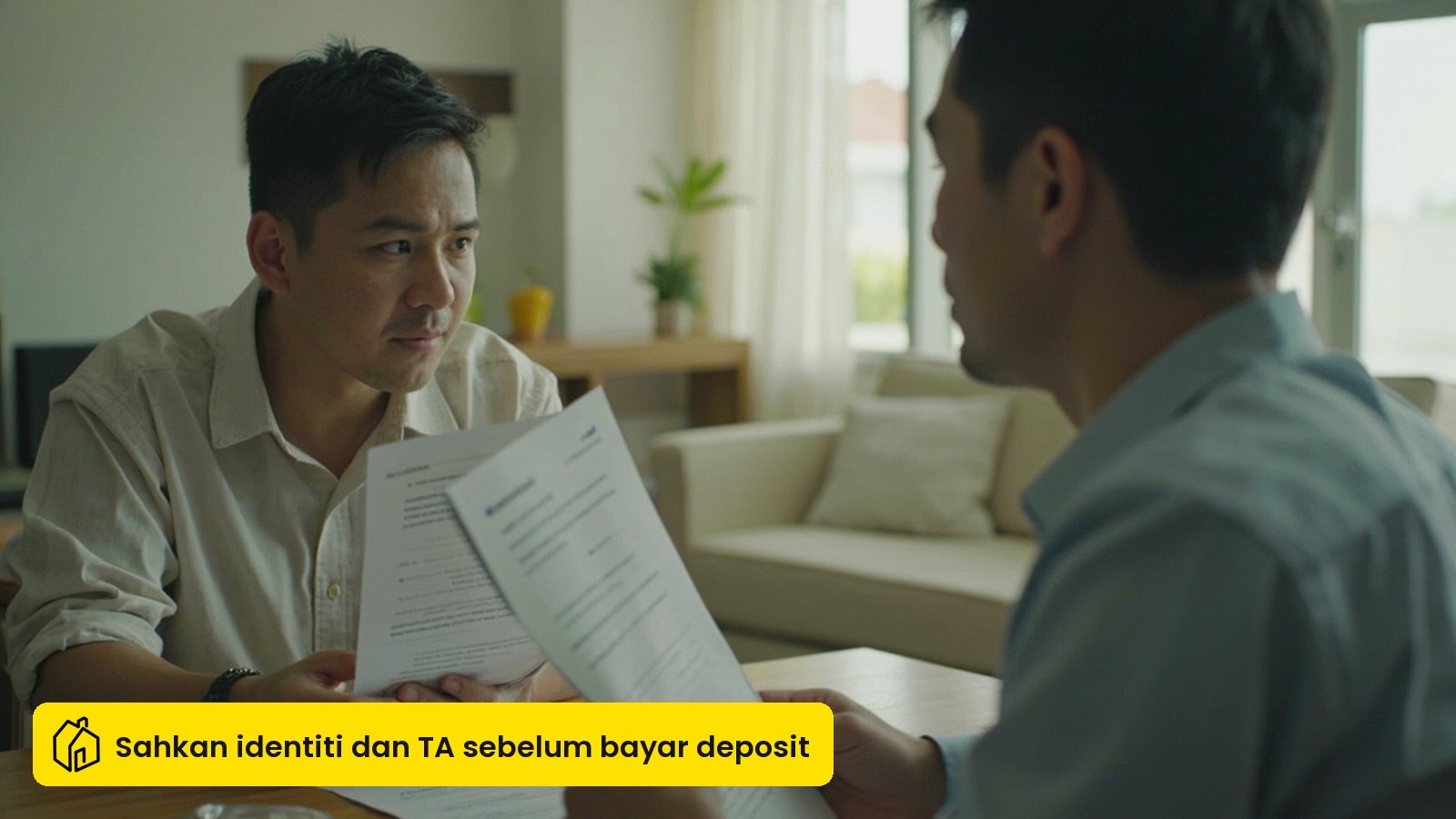
Why tenants who keep their deposit do four things in the first 24 hours
A tenant keeps their deposit by confirming four things — landlord identity, the actual unit, a stamped tenancy agreement, and a named recipient bank account — before any money moves. The real question is not "does this listing look legitimate"; it is whether the listing survives four checks that every serious tenant in 2026 now runs: person, unit, paperwork, money.
PDRM CCID recorded rental scam cases rising from 184 in 2023 to 922 in 2025 (a roughly five-fold jump in two years), with rental fraud recovery below 0.5 percent of reported cases. That is the climate your listing is being filtered through today. Listings that fail any of the four checks lose their first serious prospect within 24 hours.
Tenant screening versus property screening, side by side
Tenants and landlords actually screen each other — and the tenant who knows what to ask skips three weeks of negotiation and lands on a move-in date. The table below maps the four checks side by side, column for column, with what a verified listing platform such as rent listings in Malaysia actually does.
| Tenant's check | What it confirms | What should already be visible | Gap between private listings and a verified platform |
|---|---|---|---|
| Person | Real name; owner or registered agent; REN/REA tag for agents | Owner IC or company extract with identity matching the TA signatory | eKYC at registration; listings tied to verified identity, not a phone number |
| Unit | Address exists; photos match; physical or live video viewing offered | Offer letter / TA signed before any payment; viewing in person or live video | Listings carry a verifiable unit reference; no "we will post the keys" shortcut |
| Paperwork | Tenancy Agreement (TA) exists, both parties signed, can be stamped | Genuine TA, stamped within 30 days via e-Duti Setem (mytax.hasil.gov.my), not a one-page WhatsApp PDF | TA template built into the platform flow; stamping is part of registration, not a separate ask |
| Money | Deposit paid into the owner's or agency's named client account, not a personal e-wallet | Bank account name matches the TA signatory; receipt issued for every sen | Deposit held in platform-owned company account at registration, not transferred to a private account |
How the "Person" check is done in practice: (1) for individual ownership, ask for IC plus a copy of the proprietor's title document and match the name on the title to the name on the TA; (2) for company-owned property, ask for an SSM extract from https://www.ssm.com.my (free) and verify the company name plus the registered signatory; (3) for agents, ask for the REN/REA tag and confirm active status on the LPPEH portal at https://www.lppeh.gov.my before any payment.
The left column is what you are quietly asking yourself during the viewing. The middle column is what should already be on the table. The right column is the gap between a private Facebook listing and the verified rent listings in Malaysia.
Which path wins for most tenants in 2026
The path that wins for most tenants in 2026 is the verified rental platform — because the four checks (person, unit, paperwork, money) are closed before the viewing, so deposit becomes move-in date, not a three-week negotiation. Three paths exist in Malaysia today:
Path A — Private listing (direct from owner)
Wins when you already know the landlord personally (family, friend, colleague) or have a formal employer relocation letter. Loses when the landlord's identity cannot be verified within 24 hours, or the deposit account does not match the name on the TA.
Path B — Engage a registered agent (REN/REA tag, BOVAEP/LPPEH)
Wins when the agent can be tagged and confirmed active on the LPPEH portal at https://www.lppeh.gov.my, and the agency runs a named client account (not the agent's personal account). Loses when screening is limited to an in-person appointment and an IC copy; that is not what post-2025 prospects ask for.
Path C — Listing on a verified rental platform
Wins when the platform runs identity screening on every listing and holds the deposit in a company-owned account. Loses if the platform does not actually run identity screening on every listing or holds the deposit in anything other than a company-owned account.
Cost and risk by path
The real cost is not "which path is cheapest"; it is "which path hurts least if the tenant gets scammed or accused of being the scammer." The table below maps the risk from the tenant's side.
| Risk event | Private listing | Registered agent | Verified platform |
|---|---|---|---|
| "I never met the real landlord" | High — no third-party record | Medium — agency letterhead, but inconsistent | Low — verified identity tied to the listing |
| TA not stamped within 30 days | High — commonly missed | Medium — agents usually handle | Low — stamping is built into registration |
| Deposit paid to a personal account, then disputed | High — common dispute trigger | Medium — depends on the agency | Low — money sits in the platform's company account |
| Default-reporting refused (no CRA route) | High — no consent clause, no record | Medium — depends on TA wording | Low — TA includes consent; verified defaults can be reported to a licensed credit reporting agency |
| Landlord cannot be verified, prospect walks | Highest opportunity cost | Medium opportunity cost | Lowest opportunity cost |
Ask for a copy of the TA already bearing the LHDN stamp within 30 days of move-in — not after. Stamping is not an admin afterthought; it is your protection if the dispute ends up in court.
The four-check printable list
Before paying deposit, run through this printable four-item list — person, unit, paperwork, money — and tick each as "pass" or "not yet". If any one is "not yet", do not pay yet.
- Person. IC or SSM extract matches the name on the TA; for agents, REN/REA tag is active on the LPPEH portal.
- Unit. Address exists on the map; photos match what you see in an in-person or live video viewing.
- Paperwork. TA is complete, two signatures, and there is a plan to stamp it within 30 days.
- Money. Recipient bank account name matches the TA signatory, not a personal e-wallet.
What most tenants miss: CTOS versus Experian
CTOS is a report the tenant pulls themselves at RM27.90 — no third party, including a landlord or agent, can pull your CTOS report without your written consent. If a listing claims "we will run a CTOS check" to vet you, ask for clarification: CTOS is a self-pull, and only the tenant can generate that report.
SPEEDHOME runs credit screening through Experian at registration, with the tenant's consent signed into the TA — not by asking you to upload your own report. That distinction matters: if a platform only asks you to upload your own report, they are not screening you; they are copying what you send.
The "pay to view" myth: a Malaysia-specific scam pattern
Viewing a unit in Malaysia has never cost money — anyone asking RM200–400 for a "viewing fee" before you see the unit is running a scam, regardless of how the listing looks. NSRC 997 records "viewing fees" as one of the most reported rental scam patterns in Malaysia today.
SPEEDHOME itself never charges a viewing fee for any unit. If an "agent" or "owner" asks for money before a viewing is scheduled, walk away and find another unit.
Discrimination guardrail: screen payers, not profiles
Ownership screening in Malaysia cannot filter by race, religion or citizenship — only by ability-to-pay indicators (salary, employment, prior tenancy record). Any IC question that goes toward a personal profile rather than a payment profile is a warning.
What to do if you have already paid
If the deposit has already gone out and you now suspect fraud, follow this sequence — the sooner the better. Three steps, in order:
- Call NSRC 997 (National Scam Response Centre) on 997 to log the case; they route to PDRM and the bank.
- Call the receiving bank to file a fraud report; the bank can freeze the recipient account if the report is made within 24 hours.
- File a police report at the nearest station and keep the copy for future reference.
Do not delete WhatsApp messages or receipts — they are primary evidence for the bank and police.
SPEEDHOME's path for tenants
SPEEDHOME runs all four checks — person, unit, paperwork, money — at the listing stage, so the deposit goes into a company account, the TA is stamped, and the deposit conversation becomes "let's move" on the first viewing. Behind the tab, this is how it works:
- Identity-tied listings. Every listing is tied to a landlord identity verified at registration, so you can answer "is this person actually the owner?" without chasing WhatsApp.
- Stamped TA, not a one-page PDF. The tenancy agreement is generated inside the platform flow and processed through e-Duti Setem; stamping happens in the flow, not as a separate LHDN run-around.
- Money to a company account. Deposits are handled through the SPEEDHOME platform account — not a personal transfer to an unknown phone number — so the question "where did the money go" is answered by the flow, not by trust.
- Consent-based default reporting. Where the tenant has given consent in the TA, verified defaults can be reported to a licensed credit reporting agency.
- Zero Deposit option. For eligible units, the 2+1+½ cash stack is replaced by SPEEDHOME's rental protection plan — a rental risk management system, not a deposit insurance product. (Check SPEEDHOME on eligibility per unit — not every unit qualifies.)
Rent on SPEEDHOME to skip the three-week negotiation
See the verified rent listings in Malaysia — every unit comes with a verified landlord identity, a stamped TA, and a deposit that goes into a company account. Deposit becomes move-in date, not a negotiation.
FAQ on landlord verification in Malaysia
What is the first thing a tenant checks before paying deposit?
Identity: whether the person they are paying is the actual owner or a registered agent, and whether the name on the TA matches. Listings without a verifiable landlord lose prospects within the first 24 hours.
How does a tenant verify a landlord in Malaysia?
Four steps, in this order: (1) match the landlord's IC or company extract against the name on the Tenancy Agreement; (2) for agents, check the REN/REA tag on the LPPEH portal at https://www.lppeh.gov.my and confirm active status; (3) request an in-person or live video viewing before any deposit; (4) confirm the TA will be stamped within 30 days via e-Duti Setem.
Is it normal to pay deposit before meeting the landlord?
No. A landlord who cannot meet in person or via live video, or who asks for the deposit into a personal account before a signed and stamped TA exists, is a scam signal regardless of how the listing looks. SPEEDHOME itself never charges a viewing fee — the "RM200–400 to view" offer is one of the most reported rental scams to NSRC 997.
Should the deposit go into the landlord's personal account or a company account?
Deposit for a self-rented unit should go into a named account that matches the party signing the TA (the owner's bank account or the agency's client account), not a personal e-wallet or a third-party name. The recipient bank must be in the same name as the TA signatory.
Can a landlord report a non-paying tenant to a credit agency?
No — publishing a tenant's personal details or reporting them without consent is not lawful. A verified rental default can be reported to a licensed credit reporting agency only where the tenant has given consent in the tenancy agreement, and the correct path is through a platform that builds the consent clause in by default.
What paperwork protects a tenant in a dispute?
A stamped Tenancy Agreement with clear consent clauses for default reporting, a record of written requests (WhatsApp messages with dates), and a clean payment ledger. Recovery then runs through the proper court process.
Is a landlord who owns many properties and carries large mortgages a scam risk?
Owning multiple properties or carrying heavy mortgage repayments is not, by itself, evidence of fraud — plenty of legitimate landlords run a multi-unit portfolio on financing. It is also not something the four-check list is built to measure; the Person, Unit, Paperwork, and Money checks confirm identity and payment flow, not a landlord's overall financial health. Run the same four checks regardless of portfolio size: match the IC or SSM extract on the title document to the name on the TA, insist on a stamped TA before paying, and pay the deposit only into an account in that same name. If a specific landlord is the subject of a public scam accusation, treat that as a reason to verify harder — not as a reason to skip the checks — and confirm current ownership on the title document itself rather than relying on reputation either way.