
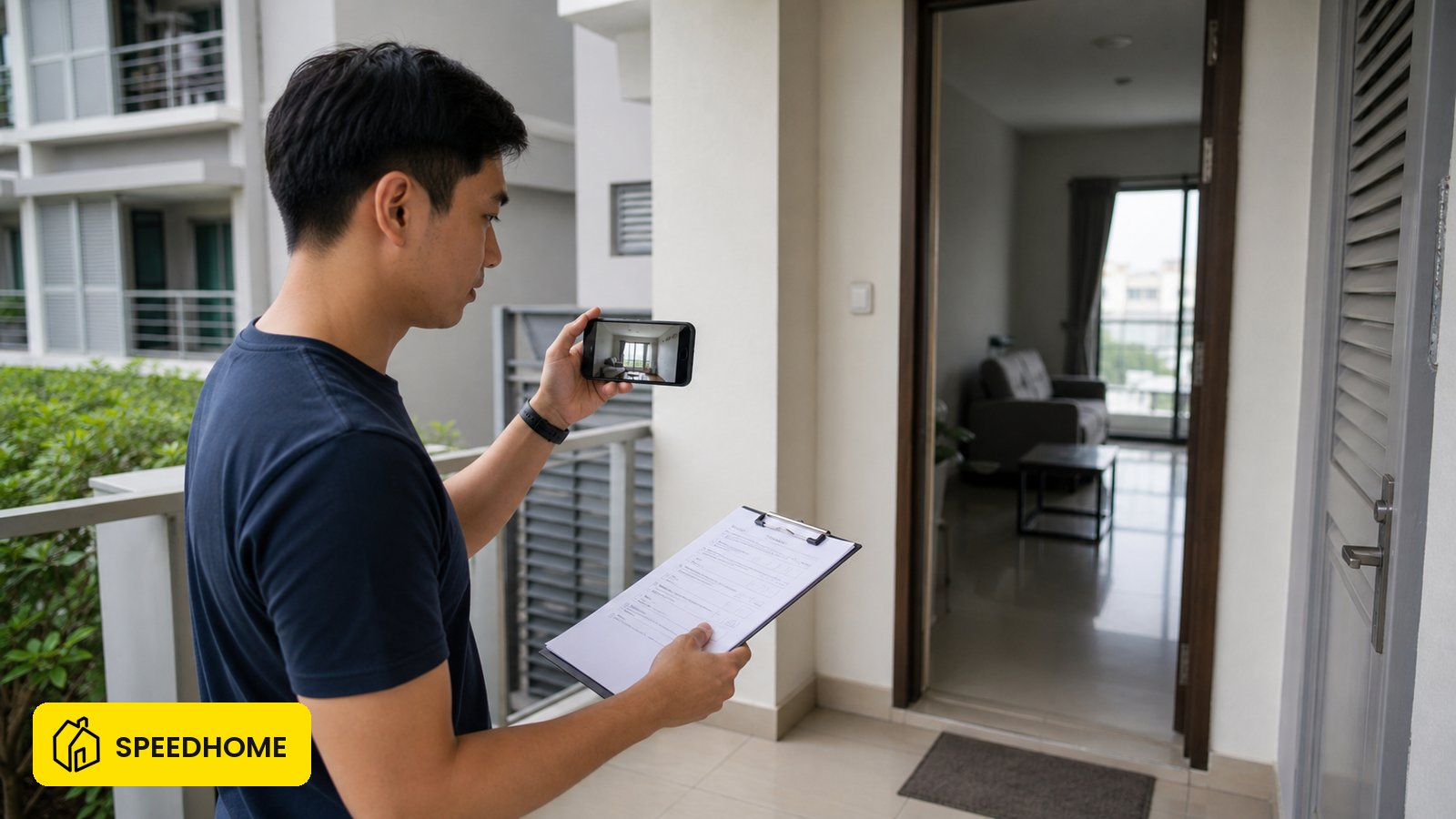
Before paying a rental deposit in Malaysia, renters must complete five checks: verify landlord ownership against the title deed (Geran) and MyKad, confirm agent REN/REA registration on BOVAEP, pay exclusively into a named client bank account, sign a formal Letter of Offer, and secure a stamped Tenancy Agreement via LHDN e-Duti Setem.
How does a tenant check the landlord before paying a deposit in Malaysia?
A Malaysian renter should run five checks before paying any deposit: confirm ownership and identity from the title deed, verify any agent's REN/REA tag at the BOVAEP portal, pay only into a named company or client account, get the unit and price in a signed Letter of Offer, and refuse to pay until a stamped Tenancy Agreement is in place.
PDRM-reported rental fraud rose from 184 cases in 2023 to 922 in 2025, and cash recovery across reported rental fraud sits below 0.5% (PDRM / NSRC public data) - the figures that make the five checks the difference between a real tenancy and a lost deposit. Ownership and identity are the two signals most often faked, which is why SPEEDHOME runs eKYC plus title-deed verification as the first gate before any deposit moves on its platform.
Most Malaysian rental portals tell renters to "verify the landlord" in two lines and link to a generic checklist. This is the operational version: five named checks, each tied to a specific scam entry point, with the document, portal, and red flag you actually use.
What each of the five checks actually does
Each check closes off a different scam entry point. Skip one and the door stays open to the next "urgent" message.
| Check | What it confirms | Where to verify | Red flag when missing |
|---|---|---|---|
| Ownership | The person offering the unit actually has the right to rent it out | Title deed (Geran) or Sale & Purchase Agreement (SPA); name on the document matches the person you are paying | "Owner is overseas, just pay me" |
| Identity | The person in front of you is the person on the documents | MyKad or passport, eKYC verification, photo of original IC (redact before sharing) | Refuses a live video call or hides the IC |
| Agent status | A negotiator or agent is real and registered | REN or REA number at the BOVAEP/LPEPH portal (bovaep.com) | No REN tag, only a personal mobile number |
| Payment channel | The money goes to a traceable, named account | Company bank account or licensed agency client account; account name matches the entity in the Letter of Offer | Personal e-wallet, personal savings account, or cryptocurrency address |
| Tenancy Agreement | The deal is enforceable after payment | Stamped TA under the Stamp Act 1949 (e-Duti Setem on MyTax), signed by both parties | "We'll sort the agreement later" or a WhatsApp screenshot as the "TA" |
How do assessment tax receipts verify title and owner identity?
The first check answers two questions at once: does this person own the unit, and is this person who they say they are? In Malaysia, the answer is on the title deed.
Ask to see the title deed (Geran) or, for a sub-let, the Sale & Purchase Agreement (SPA) plus a written Letter of Authority from the registered owner. The name on the document must match the name on the MyKad or passport of the person you are negotiating with. A sub-landlord without a written authority from the registered owner cannot grant you a tenancy that survives a complaint.
For identity, ask for a live video call showing the original MyKad or passport and the keys to the unit. A genuine owner has no problem showing both. A scammer will cut the call, blame the connection, or say the unit is in another state and the keys will be couriered. The video call is the cheapest, fastest check you will ever run.
How do you validate a negotiator on the BOVAEP register?
A registered agent carries a REN (Real Estate Negotiator) or REA (Real Estate Agent) tag that you can look up on the BOVAEP/LPEPH portal in under a minute. An unregistered agent is no different from a stranger on the street.
Ask for the negotiator's REN number or the agency's REA number. Look it up at bovaep.com. A genuine negotiator will give you the number without being asked. A genuine agency will answer its official phone line - not just the mobile number the negotiator gave you. For a private landlord (not an agent), this check still applies: the landlord's identity is verified by the documents in the ownership check, and you skip the agent step.
What the check does not do: it does not cover the deposit. The named payment channel and the stamped TA are what actually secure the money.
Which account types keep a deposit traceable?
The deposit must go to a traceable, named account - never to a personal e-wallet, a personal savings account, or a cryptocurrency address. This is the single check that decides whether the money can be recovered if anything goes wrong.
Get the account name and number in writing before any transfer. The account name must match the entity in the Letter of Offer - the owner for a direct rental, the agency for an agent-led rental. If the account name is a person's name and the Letter of Offer names a company, stop. If you are asked to split the deposit across multiple accounts or pay a "processing fee" to a different account, stop. If the agent asks for cash, stop.
SPEEDHOME's platform records show that on verified flows, deposit collection goes to a single company or client account with a paper trail; that paper trail is the reason NSRC and bank fraud teams can sometimes freeze funds before they move out of the destination account.
Why check the Letter of Offer and stamped TA?
The Letter of Offer (LO) and the stamped Tenancy Agreement (TA) are the two documents that turn a viewing into an enforceable tenancy. No TA means no tenancy, no matter how much you have paid.
The LO is what locks in the unit, the rent, the move-in date, and the deposit amount before any money moves. It is signed by both parties, dated, and attached to the eventual TA. The TA is the contract that governs the tenancy: rent, deposit, duration, maintenance responsibilities, early-termination terms, and the default clause that makes credit reporting lawful on consent.
Stamp duty on a TA in 2026 follows the Finance Act 2024 scale, paid through e-Duti Setem on MyTax (mytax.hasil.gov.my) since January 2026. The RM2,400 annual-rent exemption was removed in January 2025, so most residential tenancies are now stamped. A landlord who refuses to stamp is signalling that the deposit will not become a contract - walk away.
| Lease duration | Stamp duty per RM250 of annual rent |
|---|---|
| Up to 1 year | RM1 |
| 1 to 2 years | RM3 |
| 2 to 3 years | RM5 |
| More than 3 years | RM7 |
Worked example: a RM2,000/month tenancy over 1 year = RM24,000 annual rent. At RM1 per RM250 over 96 blocks of RM250 = RM96 stamp duty. Use e-Duti Setem on MyTax to pay before signing, or within 30 days of execution if stamped after.
For a tenant, the SPEEDHOME flow builds the LO and the TA inside the platform, so the unit, the rent, the deposit and the agreement are tied to the same verified owner before any deposit moves.
The scam-signal shortcut: when to refuse immediately
The five checks collapse into a single rule: if any one of them fails, refuse to pay. The "reason" given for skipping the check is the scam itself.
- "Owner is overseas, just transfer the deposit to my account" - ownership fraud.
- "Pay RM300 first to view the unit" - pay-to-view fee.
- "The unit you saw is taken, but I have another one the same" - bait-and-switch.
- "We'll sign the agreement after you pay the deposit" - no TA, no tenancy.
- "Send the deposit to my personal account, the company account is having issues" - phantom agent.
These five lines are the pattern in most deposit-loss reports SPEEDHOME sees from renters who flagged a problem too late. The first three checks above catch each one.
What verification steps precede the property visit?
Run these three phone screenshots and three questions before you meet the landlord or agent. If any answer is evasive, treat it as a red flag - not a negotiation point.
Phone screenshots to take before you leave home: 1. The listing page (URL, screenshot the price, the unit number, and the landlord/agent name). 2. The BOVAEP/LPEPH portal result showing the REN or REA tag matches the agent's name. 3. The MyKad or passport of the person you are meeting, with full IC number hidden, after a live video call.
Questions to ask, in order: 1. "Can I see the title deed (Geran) or SPA + Letter of Authority before I pay anything?" 2. "Which company or personal account should the deposit go to, and whose name is on it?" 3. "Will the Tenancy Agreement be stamped through e-Duti Setem on MyTax before I move in?"
If the answer to any of those is "we'll sort it later" or "just transfer first" - that is the scam-signal shortcut above speaking. Leave.
What to do if the deposit has already gone to the wrong place
Time matters more than perfection. The first 24 hours decide whether the bank can freeze the funds.
- Call your bank's fraud line immediately and ask for a recall on the transfer.
- Preserve every receipt, chat screenshot, and the LO or TA you were sent - do not delete anything.
- Lodge a police report with the full payment trail attached.
- Report to the National Scam Response Centre (NSRC) hotline 997 - the earlier a freeze request reaches the destination bank, the better the outcome.
- If the deposit went to a personal account that does not match the Letter of Offer, that mismatch is your strongest evidence.
Recovery across all reported rental fraud cases still sits below 0.5% (PDRM / NSRC public data), but the bank freeze, the police report and the NSRC report together are what make future claims possible and what a licensed credit reporting agency would require before any default or fraud record could be lawfully attached to the other party's name.
How SPEEDHOME closes the five checks in one flow
The structural answer to deposit-stage scams is to keep ownership, identity, agent status, payment channel and agreement inside one verified channel, so the renter never has to run five separate checks before paying.
On SPEEDHOME, listings are tied to eKYC-verified owners, the deposit moves to a single SPEEDHOME-managed account (not to an individual), and the Tenancy Agreement is generated, signed and stamped on the platform before keys change hands. Not every listing is zero deposit, and the Zero Deposit option is a managed rental-risk system - not a financial guarantee product - that replaces the upfront cash deposit with rental protection for eligible units, so check the live listing for current Zero Deposit eligibility. What the platform does do is remove the specific entry points that power the most common landlord-side scams: unverified listings, deposit to a personal account, and no formal agreement before keys change hands.
For renters who want a safe starting point, browse verified rental listings on SPEEDHOME. For anyone asked to pay a viewing fee, read is it normal to pay a viewing fee for rental in Malaysia. To verify any agent claiming a registration number, read how to check a real estate agent REN number. For a broader tenant-screening playbook, start from where to rent in Malaysia.
FAQ
What is the single most important check before paying a deposit?
The ownership check. Confirm the person you are paying owns the unit (or has a written Letter of Authority from the registered owner) before any money moves. If the ownership fails, none of the other checks matter.
Is it normal for an agent to ask for a fee just to view the unit?
No. Viewing is always free in Malaysia. Any request for a fee - typically RM200 to RM400 - before you are allowed to view the actual unit in person or by live video is a pay-to-view scam. Refuse and move on.
Where should the deposit be paid - to the owner or the agent?
To a traceable, named account. For a direct rental, the company or personal account of the registered owner whose name is on the title deed. For an agent-led rental, the agency's client account. Never to a personal e-wallet, personal savings account (when an agency is named in the LO), or a cryptocurrency address.
Can a tenancy exist without a stamped Tenancy Agreement?
No. Without a stamped TA signed by both parties there is no enforceable tenancy - even in the Magistrates' small-claims procedure. The stamped TA is the document a landlord or tenant would rely on in any later dispute, and stamping is done through e-Duti Setem on MyTax.
Is the landlord allowed to report to a licensed credit agency with consent a tenant who refused to pay?
A verified rental default can be reported to a licensed credit reporting agency only where the tenant gave consent in the tenancy agreement; publishing or sharing a tenant's details without legal basis is not lawful.
Does paying through a verified platform guarantee I will not lose the deposit?
No platform eliminates all risk. A verified platform removes the specific entry points that power the most common landlord-side scams - unverified listings, deposit to a personal account, and no formal agreement before keys change hands - but you still need to read the unit number on the TA against the title deed before signing, and confirm the deposit account name matches the entity named in the Letter of Offer.