
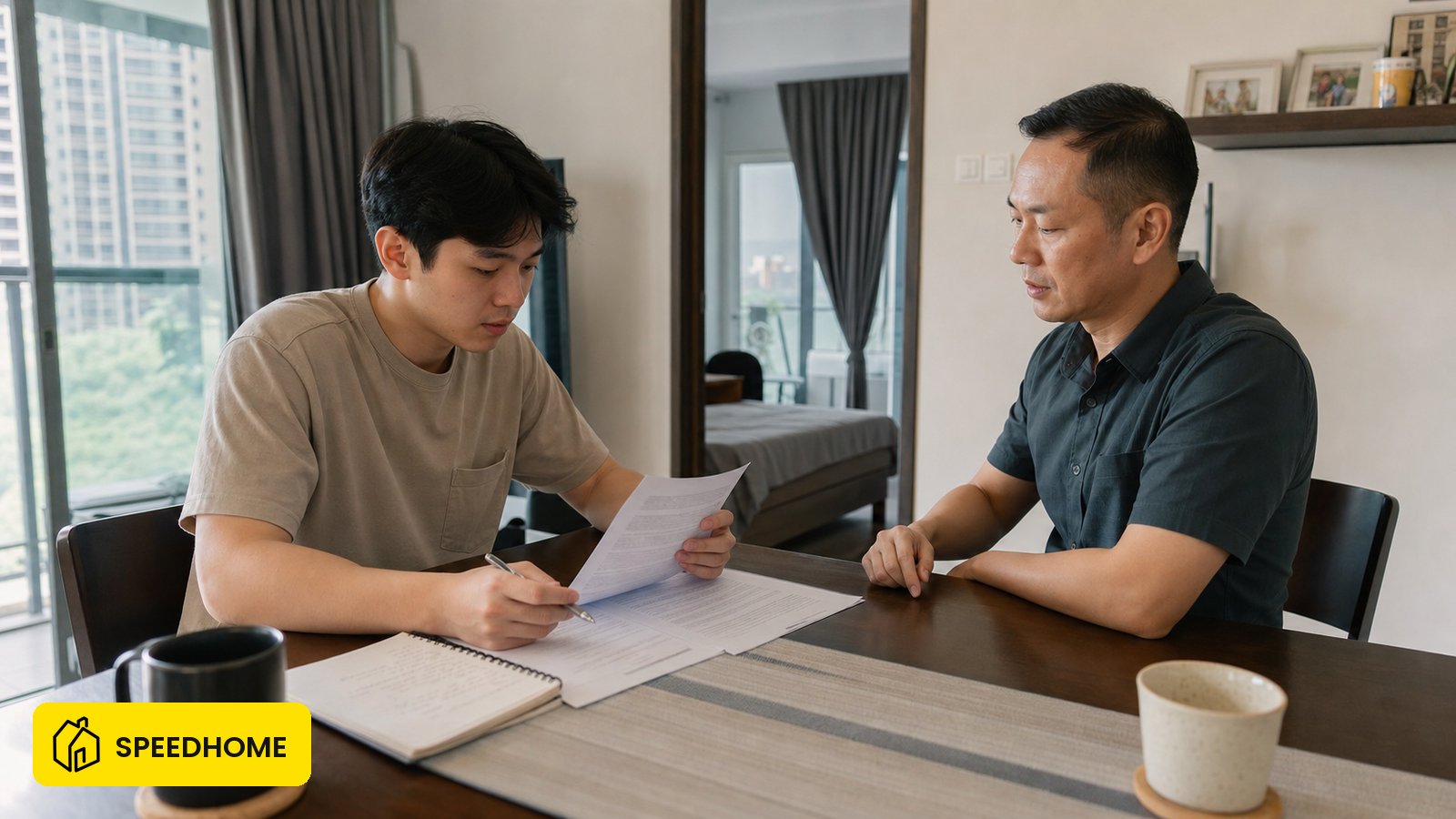
Opener
Cara sublet bilik the right way in Malaysia is a written request first, a written yes from your landlord second, and only then the new occupant moves in. Whether you can sublet lives in your tenancy agreement — not in the fact that you hold the tenancy, so silence is not consent and a verbal nod is not enough.
"Cara sublet bilik" is the search tenants run when they want to share or replace the room they rent, but the law in Malaysia treats the question as a private contract matter. There is no Residential Tenancy Act in force as of June 2026, so the agreement plus general contract law governs. The rest of this page walks through what the agreement says, what your written ask needs to include, and what it costs if you skip the ask.
SPEEDHOME room-rental platform data (Q1 2026, 8,400 managed rooms across Klang Valley, Penang, and Johor Bahru) shows the most common trigger for early termination involving room-sharing is a verbal-only arrangement that was never recorded. That is the pattern the rest of this page is built to prevent.
Co-living vs sublet vs plain room rental
Plain room rental is a single tenancy between you and the landlord; co-living is the same tenancy with operator-curated sharers under documented house rules; a sublet is a second tenancy you create on top of yours — and that second layer is what triggers the consent question.
| Arrangement | Who is the contracting party? | Does landlord consent cover the other occupants? | Typical risk if consent is missing |
|---|---|---|---|
| Plain room rental | You and the landlord | Yes — named tenant on the agreement | None for staying alone; breach if you let a stranger pay to stay |
| Co-living | You and the landlord (or operator) | Usually yes — house rules cover named sharers | Low if occupants are pre-named; breach if you swap in an unlisted paying occupant |
| Sublet | You and a sub-occupant you brought in | No — consent for the sub-occupant is a separate ask | Tenancy termination, deposit forfeiture, civil claim |
Tenancy vs lease: the NLC line that matters here
Under the National Land Code, a residential letting of three years or less is treated as a tenancy, and a letting of more than three years is treated as a lease that may need to be registered at the Land Office (Forms 15A and 15B are the relevant instruments). In practice, most residential sublets sit inside a tenancy, so Form 15B Land Office registration does not apply — but if the term you are agreeing with the sub-occupant pushes past three years, treat it as a lease question and check with a lawyer before you sign anything.
Read the sublet clause first
The single document that decides whether you can sublet is your tenancy agreement. Express permission lets you sublet on stated terms; an express prohibition ends the question; silence is the most common trap — silence is not consent.
| What your agreement says | Can you sublet? | What to do before anyone moves in |
|---|---|---|
| Express permission (e.g. "tenant may sublet with landlord's prior written consent") | Yes, subject to the conditions stated | Follow the stated conditions; get consent in writing each time |
| Express prohibition (e.g. "no assignment or subletting without consent, which may be withheld") | Only if the landlord separately consents in writing | Ask in writing; do not move anyone in until you have a written yes |
| Silent on subletting | Not by default — silence is not consent | Ask in writing before any new occupant pays you or moves in |
| Permission limited to a named occupant type (e.g. immediate family only) | Only within that limit | Do not stretch the clause to a paying stranger |
The written ask that holds up if things go wrong
A WhatsApp message that says "boss, boleh tak kalau aku letak kawan sekejap?" is not the same as written consent. A real consent record names the parties, the unit, the dates, the rent you will charge the sub-occupant, and is signed by the landlord.
| Element to include in your written request | Why it matters |
|---|---|
| Your name, the unit address, and the tenancy reference or date | Anchors the request to the right tenancy |
| The proposed sub-occupant's full name and IC/passport number (with their consent to share) | Lets the landlord run the same screening they ran on you |
| The exact dates of the sub-occupancy and the rent you intend to collect | Stops the arrangement sliding into an undocumented stay |
| A request for written consent signed by the landlord, not just a reply message | Verbal or informal "ok" is hard to prove if the tenancy is later disputed |
| A note that you remain liable to the landlord under your agreement | Sets the legal position clearly so the landlord cannot claim later that you "handed over" the tenancy |
The 5-step written-consent checklist
- Read the sublet clause first — note whether your agreement allows it, prohibits it, or is silent. The wording in your hand drives every next step.
- Draft the written request — use the five elements above as a checklist. Include the proposed rent, the dates, and the sub-occupant's identification, and end with a direct line: "Please reply on this thread to confirm written consent."
- Send it on a timestamped channel you already use with the landlord — WhatsApp or email both work, provided the landlord replies on the same thread. Do not switch channels mid-conversation; the same-thread reply is the evidence.
- Wait a clear period before treating silence as a no — give the landlord seven (7) calendar days from the timestamped read receipt or delivery to reply. If there is no read receipt, wait seven (7) days from the time the message was sent. After that, treat silence as "no, not consented" and do not move the new occupant in.
- If the landlord does not respond within 7 days, send one follow-up — restate the original request in a single short message, give a final 7-day window, and end the thread. If still no reply, do not proceed; the sublet has no consent and the risk table below applies.
Send the request through a channel that leaves a timestamp, save the landlord's reply in the same thread, and file the signed consent with the rest of your tenancy paperwork.
Where a paying occupant stops being a guest
A friend staying over for a week is a guest; a friend paying you rent every month is a sublet. The line is drawn by whether money changes hands, how long they stay, and whether the landlord has consented in writing.
| Situation | Sublet or guest? | What you should do |
|---|---|---|
| A friend sleeps on your couch for a long weekend | Guest | No change needed; keep the room primarily yours |
| A cousin stays for two months, no rent, you stay in the room | Borderline guest | Tell the landlord in writing so it is on record; do not collect rent |
| Someone pays you monthly rent and keeps their clothes and keys at the unit | Sublet | You need written landlord consent first; without it you are in breach |
| You advertise the room on a listings platform and collect deposits from strangers | Sublet | Written consent is non-negotiable; treat any collection without consent as a breach |
| You run Airbnb-style short stays in the room | Sublet plus short-stay | Three layers must all allow it: your agreement, the building's strata rules, and any local council rules |
Cost and risk if you sublet without permission
The realistic cost of an unauthorised sublet is losing your tenancy, forfeiting your deposit toward proven loss, and carrying liability for everything the person you let in does to the property. The landlord cannot lawfully lock you out or disconnect water or electricity to force the issue — recovery runs through the courts.
| Risk to you (the tenant) | Realistic outcome | How it is enforced |
|---|---|---|
| Tenancy terminated | You and the person you let in both have to leave | Written notice, then lawful recovery of possession through the court |
| Deposit applied to proven loss | Landlord retains toward arrears or damage, limited to proven loss under general contract law | Deduction per the agreement; dispute goes to the civil courts |
| You stay liable for the sub-occupant | If the sub-occupant does not pay or damages the unit, the landlord comes after you | Contract claim against you; the sub-occupant is not the landlord's counterparty |
| Reported to a credit agency (only with your consent) | A verified default can be reported only where you consented in the tenancy agreement | Consent-based reporting; publishing your details is not lawful |
| Short-stay angle compounds the breach | Building rules can prohibit short-term rental on top of the agreement breach | Two independent grounds to lose the tenancy |
Recovery of possession runs through a written demand and then court action — it is not instant and it is not self-help.
A worked exposure on a typical Klang Valley room: rent RM1,200/month × 2 months unpaid = RM2,400, plus cleaning and admin typically RM300–500, plus a typical end-of-tenancy touch-up often RM300–500, gives a realistic exposure of RM3,000–3,400 before any damages claim; a successful civil claim for property damage or unpaid utility charges can push that figure higher, and filing fees at the Magistrates' Court scale with quantum.
What subletting usually looks like in practice
A common 2025–2026 pattern: a tenant on a twelve-month room tenancy near KL gets a one-month work posting in Singapore, asks the landlord verbally if a friend can cover the rent, the landlord says "ok lah", and the friend moves in. Two months later the friend stops paying, the landlord issues a written demand for the arrears to the original tenant, and the original tenant is on the hook for the full arrears (typically two months' rent on a Klang Valley room) plus a damages claim because the verbal nod is not a written consent. The fix that would have prevented the dispute was a single WhatsApp request naming the sub-occupant and the dates, with the landlord replying "ok" on the same thread — a five-minute step that converts a breach into a clean record.
Where the SPEEDHOME path changes the question
The clean way to "sublet bilik" is to remove the ambiguity up front: rent a managed room where the platform is the named party on the agreement, so there is nothing to quietly let out.
On SPEEDHOME's managed platform the platform is the named party on the agreement and the room is let on documented terms, not a quiet handshake. SPEEDHOME's managed-room contracts in Klang Valley run a standard 12-month fixed term with a one-time admin fee; check the listing for the "Managed" badge to confirm. For tenants weighing a room rather than subletting the one they hold, managed rooms on SPEEDHOME list rooms where the upfront cash deposit is replaced with a managed rental-risk system — useful when the person you would sublet to cannot raise a deposit. It is not a financial guarantee product, and not every unit qualifies, so check the listing for the badge.
A worked SPEEDHOME path for the "kosong bilik" case
A tenant in a Petaling Jaya room tenancy goes to Singapore for a fixed three-month posting. The path without SPEEDHOME is to ask the landlord for a written sublet consent, get the proposed sub-occupant screened, and carry the liability if anything goes wrong. The managed path is to list the room back into the SPEEDHOME pool for the three-month window, the platform assigns a screened replacement tenant for that period, the original tenant's contract is paused rather than sublet, and on return the original tenant resumes. The trade-off is that the platform fee replaces a deposit you would not have collected anyway; screening is the platform's job, not yours — that's the whole point of the managed path.
Short-stay and Airbnb: three permission layers
Running Airbnb or a short-stay in a room you rent is not a single yes/no question — it is three independent permission layers, and missing any one is enough to lose the tenancy. The layers, in order of how they bite:
- Tenancy agreement — the written contract you signed with the landlord. Most residential agreements prohibit commercial short-stay use outright.
- Building rules / JMB or MC by-laws — the management corporation can pass a by-law that prohibits short-term lets in the development, and that by-law binds you even if your landlord personally did not object.
- Local council / state tourism short-stay zoning — Kuala Lumpur's short-stay licensing for serviced apartments under Federal Territory tourism licensing, and Penang Island strata by-law precedent on short-term lets, are the clearest local examples; other state authorities (e.g. Johor Bahru, Melaka) can require similar licensing. Running paid stays without the licence is a separate breach on top of the tenancy and strata breaches.
The guide on whether subletting is legal in Malaysia sets out the legal position, the piece on what happens if a tenant sublets without the landlord's permission walks through the landlord-side consequences, and the room rentals and co-living in Malaysia guide explains how a lawful room rental differs from a sublet. If you are starting the search instead of subletting an existing room, Where to rent in Malaysia maps the same-language hub and spoke pages to the right listing route.
Reviewed by
Reviewed by Aiman Razali, SPEEDHOME Legal Operations — last updated 24 June 2026.
Date published: 24 June 2026. Date modified: 24 June 2026.
FAQ
What is the cara sublet bilik if my tenancy agreement says nothing about subletting?
Ask the landlord in writing and get a written yes before anyone moves in. Silence in the agreement is not consent; treating silence as "allowed" is the most common reason tenancies get terminated over a sublet, and any later dispute under RM5,000 ends up at the Magistrates' Court small-claims procedure where the written record is what decides it.
Is subletting a room without permission illegal in Malaysia?
Subletting without permission is a civil contract breach in Malaysia — not a criminal offence. The landlord's remedies are termination, a damages claim, and court recovery of possession, not lockouts or utility cuts. Claims under RM5,000 are filed at the Magistrates' Court; the Sessions Court hears higher-value disputes; the Tribunal for Homebuyer Claims does not have jurisdiction over a private tenancy.
Can I let a friend stay rent-free without calling it a sublet?
Yes, usually, as long as they are a guest and not a paying occupant. The line is whether money changes hands and whether the arrangement runs long enough to look like commercial occupancy — when in doubt, tell the landlord in writing so it is on record.
Who is responsible if the person I sublet to damages the room or stops paying?
You are. As the original tenant you remain the landlord's counterparty, so unpaid rent and damage by the person you let in come back to you. You can pursue that person under your separate sub-tenancy, but the landlord looks to you first. SPEEDHOME's Q1 2026 platform records (8,400 managed rooms) show that a meaningful share of sublet-related early terminations originated from verbal-only arrangements where the original tenant then had to chase the sub-occupant for arrears — a chase that the original tenant carries the legal risk for.
Can I run Airbnb or short-stay lets in a room I rent?
Only if all three permission layers line up: your tenancy agreement, the building's strata rules or JMB/MC by-laws, and any local council or state tourism short-stay licensing. A management corporation by-law can independently prohibit short-term rental on top of any agreement breach, so check both before the first booking. For strata disputes tied to short-stay use, the recent strata-shortterm-let-case-2026 line of reasoning treats building rules as binding on tenants whether or not the landlord personally objects.
Where do I go to resolve a subletting dispute in Malaysia?
Malaysia has no dedicated residential tenancy tribunal. A quantifiable claim up to RM5,000 can use the Magistrates' Court small-claims procedure without a lawyer; larger claims go to the civil courts. The Tribunal for Consumer Claims does not hear a private residential tenancy dispute.
Can the landlord lock me out or disconnect utilities if I sublet without asking?
No. The lawful recovery path runs through the courts: a written demand first, then a court order for possession and any arrears. Locking you out, removing your belongings, or disconnecting water or electricity is unlawful self-help, even if you are in breach.