
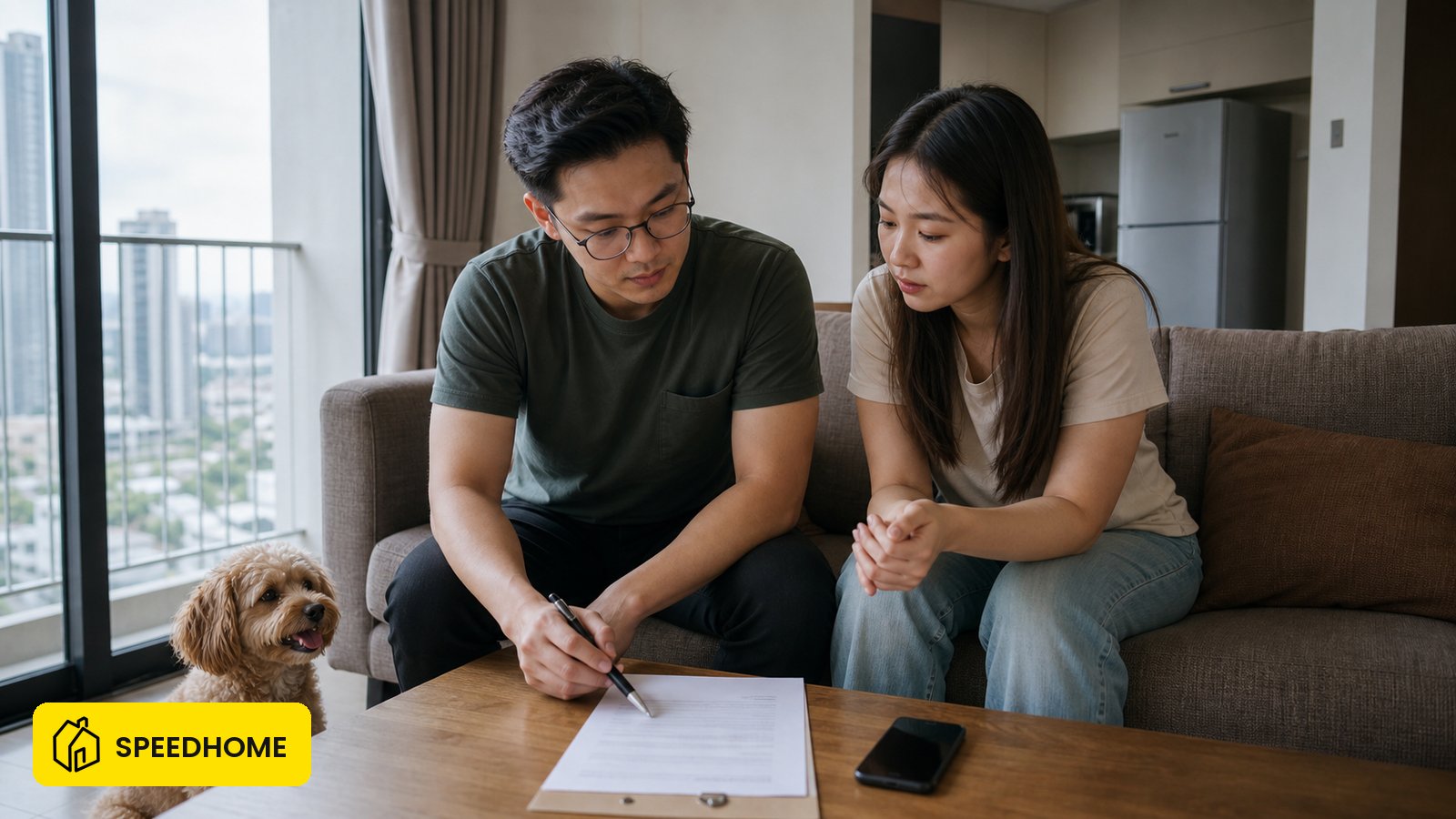
There is no official list of cat-friendly buildings in Kuala Lumpur — cat approval in KL runs unit by unit, decided by the landlord and the building's registered by-laws, not by the city. What you can control is the process: check the by-law, get the owner's written consent, agree the deposit terms, and prepare the unit for an indoor cat. This guide covers the rules, the real costs, and the questions to settle before signing.
What does "cat-friendly" mean in a KL rental?
It means the unit owner accepts cats — nothing more. It is not a building certification, and no KL authority issues one. A genuinely cat-friendly rental needs the owner's yes in the tenancy agreement plus the building management's written position.
The same condo tower can hold landlords who welcome cats and landlords who refuse all pets, because permission attaches to the unit, not the address. That is why published "cat-friendly building lists" deserve suspicion: buildings drift, managements change, and a blog list cannot bind either. Verify the two layers yourself for the specific unit you want.
| Layer | Who decides | What to get in writing |
|---|---|---|
| Unit | The landlord | A pet clause naming the cat, count, and indoor-only status |
| Building | JMB or MC, via registered by-laws | Management's written reply on pets and the by-law they cite |
| Housemates | Other occupants, if renting a room | Their explicit agreement before you book |
For the general rules that apply across Malaysia — what landlords can refuse, deposit law, and the tenant-side checklist — start with renting with pets in Malaysia. This page handles the KL-specific layer on top.
How do KL building by-laws treat cats?
In strata-titled KL buildings, registered by-laws bind tenants directly under the Strata Management Act 2013 — a landlord cannot promise what a by-law prohibits. Additional by-laws need a special resolution and filing with the Commissioner of Buildings; an unregistered house rule carries far less weight.
What that means when you shortlist:
- Most KL condos and serviced apartments are strata-titled, so the by-law check is non-negotiable before you pay.
- By-laws commonly target animals that cause nuisance, odour, or hygiene problems rather than banning every animal — but some do restrict pets outright. Read the actual wording.
- Ask the management office for the registered by-law, not a phone opinion. A written reply citing the by-law is the evidence that protects you later.
- Landed houses and some older walk-ups skip the strata layer entirely — often a faster first conversation for a cat owner.
KL's rental stock spans high-rise condos around the rail lines, older walk-up apartments, and landed terraces further out. Cats travel well across all three — indoor-only cats care about the unit, not the postcode — so your real constraint is the by-law and the owner, not the property type.
What does renting with a cat cost in Kuala Lumpur?
Expect three possible pet-related costs: an extra refundable deposit (market practice is half a month's to one month's rent), occasionally a one-time pet fee, and sometimes a small rent premium. None has a statutory cap — every figure is contractual.
KL rents being what they are, the pet line-item deserves budgeting:
| Cost | Typical KL practice | Notes |
|---|---|---|
| Extra pet deposit | 0.5-1 month's rent, refundable | Conditions must be written into the agreement |
| One-time pet fee | Less common, non-refundable | Clarify it is not a deposit |
| Rent premium | Varies; pet-friendly listings run ~10-20% above comparable units (SPEEDHOME platform records, Q1 2026) | Reflected in asking rent, often not itemised |
Two protections matter. First, photograph floors, skirting, walls, and soft furnishings with timestamps on move-in day — cat-related deductions are the classic dispute, and evidence wins it. Second, define the refund condition precisely: "refundable subject to no pet-caused damage beyond normal wear" beats "refundable" alone.
Moving with a cat: the practical checklist
Move the cat last, set up one quiet room first, and secure windows and balconies before the cat explores. In a high-rise, full-height windows and balcony gaps are the real hazard — mesh or lock them on day one.
- Before booking: written owner consent, management's written position, deposit terms in the agreement.
- On move-in day: photograph condition everywhere, timestamped.
- Set-up order: one closed room with litter, water, and hiding space; let the cat decompress before exploring.
- Cat-proofing: secure window stops or mesh on balconies, check gap widths on railings, remove poisonous houseplants.
- Neighbour relations: keep the litter routine discreet and quiet hours respected — most cat complaints are odour and noise complaints in disguise.
Questions to ask before you sign
Five questions settle almost every cat-related dispute in advance: does the by-law allow cats, does the owner consent in writing, what is the extra deposit and its refund condition, who fixes what damage, and what happens if management objects later.
- "Which registered by-law covers pets in this building?" — get the citation in writing.
- "Will the pet clause name my cat and state indoor-only?" — specificity protects you.
- "What is the pet deposit amount and exact refund condition?"
- "Who is liable for damage — and what counts as normal wear for a cat unit?"
- "If management objects after I move in, what is the agreed path?" — the answer should reference your written approvals.
For the wider paperwork around Malaysian rentals — deposits, stamping, and move-in records — the things to know before renting in Malaysia checklist is the companion read.
Shortlist the unit, then have the cat conversation early
The cat-friendly answer in KL is produced by paperwork, not by a list: by-law verified, owner's consent in the agreement, deposit terms you can quote. Start from live KL rental listings, make the cat your opening message, and filter for the owners worth that conversation — browse rentals on SPEEDHOME.
FAQ
Are there officially cat-friendly condos in Kuala Lumpur?
No official designation exists. Cat approval is decided per unit by the landlord and constrained by the building's registered by-laws, so no third-party list can guarantee a building. Verify the by-law with management and the owner's consent in writing for the specific unit.
Can a KL landlord refuse my cat?
Yes. With no Residential Tenancy Act in force as of 2026, a private landlord may lawfully decline tenants with pets. Once your tenancy agreement is signed with a pet clause, that clause governs and cannot be unilaterally revoked.
How much is a cat deposit in Kuala Lumpur?
There is no statutory cap. Market practice is an extra refundable deposit of half a month's to one month's rent, with amount and refund conditions written into the agreement. Documented move-in condition is what protects the refund.
Do cats count under "no pets" by-laws in strata buildings?
Usually yes — a cat is an animal, so a by-law prohibiting animals generally includes cats. But many by-laws only prohibit animals causing nuisance or hygiene problems. Read the registered wording and get management's written interpretation.
Is it easier to rent with a cat than a dog in KL?
Generally yes. Cats are small, quiet, and indoor-only, which fits KL's high-rise stock and noise-sensitive shared spaces. Dogs face weight, noise, and shared-space restrictions that many KL buildings decline outright.
Does Zero Deposit cover my cat?
Zero Deposit is a managed rental-risk arrangement, not pet cover. Any cat deposit or pet clause sits separately on top of it, refundable per your agreement's terms. Confirm eligibility on the specific listing — see how Zero Deposit works.