
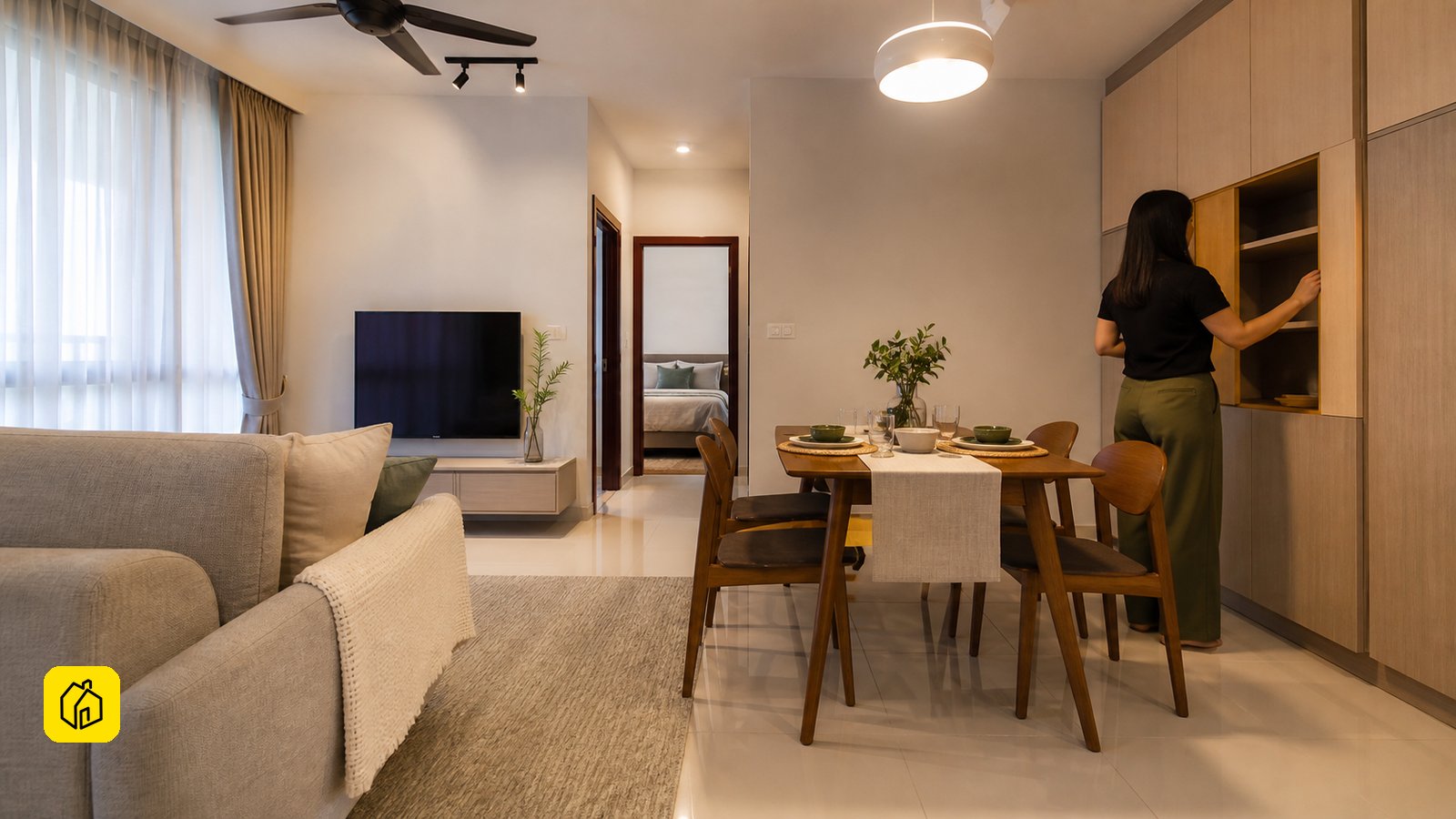
Own a unit at Cerrado (or buying one)? Run it whole-unit and price to the demand our own board has already measured: the RM1,500 furnished 2-bed has drawn 75 chat requests and 27 viewings since 2020, while the fresh RM3,200 3-bed ask sits at 2. Against the RM320,000 live asking floor, RM1,500 a month is about 5.6% a year gross. Rooms are unproven at this building and short-stay has no measured unit — both wait on the management's written rules.
Three ways to run your unit
Pick a model card, tell the tool which unit you own, then put in your own numbers. The answer updates as you type, and the charts show the trade-offs.
Loading the renovation ROI comparison…
What can you earn?
Two dedicated zero-deposit listings carry this building on SPEEDHOME's own board, and their demand split tells you what to own and how to price it. "Cerrado Suites Southville City — 1500 / 656 sqft / 2bed 1bath — CR 75 / VA 27" (SPEEDHOME): the RM1,500 furnished 2-bed has pulled 75 chat requests and 27 viewings since it listed in 2020 (lifetime counters, read 10 Oct 2026). The 1,207 sqft 3-bed — "Cerrado Southville City, Dengkil — 3200 / 1207 sqft / 3bed 2bath" — asks RM3,200, listed September 2026, 2 chat requests. Same towers, same market: the small unit priced to demand is the product renters want.
Worked out: RM1,500 x 12 = RM18,000 divided by RM320,000 = 5.6% a year gross. The edges: the building's live rent floor is RM1,100 (4.1%), and at the RM265,000 search-snippet card (RM403 psf) the same rent pays 6.8%. All asking-based — no transacted price record exists for this estate, and the RM201 psf corridor figure you may find is old low-rise Dengkil, not Southville City.
The wider market, for context: iProperty's live building profile reads "Asking prices from RM 320,000 | Monthly rent from RM 1,100 | 17 For Sale | 5 For Rent" (10 Oct 2026) — while search headlines for the same building claim 69-74 rentals. We recorded the gap; we did not reconcile it. Around us in Dengkil, our own board carries comparable whole-units at RM1,400-2,750 (Casa Bayu RM1,500, Casa Bluebell RM1,700, Kita Bayu RM1,800) — context, not this building.
Rooms are the unproven maybe: the only room-class card in the corridor read asks RM750 (Savanna Executive Suites, a neighbouring scheme), and a 3-bed split at RM500-750 grosses RM1,500-2,250 — arithmetic, not a measured Cerrado room market. The proven 656 sqft 2-bed cannot be split into lettable rooms anyway. Any split needs the management's written yes first. SPEEDHOME coliving is cat-friendly — cats welcome in our coliving rooms — and pet-friendly rooms earn about 15-20% more.
Short-stay is an empty lane here: zero Cerrado-named units on Airbnb at the October 2026 check, while Southville-area homestays run SGD182-268 per 5 nights (about RM120-177 a night) — corridor context only.
Why whole-unit wins here
The verdict is our own demand counters, not taste: 75 against 2 on the two dedicated cards. A 1,616-unit, four-tower estate means your listing competes against dozens of near-identical plates, so what stands out is price-to-demand, furnishing and zero deposit — not a designer fit-out. The 828 sqft 3-bed plate has no specific ask measured yet; corridor 3-beds say RM1,400-2,750 is the realistic zone, and your own comparable goes in the calculator. With 17 resale cards on the live profile, treat selling as a bonus — this is a rental building.
Honest gaps: no transacted price record for the estate; the rental-count discrepancy above; room rates and short-stay unmeasured in-building; running costs not published.
5 checks before you buy
-
Get the real land title document — not the agent's ad. It decides what you can legally do with the unit. Done: you hold the title copy.
-
Get the management's rules in writing — short-stay, room rental, pets. One letter answers all three. Done: you have the letter.
-
Get the real running costs — maintenance fee, sinking fund, quit rent. None are public, so ask. Done: a number on paper. See the real cost of self-managing a rental.
-
Show your renovation plan to MP Kajang before you sign anything. Dengkil sits at the Kajang-Sepang edge and MP Kajang is the council here — Selangor, not KL; no KL-style blanket partition ban named, but new walls need council approval and existing bedrooms are the only safe split. Done: the council tells you in writing.
-
Until checks 1 and 2 are done, buy nothing you cannot undo. For Cerrado: furniture yes, walls no — a reversible SPEEDRENO rental fit-out converts the unit back to normal in a day.
FAQ
Can you rent rooms at Cerrado?
No Cerrado room rate has ever been measured — the only room-class card in the corridor read is RM750 in a neighbouring scheme. A 3-bed split at RM500-750 grosses RM1,500-2,250 on corridor numbers, and the proven 2-bed cannot be split. If you try it anyway: written management approval first. See the room rental and co-living guide.
What yield does Cerrado give?
About 5.6% a year gross: the measured RM1,500 2-bed ask over the live RM320,000 asking floor — 4.1% at the RM1,100 rent floor, 6.8% at the RM265,000 snippet card. Those are asking figures, not a promise; your real yield is lower after vacancy and costs, and no transacted price record exists for the estate.
Is short-stay allowed at Cerrado?
Nothing measured says it is happening: zero Cerrado-named units on Airbnb at the October 2026 check, while Southville-area homestays run about RM120-177 a night. What governs is the management's written rules — Malaysia's top court confirmed a management can ban short-stay in a strata tower (Verve Suites ruling, 2020). Get the letter before you spend.
Are pets allowed at Cerrado?
The building's rules are not public. SPEEDHOME coliving is cat-friendly — cats welcome in our coliving rooms — and pet-friendly rooms earn about 15-20% more. The offer is SPEEDHOME policy; building rules can vary.
What running it looks like
Setup is the two documents: title and house rules, plus your strata statement because the running costs here are self-verified. The work is one tenant for a whole unit — or three if you ever split, on your own quotes and with the letter in hand. Whole-unit, the cycle is one listing, a handful of viewings, a stamped tenancy agreement, then rent day. The 75-chat-request card is the proof of what a right-priced furnished zero-deposit listing does in a 1,616-unit estate: it out-pulls its neighbours for years. SPEEDHOME runs the listing, the viewings and the zero-deposit screening; you approve the tenant before the agreement is signed.
Ready? List your unit with SPEEDHOME — zero deposit, we run the viewings, you approve the tenant.
All figures are asking prices read on 10 Oct 2026 (SPEEDHOME's own dedicated board and iProperty's live building profile; Airbnb and search excerpts for context only). Running costs are not published. More: the landlord investment decision guide.