
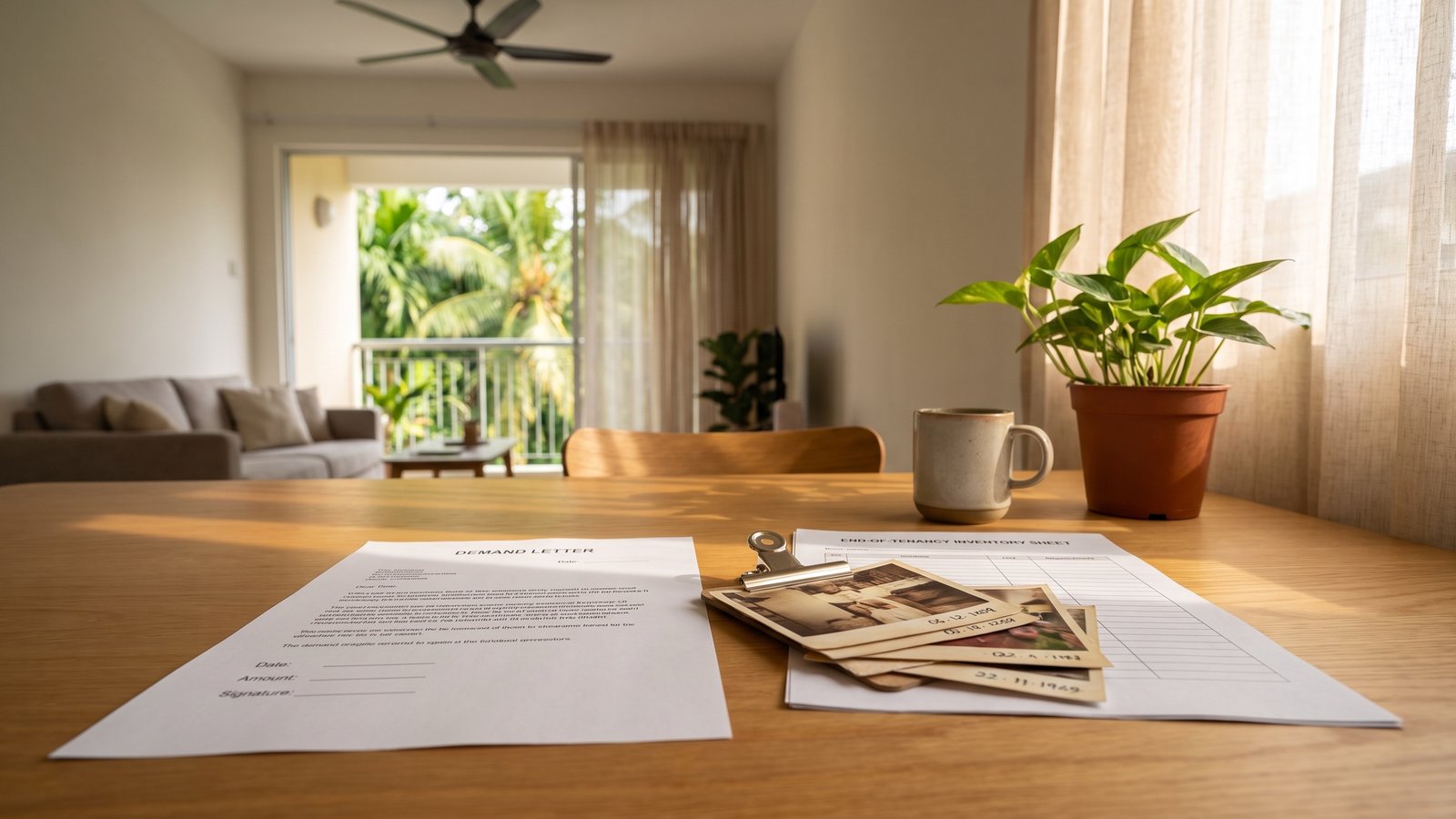
A demand letter for an unreturned deposit is a pre-litigation step that creates a paper trail for a small-claims or Magistrates' Court claim. It is not legal advice, not a court filing, and does not need a lawyer. This is general information, not legal advice. The forum is NOT TTPM — TTPM (the Tribunal for Consumer Claims) does not handle private residential tenancy deposit disputes. The right track is the Magistrates' Court small-claims track for claims ≤RM5,000 (Order 93 of the Rules of Court 2012, Form 198, no lawyer required in most cases). For larger amounts, the ordinary Magistrates' Court (≤RM100,000) or Sessions Court is the track. The proposed Residential Tenancy Act is still a draft Bill in 2026 — it has not been tabled in Parliament or gazetted — so the law that applies is the general law of contract (primarily the Contracts Act 1950) and the civil procedure rules.
This page is the 2026 dense guide for a tenant whose landlord has not returned the deposit after move-out. It carries an inline demand-letter template, a 1-step report path, the TTPM-vs-court-tier distinction (linked, not re-stated), and the SPEEDHOME operator close.
Why the deadline is contractual, not statutory (the most common mistake)
There is no statutory deadline for a landlord to return a tenancy deposit in Malaysia in 2026. The 14-day / 30-day / "by law" windows that appear in forum threads and free-template sites are drafting conventions or contractual terms in the TA, not statutory deadlines. The right way to frame the deadline in a demand letter is "within 14 days of receipt of this letter" (a drafting convention), not "within 14 days by law" (a false claim).
- What the TA usually says. Most TAs name a deposit-return window (commonly 14 days, 21 days, or 30 days from move-out), but the window is contractual, not statutory. If the TA names 14 days, the 14-day clock starts on the day named in the TA; if the TA is silent, the general law applies.
- What the law does not say. Malaysia has no statute that fixes a deposit-return window for private residential tenancies. The proposed Residential Tenancy Act is still a Bill; any agent or "free template" site that quotes you a statutory 14- or 30-day window is asserting a law that does not exist.
- What you can credibly claim in the demand letter. "I require the return of my deposit of RM X within 14 days of receipt of this letter, in line with the TA dated [date] and the move-out inventory dated [date]. If I do not receive the deposit by [date], I will file a claim in the Magistrates' Court small-claims track without further notice."
Honest limitation: the deadline in your demand letter is a pressure tool, not a legal right. The legal right you can enforce is the civil claim under the TA. If the deadline passes without payment, the next step is the Magistrates' Court filing, not a second demand letter.
The demand letter: what goes in the inline template?
The demand letter is a one-page document. It names the recipient, the amount, the date of the original TA, the lawful grounds, the deadline, and the statement that court action will follow if not paid. The template below is a starting point; tailor the [bracketed] fields to your situation.
``` [Your full name] [Your current address] [Your phone] [Your email]
[Date]
To: [Landlord's full name] [Landlord's address — last-known address from the TA]
Re: Demand for return of tenancy deposit — TA dated [date of TA], [property address]
Dear [Landlord's name],
I am the former tenant of the property at [property address] under the Tenancy Agreement dated [date of TA] between you and me. I vacated the property on [move-out date] and returned the keys on [key-return date].
Under the TA, I paid a security deposit of RM [amount] on [date of deposit payment]. The deposit was held by you as security for performance of my obligations under the TA. I have performed all my obligations under the TA to the date of vacation, and the move-out inspection on [date] recorded no damage beyond fair wear and tear (a copy of the move-out inventory is attached).
I require the return of the deposit of RM [amount], less any documented deductions for damage beyond fair wear and tear, within 14 days of your receipt of this letter — i.e. by [date 14 days from sending].
If I do not receive the deposit by [date], I will file a claim in the Magistrates' Court small-claims track under Order 93 of the Rules of Court 2012 without further notice. The filing fee is RM 10–RM 20 (confirm at the registry); no lawyer is required for claims up to RM 5,000.
I would prefer to resolve this without court action. Please respond in writing within the deadline above.
Yours sincerely, [Your signature] [Your printed name] [Date]
Attachments: 1. Copy of the Tenancy Agreement 2. Copy of the move-in inventory / condition report 3. Copy of the move-out inventory / condition report 4. Photos of the property at move-in and move-out 5. Copy of the final utility bills 6. Proof of delivery of this letter (registered post receipt or courier tracking number) ```
The five attachments are the standard set. The move-in inventory and the photo record are the two most often missing — and the two that decide most small-claims outcomes. If you do not have a shared move-in photo record or a written defect list, the demand letter still goes out, but the civil claim becomes harder.
What to leave out of the demand letter. Do not threaten criminal action unless you have a police report. Do not name a fake RM amount; the demand letter must match the TA. Do not use insulting or aggressive language; the small-claims magistrate reads the letter, and the tone affects the case.
The 1-step report path: what happens after the deadline?
If the landlord does not pay by the deadline, the next step is the Magistrates' Court small-claims claim. The path is one step repeated: file, evidence, attend. No lawyer is required in most cases. The filing fee is in the low-tens of ringgit — confirm the current fee at the registry; do not freeze an RM figure.
| Step | Where | What to bring |
|---|---|---|
| 1. File the small-claims claim (Form 198, Order 93 Rules of Court 2012) | Magistrates' Court in the district where the property is, or where the landlord resides | The TA, the move-in/move-out inventories, the photo record, the demand letter + proof of delivery, the final utility bills, your ID |
| 2. Serve the claim on the landlord | Court bailiff, or registered post / courier with tracking | The Form 198 + the supporting documents; keep the proof of service |
| 3. Attend the hearing | Magistrates' Court, on the date set by the registry | Bring originals of every document; bring the move-in / move-out photos; be ready to answer the magistrate's questions |
For claims above RM5,000, the ordinary Magistrates' Court (up to RM100,000) or Sessions Court is the track. Lawyer or no lawyer is your choice; many small-money claims are run without one.
Honest limitation: small-claims outcomes are not guaranteed. A landlord who has the deposit and refuses to return it may also be a landlord with no assets to satisfy a judgment. The realistic upside of a small-claims claim is the order itself, which can be enforced against future assets, and a paper trail that supports a related criminal complaint if the landlord is acting in bad faith.
Why TTPM is the wrong forum (LINK, not re-stated)
TTPM (the Tribunal for Consumer Claims) does not handle private residential tenancy deposit disputes. The Tribunal for Consumer Claims sits under the Consumer Protection Act 1999; section 2(2)(d) of that Act excludes "any trade, business, profession, or other activity carried out by a person in respect of land" — that exclusion reaches private residential tenancy. The right forum is the Magistrates' Court small-claims track, not TTPM. For the full forum tier table and the underlying reasoning, see which court or tribunal handles a rental deposit dispute.
What evidence to keep (the part the magistrate will ask for)
The case you can prove is the case you can win. The six items below are the standard set; keep them even if you think the amount is too small to file.
- The TA — signed by both parties, with the deposit terms on the page.
- The move-in inventory — a written, dated, photo-supported record of the property's condition when you moved in. Both parties should sign this; if the landlord did not sign, the photos still count, and the dated record is the evidence.
- The move-out inventory — the same shape, dated the day you returned the keys.
- The photo record — dated, time-stamped photos at move-in and move-out. Phone-camera is fine; the timestamps and the EXIF data are the proof.
- The final utility bills — TNB, water, internet — showing the account is closed and the final balance is zero (or settled).
- The demand letter + proof of delivery — the letter above, sent by registered post or courier with tracking, with the proof of delivery kept on file.
What is the SPEEDHOME-tenant playbook?
On the platform-managed listings, deposit disputes that reach formal escalation almost always trace to "no shared move-in photo record" and "no written defect list at handover." The platform's Homerunner walkthrough produces both — the move-in inventory and the move-out inventory are shared, signed, and photo-supported. The demand-letter template above expects both; the platform's standard process is the structural close that prevents the dispute from needing the letter at all.
- If your listing was SPEEDHOME-managed and the dispute is at the platform level. Open a SPEEDHOME chat case before sending a demand letter; the platform's ops team can mediate in line with the TA's deposit clauses, and a platform-mediated settlement is faster than a small-claims filing.
- If your listing was SPEEDHOME-managed and the platform process has been exhausted. Send the demand letter above; if the deadline passes, file the small-claims claim. SPEEDHOME will provide the move-in and move-out inventories and the photo record on request.
- If your listing was not SPEEDHOME-managed. Send the demand letter above; if the deadline passes, file the small-claims claim. The template and the path are the same; the only thing that changes is the source of the evidence.
FAQ
Is there a statutory deadline for the landlord to return the deposit?
No. As of 2026 there is no statute in Malaysia that fixes a deposit-return window for private residential tenancies. The window in your TA is contractual; if the TA is silent, the general law applies. The 14-day / 30-day windows in forum threads are drafting conventions, not law.
Does TTPM handle a private tenancy deposit dispute?
No. The Tribunal for Consumer Claims (TTPM) does not handle private residential tenancy deposits. The Consumer Protection Act 1999 s.2(2)(d) excludes "any trade, business, profession, or other activity carried out by a person in respect of land" — that exclusion reaches private residential tenancy. The right forum is the Magistrates' Court small-claims track (≤RM5,000) or the ordinary Magistrates' Court (≤RM100,000) or Sessions Court.
Do I need a lawyer to write a demand letter or file a small-claims claim?
No. The Magistrates' Court small-claims track is designed for tenants without a lawyer, with filing fees in the low-tens of ringgit (confirm the current fee at the registry). The demand letter above is the standard shape; you can send it without a lawyer. For a larger claim in the ordinary Magistrates' Court or Sessions Court, a lawyer is optional.
What if the landlord does not respond to the demand letter?
The deadline passes, and the next step is the Magistrates' Court small-claims filing (Form 198, Order 93 Rules of Court 2012). A second demand letter is not required; the first letter is the paper trail.
What if I do not have a move-in inventory or a photo record?
You can still send the demand letter and file the small-claims claim; the case is harder, but the absence of a move-in inventory is itself evidence (the landlord's TA usually requires a move-in inventory, and a missing one cuts both ways). The lesson is: on the next tenancy, take dated photos at move-in and share them with the landlord in writing.
Is the RTA going to change any of this?
The proposed Residential Tenancy Act is still a Bill in 2026. It has not been tabled in Parliament or gazetted. When / if the RTA is enacted, it may set a deposit-return window, a statutory cap, and a dedicated tenancy forum; until then, the contractual frame and the general law of contract apply. This page will be updated to reflect the new framework if / when the RTA comes into force.
CTA
If you are choosing a new rental and want a platform-managed listing where the deposit is held by SPEEDHOME and the move-in and move-out records are shared and photo-supported, browse SPEEDHOME verified rentals.
How this page stays accurate. The legal statements rest on Rules of Court 2012, Contracts Act 1950 and Consumer Protection Act 1999; figures are checked against a dated fact registry at every update. Report an error: [email protected].