
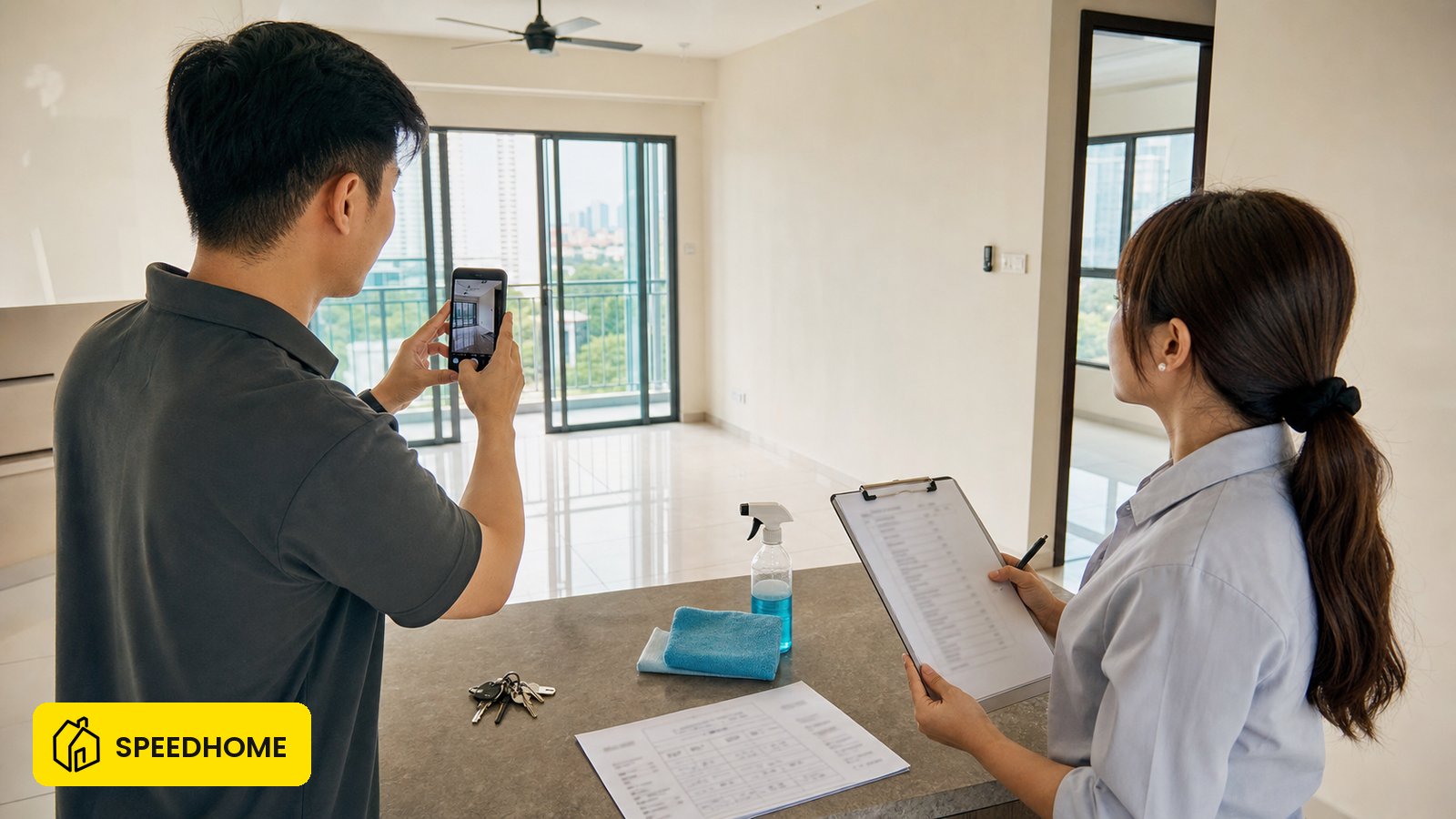
The rental deposit return process should start before move-out day, not after the keys are handed back. Tenants should finalise rent, utility bills, cleaning, keys and proof of unit condition. Landlords should inspect the unit, list every deduction clearly, and return the balance of the deposit without unreasonable delay.
When should the deposit process actually start?
Start 30 to 60 days before move-out, not after the keys are returned.
Tenants should check the move-out notice, utility bills, unit condition, furniture and cleaning requirements. Landlords should explain how the final inspection will be done and when the deposit will be processed.
If everything is left to the last day, small issues become big ones. Meters are not yet read, keys are missing, bills have not been issued, and the photo record is incomplete.
What handover and inspection steps secure your full deposit?
Finalise rent, bills, cleaning, small repairs and a move-out video of the unit.
Film every room, open the cabinets, record the meters, and show the air-conditioner, appliances, toilet, kitchen, doors and windows. Store everything in one folder that is easy to share.
Do not leave personal items, rubbish or food behind. A dirty unit gives the landlord room to apply cleaning deductions.
How should the landlord calculate deductions?
Calculate deductions based on evidence, not on personal frustration.
Each deduction should have a category: rent, utilities, cleaning, repairs, missing items or other. Add the amount and the supporting evidence. This makes the conversation far more professional.
If a repair requires a quotation, tell the tenant. Do not stay silent for weeks without giving a status update.
What can a tenant do if the deposit is returned late?
Request a written status update and an itemised breakdown of deductions, politely but firmly.
Send a short message: move-out date, keys returned, bills settled, and ask for the deposit return date. If there are deductions, ask for evidence and receipts.
Avoid extreme accusations in the first message. Keep the tone professional so your record looks reasonable if it has to be referred to later.
What can a landlord do to avoid disputes?
Set the deposit process in the tenancy agreement from the start.
State the inspection window, the types of deductions allowed, who pays the bills, the cleaning standard, and how the inspection is done. The clearer the agreement, the less room there is for interpretation.
Use an inventory list and a move-in video. The deposit is not just a move-out issue; it starts on the day the keys are first handed over.
What should you check before deciding?
Use this table as a quick decision check before you sign, renew, deduct, report, or move out.
| Situation | What to check | Safer next step |
|---|---|---|
| Tenant has already moved out | Keys, meters, bills, move-out video | Run the final inspection immediately |
| Landlord wants to deduct from deposit | Damage evidence and receipts | Provide an itemised breakdown |
| Deposit has not been returned | Move-out date and bill status | Request a written update |
A table is not a substitute for the tenancy agreement. It is a pressure test. If the written agreement, payment record, inspection video and WhatsApp trail do not line up, slow down and fix the evidence first. Most rental disputes become expensive because one side relies on memory instead of dated proof.
What evidence should be prepared before a dispute happens?
Prepare evidence while the tenancy is still calm, because evidence gathered too late is usually weaker.
A good tenancy record does not need to be complicated. Keep the tenancy agreement, payment receipts, move-in video, move-out video, utility bills, damage report messages, notices, quotations and key handover photos in one folder. If a review is needed later, both sides can understand the story without digging through old messages one by one.
This matters because most tenancy disputes are not won by whoever is angrier or more articulate. They come down to what can be proven. For rent issues, show the due date and bank record. For damage issues, show the before and after condition. For deposit issues, show the final bill, keys, inventory and inspection photos.
Do not wait until the relationship is already tense to request documents. Make receipts, confirmations and photos a normal routine. A clean record should feel professional, not like an attack.
How should you communicate when money is involved?
Use short, clear written messages that include the amount, date, reason and next step.
Messages that are too long and emotional usually make resolution harder. A good message states what happened, the amount involved, the documents that support it, what is being asked for, and the reply deadline. This brings the discussion back to facts.
If a tenant asks for the deposit to be returned, state the move-out date, that the keys have been returned, that the final bills have been handled, and the payment date being requested. If a landlord claims arrears, state the overdue months, the amount, the date payment was due and the payment record. If the issue is damage, attach the photos or video, the location and when it started.
Phone calls can help for urgent issues, but follow up with a short message afterwards. This avoids the common problem where one side remembers one thing and the other side remembers something else.
When should you stop negotiating and escalate?
Get outside help when the amount is large, safety is involved, or the other side refuses to discuss the evidence.
Not every dispute is worth taking further. Sometimes a written settlement is better, especially if the amount is small and both records are imperfect. Outside help is more appropriate when there is a large arrears amount, a threat to lock the tenant out, serious damage, harassment, refusal to return keys, a safety issue or a large deposit deduction.
The escalation route for a stalled deposit is stepwise:
- Written demand (Letter of Demand). Send a dated written demand stating the move-out date, that keys and bills are settled, the deposit amount held, the deductions you accept, and a repayment deadline (commonly 7–14 days). Keep a copy — this is the document a court will ask about first.
- Magistrates' Court small-claims procedure (Order 93). An individual claiming RM5,000 or less from the former landlord can file in Form 198 at the Magistrates' Court without a solicitor; the claim fee is small (verify the current registry fee on the official eKSS table on the day of filing) and recoverable costs are capped at RM100. A company cannot commence a small claim, and this route is for money claims — not for possession.
- Higher civil claims. Amounts above RM5,000 go to the Magistrates' Court or Sessions Court as ordinary contract claims; a Sessions Court has unlimited jurisdiction for landlord-and-tenant disputes. Malaysia has no dedicated residential tenancy tribunal, and the consumer claims tribunal is not the reliable route against a private individual landlord for a deposit.
- Never self-help. Even after the tenancy has ended, do not lock the tenant out, disconnect utilities or remove belongings to pressure a settlement — recovery of possession must go through the courts, and a self-help move can turn you from claimant into defendant.
Before getting outside help, put together a timeline. List the dates, amounts, messages, photos, receipts and clauses being relied on. A clean timeline makes it easier for a lawyer, platform support, mediator or the court to understand the issue quickly.
Avoid pressure tactics that can backfire. Do not use threats, publicly shame anyone, lock the tenant out without following the process, take the other party's belongings, or share their personal information. Stay on notices, records, negotiation and the right channels.
What is the safest overall approach?
The safest approach is to separate your emotions from the tenancy decisions.
Rental problems feel personal because they involve a home, money and trust. But the decisions should still come back to the agreement and the evidence. Ask first: which document supports this point? Which receipt? Which video? Which message?
For tenants, this means paying rent on time, reporting damage early, recording the unit condition and getting written approval. For landlords, this means screening tenants, using a clear agreement, responding to maintenance reports, breaking down deposit deductions and avoiding risky shortcuts.
The more organised side usually has the stronger position. Not because documents solve everything, but because they reduce the guessing. A clear record makes negotiation easier, makes explanations easier, and makes it easier for both sides to move on to the next step.
How do you turn this into a repeatable checklist?
Turn this into a short checklist that can be used every viewing, key handover, renewal or move-out.
A checklist stops the same mistakes from repeating under different names. For tenants, the checklist should cover identity, payment, agreement terms, unit condition, utilities, access cards, how to report damage and notice periods. For landlords, the checklist should cover tenant screening, proof of handover, tenancy start date, maintenance response, inspection notes and final accounts.
A checklist should not be so long that people stop using it. Use direct questions: has the rent been paid or not, have the bills been settled or not, has the video been saved or not, are the keys complete or not, has the notice been put in writing or not, and does the next step have a date or not.
A repeatable process is very useful for landlords managing more than one unit. It reduces decisions driven by mood or memory. Tenants also accept the process more easily when the same standard is applied every time.
What should be rechecked before taking action?
Before making a final decision, recheck the latest agreement, the latest payment record and the latest proof of unit condition.
Rental facts can change quickly. A tenant may already have paid after an old screenshot was taken. A landlord may already have repaired damage after the first complaint. A bill may still be an estimate, not the final bill. Rent prices and tenancy terms can also change. So the final decision should be based on the most recent record.
What are the signs the process is already tidy enough?
The process is tidy enough when an outside person can understand the issue without a long story.
If your folder clearly shows the agreement, payments, photos, videos, messages and dates, the issue is easier to resolve. If everything depends on "he said" and "I remember", the dispute will eat up time. The goal is not to win an argument. The goal is for decisions about money, deposit, damage or move-out to be explained calmly.
Final note before closing the account: what should you recheck?
Do not close the tenancy account based on trust alone.
Recheck the rent total, final bills, keys, access cards, unit photos and agreement messages once more. These small steps are usually enough to prevent the long deposit disputes that drag on after the tenant has already moved out.
Why use SPEEDHOME for the next rental step?
The platform helps make the rental process more organised so that payment records, agreements and key handovers are easier to refer back to when it is time to return the deposit.
FAQ
Can I claim the deposit if the landlord goes silent?
Ask for a written explanation first and keep all evidence. If it still fails, send a formal Letter of Demand with a repayment deadline; as a last resort, an individual can pursue RM5,000 or less through the Magistrates' Court small-claims procedure (Order 93, Form 198, no solicitor needed).
Should we do the inspection together?
Strongly recommended. If that is not possible, record a clear move-out video and send it through a dated channel.
Which deductions are disputed most often?
Cleaning, repainting, furniture damage, the final bill and using the deposit as the last month's rent.
Can every type of damage be deducted?
No. Deductions must be reasonable, related to the tenancy and supported by evidence. Normal wear and tear should not be treated like major damage.