
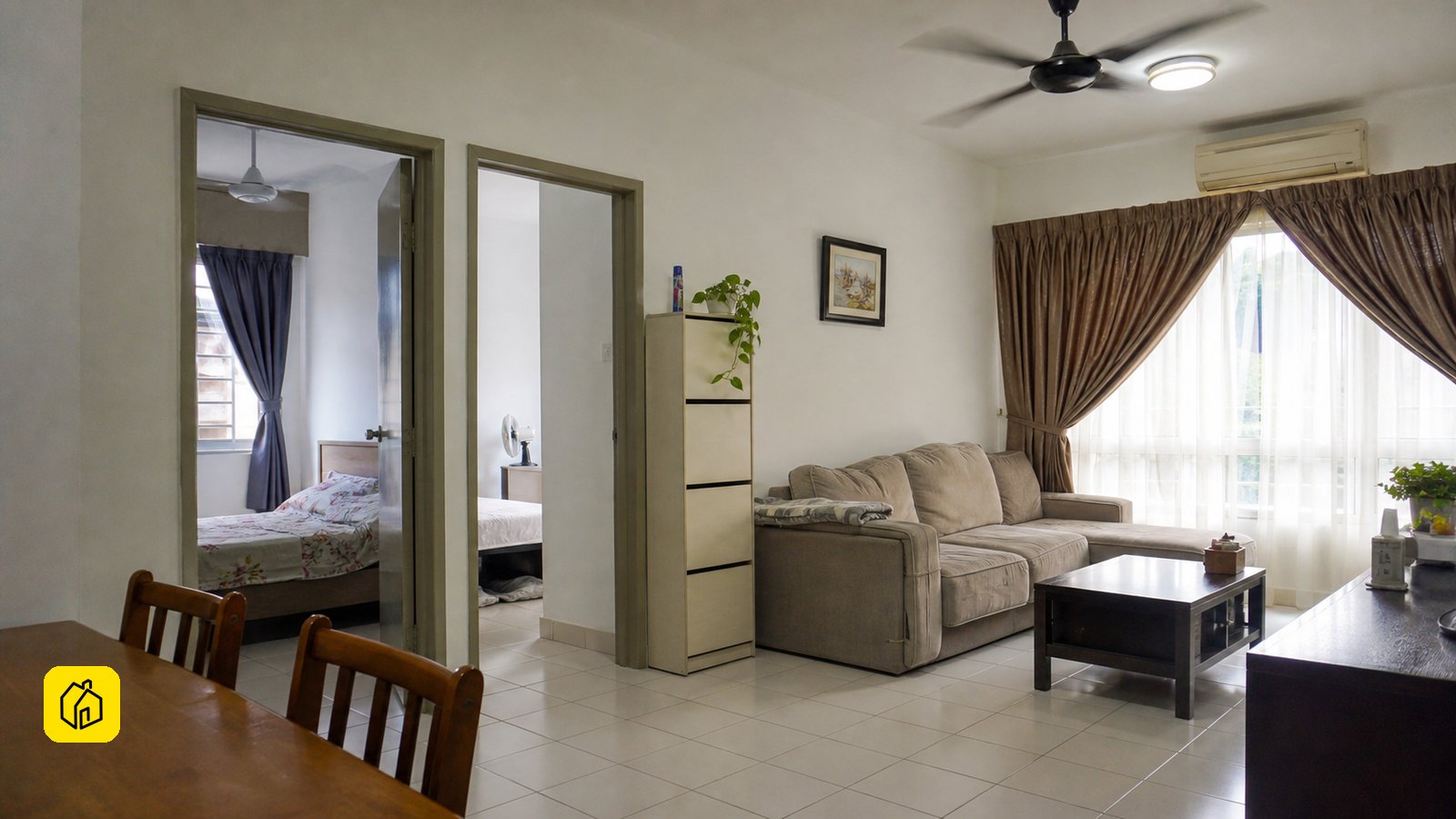
Iris Apartment: the landlord verdict
Treat Iris Apartment as a compact whole-unit long-term decision first. The evidence supports a leasehold, low-cost-tier apartment at Jalan 2/109C, Taman Abadi Indah, off Jalan Klang Lama, with six twelve-storey blocks and standard two-bedroom units of roughly 624–660 sq ft. That compact plan makes a normal household tenancy easier to test than a room-rental conversion. It does not prove a room premium, pet demand, short-stay permission or a current building rent.
The live Taman Desa rental route is the availability surface. This page helps an owner decide what to do with one parcel before it is listed.
What is known, and what is deliberately unknown?
The public record is strongest on location, building form and compact two-bedroom layouts. It identifies open parking, two passenger lifts per block and 24-hour security; it does not consistently establish a developer name, completion year or total-unit count. The public sources name rail options in the wider area but do not prove a walkable rail journey, so do not buy or price this unit on a transit-walk claim.
| Decision input | Supported public record | Owner must verify |
|---|---|---|
| Layout | Two bedrooms, one bathroom, roughly 624–660 sq ft | Exact parcel plan, storage and current condition |
| Project form | Six blocks, twelve storeys; modest facilities | Block maintenance, lift condition and parking allocation |
| Location | Taman Desa/Jalan Klang Lama corridor | Actual journey and current neighbourhood comparison |
| Operating rules | Not established by public sources | By-laws, renovation process and title restrictions |
This matters because a compact two-bedroom unit has little margin for a poorly planned conversion. A whole-unit tenant can use the rooms as designed. A shared model should only be considered if the existing rooms remain liveable and management confirms the arrangement in writing.
Why is a whole-unit tenancy the sensible first model?
It works with the evidenced two-bedroom layout and does not require an unverified structural or management assumption. Start by testing whether the parcel is clean, functional and competitively furnished for a household or couple. Put the actual comparable rent, annual charges, repair allowance and vacancy assumption into the calculator; do not work backwards from a desired yield.
Room rental is conditional, not a default. The owner needs an existing approved bedroom configuration, sufficient privacy and storage, a written management response on the intended occupancy and a practical utility plan. A short-stay model is not a more profitable version of the same decision: it needs its own title, management and operator-economics evidence. The rule of thumb here is simple — do not spend on a model that has not passed its evidence gate.
| Model | Verdict today | Evidence needed before it becomes a real option |
|---|---|---|
| Whole-unit long-term | Default | Current same-layout comparable and normal unit DD |
| Existing-bedroom room rental | Conditional | Written management position plus a workable, approved layout |
| Pet-led co-living | Conditional | Written pet and occupancy rules; no assumed rental uplift |
| Short stay | Not underwritten | Current written rule, title review and actual ADR/occupancy case |
What should the fit-out achieve?
Use fit-out to make the compact plan easier to rent as a normal home, not to force a higher-density model. Repair water-sensitive areas, improve lighting, make storage practical and choose appliances that a whole-unit tenant values. Keep the scope reversible. Do not assume that new partitions, plumbing changes, external air-conditioning work or per-room meters are routine works; ask the management office what needs an application before you accept a quote.
For Iris Apartment, a SPEEDRENO brief should be condition-led: photograph the kitchen, bathroom, doors, windows and electrical points, then price repair and furnishing choices separately. A compact unit is particularly sensitive to clutter and circulation. A better storage or appliance decision can make the ordinary tenancy more competitive; it does not by itself create a room-rental thesis.
The shared calculator compares the incremental economic return of a lean and a higher-spend plan. It keeps renovation in invested capital and reduces the answer for vacancy, operating cost and economic depreciation. That is more useful than claiming that a generic renovation amount automatically creates a rent uplift.
Which documents decide the risk?
The management file and parcel documents decide the downside more than a portal listing does. Before committing capital, obtain:
- The individual title and any recorded use restrictions for the exact parcel.
- Current by-laws and the renovation application. Ask directly about existing-bedroom subletting, pets, short stay, submeters and any service alteration.
- Latest maintenance and sinking-fund statements, AGM minutes and special-levy notices.
- A dated condition record: walls, wet areas, fittings, appliances, doors, windows and meter locations.
- Three current comparable homes with the same general layout, condition and furnishing level.
- A contractor scope that labels ordinary repairs separately from work requiring management approval.
Use the landlord investment decision guide to compare the whole purchase decision, and the self-management cost calculator to make the recurring workload visible.
What can go wrong?
The material risk is an expensive conversion that still has to be rented as a small whole unit. If management does not support the proposed occupancy or alteration, the owner needs a normal-home fallback. If the comparable evidence is weaker than expected, the correct response is to revise the rent and scope, not invent a building-wide yield. If the AGM minutes show a levy or the parcel condition shows deferred repairs, add those to invested capital before comparing scenarios.
The same discipline applies at handover. Keep a dated inventory and photos for the actual furnished items, obtain written repair approvals where required, and re-check the economics before each new tenancy cycle. That keeps a low-cost-tier apartment from becoming a high-maintenance experiment simply because an initial fit-out was over-specified.
There is also an operational trade-off. Whole-unit tenancy has one household relationship and one turnover event; each additional room tenant adds communication, condition, collection and shared-space work. That may be worthwhile where the documents and actual layout support it, but this page does not price that work as if it were free.
Calculator
Begin with whole-unit inputs; unlock the other scenarios only when their written evidence exists. The chart makes a higher spend visibly unattractive when it does not add economic NOI.
Loading the renovation ROI comparison…
Frequently asked questions
Is Iris Apartment suitable for room rental?
It may be, but the compact two-bedroom layout makes that a parcel-level question. Confirm the approved plan, livability after furniture and the current management rules before committing to a shared model.
Is Iris Apartment walkable to rail?
Do not state that as a decision fact. The fact record names nearby rail options but does not verify a walkable rail journey; test the journey from the actual block at the time tenants would use it.
Which rent belongs in the calculator?
Use dated comparable evidence for the same layout and condition, then test a vacancy allowance and the current annual charges. The page intentionally avoids a frozen building rent or yield.
Matched SPEEDHOME close
When the documents and calculator support a compliant whole-unit plan, list it with SPEEDHOME. That is the right hand-off from owner DD to tenant matching and tenancy workflow. List with SPEEDHOME; use the Taman Desa listings for current tenant-facing availability.