
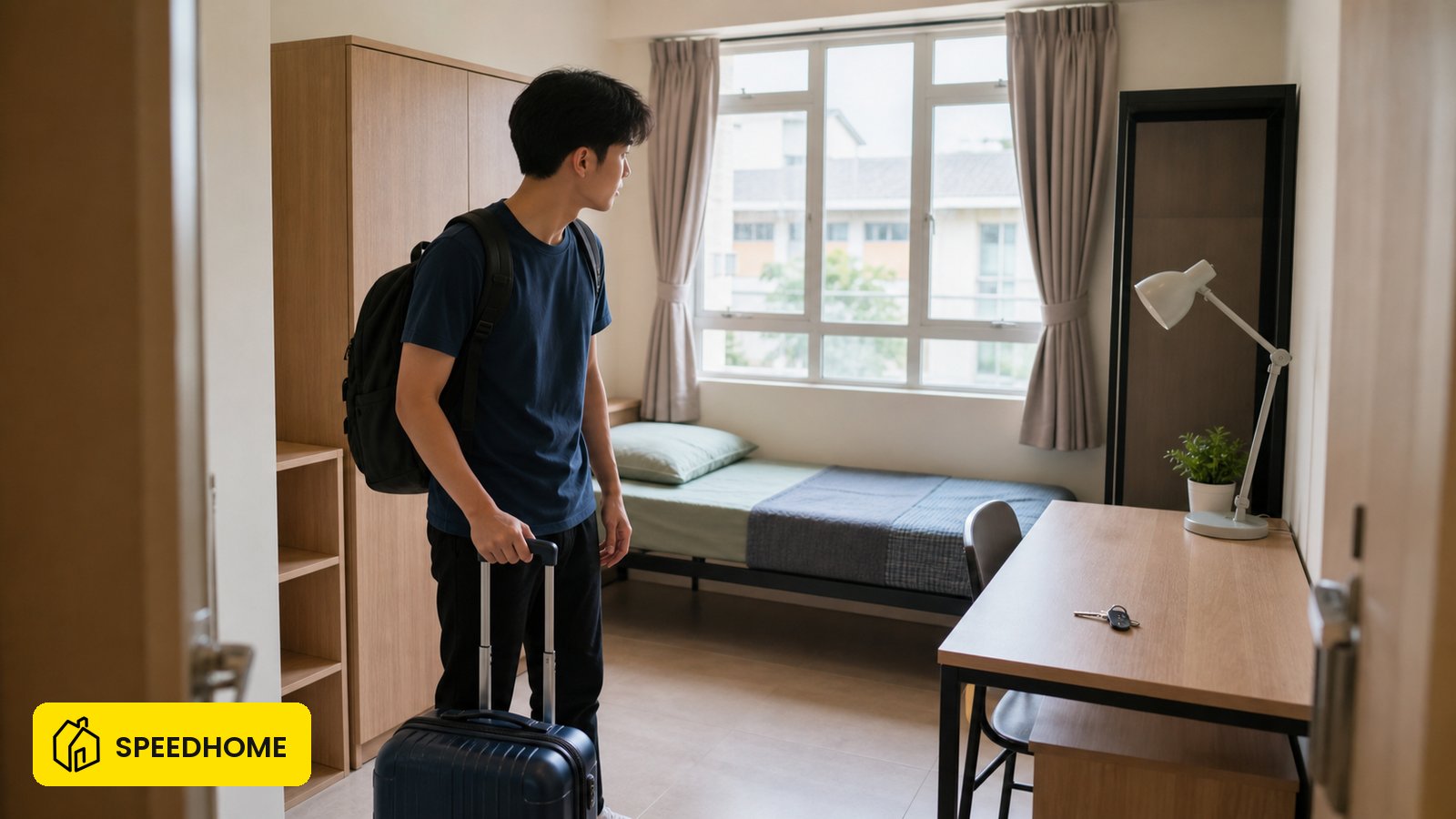
Is renting a room in Malaysia a good option for students?
Yes — for most students in Malaysia, renting a room is the most affordable and practical way to live near campus: rooms typically cost RM400–RM900 a month in major cities, versus RM1,200–RM2,500 or more for a whole studio or 1-bedroom unit. The trade-off is shared facilities and less privacy. Whether it suits you depends on your budget, study location, and how much flexibility you need.
Room rental vs whole unit vs co-living for students
The three main options for a student renter are a shared room or single room in a house, a self-contained studio or small apartment, and a co-living unit with managed amenities. Each suits a different budget and lifestyle.
| Option | Typical monthly cost (KL / major cities) | Private bathroom | Kitchen access | Minimum tenure | Deposit at signing |
|---|---|---|---|---|---|
| Shared room (2 pax) | RM250–RM500 | Usually shared | Shared | 3–6 months | 1–2 months rent |
| Single room in house | RM400–RM900 | Often shared | Shared | 3–6 months | 1–2 months rent |
| Co-living unit | RM600–RM1,200 | Usually en-suite | Shared or in-room pantry | Monthly or 3 months | Varies; some offer zero cash deposit |
| Studio / small 1-bed | RM1,200–RM2,000 | Private | Private | 6–12 months | 2–3 months rent + utilities |
| Purpose-built student accommodation (PBSA) | RM400–RM700 | Shared | Shared | Per-semester | Varies by operator |
Rent figures are indicative ranges only; check live listings on /rent for current availability and pricing near your institution. Do not rely on figures quoted outside verified listing platforms. For a deeper comparison of room structures, deposits and co-living arrangements, see our room rentals in Malaysia guide.
Co-living units typically bundle WiFi, cleaning services, and house rules into the rent. The trade-off is less flexibility to customise your space. Plain room rental in a house or older condo gives you more independence but requires you to manage utilities and house rules directly with other tenants.
When each option wins
Room rental wins on budget and flexibility; a whole unit wins on privacy; co-living wins on managed convenience for students arriving from outside the city.
Room rental is the right choice when you:
- Have a monthly housing budget under RM800.
- Are studying in KL, Petaling Jaya, Shah Alam, Johor Bahru, or Penang where room supply is dense.
- Prefer a shorter minimum tenure (3 months vs 12 months for a full apartment).
- Are happy to split utilities with housemates.
- Want to live close to a university without paying for space you do not need.
A whole unit makes sense when you:
- Value privacy and control over your living environment.
- Are in Malaysia long-term (a year or more) and want a stable base.
- Have a co-student or partner to split a 1-bed or 2-bed unit, bringing cost in line with single-room rents.
- Require a quiet space for intensive study that shared accommodation cannot provide.
Co-living works best when you:
- Are arriving in Malaysia from another city or country and want a managed, move-in-ready setup.
- Do not want to deal with utility accounts, WiFi contracts, or housemate disputes yourself.
- Are comfortable with house rules set by the operator (guests, noise, cleaning schedules).
- Can spend RM600–RM1,200 a month and want the all-in convenience.
Cost and risk: what students need to know
The biggest financial risk for students is the upfront deposit — not the monthly rent. Under a standard room rental agreement you pay utility deposit, security deposit (typically one to two months' rent), and the first month in advance before you move in.
Upfront cost breakdown
| Item | Typical amount | Notes |
|---|---|---|
| Security deposit | 1–2 months rent | Held against damage or unpaid rent; refundable at end of tenancy if no deductions |
| Utility deposit | RM100–RM300 | Covers water, electricity, internet; sometimes bundled |
| First month's rent | 1 month rent | Paid at signing |
| Stamping fee | Varies by annual rent | Stamp duty follows the Finance Act 2024 scale (RM1/RM3/RM5/RM7 per RM250 by lease duration); no RM2,400 exemption since January 2025 |
| Agent commission | RM0–1 month rent | Some landlords use agents; direct listings via verified platforms avoid this |
| Minimum cash needed before move-in | ~3–4 months rent equivalent | Varies by unit and arrangement |
Malaysia has no statutory residential rent-deposit cap. The deposit amount is set by the tenancy agreement, and a landlord's right to retain any of it at the end is limited to proven loss under general contract law. This means your deposit is legally protected — but if there is a dispute you have to go through the civil courts to recover it. Claims up to RM5,000 can use the Magistrates' Court small-claims procedure without a lawyer.
Legal protection students should know
As of 2026, Malaysia has no Residential Tenancy Act in force. In August 2026 KPKT told Dewan Negara it is still finalising the Residential Tenancy Bill, so no dedicated gazetted tenancy statute governs your room rental yet — it is governed by the tenancy agreement you sign together with general contract law (Contracts Act 1950, Civil Law Act 1956, Specific Relief Act 1950) and the ordinary courts. This means your written tenancy agreement is your main protection. Do not move into any accommodation without a signed, stamped tenancy agreement.
A landlord cannot lawfully remove you by self-help — locking you out or disconnecting water or electricity. Recovery of possession must go through the lawful court process. If you believe an illegal eviction attempt is happening, document everything and seek legal advice.
International students: the visa-rejection clause
Neither EMGS nor the Immigration Department publishes guidance on what happens to a private tenancy if a Student Pass application is rejected: EMGS's published refund policy covers only its own processing and immigration fees, not accommodation. As of 2026 a signed tenancy remains a binding private contract even if the tenant's visa is refused, so the practical protection is a written clause agreed up front — for example allowing termination with proof of visa rejection and a defined deposit-refund treatment. This is a negotiation point to raise before signing, not a standard term you can assume.
What "subletting" means for students
If you rent a room in a shared house, you are usually a direct tenant of the property owner or the property's head-tenant. If the person collecting your rent is themselves a tenant (not the owner), they are subletting to you. This is only legal if their own tenancy agreement permits it and they have the landlord's written consent. Always confirm who owns the property and who you are contracting with before you sign or pay anything. Ask to see the landlord's proof of ownership or the registered company if the landlord is an operator. For a full breakdown of what your tenancy agreement should include and what each party's rights and obligations are, see the room rentals and co-living guide.
Scam checklist for student renters
PDRM-recorded rental scam cases rose from 184 in 2023 to 922 in 2025, with about RM2.5 million in victim losses across 2023–2025. Students paying before viewing are prime targets, so verify four things before any money moves.
Before you pay anything — deposit, "booking fee", or first month's rent — run this checklist:
- Verify the person. Confirm the name on the listing matches the person you are dealing with. Ask for proof of ownership (or the head-tenant's tenancy agreement with sublet consent).
- Verify the unit. View the room in person or on a live video call at the actual address. Never pay for a unit you have only seen in photos.
- Verify the paperwork. Insist on a signed tenancy agreement before payment, and check who the contracting party is.
- Verify the payment channel. Pay only to an account or entity you can confirm — never to a personal account with a different name from the landlord or operator.
The four-step structure comes from rental-scam prevention guidance for Malaysia: verify the person, the unit, the paperwork, and the payment channel. If any step fails, walk away. For the full red-flag list, see our rental scam red-flag checklist for Malaysia.
Discrimination in room rentals: what students should know
A March 2026 study of 35,367 iBilik room-rental listings in the Klang Valley found 42.8 per cent carried explicit racial exclusions, and a 2019 YouGov survey found 46 per cent of Malaysian Indian respondents said they had faced ethnic discrimination when renting. Screening happens, and students should plan for it.
Three facts give you a realistic picture:
- A March 2026 study by the NGO Architects of Diversity ("Room Rental Discrimination: Volume 1 — Klang Valley"), which analysed 35,367 room-rental listings on the iBilik platform, found 42.8 per cent carried explicit racial exclusions; 31.7 per cent of all listings explicitly excluded Indian renters, versus 7.6 per cent excluding Malays and 3.9 per cent excluding Chinese. These findings are specific to iBilik room-rental listings and do not automatically extend to whole-unit rentals or other platforms.
- A 2019 YouGov Omnibus survey of 1,204 Malaysians found 46 per cent of Malaysian Indian respondents said they had faced ethnic discrimination when renting property, compared with about 20 per cent of Chinese and 18 per cent of Malay respondents; 62 per cent had seen rental ads with racial requirements.
- There is no comprehensive Malaysian residential fair-housing statute. Article 8 of the Federal Constitution guarantees equality before the law, but its anti-discrimination clause applies to citizens and to law and public-authority action — it does not automatically convert a private tenancy refusal into a legal offence.
Practical steps for students: filter listings on platforms that verify landlords, ask neutral qualifying questions up front (move-in date, tenure, budget) so the conversation centres on your tenancy profile, and keep records of any listing or reply that states a racial condition. If you are refused, redirect your search rather than trying to litigate — the faster route is a platform where the operator has already committed to verified-listing standards.
The SPEEDHOME path for student renters
SPEEDHOME lists verified rooms and co-living units across major Malaysian cities where tenants can rent with zero cash deposit on qualifying properties — replacing the large upfront cash sum with a managed rental-risk system.
Zero Deposit is a managed rental-risk system, not a financial guarantee product. It replaces the upfront cash deposit; in the rare case of severe end-of-tenancy damage the recoverable amount can be limited, so it is not a blanket guarantee. Not every unit on the platform qualifies — the listing will show clearly whether Zero Deposit is available.
For a student with limited savings, the practical benefit is direct: instead of locking up three to four months' rent as a deposit before you move in, you pay the first month and the Zero Deposit service fee instead, preserving cash for living costs, tuition, or emergencies.
How to find student-suitable rooms on SPEEDHOME:
- Go to /rent and filter by room type, budget, and location near your institution.
- Use the area filter to check supply in student-dense areas (Petaling Jaya, Shah Alam, Setapak, Johor Bahru, George Town).
- Look for the Zero Deposit badge on listings where it is available.
- Contact the landlord or operator directly through the platform — all landlords on SPEEDHOME have agreed to SPEEDHOME's verified-listing standards.
- Read the tenancy agreement before signing. If you are unsure about any clause, ask the landlord to explain it in writing.
Rooms on the platform are listed by SPEEDHOME PROPERTY SDN. BHD. (Registration No. 202601021813 (1683910-A)) as the Master Tenant where SPEEDHOME is the operator, or directly by individual landlords on the platform. The platform operator is SPEEDRENT TECHNOLOGY SDN. BHD. (Registration No. 201601005661 (1176587-M)).
FAQ
Can a student rent a room without a full tenancy agreement in Malaysia?
Technically possible, but strongly inadvisable. Without a signed, stamped tenancy agreement you have no written record of your rights, the agreed rent, or the deposit terms. If a dispute arises, you have no document to rely on in court. Always insist on a written agreement, even for a short stay.
How much deposit does a student normally pay to rent a room?
Most room rentals require one to two months' security deposit plus a utility deposit of RM100–RM300, paid upfront. On SPEEDHOME-qualified listings, Zero Deposit removes the security deposit cash requirement. Malaysia has no law capping the deposit amount — it is whatever the tenancy agreement states.
Can my landlord evict me without going to court?
No. A landlord cannot lawfully remove you by locking you out or disconnecting water or electricity. Recovering possession must go through the lawful court process. If a landlord attempts a self-help eviction, document it and seek legal advice immediately.
What is the difference between a room rental, co-living, and subletting?
In a room rental, the property owner rents a room directly to you. In co-living, an operator manages a property and rents to multiple occupants with bundled services. Subletting is when an existing tenant rents their room (or the whole unit) to you — this is only legal if their own tenancy agreement permits it and the original landlord has given written consent.
Is it safe to pay rent to someone other than the property owner?
It can be, but verify the arrangement before you pay. Ask to see the head-tenant's tenancy agreement and confirm that subletting is permitted. If the person collecting your rent has no authority to sublet, you may have no legal protection if they disappear with your deposit. Use a verified platform or pay only to an entity you can confirm.
What if my landlord refuses to return my deposit at the end of my tenancy?
A landlord can only retain your deposit to cover proven loss — unpaid rent, repair costs for damage beyond fair wear and tear. If you believe your deposit is being wrongly withheld, document the condition of the room at move-out (photos, video) and send a written demand. Claims up to RM5,000 can be filed at the Magistrates' Court small-claims procedure without a lawyer. Malaysia has no dedicated residential tenancy tribunal; disputes are decided in the civil courts.