
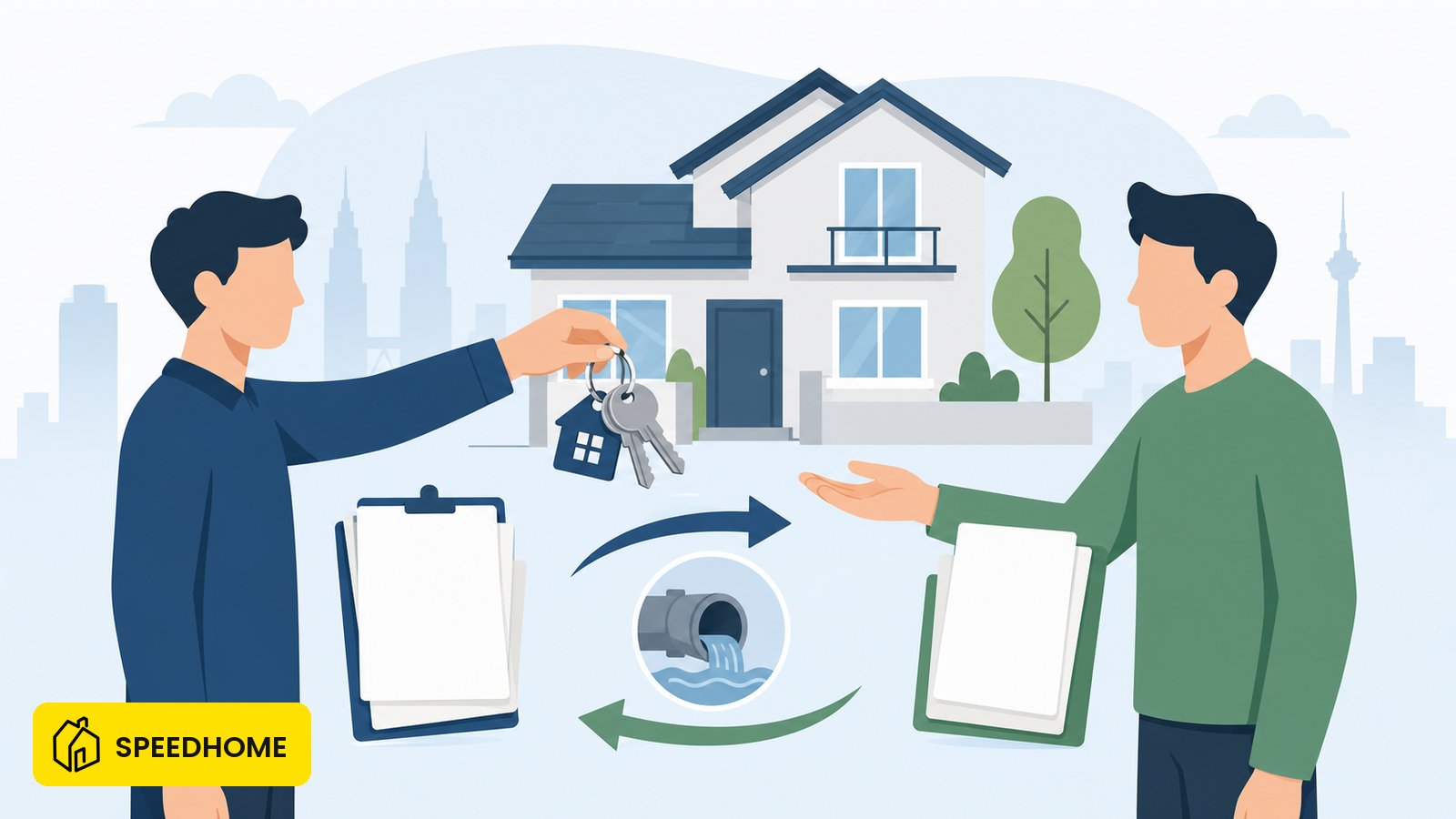
What happens to an IWK account and old arrears when selling a rental property in Malaysia?
Selling a rental property does not automatically close or transfer the IWK sewerage account — the seller has to notify IWK, and until that happens any unpaid balance stays exposed to the seller. IWK's own guidance says it no longer apportions outstanding amounts between an old and new owner, so a completed sale with an unsettled IWK balance can leave both sides with a dispute months or years later — the gap that produces the arrears letter landing on a landlord's desk long after a tenancy, or even a sale, has ended.
Most landlord confusion about IWK falls into two buckets: what happens to the account when the property changes hands, and why a bill for an old address, an old tenant, or a sold property shows up years later. Both trace back to the same cause — IWK bills the property, not the person living in it, and account changes are not automatic on a handover or a sale.
Does the IWK account close automatically when I sell the property?
No. IWK's guidance places the responsibility on the seller to notify IWK of the change of ownership, typically by submitting the relevant pages of the Sale and Purchase Agreement showing the parties, address and dates. Until that notification happens, the account can remain active in the seller's name, and Indah Water's domestic-customer guidance flags that owner or purchaser liability for outstanding charges can stay relevant even after a change of hands, so a seller should not assume completion alone settles the account.
Under section 169 of the Water Services Industry Act 2006, a person who sells a property remains liable for any recoverable amount that became payable to the sewerage operator before the transfer — and the same section lets the licensee pursue the purchaser too. That double-sided exposure is why "the lawyer will have sorted it" is not a safe assumption; an unsettled bill at completion is not neatly split, and working out who carries it requires a paper trail, not a phone call.
The practical sequence for a seller: request a final IWK statement before completion, settle any balance, and submit the ownership-change notification with SPA extracts so the account is re-registered rather than left dormant. A buyer's lawyer should confirm the IWK account is clear alongside the usual TNB and water provider checks — see the utility bills guide for how those transfers normally work.
Why did I get an IWK arrears letter years after the tenant left?
Because IWK bills the property owner, an old-dated arrears letter is not necessarily wrong just because it feels old — but it isn't automatically enforceable either. Civil claims for money owed are generally subject to the six-year limitation period under section 6(1) of the Limitation Act 1953, though that only matters if the person being chased actually raises it as a defence — limitation does not erase the debt on its own or stop IWK from writing to ask for it.
IWK issues bills every six months. If a bill from several cycles ago was never paid — missed during a change of tenant, a change of ownership, or an admin gap on IWK's side — IWK can still send a demand under section 88 of the Act, which lets it recover unpaid charges through civil action, with a certified statement of the amount serving as prima facie evidence. None of this requires the current occupant, or even the current owner, to have caused the shortfall — the debt sits on the account history.
What a landlord should do with an old arrears letter:
- Request an itemised statement from IWK — which billing cycles the amount covers, and the dates.
- Cross-check against your own ownership and tenancy dates. A cycle before you owned the property, or one already settled, is a legitimate dispute point.
- Escalate an unresolved dispute to SPAN, the water services regulator, if IWK customer service doesn't resolve it.
- Don't ignore the letter outright. Limitation has to be raised as a defence in court — it is not automatic, and charges remain payable within thirty days of billing under the Act.
For who is responsible for the IWK bill during an active tenancy — landlord versus tenant, and how a tenancy agreement clause changes that — see who pays the IWK bill in a Malaysian rental. This page covers the account-lifecycle gaps around a sale or a long-closed tenancy, not the day-to-day billing split.
Is the RM12-to-RM15 increase relevant to an old arrears letter?
It can distort the arithmetic. If a letter appears to charge RM15/month for cycles before 1 January 2026, that portion is wrong and worth querying — the higher rate only applies from that date.
The standard domestic sewerage charge moved from a lower pre-2024 legacy rate (roughly RM8/month — outdated, never the current rate) to RM12/month from 1 January 2024, to RM15/month from 1 January 2026 — the final phase of a schedule under the Water Services Industry (Sewerage Services Charges) Regulations 2022 and its 2025 Amendment. An itemised statement should show which rate applied to which cycle — if a demand simply multiplies today's RM15 rate across several years, that's worth challenging.
| Period | Standard domestic rate | Per 6-month cycle |
|---|---|---|
| Pre-2024 (outdated rate — do not cite as current) | ~RM8/month | ~RM48 |
| 1 Jan 2024 – 31 Dec 2025 | RM12/month | RM72 |
| From 1 Jan 2026 | RM15/month | RM90 |
Do septic-tank properties get IWK bills too?
Yes, just not the monthly connected-sewerage charge. A property on an individual septic tank (IST) skips the standard connected-sewerage rate, but the owner still has a statutory duty under section 65 of the Water Services Industry Act 2006 to have the tank desludged periodically — IWK cites roughly once every two years — and to grant IWK access, with a fine of up to RM50,000 on conviction for non-compliance.
Desludging is a chargeable IWK service, so IST owners do receive bills, tied to the desludging schedule rather than a monthly cycle. As of 2026, IWK's prescribed domestic desludging charge for a standard tank is RM192 per service (effective since October 2022) — roughly RM8/month averaged over a 24-month cycle within local authority areas, or a 36-month cycle outside those areas at roughly RM5.33/month per IWK's FAQ. An abortive-trip charge of RM80 applies if access fails or the tank turns out empty on the scheduled visit. A landlord selling or holding an IST property should confirm the last desludging date changed hands correctly in the handover paperwork — a separate check from the account transfer above.
Where does tenant versus owner liability sit through all of this?
Regardless of who is living in the property, section 67 of the Water Services Industry Act 2006 deems the owner, management corporation or occupier to have contracted with the sewerage operator the moment service is provided — so liability does not depend on a signed application. As between landlord and tenant, the account and the arrears trail follow the registered owner; a tenancy agreement can only shift reimbursement, not the underlying account relationship.
That matters for the arrears-letter scenario specifically: a tenant who left years ago is not IWK's target for an old balance on an account they never held — the letter goes to whoever was the registered owner for that billing period. A landlord managing several tenancy exits over the years should keep a simple log of IWK account status at each handover, so a demand years later can be checked against actual dates rather than disputed from memory. Two related gaps worth closing the same way: quit rent payable while overseas, and JMB minimum water charges in condos — bills that don't stop just because no one is watching them.
SPEEDHOME's managed tenancy framework records the utilities position, including IWK reimbursement where applicable, at move-in — a dated record to check an old claim against instead of reconstructing it later. Zero Deposit is SPEEDHOME's managed rental-risk system, not an insurance product, and it does not cover IWK charges directly; it protects against tenant-caused loss at end of tenancy through a documented claims process, while the IWK account remains the owner's responsibility through every sale and tenancy change. Landlords who want this handled as a system rather than an annual scramble can read more about SPEEDHOME's landlord tools.
FAQ
Does selling a property automatically close the IWK account?
No. IWK expects the seller to notify it of the ownership change, usually with SPA extracts showing the parties, address and dates. Until then the account can stay active under the seller's name, and IWK no longer apportions an outstanding balance between old and new owners — confirm the account is settled and re-registered as part of the sale, not after.
Can IWK come after me for arrears from years ago?
IWK can issue a demand for unpaid charges regardless of age, and can pursue recovery through civil action under section 88 of the Act. Whether a claim succeeds in court can turn on the six-year limitation period under the Limitation Act 1953, but limitation has to be raised as a defence — it does not automatically cancel the debt or stop IWK from writing to demand it.
I sold my property years ago — why is IWK still writing to me?
Most likely the ownership-change notification was never processed, or the arrears predate the sale and were never settled before completion. Request an itemised IWK statement showing the billing cycles in question, then compare those against your actual ownership period before assuming the letter is a mistake.
Is a septic-tank property exempt from IWK charges?
No. IST properties skip the monthly connected-sewerage charge but remain subject to IWK's desludging service and its statutory access requirements. As of 2026, the standard domestic desludging charge is RM192 per scheduled service.
Who pays IWK charges — the landlord or the tenant?
By default, the registered account holder — normally the landlord — since the account never transfers into a tenant's name. A tenancy agreement can shift reimbursement, but not who the account sits with. See who pays the IWK bill for the tenancy-level breakdown.
What should I check before buying a rental property with tenants already in place?
Ask for the seller's most recent IWK statement and confirm the account is being formally transferred, not left dormant. Combine that with the usual TNB and water provider checks, and if the property runs on a septic tank, ask when it was last desludged so you don't inherit an overdue compliance issue.
Accuracy note. This page is built on verified primary sources and a dated fact registry; figures are re-verified on each update. Spotted an error? Email [email protected] with this page's link.