
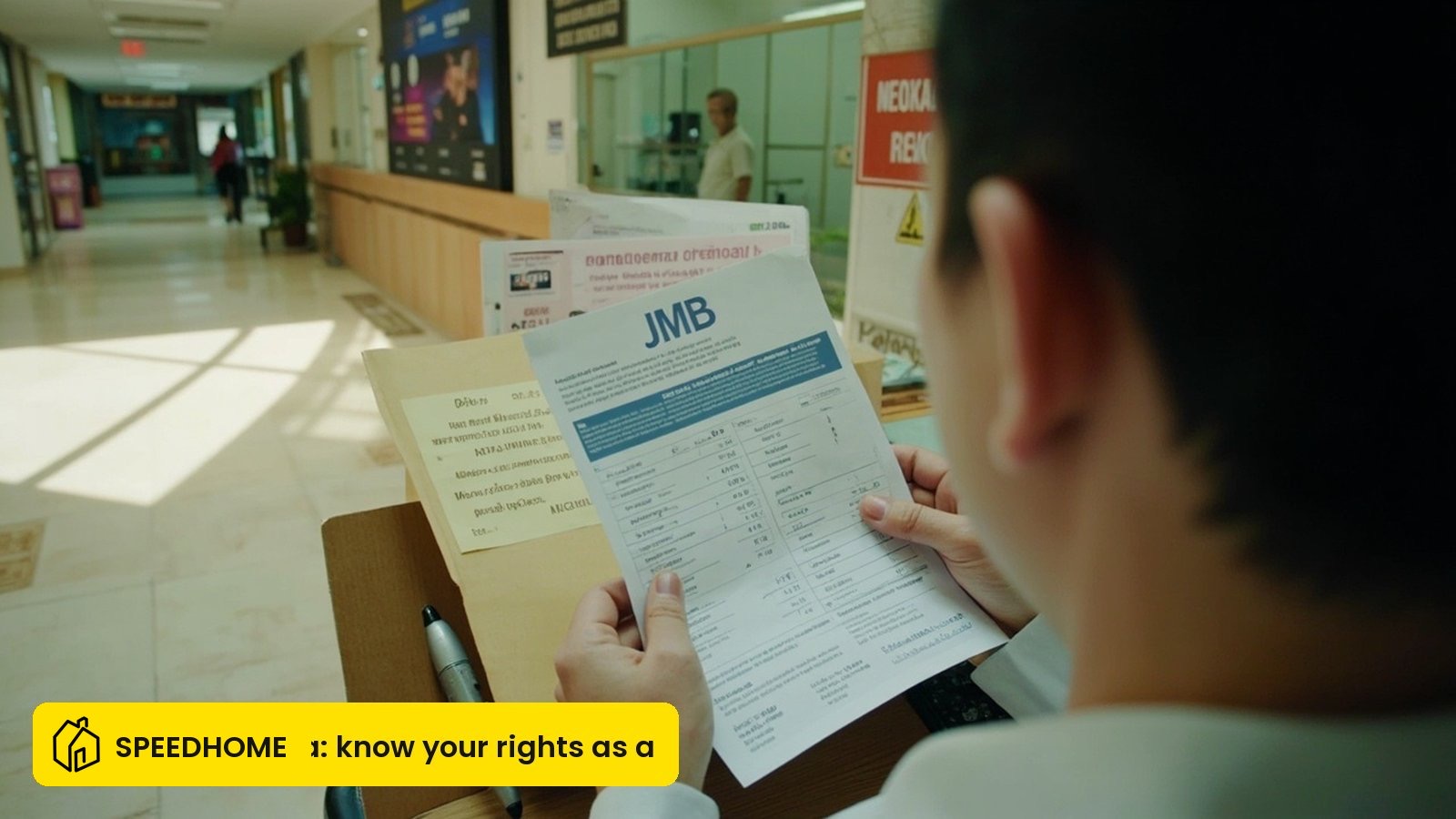
What is a JMB in Malaysia — and why it matters more when you rent out your unit
A JMB (Joint Management Body) manages a Malaysian strata building from developer handover until strata titles are issued. The Strata Management Act 2013 governs it: the JMB collects maintenance fees, manages common areas, enforces house rules, and deals with the registered owner — not your tenant.
The entire competitor field on this topic is written for homeowner-occupiers — "I live here and the management is ignoring my leak repair." That is not the landlord question. The landlord question is: "I have rented out the unit, my tenant is living there, and the JMB has just issued a demand notice in my name. What are my rights, what are my risks, and what can I do?"
This pillar answers that question from the legal basis up: what the JMB is, who the management body deals with at each stage of the building lifecycle, how maintenance fees and sinking fund contributions flow, what the management can legally do when fees are not paid, and the practical mistake that most landlord guides miss entirely.
For the deeper dispute guide including the access-card trap, Airbnb by-law issues, and Tribunal filing steps, see JMB Malaysia Condo — owner rights, fees and disputes explained.
The law that governs a JMB in Malaysia
The Strata Management Act 2013 (Act 757) creates and governs the JMB. It holds office from developer handover until the Management Corporation (MC) forms on strata title issuance. Both bodies share the same core obligations: collect charges, maintain common areas, and keep a sinking fund.
The Strata Management Act 2013 is the single statute that defines what a JMB can do, what it must do, and what it cannot do. The act sets the recovery process for unpaid maintenance fees, the jurisdiction of the Strata Management Tribunal, and the penalties for non-compliance on both sides — by owners and by the management body itself.
Three things the act makes clear that directly affect a landlord who rents out a condo unit:
- Maintenance fees and sinking fund are the owner's obligation. The JMB or MC bills the registered owner. Your tenant occupies the unit but is not a party to the management body's legal relationship with you.
- The recovery route for unpaid fees is statutory. Before the JMB can take legal action, it must serve a written demand giving the owner at least 14 days to pay. There is no legal basis for access-card deactivation or utility disconnection as a recovery mechanism.
- Disputes between the owner and the management body go to the Strata Management Tribunal, not to a landlord-tenant tribunal. Malaysia has no dedicated residential tenancy tribunal. Tenant disputes go to the civil courts.
JMB vs MC vs managing agent: who runs your building and when
The management body in your condo changes at one specific legal milestone: strata title issuance. Before that point it is a JMB; after that it is an MC. A managing agent is hired staff — it has no independent legal authority.
| Body | Stage | Governed by | Who they deal with |
|---|---|---|---|
| Developer | Pre-handover, first period after VP | Strata Management Act 2013 (preliminary period) | All owners |
| JMB (Joint Management Body) | Post-handover, before strata title issuance | Strata Management Act 2013 | Registered owners only |
| MC (Management Corporation) | After strata title issuance | Strata Management Act 2013 | Registered owners only |
| Managing agent or management office | Appointed by JMB or MC under contract | Contract with JMB or MC | Day-to-day operations — not the legal party |
Your tenant is an occupant. All demand notices, fee bills, and legal obligations attach to the name on the registered parcel record — that is you, the owner. The JMB or MC has no obligation to negotiate with your tenant or to redirect its legal actions because your tenancy agreement says the tenant pays the fees.
Who pays: maintenance fee and sinking fund owner liability
Both maintenance fee and sinking fund are billed to the registered owner under SMA 2013 s.25(1). A tenancy agreement can require the tenant to reimburse you, but it does not bind the management body. If the tenant stops paying, the arrears and penalties attach to you — not to them.
| Charge | What it funds | Who management bills | Can you pass it to the tenant via the TA? | Risk if tenant does not pay |
|---|---|---|---|---|
| Maintenance fee / service charge | Day-to-day common-area operations: security, cleaning, lifts, lobby utilities | Registered owner (billed by JMB or MC) | Yes, by written agreement in the tenancy agreement | Arrears and enforcement attach to the owner; the management body does not chase the tenant |
| Sinking fund | Long-term capital reserve: roof, major lift replacement, external repainting | Registered owner (billed by JMB or MC) | Normally stays with the owner; it builds building-level asset value, not tenant-level equity | Owner remains liable for arrears; the tenant's non-payment creates a shortfall in the owner's name |
The sinking fund minimum is at least 10% of the maintenance charge under the Strata Management Act 2013. Both accumulate as arrears and attract enforcement if unpaid.
For a detailed breakdown of each arrangement option, including sample tenancy agreement wording, see who pays the maintenance fee — landlord or tenant?.
The safest way to structure maintenance fees in the tenancy agreement
Bundle the maintenance fee into the rent and pay the management body yourself. This single step removes the most common maintenance-fee dispute pattern: the tenant pays the management office directly, payment lapses, arrears build in your name, and you discover the problem only when the demand notice arrives.
| Arrangement | Risk to owner | Visibility | Recommended? |
|---|---|---|---|
| Bundle into rent; owner pays management directly | Lowest | Full — owner controls one outgoing payment per month | Yes — default recommendation for most landlords |
| Tenant reimburses owner monthly; owner pays management | Medium | Partial — owner must collect from tenant before paying management; owner carries the timing gap | Acceptable if the TA states the exact amount, due date, and non-payment consequence |
| Tenant pays management body directly | Highest | Zero — owner has no visibility until an arrears notice arrives | Avoid — the JMB or MC has no obligation to alert the owner that the tenant has stopped paying |
If your current arrangement is the third type and the tenant stops paying, you face two simultaneous problems: a tenancy dispute over non-payment and a strata arrears demand in your name. The management body does not care about the tenancy side.
Step-by-step: what the JMB or MC can do when fees are not paid
Under SMA 2013 s.34(1), the management body must first serve a written demand giving the owner at least 14 days to pay. If still unpaid, it can claim at the Strata Management Tribunal, sue in court, or seize the owner's movable property via a warrant of attachment.
| Step | What happens | Legal basis |
|---|---|---|
| 1. Written demand | Management serves a written notice to the owner, giving at least 14 days to pay | SMA 2013 s.34(1) |
| 2. Strata Management Tribunal or civil court | Management files a claim at the Tribunal (for amounts up to RM250,000) or sues in the civil courts for larger amounts | SMA 2013 s.34(2); SMA 2013 s.105(1) |
| 3. Warrant of attachment | Management recovers the debt by seizing the owner's movable property via a court-issued warrant | SMA 2013 s.34(2) / s.35 |
| 4. Criminal offence | The owner who ignores a valid demand without paying or disputing commits an offence | SMA 2013 s.34(3) |
The management body does not have a statutory right to deactivate building access or disconnect water or electricity as a fee-recovery mechanism. Recovery runs through the Tribunal, the court, or the warrant process — not through access control or service interruption.
If you receive a demand notice: respond in writing within the 14-day window. Even if you dispute the amount, state your dispute clearly in writing. Silence converts a disputable fee into an uncontested admitted offence.
Penalties and what happens when you ignore a demand notice
Ignoring a valid written demand is an offence under SMA 2013 s.34(3) — a fine up to RM5,000 or up to 3 years imprisonment or both, plus up to RM50 per day while it continues. Under s.123, a management body that ignores a Tribunal award faces equally serious criminal penalties.
The daily accumulation matters. If the offence runs for 60 days before the owner responds, the continuing-offence element at RM50 per day reaches RM3,000 on top of the base fine. Combined with the underlying arrears and any legal costs, the financial exposure from silence is always greater than from contesting the demand in writing.
For the management body's side: failing to comply with a Strata Management Tribunal award is a criminal offence under s.123 — a fine up to RM250,000 or up to 3 years imprisonment or both, plus up to RM5,000 per day for a continuing failure to comply. Both sides have real enforcement exposure under the act.
The practical lesson: the demand notice starts a clock. Respond in writing — either with payment, or with a clear written dispute citing why the amount is not owed — before the 14-day window closes.
Worked example: the same arrears problem, two very different outcomes
An owner who responds to a demand notice in writing and documents the underlying management failure is in a fundamentally different legal and evidentiary position from one who goes quiet — even when the building problem is identical.
Landlord A owns a unit in Shah Alam. The management has failed to repair a leaking roof above the common corridor for three months, causing water ingress into the floor's corridor ceiling. Landlord A has sent written complaints by email — dated, referenced, with photos attached — and received no repair action. When a maintenance fee demand arrives, Landlord A pays it within the 14-day window and simultaneously sends a written notice to the management body asking for the repair to be completed within 14 days, citing the management's failure to maintain a common area as required by the act. When the repair is still not done, Landlord A files a Strata Management Tribunal claim for an order to repair and compensation. The claim is below RM250,000. The Tribunal schedules a hearing.
Landlord B has the same leak, the same broken promises from management. But Landlord B's written complaints are WhatsApp messages to the management office phone (no formal reference number), and Landlord B ignores the maintenance fee demand, reasoning that the management's failure "offsets" the debt. The management body issues an offence notice under s.34(3). Landlord B now faces criminal-offence exposure for the ignored demand and the same unresolved leak — but from a weaker evidential position. Offsetting an unliquidated repair claim against a liquidated fee demand is not a defence to ignoring the written demand.
The lesson: pay within the 14-day window or dispute in writing before it closes; keep every complaint formally dated with a written reference; and use the Tribunal as the escalation route, not silence or verbal pressure.
The access-card trap — why "tell management to block the card" backfires
If your tenant refuses to leave or pay, asking the JMB or MC to deactivate the tenant's access card is not a legal remedy — it is a self-defeating shortcut that can expose you to a counter-claim from the tenant for interference with their right to quiet enjoyment.
This is the move most landlord guides do not mention because they write for homeowner-occupiers, not for landlords dealing with a tenant who will not vacate. The access card in a strata development controls entry to the building and the floor — deactivating it prevents the occupant from entering the premises, which is the functional equivalent of locking the tenant out without a court order.
Self-help removal of a tenant is unlawful under Malaysian law. Asking the management body to act as the enforcement mechanism by cutting access compounds the problem: the tenant may have a counter-claim, and the management body that complies exposes itself as well. For house rules and preventive documentation before a tenancy starts — the stage where you avoid this problem entirely — see house rules landlords should set for tenants.
The lawful route if your tenant refuses to vacate or pay: a written demand, then court proceedings for vacant possession (Writ of Possession) and/or recovery of arrears (Writ of Distress), enforced by the court bailiff.
Which disputes go where: Strata Tribunal, civil courts, or small-claims
The Strata Management Tribunal hears owner-vs-management disputes up to RM250,000. Disputes between a landlord and a tenant over rent, deposits, or the tenancy agreement are private contract matters — the Strata Tribunal has no jurisdiction over them. This distinction is missing from every competitor guide in this cluster.
| Type of dispute | Correct forum | Key features |
|---|---|---|
| Owner vs JMB or MC — unpaid maintenance fees, by-law enforcement, management failures, sinking fund misuse | Strata Management Tribunal (SMA 2013 s.105(1)) | Claims up to RM250,000; cannot hear land-title disputes; non-compliance with award is a criminal offence |
| Landlord vs tenant — rent arrears, deposit, tenancy breach (up to RM5,000) | Magistrates' Court small-claims procedure | No lawyers required; capped at RM5,000 |
| Landlord vs tenant — rent arrears or deposit (above RM5,000) | Magistrates' Court or Sessions Court | Lawyer usually engaged; Sessions Court has unlimited jurisdiction for landlord-and-tenant actions |
| Serious management failure — fund misappropriation, refusal to hold AGM | Commissioner of Buildings (COB) referral + Tribunal or court | COB can investigate and direct the management body |
For a full walkthrough of filing a Strata Management Tribunal claim, see can a strata owner sue the JMB or MC in Malaysia?.
How SPEEDHOME helps keep JMB disputes from compounding your tenancy risk
SPEEDHOME's landlord platform does not represent you at the Strata Management Tribunal — only you can do that as the registered owner. What it does is keep the tenancy side clean: documented agreement, rent tracking, and tenant screening so a payment default does not arrive alongside a management fee demand.
The scenario that hits landlords hardest is not a JMB dispute on its own. It is a JMB arrears demand and a tenancy problem arriving simultaneously — a management demand notice on the same day a tenant goes quiet on rent. When both arrive together, neither resolves quickly, and the pressure to take shortcuts — like asking management to deal with the tenant — is highest precisely when shortcuts are most dangerous.
SPEEDHOME's platform keeps those two tracks separate. The tenancy agreement is documented and enforceable. Rent is tracked. If a JMB demand notice arrives, you deal with it from a clean position on the tenancy side — not from a compound dispute.
Zero Deposit is a managed rental-risk system, not a financial guarantee product. It replaces the upfront cash deposit; in the rare case of severe end-of-tenancy damage the recoverable amount can be limited. Not every unit qualifies.
If you want tenant screening, a documented tenancy agreement, and rent tracking from the start of the tenancy — so that JMB issues stay separate from tenancy issues — SPEEDHOME for landlords is where to start.
Frequently asked questions
What is a JMB in Malaysia?
A JMB (Joint Management Body) is the statutory management body formed under the Strata Management Act 2013 to run a strata building after the developer hands over the common areas but before individual strata titles are issued. It collects maintenance fees and sinking fund contributions, manages common areas, and enforces house rules. Once strata titles are issued, the JMB transitions to a Management Corporation (MC). As a landlord, your obligations to both bodies are the same.
Who is responsible for paying the JMB maintenance fee — the landlord or the tenant?
The landlord. Under section 25(1) of the Strata Management Act 2013, the maintenance fee is billed to the registered parcel owner, not the occupant. Any arrangement in your tenancy agreement for the tenant to reimburse you or pay directly does not bind the JMB or MC. If the tenant stops paying, the arrears and enforcement attach to you. The safest structure is to bundle the fee into the rent and pay the management body yourself.
What can the JMB do if maintenance fees are not paid?
Under section 34(1) of the Strata Management Act 2013, the management body must first serve a written demand giving the owner at least 14 days to pay. If still unpaid, it can file a claim at the Strata Management Tribunal (for amounts up to RM250,000), sue in the civil courts, or recover the debt by seizing the owner's movable property via a warrant of attachment. Ignoring the demand is a criminal offence: a fine up to RM5,000 or up to 3 years imprisonment or both, plus up to RM50 per day for a continuing offence.
What is the Strata Management Tribunal and when can an owner use it?
The Strata Management Tribunal hears disputes between strata owners and management bodies — unpaid maintenance fees, common-area maintenance failures, by-law enforcement disputes, and sinking fund misuse — where the claim does not exceed RM250,000 (SMA 2013 s.105(1)). You can file without a lawyer. It is not a landlord-tenant forum: disputes between you and your tenant over rent or deposits belong in the civil courts.
Can I ask management to deactivate my tenant's access card to make them leave?
No. The Strata Management Act 2013 does not give a JMB or MC a statutory right to deactivate a resident's access card as a debt-recovery or eviction mechanism. If you request it as a way to pressure your tenant out, you may expose yourself to a counter-claim from the tenant for unlawful interference with their right of occupation. The lawful route to recover possession from a tenant who will not vacate is through the civil courts, not through access control.
What is the difference between a JMB and an MC?
Both manage a strata building under the Strata Management Act 2013. The difference is the stage of the building's title history: a JMB exists from after the developer hands over the common areas until individual strata titles are issued to all parcel owners. Once strata titles are issued, the JMB is replaced by an MC. As an owner who rents out a condo unit, your maintenance fee obligations, sinking fund obligations, and exposure to the management body's enforcement powers are the same under either body.
Can the JMB ban Airbnb or short-term lets in my condo?
Yes, if the building's by-laws say so. In Innab Salil & Ors v Verve Suites Mont' Kiara Management Corporation [2020] 6 MLRA 244, the Federal Court confirmed that a management corporation may pass a binding by-law prohibiting short-term letting, treating those lettings as licences rather than tenancies that fall outside the owner's protected dealing rights. The ruling applies to buildings that have passed such a by-law — it is not a national ban. Whether short-term letting is permitted in your specific building depends on that building's own by-laws. Check with the JMB or MC before listing on any short-stay platform.