
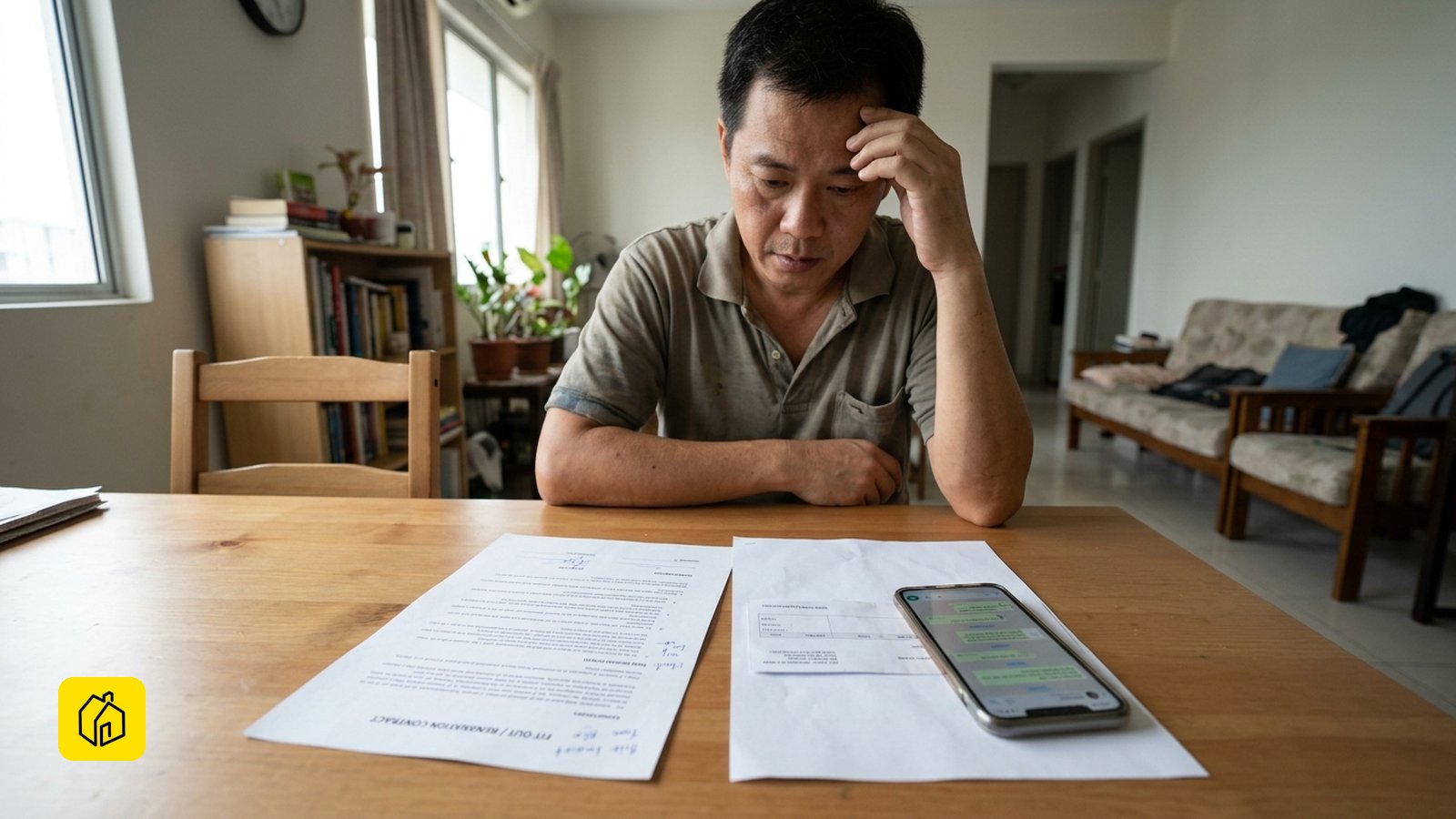
Most "kaki kapur" deposits are never fully recovered — that is the honest answer. The three right next moves are easy: secure the paper trail, file a police report, and send a formal demand letter. The bigger the paper trail built in the first 24 hours, the stronger the position for a small-claims or magistrates' court claim later.
Contractor took your deposit and disappeared — what now?
Recovery is hard. The honest answer is: most "kaki kapur" deposits are not fully recovered. But the next three right moves are easy — secure the paper trail, file a police report, send a formal demand letter — and each one makes the next stage stronger, including the small-claims or magistrates' path if the amount justifies it. The bigger the paper trail you build in the first 24 hours, the better the position for a civil-court claim later. None of this is a guarantee; it is the staged process a landlord can still run after the deposit walks.
What "kaki kapur" looks like, in plain language?
A "kaki kapur" event is a four-step pattern: a contractor takes a deposit (often 10–30% of the contract value), pushes the start date back once, pushes it back again, then stops answering messages. The deposit is the loss; the unreturned calls are the confirmation. This is the after-deposit-moves half of the contractor-fraud problem — the before-deposit half is the CIDB check, which would have caught the obvious fakes but does not stop a registered contractor from walking with the deposit. The shape is consistent: a low quote, a pressure to pay quickly to "lock in the price," a vague start date, then silence.
The four steps usually look like this:
| Step | What the contractor does | What is actually happening |
|---|---|---|
| 1. Quote accepted, deposit paid (often 10–30% of contract) | Pushes for bank transfer, claims price is "only valid this week" | The contractor now holds the landlord's money before any work |
| 2. First start-date slip | "Materials delayed," "site still being cleared," one or two more days | The contractor is using the deposit, not mobilising for the job |
| 3. Second start-date slip | Replies slow down, excuses get thinner, calls go to voicemail | The contractor is no longer committing time to this job |
| 4. Phone off, address empty | Number off, WhatsApp last seen days ago, address is a co-working mailbox or empty shop | The deposit is gone; recovery is now the only path |
The deposit — RM1,500 to RM10,000 on a typical RM15,000–RM30,000 fit-out — is the lost amount. The work that was supposed to follow is the lost time. The point of the next sections is to stop the paper trail from going cold, because every later stage (police report, demand letter, small claims) depends on it.
What paper-trail sequence follows a contractor default in 24 hours?
This is the table no landlord guide in Malaysia productises — the staged sequence a landlord can still run in the first 24 hours after the contractor stops answering, with what each step actually produces for the next stage. Run the steps in order. Each one makes the next stronger.
| What just happened | What to do in the next 24 hours | What to do in the next 7 days | What the realistic recovery looks like |
|---|---|---|---|
| Contractor took a 10–30% deposit, slipped the start date twice, and has stopped answering | Screenshot every WhatsApp message, save the bank-transfer receipt, save the contractor's quote and any signed agreement. Put all four in one dated folder — call it the "evidence pack." Do not delete the thread. | Send a formal demand letter by registered post (Pos Malaysia) AND a clear timestamped WhatsApp with read receipt. Both are paper trails; the post is the stronger one in court. | A clean evidence pack + a registered-post demand letter is the position a small-claims or magistrates' filing rests on. Without it, the filing has nothing to attach. |
| The contractor is CIDB-registered but has stopped answering | Note the contractor's name, registration number, and the date they last replied. Check the CIDB register one more time — if the registration is still active, the complaint is real. | File a written complaint with CIDB against the contractor's registration. CIDB cannot recover the deposit, but a recorded complaint is a public paper trail other landlords can see. | A CIDB complaint is not a recovery tool; it is a slow, public pressure tool. A repeat-offender contractor builds up complaints. |
| The deposit is under RM5,000 and the contractor is unresponsive | Do nothing more for 24 hours; the evidence pack and the demand letter are the priority. | After the 7-day demand letter window has passed with no payment, file a small-claim in the Sessions Court (the small claims procedure covers claims up to RM5,000). | Small-claim filing fees are low (around RM30–RM100 depending on the claim amount). The barrier is evidence, not filing cost. |
| The deposit is over RM5,000 and the contractor is unresponsive | Same as above for the first 24 hours. | After the 7-day demand letter window has passed, the path is the magistrates' court (for claims up to RM100,000 in contract disputes). | Magistrates' court is slower, more formal, and the contractor may simply not turn up. A default judgment is more likely than a recovery cheque. |
| The contractor's number is off, address is empty, and there are no assets to attach | A police report (PDRM) is a paper trail, not a recovery guarantee. The report is filed at the nearest balai polis. | The report number is the second piece of paper — used in the small-claim filing and the CIDB complaint, not as a separate recovery path. | A PDRM report does not, on its own, lead to a refund. It supports the civil-court path and the CIDB complaint. |
The honest read: most "kaki kapur" deposits are not fully recovered. The point of the staged process is to build a paper trail that prevents the next one, not to make this one whole.
What to do in the next 7 days: the formal demand letter?
The single most important paper-trail move after the evidence pack is a formal demand letter sent by registered post, with a duplicate WhatsApp as a backup. This is the document a small-claims or magistrates' filing will rely on later — a filed claim without a prior demand letter is much weaker. The demand letter does three things: it gives the contractor a final chance to pay; it sets a clear deadline (usually 14 days from the date of the letter); and it creates a dated, stamped, third-party-receipted record that the landlord asked for the money back before filing.
The minimum contents the letter must carry:
- The contractor's full business name and address, the date of the original quote, and the deposit amount (in RM, with a copy of the bank-transfer receipt attached)
- The agreed start date and the number of times it slipped, with dates if possible
- A clear statement: "Please return the deposit of RM ___ within 14 days of this letter"
- The landlord's name, IC number (last four digits only — for safety), the property address, and a contact number
- A line that says "I will file a small claim / magistrates' claim if the deposit is not returned by [date]"
- Sent by Pos Malaysia registered post, with the tracking number saved. The tracking number is the proof the letter was sent; the receipt of delivery is the proof the contractor received it.
The duplicate WhatsApp is not a substitute — it is a backup. A WhatsApp message can be deleted, edited, or screenshot-out-of-context. A registered-post receipt cannot. Save the Pos Malaysia tracking number and the delivery confirmation in the same evidence pack as the bank transfer and the WhatsApp screenshots.
What to do in the next 30 days: small claims and magistrates' court?
The civil-court path is the only realistic recovery tool once the demand-letter window has passed. The right court depends on the deposit amount: claims up to RM5,000 go to the Sessions Court under the small-claims procedure; claims above RM5,000 go to the magistrates' court (for contract disputes up to RM100,000). The small-claims procedure is faster, cheaper, and more informal than a full magistrates' filing — filing fees are low (around RM30 to RM100), no lawyer is required, and the hearing is short. The magistrates' court is more formal and takes longer, but it is the only path above RM5,000.
Both paths run on the same evidence: the demand letter, the bank-transfer receipt, the WhatsApp screenshots, the contractor's quote, and (if filed) the police report number. Without the demand letter, the court will usually ask "did you ask for it back first?" — the answer needs to be yes, on the record. With it, the hearing is short and the position is clean.
A practical note for the larger and the corporate defendant: above RM5,000, or when the contractor is a registered company rather than a sole trader, a 30-minute paid consultation with a contract-disputes lawyer is a small cost against the deposit, and a much smaller cost than filing a claim in the wrong court. The procedural steps for filing against a company differ from filing against an individual, and the small-claims procedure is not always the right fit for a company defendant. SPEEDHOME does not draft filings, but the SPEEDRENO fit-out path is the structurally safer alternative if the job has not yet started.
What the realistic recovery looks like?
The honest answer: most "kaki kapur" deposits are not fully recovered. The point of the staged process is to build a paper trail that makes the civil-court filing clean, makes the CIDB complaint real, and prevents the next contractor from doing the same thing — not to make this loss whole. A landlord who runs the full sequence (evidence pack, police report, demand letter, small-claim filing) has a defensible position. A landlord who has all four documents usually recovers a portion of the deposit — frequently through a default judgment that the contractor never pays because there is nothing to attach. A landlord who has only the WhatsApp thread usually gets a sympathetic hearing and a quiet dismissal.
The pattern is well-known. The practical recovery rate for deposit-theft cases against disappearing contractors is low; the value of the staged process is not in this deposit, it is in the next one. A CIDB complaint and a published small-claim judgment make the same contractor harder to recruit for the next landlord. That is the realistic recovery — the paper trail outlives the loss.
How to prevent the next one: staged payments, milestone-tied
The protection that actually works is splitting the payment into stages tied to work milestones, not handing over a single large deposit. The contract should specify a small mobilisation sum on signing, a larger stage payment after materials arrive on site, the bulk on practical completion, and a final retention sum held for the defects-liability window. A contractor who insists on a single large deposit upfront is asking the landlord to carry 100% of the risk for 0% of the work done. This is the protection that has to be written into the contract before the deposit moves, not negotiated after.
A defensible staged-payment pattern:
- 10% mobilisation on signed contract — small enough that, if the contractor walks, the loss is contained
- 30% on materials-on-site — verified by a photo of the materials at the address
- 50% on practical completion — verified by a joint walk-through
- 10% retention, released after the defects-liability window (typically 30–60 days for a fit-out) — verified by no defects reported in that window
A genuine contractor will accept this pattern because their materials supplier and their track record cover their working capital. A contractor who refuses staged payments, or who insists on a 30–50% deposit upfront, is signalling that they cannot fund mobilisation without the landlord's money. That signal is the warning.
SPEEDRENO's fit-out model does not start with a deposit in the contractor's hand
The fit-out service is the platform fit-out arm for landlord vacant-unit and listing-stage work, and the fit-out model is built on staged payments tied to work milestones — not a single large upfront deposit. the fit-out service starting cost band is RM16,000–RM20,000 all-in, calibrated to the RM2,000–RM6,000 rent band (the platform data, Q1 2026). The fit-out service does not replace a CIDB check, and it does not eliminate the need for the landlord to read the contract. It removes the specific failure mode that this page is about: the deposit that walks out in one move before any work starts.
SPEEDRENO is not the only path a landlord can take. A landlord who already has a CIDB-registered contractor they trust, and who has negotiated a milestone-tied payment schedule into the contract, can run the job outside SPEEDRENO. The point is not that SPEEDRENO is the only answer. The point is that the SPEEDRENO fit-out model is built so the landlord does not start by handing over a deposit that the contractor can walk away with — and that is the structural fix for the "kaki kapur" pattern, not a legal claim after the loss.
| What the SPEEDRENO fit-out model does | What it does NOT do |
|---|---|
| Stages payments to work milestones; the landlord's money trails the work | Replace a CIDB check; the supervising contractor is still on the public register |
| Coordinates CIDB-registered trades across the fit-out scope (tile, paint, electrical, plumbing surface) | Cover structural works, hacking, or design-led owner-stay renovation |
| Holds a retention sum through the defects-liability window | Guarantee the deposit of a separate contractor the landlord hired outside SPEEDRENO |
| Issues a single, dated, landlord-facing contract that names the milestones | Act as a recovery service for a "kaki kapur" loss that has already happened — that is the civil-court path on this page |
So, which path should you take?
If the deposit has already walked, run the staged paper-trail sequence on this page — evidence pack, police report, demand letter, small-claim filing — and for a deposit above RM5,000 or a corporate defendant, pay for a 30-minute contract-lawyer consultation before filing. If the job is a tenant-ready fit-out for a vacant unit and the deposit has not yet moved, the structurally safer path is the fit-out service through the platform — staged payments, CIDB-registered trades, retention through the defects window. Start the fit-out service path here with the unit address, the target rent band, and the current condition note ready. If you have not yet hired the contractor and want to run the check before any deposit moves, see the CIDB contractor check — it is the 2-minute filter that would have caught the obvious fakes. For a single-trade repair during a tenancy, the the repair service path is the relevant arm, not the fit-out arm.
SPEEDHOME is one option worth comparing alongside the routes above.
FAQ
Will a police report (PDRM) get my deposit back?
No, on its own. A police report is a paper trail — it records the loss, gives the matter a report number, and supports the small-claim or magistrates' filing. PDRM does not typically investigate contractor-deposit disputes as a criminal matter unless there is clear evidence of fraud from the start (a fake company number, a false CIDB certificate, an identity that does not exist). The realistic path to recovery is civil court, not the police report. File the report because the report number strengthens the civil filing, not because the police will recover the money.
How long do I have to file a small claim?
The standard limitation period for a contract claim in Malaysia is six years from the date the cause of action arose. For a deposit-theft case, the clock starts on the date the contractor was supposed to start work and did not — or, more cleanly, the date the demand letter expired without payment. The practical answer is to file within 30–90 days of the demand letter expiring, while the evidence is fresh and the WhatsApp screenshots still match the contractor's last-seen timestamp. Waiting two years to file is legally allowed but practically much weaker.
Do I need a lawyer for a small-claim filing?
For claims up to RM5,000 in the Sessions Court small-claims procedure, no. The procedure is designed to be used without a lawyer; the forms are short, the filing fees are low, and the hearing is informal. For claims above RM5,000 in the magistrates' court, a lawyer is not required by law but is usually a good idea — the procedure is more formal, the contractor may be a registered company (not an individual), and the cost of getting the filing wrong is much higher than the cost of a 30-minute consultation.
What if the contractor was a "direct" contact — no company, no contract, just WhatsApp?
The position is weaker but not hopeless. The WhatsApp thread is the contract. The bank-transfer receipt is the evidence of payment. Save everything — the original quote (even a one-line WhatsApp message naming the price is enough), the agreed start date, every follow-up, every missed call. File the police report, send the demand letter (by registered post to the contractor's last known address — if you do not have one, send to the address on the bank-transfer record or the IC number on the transfer reference), and proceed to the small-claims filing. The "no formal contract" framing actually helps in one way: the small-claims procedure is built for low-value disputes without a lawyer, and a clear WhatsApp trail is exactly the kind of evidence it is designed to handle.
Can I post a public review naming the contractor?
Yes, with care. Stick to facts: the contractor's name, the date, the deposit amount, the date they stopped replying. Do not call them "a cheat" or "a criminal" — those are opinions that can draw a defamation claim, and the civil-court filing is the cleaner place to make the legal point. Public reviews on Google, Facebook, or contractor platforms do have an effect: a contractor with several visible complaints will struggle to take the next deposit. The CIDB complaint is the formal version of the same pressure, and it sits on the contractor's public record.
If the contractor was CIDB-registered, does CIDB refund the deposit?
No. CIDB is the construction industry register; it regulates who is allowed to do construction work, not who refunds deposits. A CIDB complaint against the contractor's registration is a public record, can lead to a suspension or a non-renewal if the complaints are serious and repeated, and is a useful pressure tool — but it is not a refund mechanism. The refund, if there is one, comes from the civil-court path.