
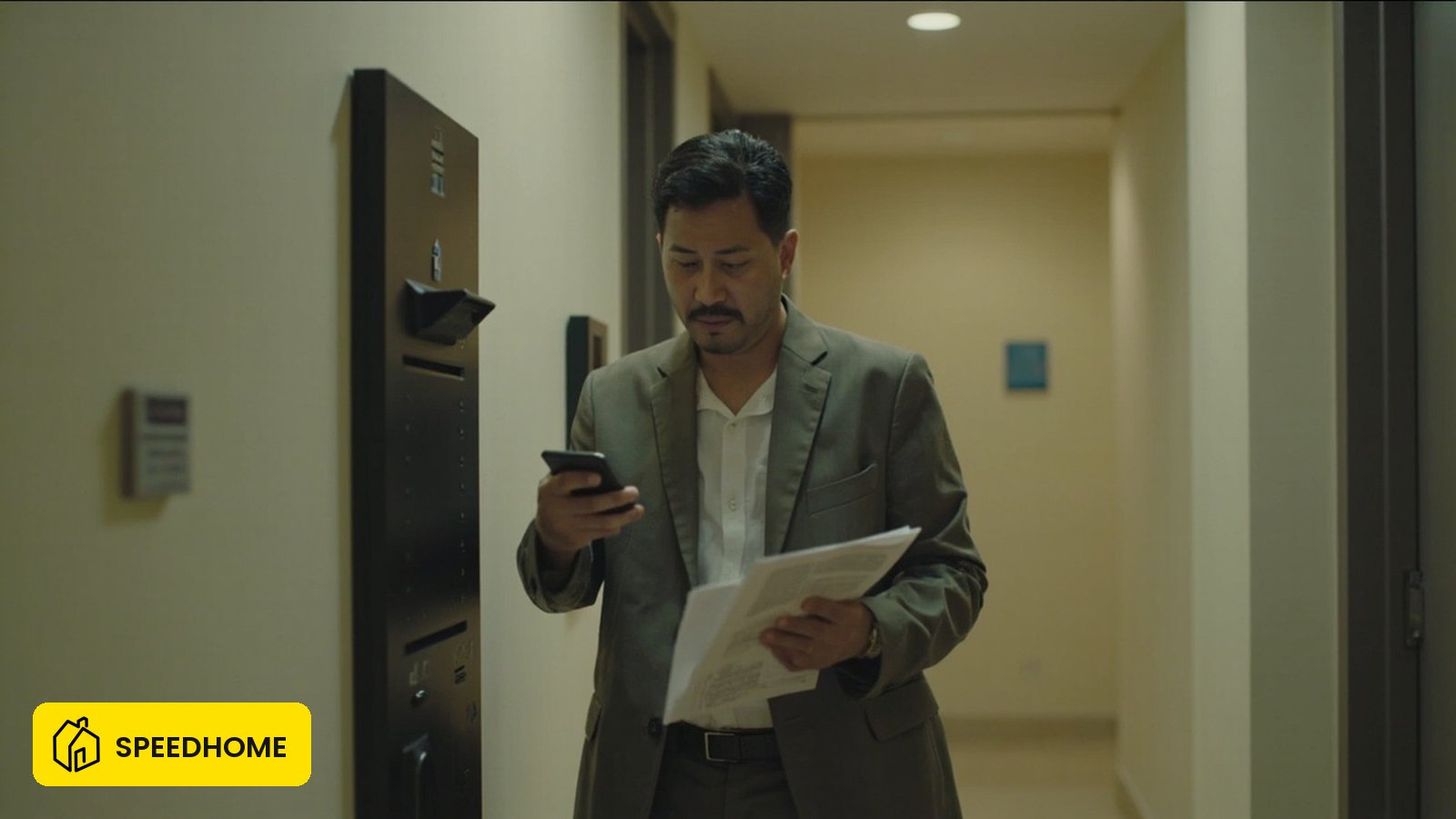
A landlord in Malaysia cannot lawfully change your locks, deactivate your access card, or block the building's lift or gate to push you out of your home. Any of these is self-help eviction, and under section 7(2) of the Specific Relief Act 1950 a landlord must recover possession through the courts — never by private force, pressure, or by using the management office as a private enforcement arm. When the block comes from the JMB/MC side rather than the landlord directly — gate tags, lift access, card deactivation at strata level — see tenant rights if a strata building blocks access.
This holds whether the deprivation is a physical lock change or a digital one — an access card disabled at the condo management system, a smart-lock password revoked, or a parking barrier blocked against your vehicle. The technology does not change the law. Your right to quiet enjoyment of the home is the same whether you enter with a metal key, a tap card, or a fingerprint. On SPEEDHOME's managed platform, the average time from a tenant's first rental default to recovery action is about 31 days — because access is never used as leverage; evidence, notices, and escalation are handled as a documented process instead.
Lockouts and access disputes — 2026 snapshot (figures current as of 2026-10):
| Item | 2026 figure / status |
|---|---|
| Court forum for a money claim up to RM5,000 | Magistrates' small-claims procedure (Order 93), no lawyer needed |
| Court forum for a money claim up to RM100,000 | Magistrates' Court |
| Court forum for a money claim up to RM1,000,000 (landlord-and-tenant and distress: unlimited, s.65(1)(a)) | Sessions Court |
| Tenancy agreements managed by SPEEDHOME across Malaysia | Over 30,000 tenancy agreements |
Is it legal for my landlord to change my locks or access card while I still live here?
No. Whether the deprivation is a changed padlock, cancelled access card, or blocked smart lock, it is unlawful self-help eviction. A home can only be recovered through a court order, enforced by the court bailiff — not by the landlord, and not by management acting on the landlord's behalf.
The rule does not turn on what device was used. A tenant who enters with a key card, a biometric reader, or an app-based lock enjoys the same protection as a tenant with a brass key. "Changing the access credential" is legally indistinguishable from changing a barrel lock when the purpose is to deny entry to a sitting tenant. The legal anchor is section 7(2) of the Specific Relief Act 1950: a landlord cannot recover possession by self-help and must use the lawful route.
This is true even if you are behind on rent, have stayed past your tenancy end date, or are in a dispute about damage. A rent disagreement is a money claim; getting the unit back is a court-led possession issue. They are separate problems, and the landlord cannot collapse them into a single private lockout. The landlord's lawful remedy is a written demand, then court action — a Writ of Possession to recover the unit and, where rent is owed, a Writ of Distress to recover arrears — enforced by the court bailiff, not personally.
Malaysia has no Residential Tenancy Act in force as of 2026 — the proposed RTA remains a draft Bill that has not been tabled or gazetted — so residential tenancies are governed by the tenancy agreement together with general law (Contracts Act 1950, Civil Law Act 1956, Specific Relief Act 1950) and the ordinary courts. For the full lockout explainer, read the companion guide on landlord changed the locks while I still live here.
The law and the process: how access deprivation is treated
Malaysian law treats every form of access deprivation — a physical lock change, a deactivated access card, a revoked smart-lock code, a blocked parking barrier — as one thing: an attempt to recover possession outside the court process. The lawful process is demand, then court order, then bailiff enforcement.
The landlord's only lawful route, if you have breached the tenancy, is the civil process. A written demand comes first. If the breach is not remedied, the landlord may file for possession and, separately, for arrears. The court decides; the bailiff enforces. At no point may the landlord, or a building manager acting on the landlord's instructions, take access away from you directly.
There is no shortcut forum for this. Malaysia has no dedicated residential tenancy tribunal. A private residential tenancy dispute is decided by the ordinary civil courts: the Magistrates' small-claims procedure for claims up to RM5,000 (no lawyer needed), the Magistrates' Court up to RM100,000, the Sessions Court from RM100,000 to RM1,000,000 (and with unlimited jurisdiction for landlord-and-tenant and distress actions), and the High Court above that. The Tribunal for Consumer Claims does not hear a private residential tenancy dispute, because a tenancy is an interest in land and a deposit or possession claim falls outside its jurisdiction.
For the landlord-side view of the same rules, see can a landlord change locks or cut water in Malaysia, and for the court-recovery mechanics, the eviction laws in Malaysia guide.
Step-by-step: what to do if your locks or access card were changed
The first move is never to force entry or confront the landlord. It is to document the denial of access, file a police report, and build a dated evidence trail — then put a written demand to the landlord before any legal escalation.
| Step | What to do | Evidence to keep | Why it matters |
|---|---|---|---|
| 1 | Photograph the changed lock or blocked reader, then document the denial in writing to yourself (date, time, what failed) | Dated photos; timestamped note | Captures the lockout before anything else moves |
| 2 | Ask the management office in writing why the card or lock stopped working, so you separate a real lockout from a system fault or fee issue | Dated screenshot of failed tap; written reply from management | A genuine lockout and a card glitch require different responses |
| 3 | Do not force the door, damage the new lock, or illegally clone a card | Photo of the changed lock / blocked card reader, dated | Keeps your own conduct clean; you stay the wronged party |
| 4 | File a police report logging the denial of access and naming the landlord | Police report reference number and stamped copy | Creates a third-party, dated record that access was denied |
| 5 | Send a written demand to the landlord (WhatsApp + email) asking for restored access within a set deadline | Sent message, read receipts, landlord's reply or silence | Shows you tried to resolve it; most disputes settle here |
| 6 | If access stays denied, seek legal advice on a possession / re-entry claim and, if needed, an interim court order | Lawyer's letter, court filing reference | Court action is the only lawful way to force restoration |
| 7 | If rent was the underlying trigger, keep paying (or hold it in a separate account with proof) and document everything | Bank records, payment offers in writing | Stops the landlord building a counter-claim for arrears |
The companion hub on tenant not paying rent in Malaysia maps the lawful options for both sides when rent is the friction underneath the access dispute.
Who is protected and who pays: your eligibility and costs?
Every lawful tenant with a current tenancy is protected from self-help access deprivation, regardless of whether the tenancy agreement is stamped. Stamping affects how easily the agreement is used as evidence, not whether you have the right to occupy the home.
| Question | Answer |
|---|---|
| Am I protected if my agreement is not stamped? | Yes. An unstamped agreement is harder to admit as evidence and may attract a stamp-duty penalty, but it does not erase your right to occupy lawfully or give the landlord a lockout right. |
| Does it matter that I entered with an access card, not a key? | No. A digital lock, access card, biometric reader, or app-based lock carries the same protection as a physical lock when used to deny a sitting tenant entry. |
| Am I protected if I owe rent? | Yes. Rent arrears give the landlord a money claim and a route to court-ordered possession — not a private lockout. Your right to quiet enjoyment survives a payment breach. |
| Can the management office block my card for the landlord? | No. Management should not act as the landlord's private enforcement arm. If asked, request the instruction in writing and treat the block the same as a lockout. |
| Can the landlord block the card for unpaid maintenance charges owed by the unit owner? | No. Under the Strata Management Act 2013 a management body recovers unpaid charges by written demand, court action, or warrant of attachment — not by blocking a tenant's access. The tenant is not the party that owes. |
| Who pays if I had to stay elsewhere during the lockout? | Proven losses caused by an unlawful lockout (hotel costs, rehousing, belongings) can form part of a civil claim against the landlord; keep receipts and a clear ledger. |
| Is there a tribunal I can file at directly? | No dedicated tenancy tribunal exists. Claims up to RM5,000 use the Magistrates' small-claims procedure; possession and larger disputes go through the civil courts. |
Penalties and risk: what the landlord is exposed to, and the risk to you
A landlord who denies access to a sitting tenant risks a civil claim for re-entry and damages, and can damage their own position in any later possession case. Your risk lies in widening your breach — by stopping rent or forcing entry — so keep your conduct clean.
The landlord's shortcut backfires in three ways. First, an unlawful denial of access can become a separate cause of action against the landlord — a claim for re-entry, for the value of any belongings affected, and for proven rehousing costs. Second, a court asked to order possession later may look unfavourably on a landlord who already took the law into their own hands; the landlord's own conduct becomes evidence. Third, where the landlord used the management office to block a card, that instruction in writing can be disclosed and used against the landlord.
Your risk runs the other direction. The two mistakes that weaken a tenant's otherwise strong position are forcing entry (damaging the new lock or door) and unilaterally stopping rent. Both hand the landlord a counter-narrative. The safer move is to photograph the changed lock or blocked reader, file the police report, pay or ring-fence the rent with proof, and let the written demand and legal process run.
What does the worked example on a deactivated access card after a rent dispute show?
A tenant two weeks behind on rent finds the condo lift card and smart-lock code reset on arrival. The lawful response is to document, file a police report, send a written demand, then escalate through the courts if access stays blocked — never to force the door or retaliate.
The tenant photographs the failed lift tap and the reset lock, asks the management office in writing why access was blocked, and files a police report logging the denial of access. They send the landlord a written demand restoring access within 48 hours, attach the rent ledger, and — because the rent was genuinely owed — keep paying or hold the rent in a separate account with proof rather than spending it. The management office's written reply, if it shows the landlord requested the block, becomes the key evidence. If access stays denied, the tenant takes the police report, the management reply, the demand trail, and the agreement to a lawyer for a possession / re-entry claim. At no point does the tenant force the door, clone a card, or stop paying rent, because clean conduct is what keeps the landlord's lockout the only unlawful act in the file.
What is the lawful path, and where does SPEEDHOME fit in?
The lawful path is always the same: document the denial of access, file a police report, send a written demand, and escalate through the courts if access is not restored. Never force entry, and never stop paying rent without advice.
On a managed SPEEDHOME tenancy, the conditions that push landlords toward access-as-leverage are designed out before they start — screening, stamped agreement, rent records, and escalation discipline sit in place from day one.
Most access-deprivation moments appear after the landlord has already lost control of the file — a weak agreement, a messy rent ledger, no documented notices, no third party in the room when friction builds. SPEEDHOME's process puts tenant screening, a stamped tenancy agreement, rent records, and escalation discipline in place from day one, so the landlord has a clean route to recovery that does not run through your front door. Two operator data points sit behind that process: SPEEDHOME has managed over 30,000 tenancy agreements across Malaysia, and SPEEDHOME platform data (2026, most recent measured period) shows The first number is the breadth of the file base — the more agreements run through a single documented system, the more the pattern of "dispute becomes lockout" gets surfaced and routed before it ever reaches a changed lock. The second is the filter at intake: rejecting problematic applicants before the agreement is signed is what removes the most common trigger for access-as-leverage, which is a tenant the landlord wishes they had never accepted. That does not mean disputes never happen on a managed tenancy; it means the structural pressure toward an unlawful lockout is materially lower, and when friction does appear there is a documented process and an intermediary before it reaches the courts.
If your current situation involves a deposit or end-of-tenancy dispute layered on top of the access problem, remember Malaysia has no statutory deposit cap and no statutory refund deadline — the tenancy agreement governs. If you are weighing your next move rather than fighting a lockout, you can browse verified rentals on SPEEDHOME where tenancies are documented and access is never used as leverage.
FAQ
Can my landlord lock me out while I still live there?
No. Denying a sitting tenant entry — by changing the lock, resetting a smart-lock code, deactivating an access card, or blocking a parking barrier — is unlawful self-help eviction. Under the Specific Relief Act 1950 s.7(2) the landlord must recover possession through the courts.
Can the condo management block my access card if the landlord asks?
No. Management should not act as the landlord's private enforcement arm. Ask for the instruction in writing, file a police report logging the denial, and treat a management-directed block the same as a landlord lockout.
Is it still illegal if I owe rent?
Yes. Rent arrears give the landlord a money claim and a route to court-ordered possession; they do not give a right to lock you out. The landlord's remedy is a written demand followed by court action, not private pressure.
Can the management block my card for unpaid maintenance fees?
Not against you. Under the Strata Management Act 2013 unpaid maintenance charges are recovered from the parcel owner by written demand, court action, or warrant of attachment — not by blocking a tenant's access. The tenant is not the party that owes.
Is there a tenancy tribunal I can file at?
No. Malaysia has no dedicated residential tenancy tribunal. Claims up to RM5,000 use the Magistrates' small-claims procedure (no lawyer needed); possession and larger disputes go through the civil courts.
Can I stop paying rent in response to a lockout?
Withholding rent is risky and can widen your own breach. Keep paying, or hold the rent in a separate account with proof and document it, then seek legal advice before treating the tenancy as repudiated.
What is the single most important thing to do first?
Buy yourself a safe night first — a friend, family, or a short-stay — so you do not act out of panic. Then begin the dated evidence trail (photograph, police report, written demand) the next morning. Panic decisions — forcing the door, stopping rent, confronting the landlord on the spot — are the ones that later weaken a tenant's otherwise strong position.
Accuracy note. This page is built on verified primary sources and a dated fact registry; figures are re-verified on each update. Spotted an error? Email [email protected] with this page's link.