
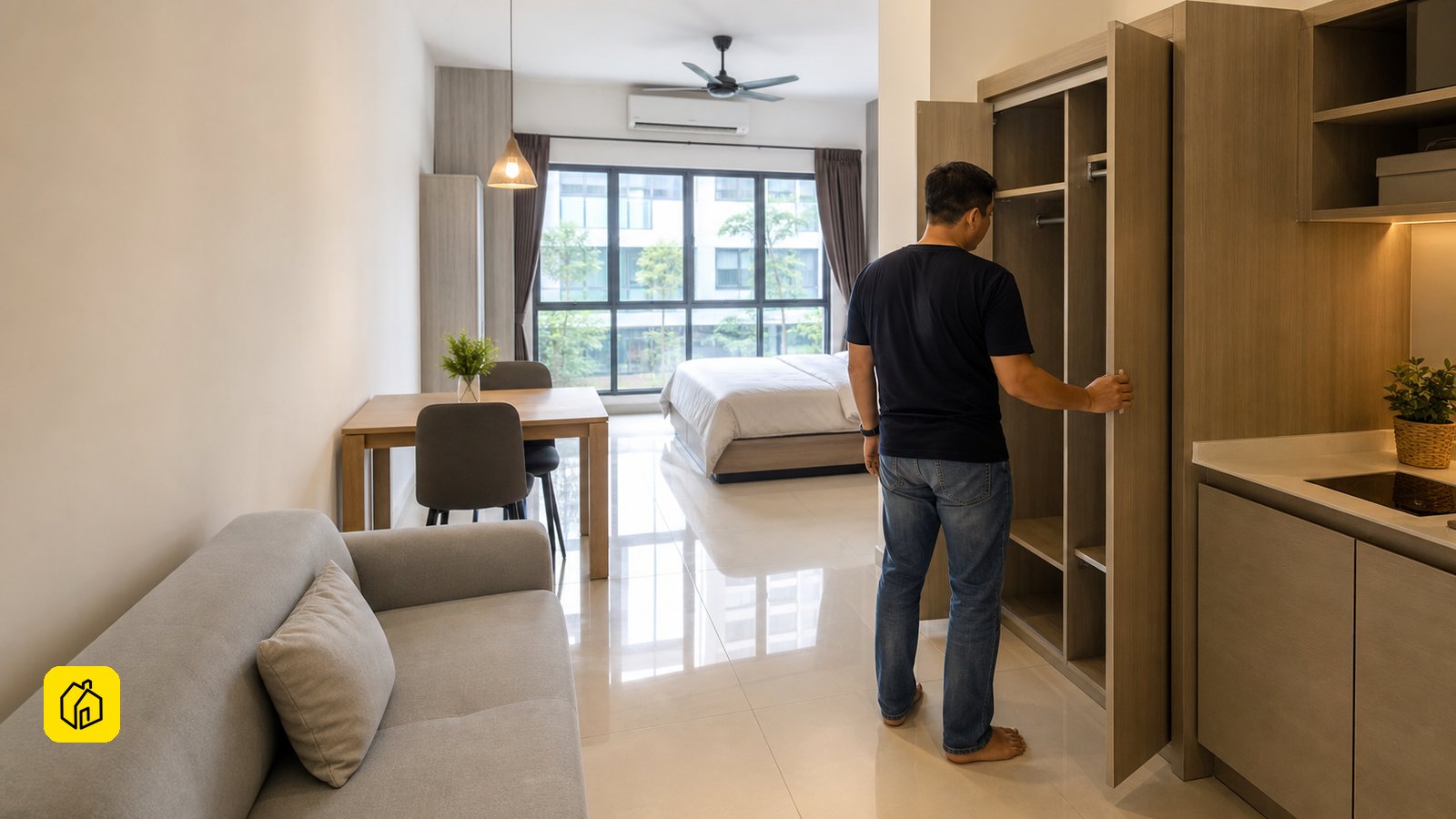
Own a unit at Menara Suria V12 SOVO? The default operating model is a whole-unit compact studio long-term tenancy on the live asking band of RM1,000-1,300 a month (with RM1,150 measured on portal cards). Demand on SPEEDHOME's own board is proven by card 302535, which logged 101 chat requests in just seven weeks at RM1,000 — the fleet's fastest fresh-listing demand velocity on record. Gross yields sit at ~5.1-5.8% (up to 6.6% at the RM1,300 asking top) against the Brickz transacted median of RM237,500 (search excerpt, n=4 thin, labelled hard). The biggest caveat: compact 500-517 sq ft plates make room partitions physically impossible and legally hazardous, while short-stay rates remain unmeasured and gated by management corporation by-laws.
Three ways to run your unit
Pick a model card, select your studio or 1-bedroom layout, and enter your exact figures. The rent field preloads RM1,150 — the verified asking median between SPEEDHOME's live RM1,000-1,300 cards and Mudah's RM1,150 studio card — while the purchase field loads the Brickz median of RM237,500. Adjust the numbers to see your net return update live.
Loading the renovation ROI comparison…
What can you earn?
First-party demand on SPEEDHOME's own board is the headline for Menara Suria V12: two dedicated cards under /rent/menara-suria-subang-jaya establish live market clearing. Listing 302535 at RM1,000 a month, created on 20 August 2026, accumulated 101 chat requests and 0 viewing appointments in roughly seven weeks (measured). That is the fastest fresh-listing counter observed across our entire fleet, proving intense tenant appetite for sub-RM1,200 zero-deposit studios in Subang Jaya. The second card, listing 303327 at RM1,300 a month, was created on 1 October 2026 and carries 4 chat requests.
Public portal data closely corroborates this rent band. A live Mudah card (search_excerpt, dated August 2026) advertises: "MENARA SURIA (V12) SOVO For RENT Rental RM 1,150. Studio with almost fully shows AS ACTUAL PHOTOS Ready to move in". Across the wider corridor, asking rents for 500-517 sq ft units cluster tightly between RM1,000 and RM1,300.
Room rental is physically moot here. The plates are compact studio and 1-bedroom layouts measuring 500 to 517 sq ft, with rare 650 sq ft corner units. No room-type listing was observed on any channel (measured null). While SPEEDHOME co-living benchmark bands suggest small rooms at RM600-700, medium rooms at RM800-900, and master rooms at RM1,000-1,200 (operator_stated), these figures cannot be applied to an open-plan studio. Erecting illegal partitions destroys light and ventilation, violates fire codes, and risks by-law fines of up to RM200 under Section 70(2) of the Strata Management Act 2013.
The sale denominator is anchored by Brickz: four recorded non-landed transactions show a median transacted price of RM237,500 at 459 psf, with a 25th-75th percentile range of RM132,000 to RM300,000 (search_excerpt, n=4 thin). Worked out against the transacted median: - At RM1,000 a month: RM1,000 x 12 = RM12,000 / RM237,500 = 5.1% gross yield. - At RM1,150 a month: RM1,150 x 12 = RM13,800 / RM237,500 = 5.8% gross yield. - At RM1,300 a month: RM1,300 x 12 = RM15,600 / RM237,500 = 6.6% gross yield.
This ~5.1-5.8% gross yield is healthy for Klang Valley serviced apartments, but carries the caveat of a thin four-transaction sample. To understand your true net return after sinking funds, assessment tax, and vacancy, see the real cost of self-managing a rental.
Short-stay presence exists, but the nightly rate is unmeasured. Agoda carries one building-named listing — "V12 Sovo Menara Suria Nice & Comfy Homestay, Shah Alam" — but no rate echo was captured in raw snippets. On Airbnb, zero units use the building name; an adjacent "@Geno" marketing card lists at RM845 for 5 nights (RM169 a night), but this is marketing adjacency, not building revenue. Maintenance and sinking fund charges are unpublished across portals (measured null).
Why compact SOVO plates dictate the operating model
Menara Suria V12 SOVO is a commercial-titled leasehold serviced residence developed by LYL Group (Lyl Land Sdn Bhd) at Jalan Subang Mas, Taman Subang Mas, under the Majlis Bandaraya Subang Jaya (MBSJ). Completed across three 24-storey towers, the scheme houses 894 units predominantly configured as 500-517 sq ft studios.
Positioned right at the junction of Subang Jaya, Shah Alam Seksyen 22, and USJ, the project offers fast vehicle access to the ELITE Highway, Federal Highway, and KESAS. While rail connectivity requires a drive to KTM Batu Tiga or LRT USJ 7, the central highway link attracts young executives, factory managers, and tertiary students who need quick road transit across Subang and Petaling Jaya.
High density (894 units) means an owner cannot rely on generic listings. However, the astonishing 101 chat requests logged in seven weeks proves that competitive pricing at RM1,000-1,200 attracts instant, high-volume tenant absorption. Because these are compact studios, overspending on elaborate custom cabinetry or luxury furnishings is a common mistake that erodes yields. Instead, an efficient, reversible SPEEDRENO rental fit-out focusing on functional essentials — durable mattress, inverter air-conditioner, washer-dryer, clean kitchen setup, and smart entry lock — delivers the fastest turnaround.
5 checks before you buy
-
Check the strata title and commercial tariff classification — Confirm 99-year leasehold status, exact parcel size (500, 517, or 650 sq ft), and verify whether utility tariffs remain commercial or have been converted to domestic residential rates. Done: physical issue document of title and utility bills inspected.
-
Inspect the JMB/MC by-laws on short-term rentals — In dense 894-unit schemes, management corporations frequently pass AGM resolutions barring short-stay guests or fining transient operators. Done: official house rules and COB circulars in hand.
-
Audit the building maintenance statement and sinking fund — With three 24-storey blocks sharing elevators and common amenities, check collection efficiency and reserve fund health before signing. Done: latest JMB audited accounts and billing statements.
-
Verify parking bay entitlement on the strata title — Studios in SOVO projects often have unbundled parking or shared season passes. Ensure your parcel legally includes an allocated parking bay. Done: accessory parcel schedule verified.
-
Validate your entry price against the RM237,500 Brickz median — With only 4 transacted sales recorded on Brickz (range RM132,000-300,000), do not overpay on seller marketing claims. Done: bank valuation confirmation in hand.
FAQ
What rental yield can I expect from Menara Suria V12?
At the Brickz median transacted price of RM237,500 (n=4, thin sample), the verified asking rent of RM1,000-1,300 delivers an estimated 5.1-6.6% gross rental yield (5.8% at the RM1,150 median). Plug your actual acquisition cost into the calculator above for an accurate net yield.
Can Menara Suria V12 studios be converted into room rentals?
No. At 500 to 517 sq ft, the existing layouts are open-plan studios or compact one-bedrooms. There is no physical space or legal basis for room partitions. Whole-unit leasing to a single tenant or working couple is the only compliant model. See the room rental and co-living guide.
Is short-stay or homestay viable at Menara Suria V12?
While building-named homestays exist on Agoda and nearby units trade around RM169 a night, short-stay income is subject to strict building house rules and unpredictable occupancy. Management corporations hold statutory authority under the Strata Management Act 2013 to restrict daily rentals. Long-term whole-unit leasing delivers far more predictable cash flow.
Are pets allowed at Menara Suria V12?
No building-level pet policy is publicly stated. However, SPEEDHOME coliving is cat-friendly — cats welcome in our coliving rooms; building rules can vary. For whole-unit rentals, pet-friendly terms are subject to landlord agreement and MC regulations, and typically command a 15-20% rental premium.
What running it looks like
Running a unit at Menara Suria V12 is straightforward because the layout is compact: one studio, one tenant, one lease. With 101 chat requests logged in just seven weeks on our board, demand for affordable Subang Jaya studios is intense when priced right at RM1,000-1,200.
SPEEDHOME takes the hassle out of tenancy management: we handle the listing, run the tenant viewings, conduct strict credit and zero-deposit screening, and automate digital SpeedSign agreements and monthly rent collection. Landlords pay a transparent 2.19% + SST processing fee on monthly rent only when tenanted. Our landlord protection plans — Standard at RM799/year + SST, Protect at 1 month's rent, and Protect+ at 1.5 months' rent — ensure full rental and eviction protection.
Ready? List with SPEEDHOME — zero deposit, we run the viewings, you approve the tenant.
The two dedicated SPEEDHOME rental listings, Mudah studio card, Brickz transaction records, Agoda homestay listing, and Airbnb geo-search are server-side reads of 11 October 2026 (evidence file menara-suria-v12-market-evidence-2026-10-11.yaml, lane bi-mine-09). Whole-unit rent reflects measured own-board asking cards (RM1,000-1,300) and Mudah snippet corroboration (RM1,150); the ~5.1-5.8% gross yield derives from the Brickz transacted median of RM237,500 (n=4 thin, range RM132,000-300,000). Compact plates preclude room rental; short-stay presence is recorded on Agoda but nightly rates remain unmeasured at the building. Maintenance charges are unpublished. Explore our landlord investment decision guide and SPEEDRENO rental fit-out guide.