
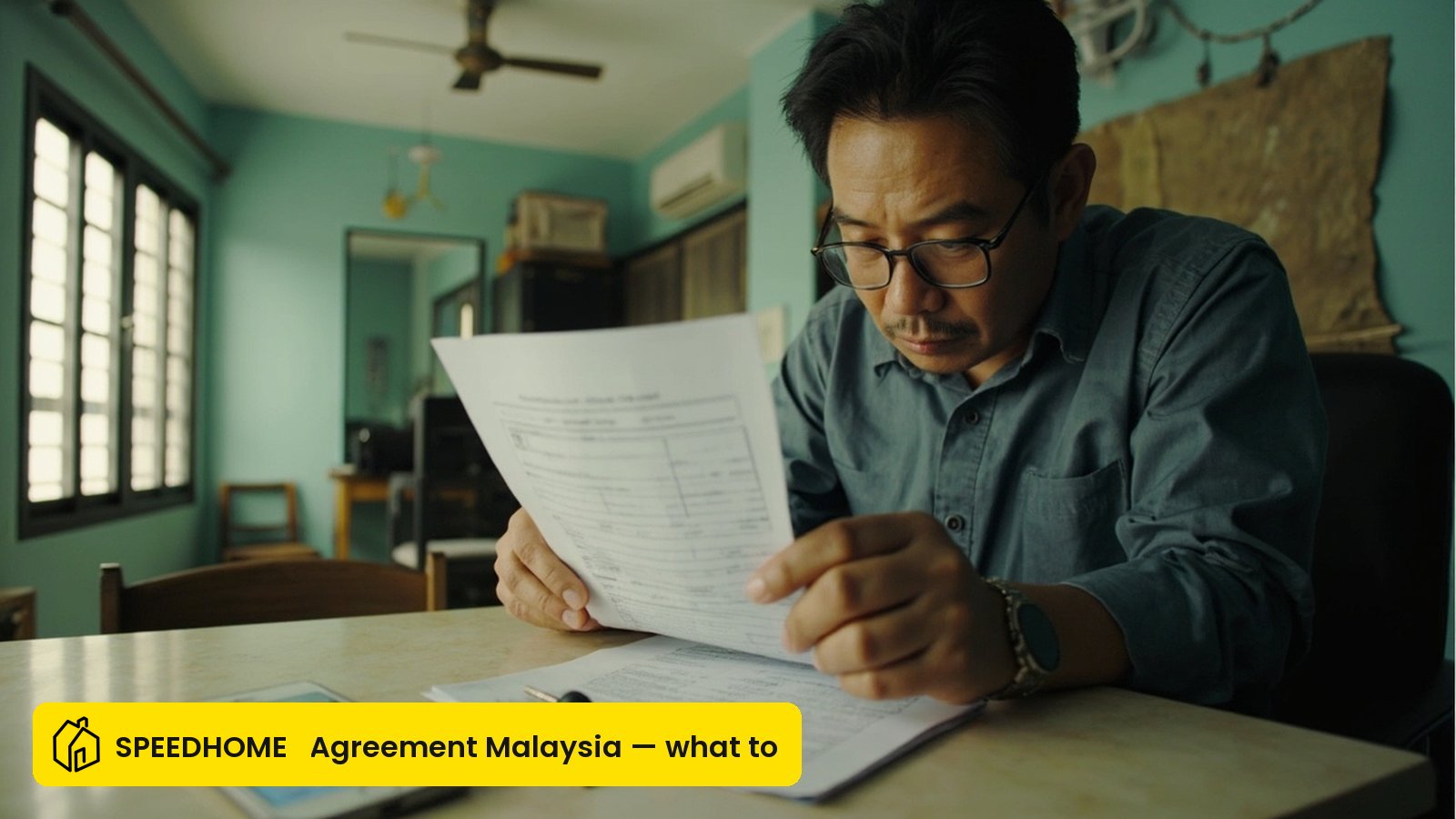
A room rental agreement in Malaysia is a contract under the Contracts Act 1950. Stamping is now managed via e-Duti Setem on MyTax, which replaced the STAMPS portal in January 2026. Dispute limits sit at RM5,000 for Magistrates' small-claims.
Why is a room rental agreement in Malaysia a private contract — with no standard form, tenancy law or deposit cap?
As of 2026, Malaysia has no Residential Tenancy Act in force. A room rental agreement is governed by the tenancy agreement itself, together with general contract law (Contracts Act 1950) and the ordinary courts — not by a dedicated tenancy statute. That means what you write in the agreement is nearly all the protection you have. The decision every room landlord faces is whether to draft and manage that agreement themselves or let a managed platform carry the compliance, screening, and paper trail.
Roughly 79% of Malaysian landlords say proper tenant screening matters to them (SPEEDHOME/INVOKE 2023 landlord survey) — yet most still rely on a template downloaded online and a WhatsApp deposit transfer. This page maps the gap between those two positions.
How do DIY templates differ from managed digital contracts legally?
The core trade-off: a DIY tenancy agreement costs less upfront but shifts every risk — screening, default, stamping, dispute — onto the landlord. A managed-platform agreement costs a monthly or sign-up fee but carries the screening, paper trail, and lawful default path for you.
| Factor | DIY tenancy agreement | Managed-platform (e.g. SPEEDHOME) |
|---|---|---|
| Draft cost | RM0 (template) to RM300–500 (lawyer-drafted) | Included in platform service |
| Stamp duty | Paid by landlord/tenant; follows Finance Act 2024 scale | Handled and tracked by platform |
| Who holds the deposit | Landlord's personal account (common, but a scam-risk signal to informed tenants) | Platform company account — verifiable, receipted |
| Default paper trail | Whatever you kept | Auto-logged; ready for court or CRA-reporting |
| Default-reporting right | You may report to a licensed CRA only where the tenant gave consent in the agreement — this clause must be drafted in | Consent is built into the platform sign-up; the reporting route is pre-cleared |
| Self-help eviction | Illegal — locks, utility cut-off, and removing belongings are all unlawful under the Specific Relief Act 1950 s.7(2) | Same law applies; platform guides the landlord to the lawful written-demand path |
| Dispute forum | Civil courts: Magistrates' small-claims (≤RM5,000), Magistrates' Court (≤RM100,000), Sessions Court (≤RM1,000,000) | Same courts; platform provides documentation |
| Room-specific clauses | Must be added manually (shared areas, quiet hours, subletting, utilities split) | Standard clauses included; house-rules addendum guided |
When each option wins
DIY works when you already have a reliable tenant relationship, a clean prior agreement, and the time to manage compliance yourself. A managed platform is the stronger choice when you are renting to someone new, renting multiple rooms, or have had a default before.
DIY is the better fit if: - You are renewing with the same tenant whose history you know. - You have a lawyer-drafted agreement with a proper consent-to-CRA clause already in place. - You actively track stamp duty deadlines and keep dated payment records.
A managed platform is the stronger fit if: - You are renting to a new tenant from a listing platform. - You want the screening done before the agreement is even signed — credit check, income verification, identity verification. - You want the deposit held in a company account (a practical scam-proof signal for tenants too). - You have experienced a default and know how hard it is to reconstruct a paper trail after the fact.
What is the cost and legal risk?
Stamp duty follows the Finance Act 2024 scale (RM1/RM3/RM5/RM7 per RM250 of annual rent by lease duration). The former RM2,400 annual-rent exemption was removed in January 2025. Stamping is now done via e-Duti Setem on MyTax (mytax.hasil.gov.my), which replaced the STAMPS portal in January 2026.
| Risk area | What the law actually says | Common DIY mistake |
|---|---|---|
| Deposit cap | No statutory cap — the agreement governs, and a landlord's right to retain is limited to proven loss (Contracts Act 1950 s.74) | Assuming any amount deducted from deposit is legally safe |
| Stamp duty | Finance Act 2024 scale; no exemption below RM2,400 rent (removed Jan 2025); use e-Duti Setem on MyTax | Using the old STAMPS portal or the old RM1/RM2/RM4 rate table |
| Default reporting | A verified default may be reported to a licensed credit reporting agency only where the tenant has given consent in the agreement; blacklisting or publishing a tenant's details is not lawful (Credit Reporting Agencies Act 2010) | Posting IC photos, naming the tenant on social media, or assuming CTOS does this automatically |
| Eviction | Self-help eviction — changing locks, cutting utilities, removing belongings — is unlawful (Specific Relief Act 1950 s.7(2)); recovery requires a written demand then court action | Changing the locks when rent is overdue |
| Dispute forum | No dedicated residential tenancy tribunal; civil courts only — small claims ≤RM5,000 (no lawyers needed), Magistrates' Court ≤RM100,000, Sessions Court for landlord-and-tenant and distress actions | Assuming a dedicated tenancy tribunal exists; there is none — all disputes go to the civil courts |
What is the SPEEDHOME path for room landlords?
A managed room rental on the platform adds three layers a DIY agreement cannot replicate: consented screening before signing, a company-account deposit trail, and a pre-built default-reporting consent clause — the exact three points where most self-managed room rentals break down.
The screening runs at sign-up. The Experian credit check and income verification happen before a tenancy is offered, not after a problem appears. The deposit goes to a company account, giving the tenant a verifiable receipt and the landlord a documented record. The tenancy agreement already includes the consent clause that makes CRA reporting lawful if a default occurs.
On the paper-trail side: the on-platform default is about 31 days from first missed payment to recovery action (SPEEDHOME platform data), because the documentation already exists and the landlord does not spend weeks reconstructing it.
Managed does not mean the law changes. The same courts, the same stamp-duty rules, and the same prohibition on self-help eviction apply. What changes is how much of the compliance work is already done when something goes wrong.
Landlords with room listings can browse the screening and rental management options at /more/landlord/speedhome. For a worked room agreement clause list and shared house rules template, see the shared house rules template guide. The broader room rentals in Malaysia guide covers area selection and demand signals.
FAQ
What must be in a room rental agreement in Malaysia?
There is no mandatory government form. A valid room tenancy agreement should cover: the parties (full legal names), the room address and which areas are shared, monthly rent and payment date, deposit amount, tenancy duration, notice period, utilities split, subletting restrictions, house rules, and — critically — the tenant's consent for CRA reporting if included. Get it stamped within 30 days of signing.
Is a room rental agreement the same as a full-unit tenancy agreement?
Legally, a room tenancy is still a tenancy agreement governed by the Contracts Act 1950. The key differences in practice are: the shared-facilities clauses (kitchen, bathrooms, common areas), the house-rules addendum, the utility-split method, and the fact that multiple tenants may share the same unit under separate agreements. Each room agreement should stand alone — do not rely on a verbal handshake for room-sharing terms.
Can I keep part of the deposit if a tenant leaves early?
Malaysia has no statutory deposit cap. Your right to retain the deposit is limited to proven loss under the Contracts Act 1950 s.74 — meaning documented deductions for actual damage, unpaid rent, or early-exit penalties that are clearly written into the agreement. Blanket retention without a documented reason is a contract breach that the tenant can dispute in the Magistrates' Court.
Can I report a defaulting room tenant to CTOS or a credit bureau?
You may report a verified rental default to a licensed credit reporting agency only where the tenant gave consent in the tenancy agreement. Blacklisting a tenant or publishing their details on social media is not lawful. If the consent clause is not in your current agreement, you cannot use this route for that tenant — build it in from the next agreement forward.
What happens if a room tenant refuses to leave?
A landlord cannot lawfully evict by self-help — changing locks, removing doors, or cutting utilities is unlawful under the Specific Relief Act 1950 s.7(2). Recovery of possession requires a written demand, then court action: a Writ of Possession to recover the room and, if applicable, a Writ of Distress for rent arrears. Claims up to RM5,000 can use the Magistrates' small-claims procedure without a lawyer.
Accuracy note. Grounded in the Contracts Act 1950, Credit Reporting Agencies Act 2010 and Specific Relief Act 1950. Every figure is bound to a dated fact registry and re-verified on each update. Spotted an error? Email [email protected] with this page's link.