
How do I find a tenant fast when my Malaysian home sits empty?
The five practical channels Malaysian landlords use to fill a vacancy fast are: a signboard at the property, a classified print ad, word of mouth, posting on unverified social-media listing channels, and a managed rental platform with built-in tenant screening — SPEEDHOME is the one that also runs that filter for you.
A SPEEDHOME/INVOKE 2024 survey of 250 Malaysian property owners found that roughly 79% of landlords say background checks are the single feature they most want from a rental platform, and about 51% say they distrust traditional agents. SPEEDHOME has managed over 30,000 tenancy agreements across Malaysia on that same screening-first model (SPEEDHOME platform operating data).
A Malaysian landlord typically has three pressures stacked on top of each other: a mortgage or assessment bill that does not pause, a property that loses condition the longer it sits empty, and the real fear of handing keys to a stranger. The right channel shortens the time a unit sits vacant and reduces the chance that a wrong tenant locks you into a 12-month problem.
Channel 1 — does a signboard or banner on the property work?
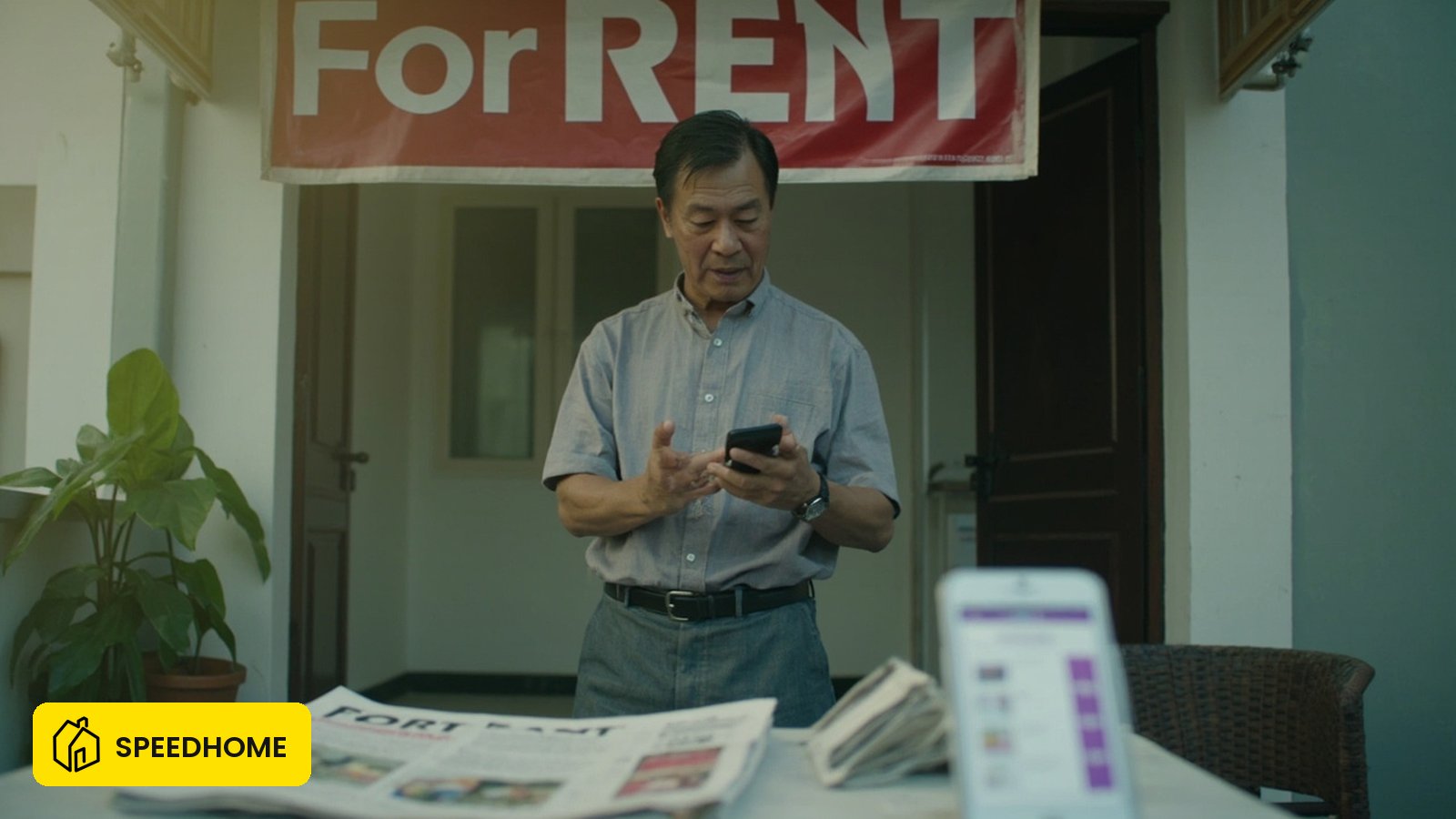
A "For Rent" signboard or banner hung at the property remains the cheapest and most evergreen channel in Malaysia, because it speaks directly to tenants who are already walking or driving past your door.
This is the channel every landlord knows and almost every landlord under-uses. A clean banner at the gate or a printed sign in the window reaches tenants who are actively house-hunting in that specific street — they have already self-selected on neighbourhood, commute distance, and budget. There is no algorithm between you and them.
| Strength | Weakness |
|---|---|
| Zero ongoing cost after the banner print | Reaches only people physically near the property |
| Targets an already-curious tenant — no scrolling | No screening filter — anyone can call |
| Works 24/7 without your effort | Limits you to the local catchment, not the wider city pool |
Practical upgrades that lift response:
- Print a phone number large enough to read from the road — QR codes on banners often go unread.
- Add a one-line headline that sells the strongest feature ("3-room, fully furnished, walk to LRT") instead of just "For Rent".
- Replace the banner if it fades; a sun-bleached banner signals neglect to a prospective tenant before they have even called.
Pair the signboard with a managed-platform listing so every enquiry that calls the banner number also reaches a tenant who has already cleared a credit and income check — the banner catches the eye, the platform carries the screening load.
Channel 2 — when does a classified print ad in a newspaper make sense?
A small print classified still works for specific tenant profiles — mature professionals, retirees, and tenants in secondary cities — who actively read the newspaper classifieds when they need a place.
A two-line ad in a Sunday classified reaches readers who are deliberate about their search and who often have stable employment and clean documentation. The rental market in Malaysia still includes tenants who do not scroll through property apps, and they remain reachable in print.
| Strength | Weakness |
|---|---|
| Reaches an older, often higher-income demographic | Tiny print slot — every word must earn its place |
| One ad runs for a week without further effort | No filtering — you take every call that comes in |
| Newspaper readers are often patient and serious | Higher cost per lead than online or signboard |
The classified is a small bet. Write the headline first ("Kajang 3-bedroom, RM1,400, fully furnished"), the details second (size, occupancy rules, contact), and the call-to-action last. Do not bury the rent inside a paragraph — readers skim the headline, decide whether to call, and only then read further.
Read the print readership as a deliberately separate funnel rather than a backup channel — newspaper classified readers are still working with print, often without a smartphone in hand, and they typically call rather than WhatsApp. Treat the classified as a complement to your signboard and online listing, not a replacement, because each channel catches a different applicant segment.
Channel 3 — how far does word of mouth through friends and family reach?
Telling your own network — friends, family, colleagues, your company WhatsApp group — that the unit is available remains one of the most trusted and least expensive channels, because the tenant arrives pre-vouched by someone you already know.
Word of mouth gets dismissed as informal, which is exactly why it works. A friend introducing a tenant is doing informal screening you would otherwise pay a platform to do. If the friend vouches for the tenant's job stability and cleanliness, your risk on day one is materially lower than a cold enquiry from a stranger.
| Strength | Weakness |
|---|---|
| Zero cost — and the tenant often arrives pre-vouched | Limited reach — only as wide as your own network |
| Higher baseline trust than a cold lead | Awkward if the relationship sours and the friend feels caught in the middle |
| Often closes fastest because both sides skip negotiation friction | No platform insurance if a dispute arises |
Practical rules that keep word of mouth useful rather than risky:
- Still run a credit and income check — a friend's vouch is not a substitute for documented verification.
- Put the tenancy agreement in writing and stamped in both names regardless of who introduced whom.
- Be honest with the introducer if the introduction does not work out — "the fit is not right" is a complete sentence.
Channel 4 — what are the risks of unverified social-media listing channels?
Posting the listing on unverified social-media listing channels gives the broadest reach in the shortest time, but it also exposes the landlord to the highest volume of unqualified or scam-flavoured enquiries.
This is the channel landlords reach for first when vacancy pressure spikes, and the channel most likely to waste a weekend. A post in an open social-media listing channel is visible to every tenant and every scam operator in the area within minutes. You will receive genuine enquiries, low-effort enquiries, and a meaningful share of enquiries from people who are not tenants at all.
| Strength | Weakness |
|---|---|
| Fastest reach to a wide pool of local tenants | Highest volume of irrelevant or fraudulent enquiries |
| Free to post, free to update | No tenant screening built in — every filter is on you |
| Easy to bump the post and stay visible | Public visibility exposes your phone number and unit details |
If you use an unverified social-media listing channel, treat it as a top-of-funnel awareness tool, not as your screening system. Move qualified enquiries to a private channel (WhatsApp, phone call) for documentation and screening before any viewing is arranged. Never accept a deposit from an enquiry that has not been screened — the rental-fraud pattern of "overseas employer, urgent deposit, can't view yet" is one of the most common scams on these channels.
Channel 5 — why choose a managed rental platform with built-in screening?
A managed rental platform combines the reach of an online listing with consented tenant screening, a stamped tenancy agreement, and a single point of contact for the tenancy lifecycle — so a landlord spends less time filtering enquiries and more time on the calls that actually close.
A managed platform does four things that no individual channel does on its own:
| Step | What the platform does | Why it matters |
|---|---|---|
| Listing distribution | Pushes the unit to a large, actively-searching tenant pool | Fills the funnel so you are not relying on one banner or one poster |
| Tenancy agreement and stamping | Provides a report-ready tenancy agreement, stamped via e-Duti Setem on MyTax | An unstamped agreement has reduced enforceability if a dispute reaches the courts |
| Lifecycle support | Handles rent collection, maintenance coordination, and the dispute paper trail | One contact instead of five middlemen |
The screening point is the most important. About 79% of Malaysian landlords say background checks are the single feature they most want from a rental platform, and about 51% say they distrust traditional agents (SPEEDHOME/INVOKE 2024 landlord survey, n=250) — because the cost of a bad tenant compounds across every month of a 12-month tenancy. The platform has managed over 30,000 tenancy agreements across Malaysia on this screening-first model (platform operating data).
For a Zero Deposit listing where the unit and applicant qualify, the tenant moves in without tying up the upfront cash deposit. Zero Deposit is a managed rental-risk system, not a financial guarantee product, and not every unit qualifies — confirm eligibility on the specific listing before relying on it. For severe end-of-tenancy damage beyond fair wear and tear, the standard protection claims process applies.
To list your property and reach pre-screened tenants: /rent. For the landlord-side workflow that pairs with this: landlord services.
Cost per channel at a glance
The five channels differ sharply on landlord cost — signboard is essentially free, classifieds cost per insertion, word of mouth and social are free, a managed platform charges a small percentage of monthly rent only once a tenant is signed, and a traditional agent typically charges the most.
| Channel | Typical landlord cost (Malaysia, 2026) | When cost is paid |
|---|---|---|
| Signboard / banner on the property | A PVC banner or corflute sign is generally tens of ringgit, one-off; inkjet or sticker prints cost less, eyelets and rope extra | Once, before listing |
| Classified print ad | A short classified line in a major daily is typically a low-double-digit to low-three-digit RM per insertion; check the newspaper's current rate card before booking | Per ad placed |
| Word of mouth | Zero direct cost | — |
| Unverified social-media listing | Zero direct cost (you absorb your own time) | — |
| Managed rental platform (SPEEDHOME) | 2.19% of monthly rent, payable only once a unit is tenanted (≈ RM43.80/month on a RM2,000 unit) | Per tenanted month |
| Traditional property manager / agent | Typically 10%–15% of monthly rent for recurring management; a one-off placement fee that commonly runs half to one month's rent (the exact figure varies by firm — confirm in writing) | Recurring + placement |
The two non-platform options most landlords compare are a managed platform and a traditional agent. On a RM2,000/month unit, a 2.19% managed-platform fee is RM43.80/month versus a 10%–15% management fee of RM200–RM300/month at a traditional agent — and a traditional-agent fee is on top of a one-off placement fee that commonly runs half a month's rent. Worked example only: on a RM2,000/month unit, half a month's rent ≈ RM1,000, but the actual placement fee varies by firm, so always get a written quote before signing; the Association of Landlords Malaysia community norm reports agent renewal fees of roughly RM750 plus 8% SST, with the SST charged on the renewal fee itself rather than on the recurring management percentage (the 8% is the quoted norm; the applicable rate depends on the RMCD classification of the agent's service — the rental/leasing service-tax rate is 8% from 1 July 2025 (live MySST FAQ) and covers rental/leasing, not agency fees).
What does a 7-day plan to fill the vacancy look like?
The fastest path to a signed tenancy is a parallel-channel listing on day one, a documented screening filter on day two, viewings from day three, and a stamped tenancy agreement by the end of the week. A linear approach (signboard this week, online next week) loses days; a parallel approach uses all five channels at once and lets the strongest one close.
| Day | Action |
|---|---|
| Day 1 | List on a managed platform; print the banner; tell 10 people in your network; post on one unverified social-media channel; book a small classified for the weekend |
| Day 2 | Set the screening criteria in writing: income multiple of rent, employment type, reference contact, credit-check consent |
| Day 3–4 | Run viewings back-to-back on the same day when possible; ask every viewer for the same documentation set |
| Day 5 | Shortlist 2–3 applicants; run a consented credit and income check before deciding |
| Day 6 | Sign the tenancy agreement; collect the deposit and first month's rent; arrange key handover |
| Day 7 | Stamp the agreement via e-Duti Setem on MyTax (mytax.hasil.gov.my); file the stamped copy and the inventory checklist together |
The single mistake that slows this plan down is collecting a deposit before the screening is complete. A deposit does not lock in a tenant — it locks you into a tenant. Hold the deposit until the credit and income checks are back.
Comparison at a glance — which channel fits which situation
The five channels are not interchangeable. Each one fits a different vacancy situation, and the right mix depends on the property, the area, and how urgently the unit needs to fill.
| Situation | Best primary channel | Best supporting channel |
|---|---|---|
| Ground-floor or high-footfall street | Signboard on the property | Managed platform listing |
| Higher-end unit or expat catchment | Managed platform listing | Classified print ad |
| Secondary city or mature tenant pool | Classified print ad | Word of mouth |
| Already-known local network | Word of mouth | Signboard on the property |
| Pressure to fill in under 14 days | Managed platform listing | Signboard + unverified social-media channel for reach |
| Unit has been empty for 2+ months | Managed platform listing (with screening) | Review price against live listings on /rent |
If the unit has been empty for more than two months, the channel is rarely the problem — the price, the photos, or the unit condition usually is. Pull live comparable rents on /rent and treat the median as your benchmark before pushing harder on advertising.
Frequently asked questions
How long does it usually take to find a tenant in Malaysia?
Time-to-let varies sharply by area, season, and asking price. A well-priced, well-presented unit in a healthy catchment usually takes a few weeks from posting to move-in, while a mispriced unit in a soft pocket can sit empty for months — the channel is rarely the bottleneck. A managed platform with active tenant demand tends to fill faster than a signboard-only listing because it widens the funnel beyond the immediate street.
Should I accept the first tenant who wants to view the property?
No. View the first applicant as practice for your screening process, not as the answer. Collect the same documentation from every applicant — IC/passport, employer letter, recent payslips, and a credit-check consent — before deciding.
Do I have to pay an agent to advertise my rental?
Not necessarily. You can list on a managed rental platform directly, which typically charges a platform or service fee on the first month's rent or on a per-tenancy basis. Traditional agents commonly charge half a month's rent to one month's rent, plus optional renewal fees. Compare both before committing.
What if no one enquires after a week?
Treat a silent week as a signal to fix the listing, not the channel. The three usual culprits are: the rent is above the live market for the area (check /rent for current comparable units), the photos are dark or show a cluttered unit, or the description does not state the strongest feature (furnished, MRT-walk, pet-friendly, etc.) in the first line.
Is it safe to give out my phone number on a signboard or social-media post?
Yes, with three stacked safeguards. First, use a secondary number — a cheap prepaid SIM or a VoIP line — rather than your personal line, so spam calls do not bleed into your daily phone. Second, screen every call before giving the property address: the unit address, floor, and access code stay private until you have a confirmed viewing appointment with an applicant who has cleared the basic identity check. Third, route calls through a WhatsApp Business account or a dedicated listing number with an auto-reply that asks for the applicant's name, intended move-in date, and number of occupants before you pick up — this filters out most one-line scams before your personal number ever rings.
I'm an overseas landlord and can't do viewings myself — which channel actually works?
A managed rental platform is the channel built for this, because it does not depend on you being physically present. Signboard, word of mouth, and print classifieds all assume a landlord (or a trusted local contact) can field calls, run viewings, and vet a stranger in person — none of that is realistic on Malaysia time-zone lag from overseas. A managed platform instead runs distribution, consented screening, and agreement stamping through the platform itself, so an absentee landlord approves an already-screened applicant remotely rather than trying to run the whole funnel from abroad. If you do use a local family member or agent as your on-the-ground contact, still require the same documented credit-and-income check before any viewing is confirmed — a trusted contact is not a substitute for screening.
Can I rent to someone on a tourist or social visit pass?
Yes in principle — a tenancy is a private contract under Malaysian law and is open to any tenant whose lawful-stay documentation covers the full tenancy term. The landlord's responsibility is to confirm the tenant has a valid right to stay in Malaysia for the entire tenancy period and to keep that confirmation on file. Confirm the pass end-date in writing before signing: if the pass expires mid-tenancy, the landlord can be left responsible for an unlawful occupant, and a tenancy signed with someone whose stay is not lawful raises the risk that the contract cannot be enforced. Screening must be consistent regardless of nationality, and the landlord should not use visa class as a blanket reason to reject applicants. For any cross-border tenancy or specific visa-class question, get specific immigration or legal advice before signing.
For live comparable rents in your area before setting your asking price: /rent. For the landlord workflow that pairs with this: /more/landlord/speedhome. For a broader landlord decision on whether to rent or sell: read the guide on getting a property ready to market.