
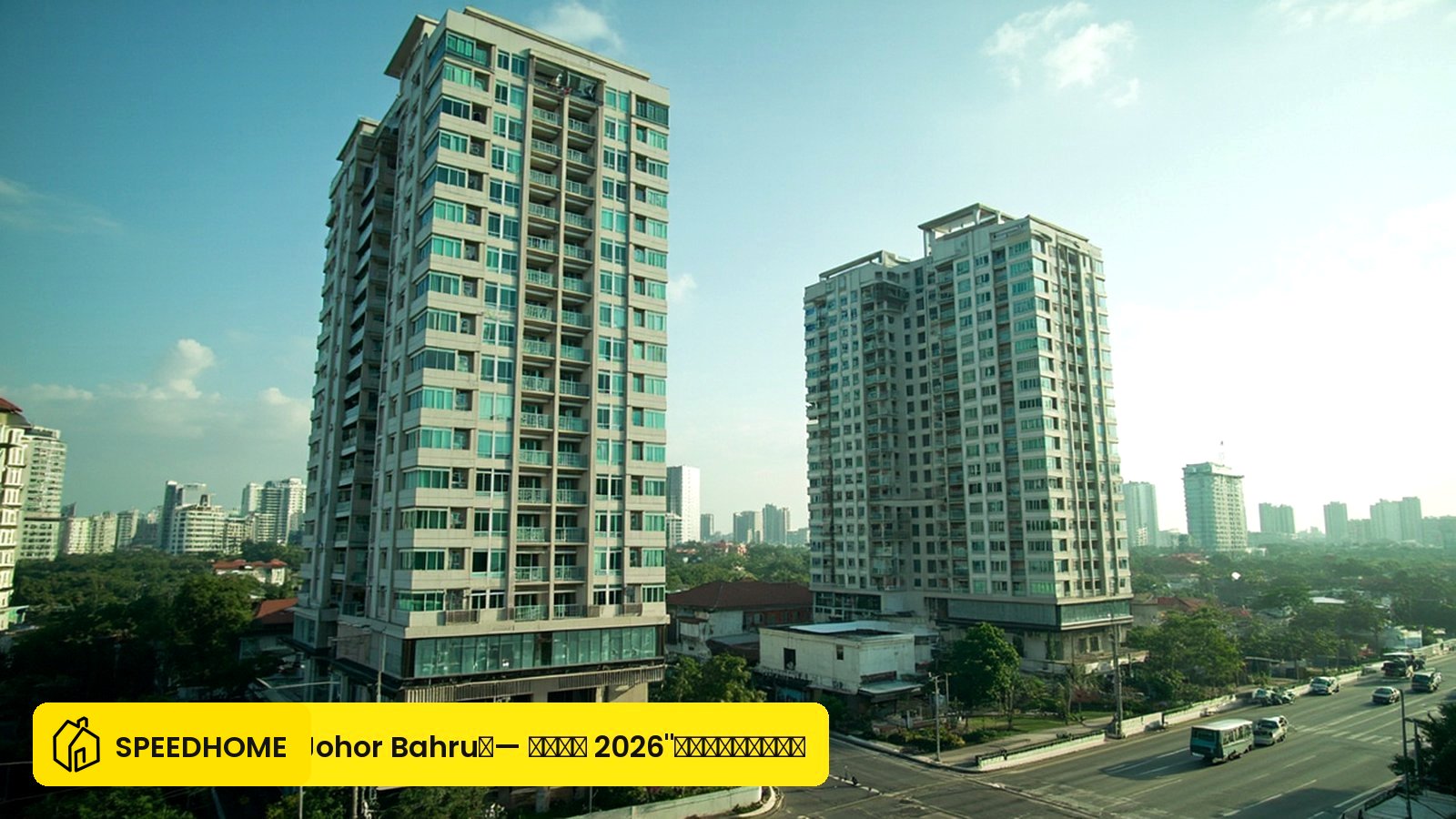
Singaporean landlords managing Johor Bahru properties can operate without an MM2H visa or long-stay pass. With the RTS Link connecting Woodlands North to Bukit Chagar targeted for passenger service around early 2027, well-located high-rise units in the city centre are cited at 6–8% gross yield while typical JB residential gross yields run roughly 5–6% (portal estimates), and avoiding vacant periods remains crucial.
**Singaporeans can own and rent out a JB unit without any visa: management runs on a stamped tenancy agreement, screened tenants (roughly 30% of tenancy applicants are rejected at the SPEEDHOME screening step) and traceable rent collection.
The RTS Link — Woodlands North to Bukit Chagar — is the tenant-pool story; JB gross yields sit roughly 5–6%.**
Singaporean's Guide to Renting Out a JB Property from Across the Causeway
You bought the JB condo. Maybe it was the RTS Link story, maybe it was just the exchange rate math versus a Singapore HDB or condo. Either way, you now own a unit an hour (or, once the RTS Link opens, a few minutes) from home — and it needs a tenant. This guide is for Singaporean owners who want to rent out a Johor Bahru property properly: no local address, no local phone number glued to your ear, and no need to fly up every time something needs signing.
SPEEDHOME's screening data shows and the platform has recorded no reported scams since April 2026 — exactly the filter a cross-border owner needs working while they're not around.
Do I need a visa or MM2H to own and rent out a JB property?
No. Foreigners, including Singaporeans, can generally buy and own residential property in Malaysia without holding MM2H or any residency visa, provided the property meets the state's minimum purchase price threshold and you obtain State Authority consent under the National Land Code — an approval step that commonly takes one to three months after your Sale and Purchase Agreement. This is a purchase formality, not a residence right: owning the unit does not entitle you to live in Malaysia, and it does not require you to. Malaysian residency is likewise not a precondition for letting the property out as a landlord.
A few categories of land and units are off-limits to foreign buyers regardless of price — Malay Reserve land, Bumiputera-quota units, most agricultural land, and low-cost housing. If your unit falls outside those categories and you've already cleared consent at purchase, you're free to rent it out like any other owner. You do not need MM2H, a Malaysia My Second Home visa, or any long-stay pass to be a landlord here — plenty of Singaporean owners have never spent a night in the unit they rent out.
How do I manage tenant screening and viewings from Singapore?
You manage it the same way any remote landlord does anywhere in the world: you delegate the on-the-ground steps and keep the decision-making with yourself. The parts that genuinely need someone physically in JB are viewings, key handovers, and the occasional maintenance callout. The parts you can — and should — do yourself from Singapore are the actual tenant vetting: reviewing applications, checking employment and income evidence, and deciding who gets the keys.
The mistake owners make is outsourcing the whole process to whoever's convenient and finding out later that "screening" meant a five-minute phone call. A workable remote setup looks like this:
- Listing and viewings: use a platform or agent that runs viewings without you needing to be there, and that gives you photos/video from the actual unit rather than stock images.
- Screening: insist on seeing verified applicant information yourself before approving — not a verbal assurance that "the tenant seems fine."
- Paperwork: the tenancy agreement should be preparable and signable without a face-to-face meeting in JB, using digital signing where the agreement's terms allow it.
- Keys: decide upfront who holds a spare set for handover and emergencies — a managing agent, a trusted local contact, or a lockbox arrangement — and put that in writing.
- Rent collection: set up a transfer method that doesn't depend on either party being in the same country to complete it, and keep records of every payment for your own tax filing on both sides of the border.
None of this requires you to be resident in Malaysia or to make repeat trips up. It does require picking a process where screening and approval authority stay with you, not with whoever showed the unit.
Does my tenancy agreement need to be stamped, and does it matter that I'm overseas?
Yes — a Malaysian tenancy agreement should be stamped with LHDN (via the MyTenancy platform or a stamping office) to be admissible as evidence in court and enforceable if a dispute arises, and being based in Singapore does not exempt you from this. Stamping is a Malaysian legal requirement tied to the agreement itself, not to where the landlord lives. An unstamped agreement is still generally valid as a contract between you and the tenant, but you lose the ability to rely on it as evidence if you ever need to go to the Sessions Court or Tenancy Tribunal over rent arrears or a dispute — precisely the situation where a remote landlord needs the paperwork to hold up without them physically present to argue the point.
Because stamping is usually done online, this is one of the easier parts of remote ownership to get right: prepare the agreement, calculate and pay the stamp duty via the platform, and keep the digital stamp certificate on file. What you should not do is let a verbal agreement or an informal WhatsApp confirmation stand in for a stamped tenancy — that's the exact gap that turns a late-rent conversation into a costly one.
What does the RTS Link actually change for me as an owner?
It changes your commute and, plausibly, tenant demand for units near the corridor — not the fundamentals of your ownership or your tax obligations. The Johor Bahru–Singapore Rapid Transit System Link connecting Woodlands North to Bukit Chagar in central JB is officially targeted to begin passenger service around the end of 2026, with Malaysia's Transport Minister expressing confidence in a 1 January 2027 start; as of April 2026 the project was reported on track for that window. Treat this as a target range, not a booked date — plans for a specific opening day can and do slip.
What it means practically: once running, the link is designed to move up to 10,000 passengers per hour per direction at peak, turning a car or bus commute into a rail trip of a few minutes between the two stations. For a Singaporean landlord, this matters less for your own convenience (you're not commuting daily) and more for the tenant pool — the RTS Link is one of the reasons JB has seen renewed interest from Singapore-based tenants and cross-border workers who want proximity to the corridor. It is not, on its own, a reason to expect a fixed or certain rent increase — treat it as one demand driver among several, not a certainty.
Why does leaving a JB unit empty cost more than it looks like?
An empty unit doesn't just forgo rent — it still carries maintenance fees, quit rent, assessment, and loan interest every month, so a vacant period is a real cash cost, not a neutral wait. Market commentary as of early 2026 places typical gross rental yields for Johor Bahru residential property in roughly the 5–6% range, with some portals and agencies citing 6–8% gross for well-located high-rise units in the JB city centre near the RTS Link corridor — net yields typically running 1.5–2 percentage points lower after costs and vacancy. These are unaudited market estimates from property portals, not official statistics, and they are not a projection of what your specific unit will earn.
| Vacancy scenario | What still runs during the gap |
|---|---|
| 1 month vacant | Maintenance + sinking fund, quit rent/assessment accrual, loan interest if mortgaged |
| 3 months vacant | Same fixed costs x3, plus lost rent that a lower asking price could likely have recovered |
| Ongoing "holding out for a higher rent" | Fixed costs continue indefinitely; foregone rent compounds while the unit earns nothing |
The practical takeaway for an owner managing this from Singapore: pricing the unit close to what comparable JB units are actually renting for, and moving fast on a qualified applicant, usually beats holding out for a marginally higher rent that costs more in vacancy than it gains.
What tax do I owe in Singapore and in Malaysia on this rental income?
Malaysia taxes the rental income at source regardless of where you live, and Singapore generally does not add a second layer of tax on top for an individual owner. On the Malaysian side, a non-resident individual landlord is taxed at a flat 30% on net Malaysian rental income (in effect since Year of Assessment 2020). Non-residents don't get personal reliefs, rebates, or the graduated resident tax bands that a Malaysian-resident owner would use — but allowable rental expenses (things like assessment, quit rent, loan interest, and repairs) are still deductible, so the 30% applies to income after deductions, not to your gross rent collected.
On the Singapore side, for individuals, Singapore generally does not tax foreign-sourced income — including rental income from an overseas property such as a Malaysian condo — even when you eventually remit that money into Singapore, unless it's received through a Singapore partnership. In practice this means the Malaysian tax at source is typically the main tax cost on this income stream for an individual owner, rather than a Malaysia-then-Singapore double hit. This is not tax advice and depends on your personal circumstances (residency status, how the property is held, whether other income complicates things) — confirm your position with LHDN/a Malaysian tax agent and with IRAS or a Singapore tax adviser before filing.
How does SPEEDHOME help a Singapore-based owner manage this?
Cross-border ownership is exactly the situation the platform's model was built to support: verified tenant screening and Zero Deposit — a risk-management system, not an insurance product — mean you're not relying on being physically present to vet an applicant or chase a security deposit dispute after move-out. Managed plans handle the viewing, screening, and paperwork coordination end-to-end, so the parts that need someone in JB happen without you needing to be the one who flies up. Whether you check in from Singapore once a month or once a quarter, the screening and agreement process works the same way for a cross-border owner as it does for a landlord living five minutes from the unit.
Can I run the whole tenancy from Singapore without driving over?
Yes — a full-service managed plan is built to run every stage of the tenancy without you needing to be on the ground in JB: The platform lists the unit, screens applicants, arranges the stamped tenancy agreement, collects rent, and handles the day-to-day management, with you approving the tenant and staying informed at each stage rather than driving over to do any of it yourself. The sequence looks like this: the unit goes live on the platform with real photos and video; applicants are screened and verified before you're asked to approve one; the tenancy agreement is prepared and, where Zero Deposit applies, the deposit conversation is replaced with the managed rental-risk system instead of an upfront cash deposit; rent is collected on a schedule and paid out to you; and ongoing management (maintenance coordination, renewals, and lease-end handling) runs under the plan rather than falling back on you to chase.
SPEEDHOME's landlord plans (effective 4 June 2026) price this as a Standard RM799 + SST annual subscription, or the Protect / Protect+ tiers where a rent-free period is taken instead of a separate annual invoice, plus a monthly service fee of 2.19% + SST deducted from each rental payout. On a RM2,000/month unit, that fee works out to RM43.80 a month (RM525.60 a year) — the fee only applies once the unit is actually tenanted, so there's no cost sitting idle while you wait for a qualified applicant. The signed agreement and your Platform record govern the exact terms of whichever plan you're on.
None of this requires a Malaysian residency status or a trip up from Singapore to sign anything in person — the model is designed so the on-the-ground steps (viewings, key handover, maintenance callouts) happen through the platform while approval authority and visibility stay with you. See the foreign investor's guide to renting out property in Malaysia for the wider owner-side picture across nationalities, not just the Singapore-JB corridor.
FAQ
Do I need to visit Malaysia regularly to keep renting out my JB unit?
No. There is no legal requirement to visit, and a properly delegated screening, signing, and key-handover process can run indefinitely without your physical presence — though most owners still visit periodically to check on the unit's condition.
Can I sign a Malaysian tenancy agreement while I'm in Singapore?
Generally yes, provided the agreement's execution terms allow remote or digital signing; the agreement still needs to be stamped with LHDN afterward to be enforceable as evidence.
Is my JB rental income taxed twice, once in Malaysia and once in Singapore?
Usually not for an individual owner: Malaysia taxes the rental income at source (30% flat on net income for a non-resident), while Singapore generally does not additionally tax foreign-sourced individual income. Confirm your specific position with a tax adviser in each country.
Will the RTS Link assure higher rent for my unit?
No single project can assure a rent outcome. The RTS Link is a plausible demand driver for units near the corridor once it opens (targeted end-2026 to January 2027), but rent levels still depend on unit condition, pricing, and the broader JB rental market at the time.
What happens if I don't stamp my tenancy agreement?
The agreement can still be a valid contract between you and the tenant, but an unstamped agreement is generally not admissible as evidence in a Malaysian court (Stamp Act 1949 s.52(1) and its proviso; there is no tenancy tribunal), which weakens your position if a dispute over rent or damages arises.
Do I need a Malaysian bank account to collect rent?
Many owners set one up for convenience and to simplify local tax filing and expense payments, though the mechanics of receiving cross-border transfers should be worked out with your bank or managing agent based on your specific setup.
Related reading
- What Singaporeans actually pay to buy in Johor
- JB rental market: what RTS means for investors
- Who actually rents JB condos
- SPEEDHOME for landlords
How this page stays accurate. The legal statements rest on National Land Code and Stamp Act 1949; figures are checked against a dated fact registry at every update. Report an error: [email protected].