
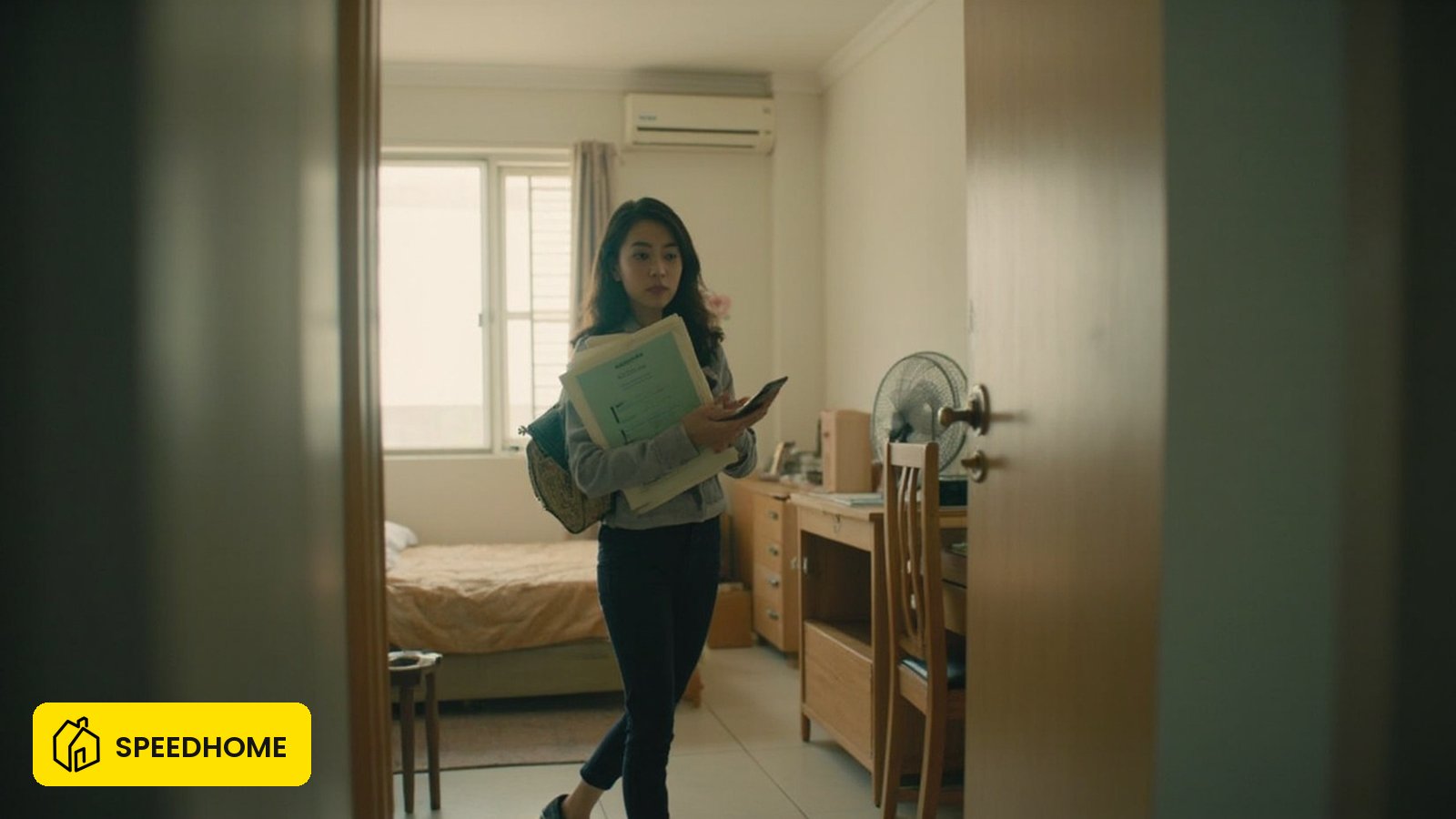
Finding a student room in Malaysia comes down to three choices: a shared room in a house or apartment, a co-living unit with built-in house rules and shared amenities, or your own studio. Each has a different upfront cost, set of obligations, and risk profile. Renting a shared room under your own tenancy agreement is cheapest month-to-month but puts the full legal liability on you. Co-living shifts house-rule enforcement to the operator. A studio costs more but gives you full tenancy rights without housemate friction. The right option depends on your budget, university distance, and how long you plan to stay.
Shared room vs co-living vs studio: the verdict
For most students on a tight budget staying six months or more, a verified shared room or co-living unit beats a solo studio on cost. Co-living suits students who want managed amenities; a studio suits those who need quiet study space.
| Shared room (house/condo) | Co-living unit | Studio or 1-bedroom | |
|---|---|---|---|
| Typical monthly rent (Klang Valley) | RM350–RM700 per person | RM550–RM950 per person | RM900–RM1,800 |
| What is included | Room only; utilities split separately | WiFi, sometimes utilities, shared cleaning; varies by operator | All yours; utilities billed to you |
| Tenancy agreement | You sign your own room TA with the landlord, or join a shared TA | You may sign with the operator or the property owner; check who the contracting party is | Standard full-unit TA |
| Upfront cash (typical 2+1+½ formula) | RM700–RM2,100 | RM1,100–RM2,850 | RM1,800–RM5,400 |
| Housemate risk | High — your co-tenants affect your living quality and deposit | Lower — operator manages house rules | None |
| Subletting or Airbnb | Not allowed without landlord's written consent; check your TA | Not your call; governed by the operator's terms | Not allowed without landlord's written consent |
Rent ranges are illustrative market estimates, not platform data. Check live listings for verified current asking rents by area.
When each option wins
A shared room wins on upfront cost. If your budget for move-in cash is under RM2,000, a verified shared room in Chow Kit, Kepong, Wangsa Maju, or Subang is the realistic bracket. The trade-off is that you share walls and a kitchen with people you may not know, and if one housemate defaults on rent or damages the property, it can affect your deposit.
Co-living wins when house rules matter. A co-living unit sets out WiFi, cleaning schedules, visitor rules and utilities in writing before you move in. There is less room for housemate conflict to erupt without a framework to resolve it. It typically costs more than a basic shared room but less than a studio. Check whether the operator is the property owner or a master-tenant subletting to you — this affects who you call when the aircon breaks and who holds your deposit.
A studio wins when study output is the priority. Students on grants, postgraduate researchers, or students close to exams often find the productivity gain from a private unit worth the premium. A studio also gives you a simpler legal relationship: one landlord, one TA, one set of obligations.
Cost and risk: what you actually pay upfront
The standard Malaysian upfront formula is 2+1+½ — two months' security deposit, one month advance rental, and half a month's utility deposit. There is no statutory cap on this amount; it is set by the tenancy agreement and general contract law, not by any Residential Tenancy Act (which remains a draft Bill, not yet law).
For the section on “Cost and risk: what you actually pay upfront”, Room Rental Agreement Malaysia: Shared House Rules Template Guide compares room structures, consent requirements and shared-house risks.
| Monthly rent | Security (2 mo) | Advance rent (1 mo) | Utility (½ mo) | Total upfront |
|---|---|---|---|---|
| RM400 (shared room) | RM800 | RM400 | RM200 | RM1,400 |
| RM600 (shared room) | RM1,200 | RM600 | RM300 | RM2,100 |
| RM750 (co-living) | RM1,500 | RM750 | RM375 | RM2,625 |
| RM1,200 (studio) | RM2,400 | RM1,200 | RM600 | RM4,200 |
| SPEEDHOME Zero Deposit (qualifying units) | RM0 | Advance rent only | RM0 | ~1 month's rent |
Zero Deposit is a managed rental-risk system, not a financial guarantee product. It replaces the upfront cash deposit on qualifying units; in the rare case of severe end-of-tenancy damage the recoverable amount can be limited, so it is not a blanket guarantee. Not every listing qualifies — check the individual listing on the SPEEDHOME platform to confirm availability.
The biggest student-specific risk is an undocumented room arrangement — paying a "deposit" to a current tenant who pockets it and has no legal right to sublet. If your room is sourced this way, you have a contract with the subtenant, not the landlord. When things go wrong, you have no standing to demand your deposit back from the property owner. Always confirm who the landlord (or master-tenant operator) is and make sure your TA is signed with them directly.
The SPEEDHOME path for student renters
SPEEDHOME lists verified rooms and co-living units alongside whole units, with each listing showing whether Zero Deposit is available. SPEEDHOME has managed 30,000+ tenancy agreements across Malaysia and has recorded zero reported rental scams on the platform since April 2026 — a screening-and-verification scale a group chat or a casual sublet cannot match. The platform's tenancy agreement is issued by SPEEDHOME PROPERTY SDN. BHD., the Master Tenant contracting party, with SPEEDRENT TECHNOLOGY SDN. BHD. as the platform operator (not a party to your tenancy) — not an individual landlord you found through a neighbour's contact or an unverified social-media listing channel. The full SPEEDHOME entity details and current SSM company number are linked from the footer of every page on speedhome.com — confirm them there before relying on a third-party copy of the registration string.
For students, the practical advantage is:
- Reduced upfront cash: on a qualifying unit, you pay one month's advance rental instead of a 3.5-month stack. On a RM600/month shared room, that is RM600 move-in cost vs RM2,100 under the standard formula.
- Credit-based screening: SPEEDHOME's income and credit check cuts out applicants who cannot sustain the rent, which reduces the housemate-default risk in shared units on the platform.
- Digital documentation: move-in photos and a signed TA are time-stamped on the platform, so your deposit claim at move-out has evidence regardless of whether the landlord is cooperative.
Browse room and co-living listings to see which units carry the Zero Deposit option. For a broader comparison of room rental versus renting a whole apartment, see the room vs whole-apartment guide. For a full co-living breakdown including what to look for in a co-living unit, see the co-living Malaysia guide. The broader room rental and co-living guide covers what tenants and landlords should check before signing any room arrangement.
FAQ
How much does a student room cost per month in Malaysia?
A shared room in Klang Valley typically runs RM350–RM700 per person; co-living units range RM550–RM950. Rents outside the Klang Valley (Penang, Johor Bahru and other regional cities) tend to be lower than the Klang Valley equivalent for the same room type, though the gap varies by area and unit class. Rents closer to university campuses or LRT stations command a premium. Check live listings — asking rents move with supply and demand.
What is the difference between a shared room, co-living, and subletting?
A shared room means you rent directly from the landlord alongside housemates, each with your own TA or under a shared TA. Co-living means you rent from an operator who manages the shared space, house rules, and sometimes utilities. Subletting is when an existing tenant rents out their room or unit to you — they become your landlord, but they remain liable to the original landlord. Subletting without the landlord's written consent is a contract breach; the original tenant can lose their tenancy and you lose your occupancy.
Do I need a written tenancy agreement for a rented room?
Yes — always. A written tenancy agreement is your legal protection for your deposit, your right to occupy, and your obligations on maintenance. A verbal deal or a WhatsApp message is not enforceable in the same way. If the person offering the room cannot produce a TA or will not sign one, that is a warning sign. For a checklist of what a room rental agreement should cover, see the room rental agreement guide.
Can my landlord keep my room deposit if I leave early?
The tenancy agreement governs deposit deductions. A landlord may deduct documented losses — unpaid rent, damage beyond fair wear and tear, or TA-breach penalties if the TA provides for them. Malaysia has no statutory deposit cap and no dedicated residential tenancy tribunal. If a landlord retains your deposit without valid grounds, the remedy is the Magistrates' Court small-claims procedure for monetary claims up to RM5,000 (no lawyer required in most cases, current filing fee applies — check the latest courts.gov.my guidance for the current threshold and fee). Bring your TA, payment records, and move-in/out photo evidence.
Is co-living legal in Malaysian condos and apartments?
Whether co-living is permitted in a specific building depends on the building's by-laws and the strata management body. A Federal Court decision involving Verve Suites confirmed that a management corporation may pass a binding by-law prohibiting occupants from subletting or licensing units in ways that breach the building's rules — the legality turns on each building's own regulations, not a national ban. If you are considering a co-living unit in a condo, confirm that the operator has the building management's approval and that the by-laws permit their arrangement.
What should I do if my room landlord refuses to return my deposit?
Send a written demand (WhatsApp or email is acceptable, but a dated letter is stronger) listing the amount owed and asking for an itemised breakdown of any deductions. If unresolved within 14 days, file at the Magistrates' Court small-claims counter for monetary claims up to RM5,000 — no lawyer is needed in most cases (current filing fee applies — check the latest courts.gov.my guidance). Malaysia has no dedicated tenancy tribunal, so civil court is the correct forum. Bring your TA, deposit receipt, move-in/out photos, and all written communication with the landlord.