
What does property maintenance mean for a tenant in Malaysia?
In the platform's recorded tenancy history, move-in photos are the single most decisive evidence at move-out — they settle most maintenance disputes faster than the tenancy wording alone. The landlord covers structural failures, major-equipment breakdowns, and pre-existing defects; the tenant covers routine upkeep, self-caused damage, and neglect.
Malaysian residential tenancies are governed by the agreement you sign and general contract principles. There is no single statute that allocates every repair by law, so the practical answer is always: what does your TA say, and what do your photos show? That is why the handover photo set matters more than any clause you negotiate.
For the specific split — who pays for what, item by item — see the table in the next section.
Maintenance and repair disputes — 2026 snapshot (figures current as of 2026-10):
| Item | 2026 figure / status |
|---|---|
| Money claim up to RM5,000 | Magistrates' Court small-claims procedure (no lawyers required) |
| Money claim up to RM100,000 | Magistrates' Court |
| Larger claims | Sessions Court or High Court |
| Dedicated residential tenancy tribunal | None — the Tribunal for Consumer Claims excludes residential tenancies |
Who pays for which repairs?
The standard split is: landlord covers structural and major-equipment failures; tenant covers day-to-day upkeep, self-caused damage, and neglect. Grey areas are resolved by cause, evidence, and the tenancy agreement — not by whoever complains first.
The table below reflects standard Malaysian rental practice. Actual allocation depends on your tenancy agreement wording and evidence. Confirm with a lawyer for contested cases.
| Repair or maintenance item | Who usually pays | Key condition | Evidence that matters |
|---|---|---|---|
| Roof, walls, foundation, structural failure | Landlord | Always landlord unless TA shifts it | Inspection report, contractor quote |
| Water heater, pump, water tank failure from age | Landlord | Equipment fails through normal wear | Technician report confirming age/wear |
| Aircon major breakdown — compressor, PCB, gas leak from corroded pipes | Landlord | Natural ageing, no tenant misuse | Technician report, pipe/unit age |
| Routine aircon servicing — filter clean, basic coil wash | Tenant | Tenant uses the unit daily; skipped servicing shifts liability for resulting damage to tenant | Service receipts, last-service date |
| Plumbing infrastructure — pipes, water pressure, mains drainage | Landlord | Infrastructure failure, not blockage by debris | Plumber report, inspection note |
| Blocked drain caused by tenant debris or misuse | Tenant | Cause is tenant conduct, not old infrastructure | Evidence of blockage source, plumber note |
| Strata maintenance fee (condo/apartment) | Landlord — legally | Under SMA 2013 the owner owes the JMB or MC, not the occupant | N/A |
| Minor consumables — lightbulbs, tap washers, door handles | Tenant (convention) | Most TAs treat these as tenant upkeep | TA clause, brief message record |
| Tenant-caused damage — burns, cracks, holes, stains | Tenant | Damage from misuse or accident, not normal use | Before/after photos, contractor quote |
| Fair wear and tear — faded paint, thinning carpet over years | Landlord | Normal ageing from ordinary, careful use | Move-in/out condition record showing no sudden change |
One rule every tenant gets wrong: if an old item fails after years of ordinary use, the landlord should replace or repair it — not charge you new-for-old. You can only be charged for the depreciated value of what was there, not a brand-new equivalent. This is the betterment principle: your deposit is not a renovation fund.
How to report a repair so the landlord cannot ignore it
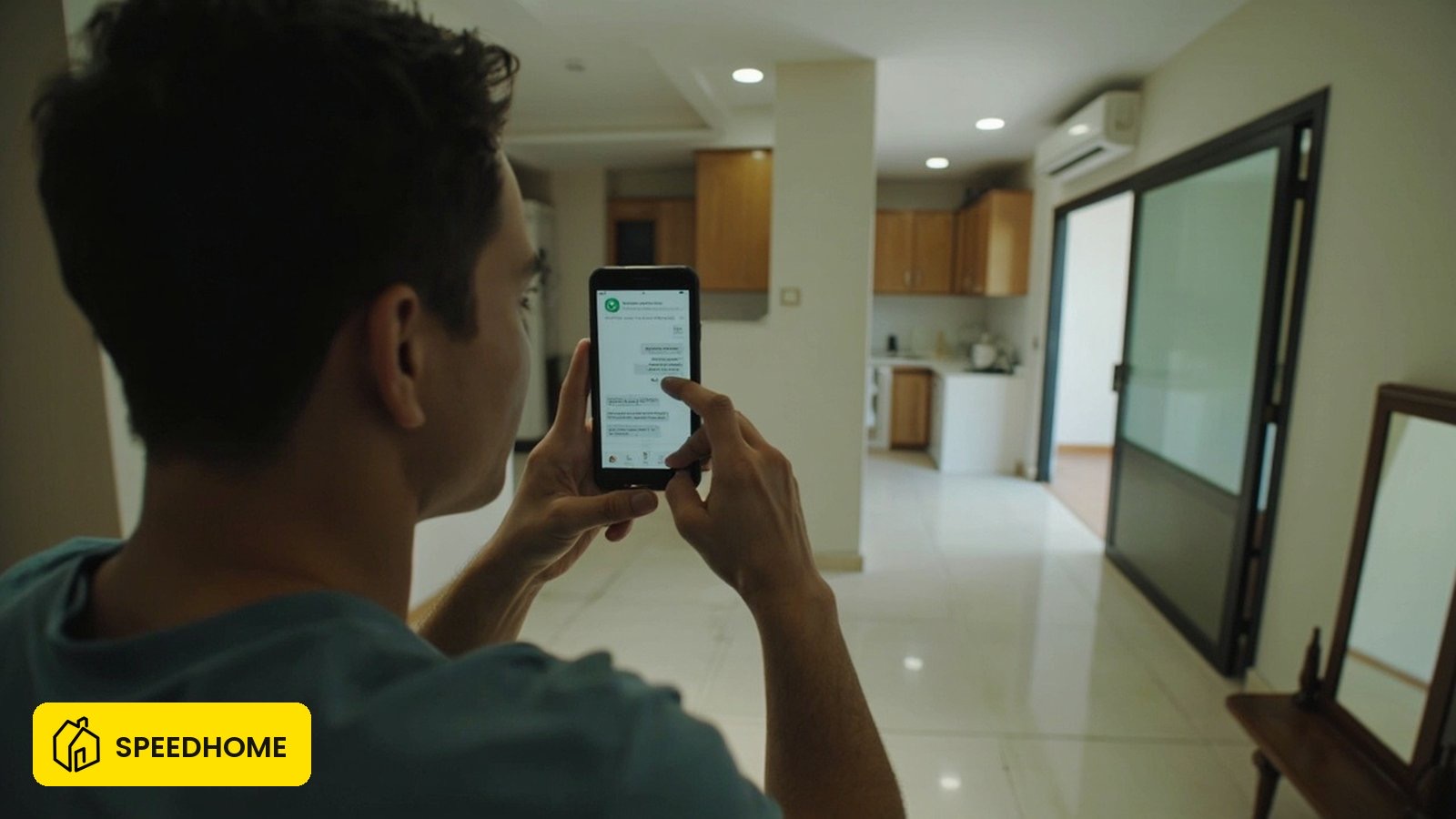
Send a written message that names the unit, the fault, when it started, and whether it is urgent. Attach a photo or short video. Written notice protects you — a landlord who ignores documented requests in a reasonable time is not acting in good faith.
A WhatsApp message with a photo creates a timestamp record that matters if the dispute reaches a court or mediation. The message does not need to be formal — it needs to be clear and dated.
What to include in your repair report: - Which item or area is affected - What the symptom is (not cooling, leaking, broken, no power) - When you first noticed it - Whether the issue is urgent — water damage, electrical hazard, or loss of a key service - A photo or short video showing the problem
Copy-paste template (WhatsApp or SMS — not legal advice):
Hi [landlord name], reporting a fault at [unit address]: [item, e.g. master bedroom aircond] is [symptom, e.g. dripping water from the indoor unit] as of [date and approximate time]. Urgent: [yes/no, and why — e.g. water reaching the socket]. Photo/video attached. Please confirm by [date + 2–3 days for non-urgent, same-day for urgent] how you plan to fix it. Thanks, [your name].
For a standard fault that is not urgent, give the landlord a reasonable response window. If there is no response after two to three weeks, follow up in writing and keep that message too. For urgent safety issues — gas leaks, severe water leaks, complete power failure — contact the landlord immediately and document the date and time.
In SPEEDHOME's recorded tenancy history, repair requests sent as a dated WhatsApp message with a photo tend to resolve within days; verbal-only reports often stretch into weeks and resurface at move-out as a "tenant never told us" dispute. The dated message is the cheapest evidence you will ever produce.
For a clean message format and a printable version, refer to the rental property repair and maintenance guide.
What if the landlord delays or refuses the repair?
A landlord who ignores a genuine structural or equipment repair is in breach of the implied duty of quiet enjoyment and fitness for habitation under general contract principles. Your options are escalation in writing, a neutral contractor quote, and — for serious cases — the Magistrates' Court small claims procedure.
Before threatening legal action, try a second written message that summarises the original report date, the fault, and the impact on you. Attach the earlier message and photo. Most landlord delays are inertia, not bad faith, and a clear summary resolves them.
If the fault makes the unit unsafe or uninhabitable and the landlord still does not act, document the impact and seek a written quote from a licensed contractor. Do not repair structural or major items yourself and deduct from rent without explicit written permission — this creates a dispute about the cost, not just the fault.
For disputes that reach a formal stage: - Claims up to RM5,000 — Magistrates' Court small-claims procedure under the Magistrates' Courts Act 1948 (no lawyers required) - Claims up to RM100,000 — Magistrates' Court - Larger claims — Sessions Court or High Court
Malaysia has no dedicated residential tenancy tribunal. The Tribunal for Consumer Claims does not handle a private residential tenancy repair dispute because a tenancy is an interest in land, excluded from its jurisdiction. For more detail on the dispute forum options, see the aircond servicing guide, which covers the dispute path for one of the most contested repair items.
How SPEEDHOME handles maintenance and damage claims when Zero Deposit is in play
On the platform Zero Deposit tenancy, end-of-tenancy damage is assessed by the platform's inspection workflow against the move-in record — not decided by the landlord alone — and the recoverable amount is capped under the managed rental-risk system, not a full-coverage guarantee.
In practice this means three things on move-out day. First, the SPEEDHOME inspection compares the unit to the move-in condition report and timestamped photos; if you kept your own dated copy, that record is the tie-breaker. Second, deductions are limited to documented damage beyond fair wear and tear, valued at depreciated cost, not new-for-old. Third, contested items can be raised through SPEEDHOME's platform review before any amount is finalised, so the landlord is not the only voice in the room.
Zero Deposit is a managed rental-risk system, not an insurance product. It replaces the upfront cash deposit; in a rare severe damage case the recoverable amount can be limited. Read the Zero Deposit disclosure before you sign. Browse SPEEDHOME rentals to see which units qualify for Zero Deposit.
Who pays the maintenance fee — you or your landlord?
The strata maintenance fee and sinking fund belong to the property owner, not the tenant, under the Strata Management Act 2013 (SMA 2013). The landlord may write the cost into your rent, but the obligation to pay the JMB or MC is always the owner's.
Some tenancy agreements require the tenant to pay the maintenance fee directly to the management body. If yours does, keep receipts. If you pay and the landlord later disputes it, those receipts protect you. If the TA is silent, do not pay the JMB directly — pay your rent and let the landlord settle the fee from it.
If the landlord stops paying the maintenance fee and the JMB or MC starts restricting access (lift card, facilities) because of the owner's arrears, that is a JMB-vs-owner dispute, not a tenant-vs-landlord one — but it directly affects you. The Strata Management Tribunal is the right forum for owner-side strata disputes under SMA 2013 s.25 and s.30; the JMB and strata management guide walks through how it works in practice.
For the full strata fee breakdown — share units, sinking fund, penalty ladder — see the maintenance fee guide.
SPEEDHOME is one option worth comparing alongside the routes above.
FAQ
Who is responsible for property maintenance in a Malaysian rental?
Tenants handle routine upkeep during occupancy; landlords handle structural failure, major equipment breakdowns, and pre-existing defects. The tenancy agreement governs; Malaysia has no single statute that allocates every repair by law. Examples that almost always fall on the landlord: a water heater that fails at year six, a ceiling leak from the floor above, a roof tile displaced in a storm, or a compressor that dies of age. Examples that almost always fall on the tenant: blocked kitchen drains caused by food waste, broken glass from an internal accident, paint damage from wall-mounted fixtures, or an aircond that stops cooling because the filter was never cleaned. The agreement and your move-in photos decide the grey cases.
What counts as fair wear and tear, and what counts as damage?
Fair wear and tear is normal ageing from ordinary use — faded paint after three years, slightly worn carpet, stiff door hinges. Damage is deterioration caused by misuse, accidents, negligence, or lack of basic maintenance. A practical test: would the same mark, scratch, or wear have appeared if a careful tenant had lived there for the same period? If yes, it is fair wear and tear. If no, it is damage. Move-in photos are the most reliable way to separate the two at move-out.
Can a landlord deduct the full cost of replacing an old item from the deposit?
No. You can only be charged for the loss in value caused by your action — the depreciated value of the damaged item, not a brand-new replacement. An old water heater that was already eight years old is not replaced at new-unit cost just because you cracked the casing. This is the betterment principle, and it means your deposit cannot be used to renovate the unit for the next tenant. If the landlord quotes you a full new-item price, ask for the depreciated breakdown in writing; most disputes end there.
What should I do if the landlord refuses to fix something that makes the unit unliveable?
Report the fault in writing with a photo and a date, then follow up if no response comes within a reasonable period. For urgent safety issues, document immediately. If repeated written requests are ignored and the fault is serious, the Magistrates' Court small-claims procedure handles claims up to RM5,000 without needing a lawyer. Larger claims go to the Magistrates' or Sessions Court. Keep all messages, photos, and any contractor quotes — the message record, not the conversation, decides the dispute.
How long does a landlord have to fix something that makes the unit unliveable?
There is no single statutory deadline for non-urgent residential repairs in Malaysia. As a working rule: urgent safety hazards (gas leaks, severe water leaks, complete power failure) should be addressed within 24–48 hours; standard non-urgent faults within 14 days. If the landlord misses both windows after a written request, you have evidence for escalation. The timeline anchor is your dated message and the landlord's non-response, not a clock — so always send the second reminder before you act, and keep it.
Is the strata maintenance fee my responsibility as a tenant?
No, unless your tenancy agreement specifically says you pay it. Under the Strata Management Act 2013, the maintenance fee is owed by the unit owner to the joint management body or management corporation. If the TA is silent, pay your monthly rent and let the landlord settle the fee.
Does Zero Deposit cover property damage claims?
Zero Deposit is a managed rental-risk system, not a financial guarantee product. It replaces the upfront cash deposit; in the rare case of severe end-of-tenancy damage the recoverable amount can be limited, so it does not provide a full-coverage guarantee. Renting through SPEEDHOME means damage claims are assessed on records and evidence through the platform, not unilaterally by the landlord alone. Browse SPEEDHOME rentals to see which units qualify.