
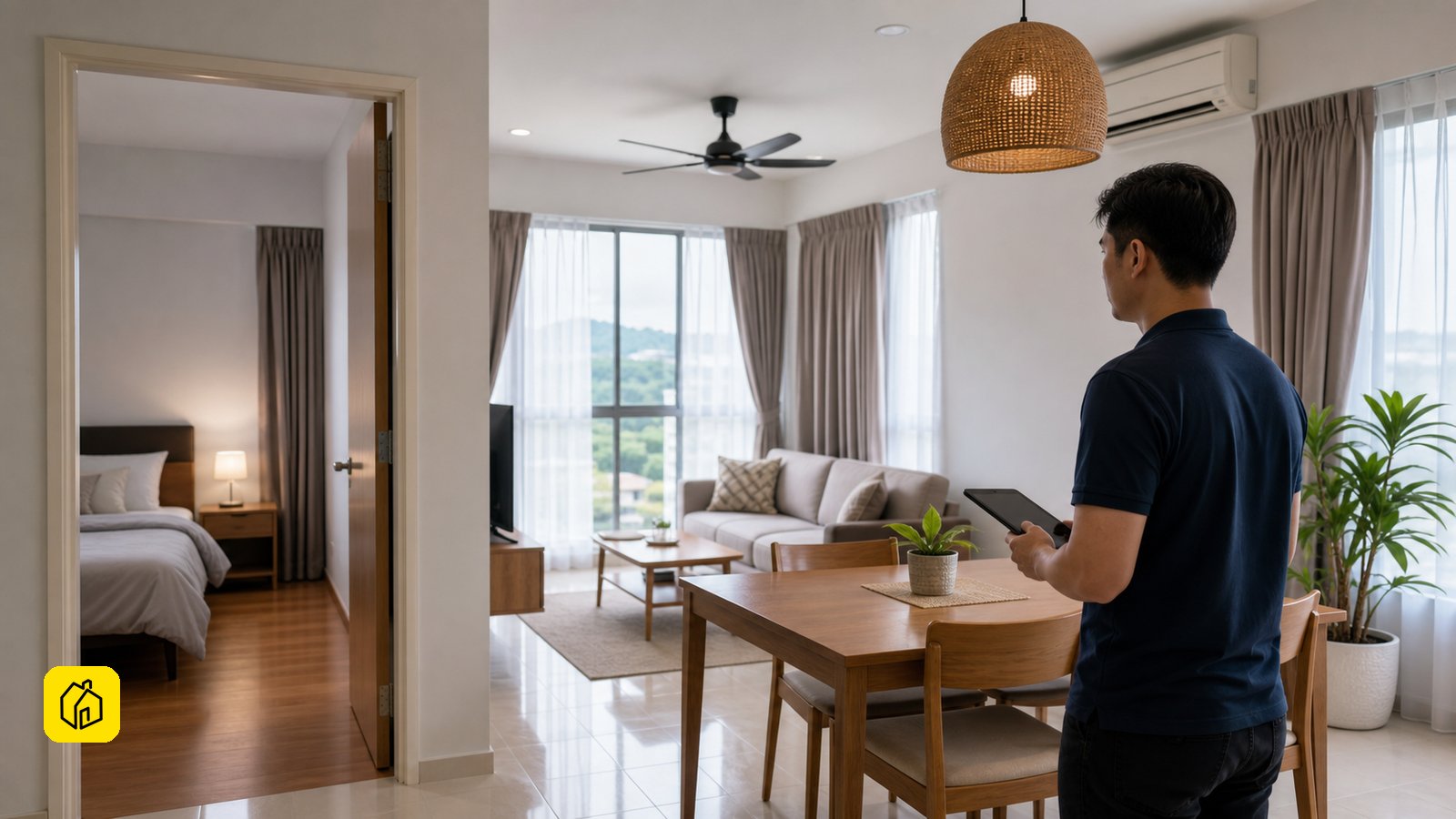
Whole-unit default with a pet-friendly edge — that is the verdict at The Nest Residences, and this time the demand proof is our own board. A dedicated RM1,350 pet-friendly card has collected 251 chat requests and 41 viewing appointments over 1.8 years — the strongest first-party demand record of this batch — and a second dedicated card asks RM2,300, ten days live, also pet-friendly. The Mudah entity splits clean across sixteen measured cards: 2-beds (755-798 sqft) run RM1,400-1,750, 3-beds (1,076-1,289 sqft) RM1,900-2,600. Rooms: nothing measured in-building, and corridor room rates never clear the whole bands. Short stay: zero Nest-named Airbnb. One honest hole: Brickz has no file for this building, so no transacted yield prints anywhere on this page — the exit is your valuation work, not a median.
Three ways to run your unit
Pick a model card, put in your own numbers — the loaded rent is the RM1,580 band mid of the 2-bed plate your 251-chat predecessor priced at RM1,350, and the purchase field is deliberately empty until a sale basis exists. The answer updates as you type.
Loading the renovation ROI comparison…
What can you earn?
First-party first, and at The Nest it is the story: SPEEDHOME's board carries two dedicated cards. The RM1,350 pet-friendly one has run since 28 December 2024 — 251 chat requests, 41 viewing appointments, the demand record at that price point. The RM2,300 pet-friendly twin went live 2 October 2026 and already holds 14 chats and 5 viewings. Both pet-friendly; that is the measured edge in a corridor where pet-allowed supply runs thin.
The measured market, every card read. Mudah's dedicated entity prints "16 Apartment / Condominium For Rent The Nest Residences in Old Klang Road, Kuala Lumpur" — a clean plate split: "RM 1,400 · 755 sq.ft. · 2 Bed 2 Bath", "RM 1,750 · 798 sq.ft. · 2 Bed 2 Bath · Fully Furnished", "RM 1,900 · 1,076 sq.ft. · 3 Bed 2 Bath", "RM 2,600 · 1,289 sq.ft. · 3 Bed 3 Bath · Fully Furnished". EdgeProp's rental excerpt corroborates a 2-bed near RM2,000 — excerpt grade, above the measured band, so the band stays Mudah's. The own-board RM1,350 sits at or below the 2-bed floor and the RM2,300 inside the 3-bed band; their plate and furnish classes are unstated, so they are presented as plate classes, never one "Nest rent".
Worked arithmetic — and where it stops. Annualised asking rent runs RM16,800-21,000 on the 2-bed plate and RM22,800-31,200 on the 3-bed. But the denominator does not exist: Brickz returned "Page not found" on all three project shapes and the exact-name search surfaces only Pinang Apartment's area feed. No transacted median, no asking ladder worth quoting — so no yield figure prints on this page. Enter your own dated purchase basis above; that is the honest underwrite until a sale file lands.
Rooms: no Nest room card exists on any channel this sweep. The corridor room machine is at other addresses — OUG Parklane RM600 (15 chats), Citizen 2 RM800 (81), Palm Spring AG13 RM850 pet-friendly (83). Two rooms at RM600-850 gross RM1,200-1,700 against a RM1,400-1,750 band; three gross RM1,800-2,550 against RM1,900-2,600 — overlap only, never a clear win. Whole-unit default.
Short stay: no Airbnb card title contains "Nest". The Jalan Puchong edge is carried by other properties — "BV Old Klang Road Jalan Puchong 2R2B Unifi Arena" at RM1,326 with 32 reviews is the visible operator, not a Nest unit. Context, not a model here.
Running costs: maintenance, sinking fund and quit rent are NOT PUBLISHED — the RM0.25-0.30 psf that circulates is the area benchmark class, not this building's rate. See the real cost of self-managing a rental.
Why a two-block OKR seam estate prices pet-friendly whole units
The Nest is a 618-unit, two-block freehold serviced residence (28 and 36 storeys externally corroborated) on the Jalan Puchong / Old Klang Road seam, completed around 2019, with common 2- and 3-bed plates from 755 to 1,289 sqft. What the seam produces is overlapping demand — Mid Valley and Puchong both reachable — and what the building's own board proves is that the pet-friendly whole-unit card is the one that compounds demand: 251 chats on 1.8 years is a renewal-grade record, and the corridor's pet-allowed alternatives are thin and scattered (Happy Garden RM1,950 at 32 chats, Bloomsvale RM3,000 at 14, an OUG Parklane room at RM600). SPEEDHOME coliving is cat-friendly — cats welcome in our coliving rooms — and pet-friendly setups earn roughly 15-20% more where allowed, market context rather than a Nest measurement. The scarcity play here is not a cleverer floor plan; it is being the compliant pet-friendly whole unit on a board that already proves the demand.
5 checks before you commit
-
Get the real title document — freehold per the family record; your individual issue document confirms category, express conditions and parking. Done: you hold the copy.
-
Get the management's written position on short-stay, multi-tenancy and pets — one letter answers all three, and the pet answer is the one worth money at The Nest. SPEEDHOME coliving is cat-friendly — cats welcome in our coliving rooms — whatever the handbook says for the corridors. Done: the letter itself.
-
Get the real running costs — maintenance, sinking fund, quit rent; nothing published, and the RM0.25-0.30 psf talk is the area class, not the rate. The AGM pack carries the audited accounts. Done: the latest statement.
-
Show your fit-out plan to DBKL before structural work — reversible refresh yes, partitions never without written approval. Done: written reply.
-
Do not underwrite an exit price on hearsay. No Brickz file exists for this building; a dated same-floor transaction or a professional valuation is the only denominator that counts, and a reversible SPEEDRENO fit-out keeps every door open while you get one. Done: a written valuation basis, not a portal rumour.
FAQ
Can you rent rooms at The Nest Residences?
Nothing was measured in-building — zero Nest room-class cards on any channel. Corridor rooms (RM600-850 at OUG Parklane, Citizen 2, Palm Spring) never clear the measured whole bands: 2 rooms gross RM1,200-1,700 against RM1,400-1,750, 3 rooms RM1,800-2,550 against RM1,900-2,600. Overlap only; whole-unit default. See the room rental and co-living guide.
What yield does The Nest Residences give?
No transacted yield exists this sweep — Brickz has no project page for the building (three shapes return "Page not found"), so there is no median to divide by. The measured inputs are the asking bands: RM1,400-1,750 (2-bed) and RM1,900-2,600 (3-bed). Enter your own dated purchase basis in the calculator above; treat any quoted "Nest yield" without a sale file as invented.
Is short-stay allowed at The Nest Residences?
Zero Nest-named Airbnb units were measured. The corridor's short-stay demand runs on other properties (the RM1,326/32-review BV unit down the road). Treat short stay as closed until the management's written position says otherwise — an MC by-law can prohibit it outright.
Are pets allowed at The Nest Residences?
The measured signal is strong: both dedicated SPEEDHOME cards at The Nest are pet-friendly, and the RM1,350 one holds 251 chats. SPEEDHOME coliving is cat-friendly — cats welcome in our coliving rooms — and pet-friendly setups earn roughly 15-20% more where allowed, market context from the operator registry. The building's own written stance is still the letter's to answer; the offer is SPEEDHOME policy.
What running it looks like
Setup is two documents: the title copy (freehold) and the management letter. The work is one plate inside the measured band — pet-friendly where the letter allows, furnished to the standard the RM1,750 and RM2,600 fully-furnished cards set, priced against the 251-chat record rather than above it. Zero deposit, professional screening, and SPEEDHOME runs the listing, the viewings and the rent collection while you approve the tenant before anything is signed; if the unit needs condition work first, that is one company too, not a contractor who leaves after handover.
Ready? List your unit with SPEEDHOME — zero deposit, we run the viewings, you approve the tenant.
The two-card dedicated board read, the 16-card Mudah entity, the Brickz three-shape probe, the Airbnb read and the cost probes are reads of 12 October 2026 (evidence file the-nest-residences-market-evidence-2026-10-12.yaml); the annualised rent figures are labelled derivations on asking figures, and no yield prints without a sale basis. More: the room rental and co-living guide and the real cost of self-managing a rental.