
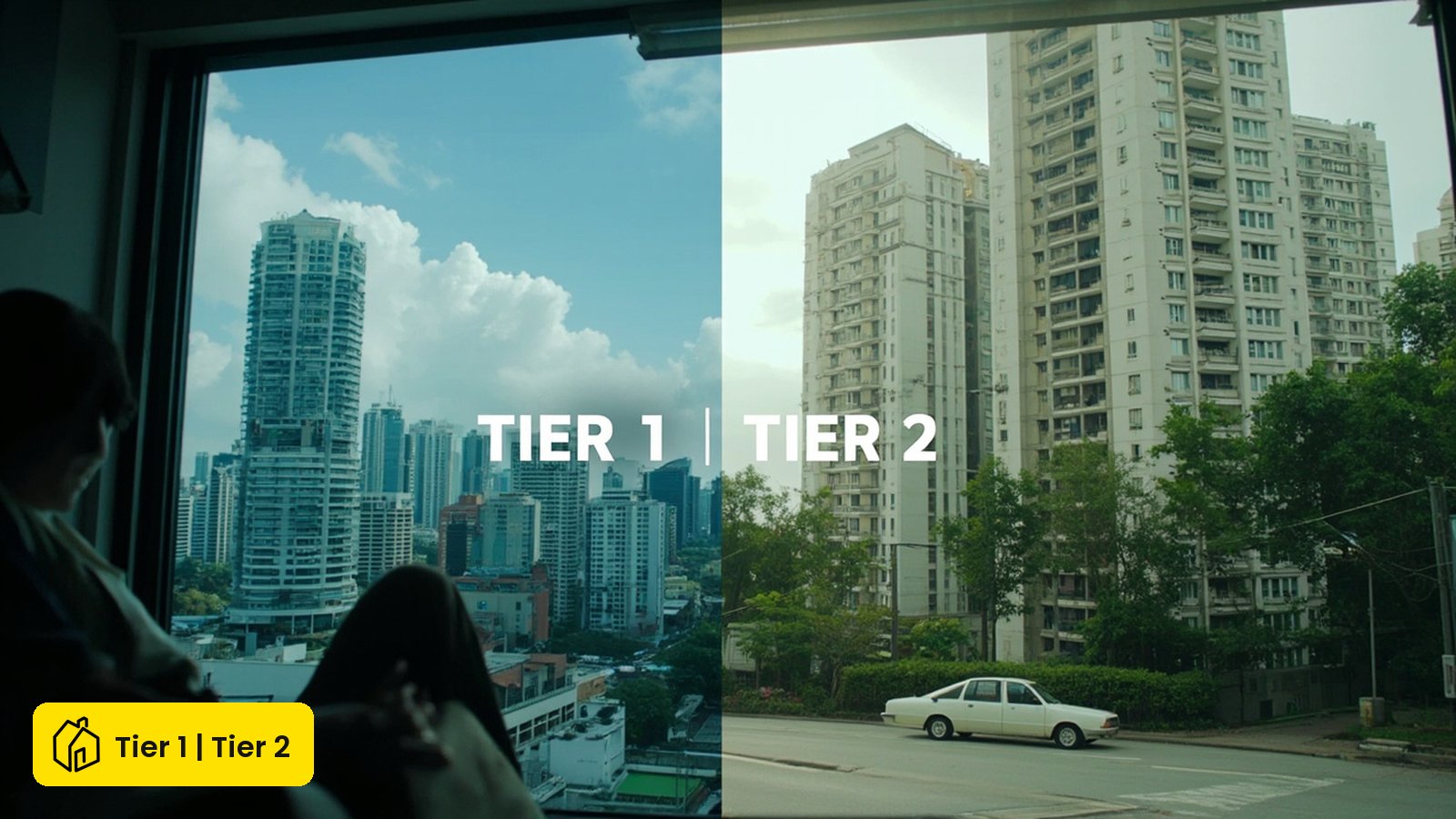
Tier 1 vs Tier 2 rental micro-markets: which is better?
Choosing between a Tier 1 city-core unit and a Tier 2 suburban micro-market is not just about rent — it is about yield, upfront deposit cash, commute honesty, and whether Zero Deposit is available on the listing you want. Neither tier is automatically better. This page gives landlords and tenants the full decision matrix, with verified numbers and no inflated claims.
What "Tier 1" and "Tier 2" actually mean in Malaysian rentals
Tier 1 micro-markets are city-core and established mid-ring locations — KLCC, Bangsar, Mont Kiara, Petaling Jaya — where rents and competition are highest. Tier 2 covers secondary suburban corridors — Cheras, Setia Alam, Cyberjaya, Kajang — where rents are lower and upfront deposit cash is proportionally smaller.
The distinction matters beyond marketing: it determines the size of the deposit stack a tenant must produce, the gross yield a landlord can realistically model, and which listings are most likely to have Zero Deposit available based on unit price range and platform penetration.
Neither label is a fixed regulatory category. "Tier 1" and "Tier 2" are shorthand used by landlords, agents, and platforms to describe relative market depth. A single corridor — say, the LRT Ampang line — can span both tiers within four stations.
The honest yield picture by tier
Malaysia's gross residential yield averaged about 4.9% in Kuala Lumpur and 5.3% in Johor Bahru in early 2026, per Global Property Guide (PropertyGuru data). NAPIC does not publish a national yield figure. Net yield — after vacancy, maintenance, and repairs — is materially lower.
The EPF dividend for 2025 was 6.15%. That means a typical gross yield in a Tier 1 KL micro-market sits below EPF before costs are deducted. Tier 2 micro-markets in suburban corridors can post slightly higher gross yields precisely because entry prices are lower relative to achievable rents — but vacancy risk and commute resistance among tenants are higher.
| Micro-market tier | Example locations | Indicative gross yield (Q1 2026) | Vacancy risk | Deposit stack on a RM1,800/mo unit |
|---|---|---|---|---|
| Tier 1 — city core | KLCC, Bangsar, Mont Kiara, Damansara Utama | ~4.5%–5.2% gross | Lower — high demand, shorter void periods | RM6,300 upfront (2+1+½) |
| Tier 1 — established mid-ring | Petaling Jaya (SS2/Damansara Jaya), Ampang Hilir | ~4.8%–5.5% gross | Low-medium | RM6,300 upfront at RM1,800/mo |
| Tier 2 — inner suburban | Cheras South, Kepong Baru, Wangsa Maju | ~5.0%–5.8% gross | Medium | RM3,500–RM5,250 at RM1,000–RM1,500/mo |
| Tier 2 — outer suburban/satellite | Kajang, Shah Alam, Cyberjaya, Setia Alam | ~5.2%–6.0% gross | Medium-high — commute friction | RM3,150–RM4,200 at RM900–RM1,200/mo |
Yield figures are derived from Global Property Guide Q1 2026 (PropertyGuru listing data); they represent gross yield on purchase price before vacancy, maintenance, and management costs. Do not use these as a per-unit guarantee. Net yield is lower in every tier. Rent ranges are indicative market medians; verify on the live portal before making any financial decision.
The deposit-stack gap between tiers — in real ringgit
Malaysia has no statutory deposit cap. The 2+1+½ formula (security + advance + utility) is a market convention applying in both tiers — the percentage is identical; only the ringgit amount differs when the rent is lower.
| Deposit line | Tier 1 (RM2,500/mo unit) | Tier 2 (RM1,200/mo unit) | Zero Deposit (where the unit qualifies) |
|---|---|---|---|
| Security deposit (2 months) | RM5,000 | RM2,400 | RM0 |
| Utility deposit (½ month) | RM1,250 | RM600 | RM0 (per current plan terms) |
| Advance rental (1 month) | RM2,500 | RM1,200 | Same as rent |
| Cash before keys | RM8,750 | RM4,200 | Advance rental only |
Not all units qualify for Zero Deposit; eligibility is shown on the individual listing and varies from unit to unit across the platform. Current plan terms and limits apply. Malaysia has no Residential Tenancy Act currently in force; deposit amounts are governed by the tenancy agreement and general contract law (Contracts Act 1950).
The Tier 1 upfront cost advantage goes to landlords — higher cash deposit in absolute terms means more cushion if the tenancy turns bad. But that cushion is weaker than it looks: the Contracts Act 1950 s.74 limits deductions to proven loss, and a landlord holding RM5,000 who cannot produce a move-in video, repair quotes, and a rent ledger will struggle in small claims court. The deposit is not a guarantee; it is evidence-dependent.
The commute honesty check — do not skip this
Before comparing Tier 1 versus Tier 2, verify the real commute — not the Google Maps estimate at 9 pm on a Sunday. Many Tier 2 suburban listings quote proximity to an LRT or MRT station without disclosing that the walk is 3 km, the feeder bus runs infrequently, or that the station is served by a single line with no interchange. A RM700/month saving disappears if the tenant commutes 90 minutes each way.
What to check before comparing tiers: - The actual distance to the nearest station (map the walk, not the straight line). - Whether a shuttle, feeder bus, or Grab ride is needed — and its daily cost. - Which lines serve the station and where they connect. - Peak-hour journey time to the tenant's workplace, not off-peak.
A Tier 2 unit with a realistic 40-minute door-to-door commute is genuinely competitive with a Tier 1 unit where the monthly rent saving covers the transport cost with margin to spare. A Tier 2 unit with a 90-minute commute requiring a car is not a value proposition for a carless tenant, regardless of the rent.
The Zero Deposit layer — where it changes the tier decision
Zero Deposit is a managed rental-risk system, not a financial guarantee product. It replaces the upfront cash deposit; in the rare case of severe end-of-tenancy damage the recoverable amount can be limited, so it is not a blanket guarantee.
Zero Deposit availability is a listing-level fact, not a tier-level promise. In practice:
- Tier 1 units at higher absolute rents may or may not have Zero Deposit depending on whether the landlord has opted in and the listing qualifies under current platform terms.
- Tier 2 units at lower rent points can be more accessible under Zero Deposit because the advance rental is a smaller absolute sum and the landlord's risk profile on a lower-rent unit is different.
For a tenant deciding between tiers, Zero Deposit converts an RM8,750 upfront commitment on a Tier 1 RM2,500/month unit to approximately RM2,500, and an RM4,200 commitment on a Tier 2 RM1,200/month unit to approximately RM1,200. The tier-level cash difference narrows substantially under Zero Deposit — which changes the comparison from "how much can I produce upfront" to "which location actually fits my life."
What replaces the cash deposit for the landlord: an Experian-backed credit and income check, a signed tenancy agreement with documented move-in evidence, and the platform's protection plan under current terms and limits. SPEEDHOME platform records show roughly 30% of applicants do not pass screening — the tenant pool that does is materially different from an open-market posting with no formal vetting.
The one scenario where cash deposit outperforms: severe end-of-tenancy damage after loss-of-rental coverage ends. The claim rate for that outcome is in the low teens. For full detail on the honest tradeoffs, see Zero Deposit rental platforms in Malaysia.
Full decision matrix — which tier for your situation
Neither tier wins outright — the right choice depends on your commute, upfront cash, and whether Zero Deposit is available on the specific listing you want. Use this matrix row by row against your actual situation.
| Situation | Tier 1 favoured | Tier 2 favoured | Zero Deposit changes this? |
|---|---|---|---|
| Tenant: needs to minimise upfront cash | — | Yes — lower absolute ringgit even at 2+1+½ | Yes — ZD narrows the gap; compare advance rental only |
| Tenant: needs to minimise monthly cost | — | Yes — lower base rent | Neutral — ZD does not reduce rent |
| Tenant: commute to city core daily | Yes — shorter commute, lower transport cost | Only if real commute is under 45 min door-to-door | Neutral |
| Tenant: remote-first / hybrid (1–2 days/week) | Maybe — if lifestyle access matters | Yes — larger space for lower rent, commute less frequent | Neutral |
| Landlord: maximising yield on a RM property already owned | Model the net yield honestly (see table above) | Tier 2 can post higher gross yield but carries vacancy risk | ZD can reduce void period by attracting screened tenants who couldn't produce the full cash stack |
| Landlord: minimising vacancy risk | Yes — demand depth is higher in Tier 1 | Risk depends on micro-location and commute rating | ZD broadens the qualified applicant pool in both tiers |
| Landlord: protecting against tenant default | No guarantee in either tier | No guarantee in either tier | ZD screening stack reduces correlated default risk; not a guarantee of recovery |
| Both: comparing schools / facilities | Depends on specific corridor | Some Tier 2 corridors have strong schools and malls | Neutral |
This matrix is a decision aid, not financial advice. Verify all numbers against live listings and current platform terms before committing.
What competitors do not tell you
Most property portals frame Tier 1 vs Tier 2 as a simple price-vs-commute trade-off. Four things they consistently omit are material to any real decision.
Most property portals present Tier 1 vs Tier 2 as a straightforward price-vs-commute trade-off, without: 1. Disclosing that gross yield is a pre-cost figure that can drop below EPF on a net basis. 2. Explaining that the 2+1+½ deposit formula applies at both tiers — the percentage is the same; only the ringgit amount differs. 3. Acknowledging that Zero Deposit is a listing-level decision, not a tier-level product. 4. Giving commute honesty beyond a straight-line distance to the nearest station.
SPEEDHOME platform records provide a different data point: on managed listings, the average time from a tenant's first rental default to recovery action is about 31 days — a number that is tier-agnostic and that illustrates why screening matters more than deposit size in predicting tenancy outcomes.
Browse Zero Deposit verified listings to see which units qualify by location — the eligibility filter on the listing page is the only reliable source, not a tier label.
For the full breakdown of what each deposit type secures and how to read the refund rules, see the rental deposit Malaysia guide.
FAQ
Is Tier 1 rental always safer for a landlord than Tier 2?
Not automatically. Tier 1 micro-markets have shorter void periods and higher demand depth, which reduces vacancy risk. But tenant default risk is not correlated with tier — it is correlated with tenant screening quality. A Tier 2 unit with a screened, income-verified tenant carries lower default exposure than a Tier 1 unit let to an unscreened applicant who produced a large cash deposit. Deposit size is not a proxy for tenant reliability.
Does Zero Deposit cost the tenant more in the long run?
Zero Deposit replaces the upfront cash deposit with the platform's current plan terms. The tenant does not pay a traditional refundable deposit; instead, the terms set out what applies in the event of damage or breach. Whether the total cost over a full tenancy is higher or lower depends on the specific plan terms, the tenant's track record, and whether any claim is made. Zero Deposit is a managed rental-risk system — it is not free money, and it is not a financial guarantee product.
Which tier has better rental yield in Malaysia?
Malaysia's gross residential yield averaged approximately 4.9% in Kuala Lumpur and about 5.3% in Johor Bahru in early 2026 (Global Property Guide, PropertyGuru data). Outer suburban Tier 2 corridors can post higher gross yields because entry prices are lower. However, gross yield does not account for vacancy, maintenance costs, management fees, or tax. Net yield in every tier is materially lower. The EPF dividend for 2025 was 6.15% — a useful personal benchmark for what a passive return looked like that year.
Can I negotiate a lower deposit in a Tier 2 area?
Yes — in any tier. Malaysia has no statutory deposit cap. The 2+1+½ formula is a market convention, not a law. In a softer market or with a long vacancy, landlords in both tiers often accept 1+1+½ or even 1+1. The strength of your negotiating position depends on local demand, the landlord's holding costs, and your own evidence of rental reliability (credit check, employment letter, references). Zero Deposit listings remove the negotiation entirely at the deposit-cash level.
What happens if a landlord in either tier refuses to return the deposit?
Malaysia has no dedicated residential tenancy tribunal. A deposit dispute is a private contract matter decided in the civil courts. For claims up to RM5,000, the Magistrates' Court small-claims procedure (Order 93) applies — no lawyer is needed and the filing fee is approximately RM20. Larger claims go to the Magistrates' Court (up to RM100,000) or Sessions Court. Gather your tenancy agreement, move-in photos or video, payment records, and all written communications before filing.
Is there a law capping deposits at two months in Malaysia?
No. As of 2026, Malaysia has no Residential Tenancy Act in force. The proposed RTA is still a draft Bill, not yet tabled in Parliament or gazetted. Deposit amounts are set by the tenancy agreement and governed by general contract law (Contracts Act 1950). A landlord's right to retain is limited to proven loss under s.74 — not to the full deposit by default.