
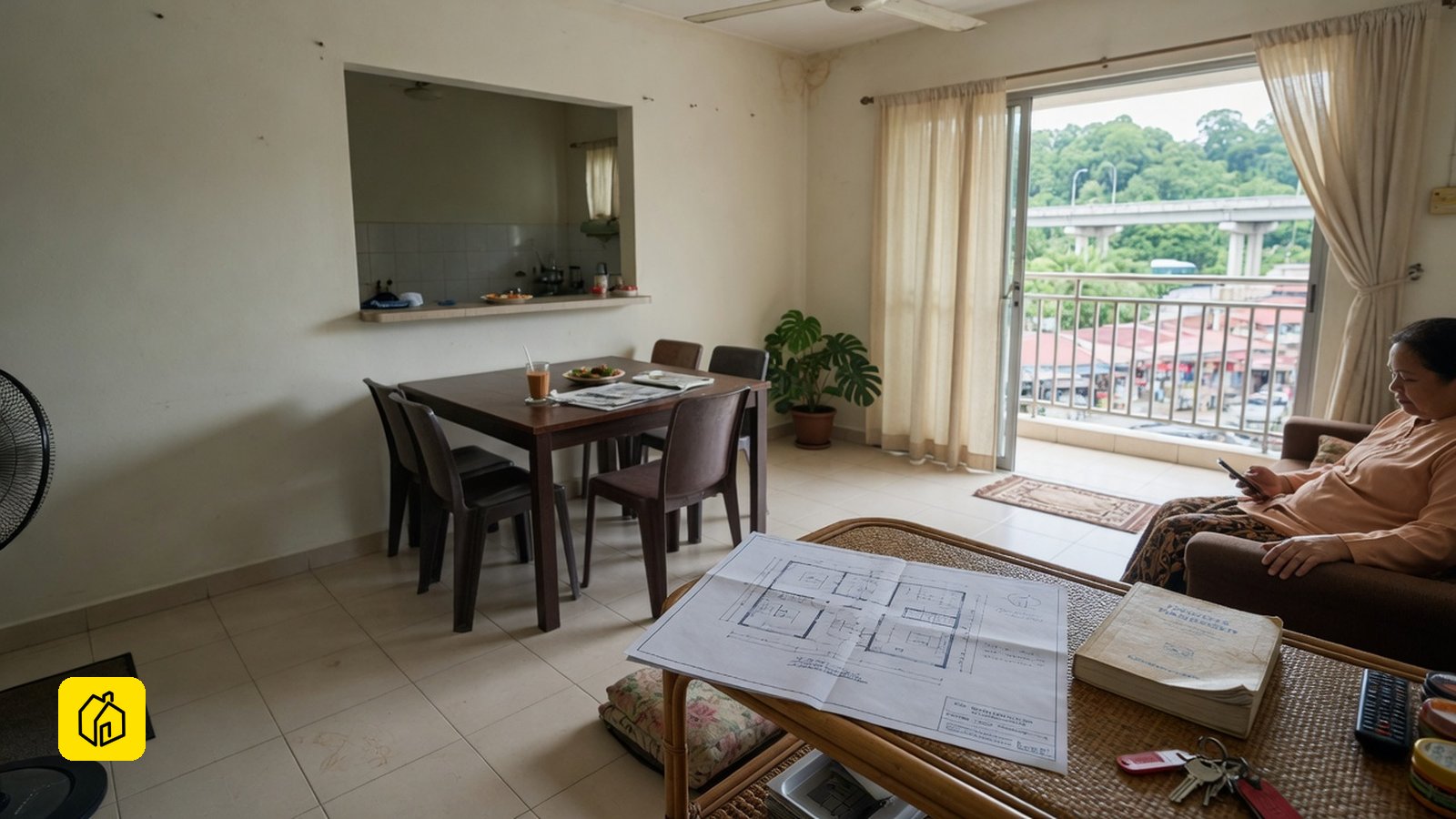
The verdict at Widuri Impian is the whole-unit default on one tight measured band. Seven live Mudah cards on the uniform 956-1,099 sqft 3-bed run RM1,300-1,800 — one plate, one band. Worked on the PropertyGuru asking floor, labelled hard, before 2.19%: RM1,300-1,800 x 12 = RM15,600-21,600 on RM279,999 = ~5.6-7.7% gross — asking floor against a measured band, the denominator is the weak leg (Brickz not found). The split is marginal: three corridor rooms at RM300-650 gross RM900-1,950, which merely overlaps the whole-unit band — in-building rooms are unmeasured. Our own board carries zero dedicated listings — first-mover vacancy. Short-stay: zero building-named. Maintenance: RM170 exists only in summarizer prose, parked.
Three ways to run your unit
Pick a model card and put in your own numbers. The rent field loads RM1,300 — the floor card of the measured seven, the honest load with zero own-board corroboration — and the purchase field stays yours: RM279,999 is an asking floor off a search snippet, iProperty's "from RM312.5K" is summarizer prose, and no transacted row was found. The rooms card stays closed: no in-building room rate exists. The answer updates as you type.
Loading the renovation ROI comparison…
What can you earn?
The measured band, full read. The Mudah entity carries 7 live cards (oldest 8 October) under the H1 "7 Apartment / Condominium For Rent Widuri Impian in Desa Petaling, Kuala Lumpur": "RM 1,300 3Bed 2Bath 980 sq.ft" at the floor to "RM 1,800 3Bed 2Bath 1,099 sq.ft Fully Furnished" at the top, a mix of partial and fully furnished, agent-listed with one private. One format, one band, RM1,300-1,800 — there is no layout mix to arbitrage.
First-party — an absence, and three corridor records. Zero dedicated SPEEDHOME listings at the building: the board page is the area template, which is first-mover vacancy. The corridor's own-board demand records say the neighbourhood pays: a single room at Chan Sow Lin, RM650 with utilities and WiFi, 324 lifetime requests and 32 viewings since October 2024 — a two-year room machine two kilometres away, corridor comp, never this building; Residensi Tasikmas at RM1,500 (3-bed, 180 requests since May 2023); D'Nuri Residences in Desa Petaling itself at RM2,000 (90 requests since September 2026). The in-corridor 3-bed class is RM1,500-2,000, and Widuri Impian's band sits at its value end.
The sale side is the weak leg — said plainly. PropertyGuru's project page: "Selling prices in Widuri Impian start from RM 279,999" — an asking floor, search-snippet grade. Brickz carries no row (one bounded query; 2008-era stock is sparse on it), so the transacted denominator is unmeasured and every yield here is asking-basis only. iProperty's "10 condos for sale from RM312.5K" is summarizer prose, parked, never cited as a price. Worked on the floor, labelled hard: RM1,300-1,800 x 12 = RM15,600-21,600 on RM279,999 = ~5.6-7.7% gross, before the 2.19% processing fee.
The split, marginal and honest. The corridor's room evidence — the Chan Sow Lin machine at RM650 at the top, Pangsaria Desa Petaling's room class from RM300 at the floor — puts three rooms at RM900-1,950, which overlaps the whole-unit band rather than beating it. In-building rooms are unmeasured, so the split buys nothing certain here; the registry's room bands (RM600-700 / RM800-900 / RM1000-1200) remain labelled defaults. See the real cost of self-managing a rental.
Why a one-format 2008 leasehold underwrites clean
Widuri Impian is Dwitasik's 99-year leasehold pair off Jalan 2/125G — Block 1 at 20 storeys, Block 2 at 21, 480 units, completed 2008 with IJM Construction as turnkey contractor — in one uniform format: 3-bed, 2-bath, 956-1,099 sqft, about 2 km from the Bandar Tasik Selatan TBS interchange with NPE, KESAS and KL-Seremban access, under DBKL. Uniformity is the underwriting: every comparable is same-format, the band is tight, and the question collapses to condition and price. Eighteen years in, the plant cycle is the hold-plan line — read the sinking-fund history before buying, and price the wet areas, wiring and plumbing first in any fit-out. Pets: nothing is published, and the offer stands regardless — SPEEDHOME coliving is cat-friendly, cats welcome in our coliving rooms — with pet-friendly setups earning roughly 15-20% more where allowed, market context from the operator registry.
5 checks before you commit
-
Read the real title document — 99-year leasehold is the record; confirm the parcel's remaining term and the quit-rent line, because the term is the yield's clock. Done: you hold the individual issue document of title.
-
Get the MC's written stance — multi-tenancy, short-stay and pets in one request; a one-format estate enforces one rule set. Done: the clauses, in writing, with the COB filing date.
-
Get the sinking-fund and maintenance record — the RM170 figure floating in search prose is unverified; the statements are the truth. Done: the last three years in writing.
-
Verify the sale side yourself — RM279,999 is an asking floor off a snippet and Brickz is empty here; your own dated sale is the only denominator. Done: your own comp, in writing.
-
Price at the value end deliberately — the band says RM1,300 clears and RM1,800 furnishes; the corridor says RM1,500-2,000 exists next door. Choose your end on purpose. Done: your ask, justified in writing. See the SPEEDRENO fit-out guide.
FAQ
What yield does Widuri Impian give?
Worked, asking-basis, labelled hard, gross, before the 2.19% processing fee: RM1,300-1,800 x 12 = RM15,600-21,600 on RM279,999 = ~5.6-7.7%. The denominator is the weak leg — an asking floor off a search snippet, no transacted row found. Bring your own dated sale.
Can you rent out rooms at Widuri Impian?
In-building rooms are unmeasured — no room card at the building exists on any surface read. The corridor says rooms pay (Chan Sow Lin's RM650 machine, 324 requests), but three corridor-class rooms at RM300-650 only match the whole-unit band. The split is marginal, not a flip; see the room rental and co-living guide.
Is short stay allowed at Widuri Impian?
No unit names the building — the grid's Sungai Besi corridor stock ("Ku Homestay Sg Besi" at $341, "LibertyHome 7.2bedroom" at $291, five nights, SGD-locale figures quoted as-is) is generic KL product. The MC's written stance gates the model regardless.
Are pets allowed at Widuri Impian?
The position is not published. Pet-friendly setups earn roughly 15-20% more where allowed, market context from the operator registry. SPEEDHOME coliving is cat-friendly — cats welcome in our coliving rooms; the offer is our policy, and the by-law variance travels in the same letter.
What running it looks like
Setup is three documents plus one discipline: the title with the remaining term, the MC's written stance, the sinking-fund history — and durable family-grade furnishing priced for the value end of a RM1,300-1,800 band, because this estate lets to one household at a time, two kilometres from TBS. The work is one clean household on a 956-1,099 sqft 3-bed — zero deposit, SPEEDHOME runs the listing, the viewings and the rent collection, and you approve the tenant before anything is signed. The plans sit on top: Standard at RM799 + SST a year, Protect at one month's rent, Protect+ at one and a half.
Ready? List your Widuri Impian unit with SPEEDHOME — zero deposit, we run the viewings, you approve the tenant.
The Mudah entity full read, the own-board pool reads, the PropertyGuru raw snippet, the Brickz non-find and the short-stay grid read are of 11 October 2026 (evidence file widuri-impian-market-evidence-2026-10-11.yaml, lane bi-mine-13b, server readers); the RM279,999 figure is an asking floor off a search snippet and the yield is asking-basis only — no transacted denominator exists; iProperty's "from RM312.5K" is summarizer prose, parked, never cited as a price; the RM170 maintenance figure is summarizer-grade, parked, re-probe candidate; the split arithmetic uses corridor room classes, never in-building rates; the SGD short-stay figures are quoted as-is in their SGD-locale fetch, never converted. More: the room rental and co-living guide and the Kuchai Lama rental guide.