
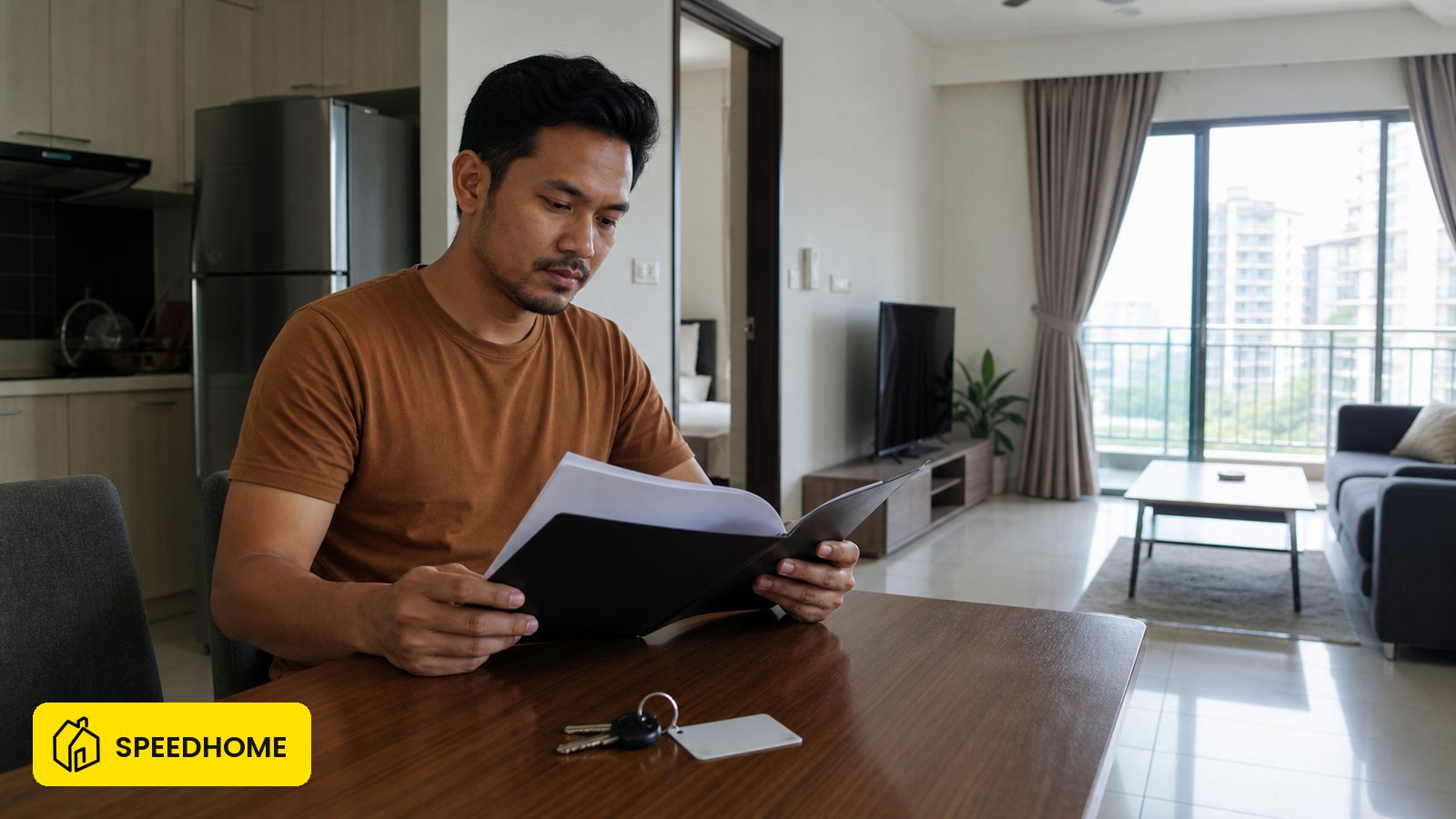
What is SPEEDHOME Zero Deposit?
SPEEDHOME Zero Deposit is a managed rental-risk system, not a financial guarantee product. It replaces the upfront cash deposit and keeps landlords protected through a protection plan — but for severe end-of-tenancy damage the recoverable amount can be limited. Not every unit qualifies.
Reviewed by SPEEDHOME Malaysia Rental Operations, June 2026. Reviewed against current tenancy-agreement terms and Malaysian contract law as of the review date.
SPEEDHOME platform data: the average time from a tenant's first rental default to recovery action is about 31 days — driven by early-detection monitoring, not a cash buffer.
The competitor angle: platforms such as Rumah-i / BlueDuck describe zero deposit as "insurance." That framing is inaccurate and matters: a regulated insurance product carries a policy schedule, defined insured events and a licensed insurer on the hook for the full claimed amount. Zero Deposit is an operator-managed risk layer (credit screening, documentation, protection plan) where the recoverable amount in edge-case scenarios can be less than a two-month cash deposit would have been. Knowing the real structure helps you make the right call.
The Malaysian rental deposit law: what the rules actually say
Malaysia has no statutory residential rent-deposit cap. Deposits are governed by the tenancy agreement, and a landlord's right to retain is limited to proven loss under general contract law (Contracts Act 1950 s.74). There is also no Residential Tenancy Act in force — the draft RTA has not been tabled in Parliament.
What that means in practice:
- The common market formula is 2 + 1 + ½: two months' security deposit, one month advance rental, half-month utility deposit — roughly 3.5 months of cash before you get the keys.
- No law sets a refund deadline. The tenancy agreement clause governs; 30 days after move-out is the most common contractual norm in Malaysian tenancy agreements. If your TA says nothing, you are negotiating under general contract law.
- If a landlord refuses to return the deposit without a lawful basis (proven damage or arrears), the recourse is civil court: small claims (no lawyers needed) for amounts up to RM5,000, or the Magistrates'/Sessions Court above that. Malaysia has no dedicated residential tenancy tribunal.
The three deposit types and the 2+1+½ stack
The standard Malaysian rental payment at signing is built from three distinct deposit lines plus the first month's rent. Understanding each one tells you exactly what you are paying for and what is refundable.
| Deposit type | Typical amount | What it actually secures | Refundable? |
|---|---|---|---|
| Earnest / booking deposit | ~½ or 1 month | Reserves the unit; rolls into advance rental on signing | Usually forfeited if tenant backs out |
| Security deposit | 2 months | Unpaid rent, tenant-caused damage, TA breach | Yes, less lawful deductions |
| Utility deposit | ½ month (sometimes 1) | Unpaid TNB / water / internet at move-out | Yes, less unpaid bills |
| Advance rental | 1 month | First month's rent paid before move-in | Applied to rent, not a deposit |
| Standard stack "2+1+½" | ≈ 3.5 months upfront | — | — |
Note: No law caps the deposit amount in Malaysia. The "2+1+½" stack is the common market formula, not a statutory requirement.
Move-in cost: traditional deposit vs Zero Deposit
Zero Deposit removes the security deposit and utility deposit line from the move-in payment. On a RM1,500/month unit, that frees up roughly RM3,750 in cash at signing — money that stays in the tenant's pocket instead of sitting locked in someone's account.
| Cost line | Traditional (2+1+½) | SPEEDHOME Zero Deposit |
|---|---|---|
| Security deposit (2 months) | RM3,000 | RM0 |
| Utility deposit (½ month) | RM750 | RM0 (per current terms) |
| Advance rental (1 month) | RM1,500 | RM1,500 |
| Cash needed at signing | RM5,250 | ~RM1,500 |
| Cash freed | — | ~RM3,750 |
Illustrative at RM1,500/month. ZD eligibility, current plan terms and applicable rent range apply — confirm on the live listing. Zero Deposit does not mean renting is free: you still pay advance rental, and the plan's terms govern what happens at move-out.
What replaces the cash deposit: the screening layer
Zero Deposit works because screening replaces the cash buffer. The risk model is not "trust the tenant and hope" — it is "select a qualified tenant so the risk event rarely occurs."
Every Zero Deposit tenancy on SPEEDHOME runs through:
- Credit check — Experian-backed check of credit history and outstanding obligations
- Income and employment verification — documentation of income relative to the rent
- Behavioural screening — pattern-based assessment correlated with default risk
- Signed TA with photographic move-in evidence — the documentation layer that makes any claim adjudicatable
The result: a meaningful share of applicants do not pass screening. The units that do reach Zero Deposit tenancy are a screened population, not a random draw from all rental applicants.
Important: the screening layer applies to the tenant. If you are a tenant browsing Zero Deposit listings, screening is a requirement, not optional — you qualify, or the unit reverts to a conventional arrangement. Browse verified Zero Deposit rentals to see which listings are currently eligible.
What Zero Deposit covers and where it is weaker
Zero Deposit is strongest against the two most common landlord risks: rent arrears (caught early by monitoring) and routine end-of-tenancy cleaning or minor damage (settled by the protection plan). It is weakest against one edge case: severe structural or systematic end-of-tenancy damage after loss-of-rental coverage ends.
| Risk scenario | ZD performance | Cash deposit comparison |
|---|---|---|
| Rent arrears: 1–2 months | Strong — early detection triggers recovery (~31 days avg on platform) | Covered by 2-month security deposit |
| Routine end-of-tenancy cleaning, minor damage | Strong — handled under protection plan terms | Covered by security deposit |
| Tenant-caused severe damage (edge case) | Limited — recoverable amount can be less than cash deposit | Up to 2 months cash available |
| Utility bill shortfall at move-out | Handled by deposit terms | ½-month utility deposit |
| Unit left uninhabitable | Covered under loss-of-rental element while active | 2 months cash, no ongoing cover |
SPEEDHOME platform data (Q1 2026) shows the severe-damage claim rate sits in the low teens. Screening filters most of the risk profiles correlated with it. That is the honest position: not "it never happens," but "the rate is low and the structure is designed to minimise it."
Landlord note: your real choice is not "Zero Deposit vs 2-month cash deposit." The risk-adjusted comparison is: Zero Deposit + full screening stack, versus 1-month deposit + full screening stack, versus 2-month deposit + no systematic screening. The cash deposit alone is not a protection system. See the landlord guide to Zero Deposit for the full risk comparison from a landlord perspective.
The lawful path at move-out: what happens if something goes wrong
At the end of a Zero Deposit tenancy, the process for resolving disputes follows the same legal framework as any tenancy: documented evidence, the terms of the TA, and — if needed — the civil courts. The landlord cannot unilaterally retain money without a lawful basis.
What the law says about self-help eviction (relevant to all tenancies, Zero Deposit or not): a landlord cannot lawfully evict by self-help. Recovery of possession must go through the lawful process (Specific Relief Act 1950 s.7(2)) — lock the tenant out is not a legal option, nor is disconnecting water or electricity.
For deposit disputes — including end-of-tenancy deduction disputes under any arrangement — the civil court is the forum:
- Up to RM5,000: Magistrates' Court small-claims procedure (no lawyer required, low filing fee)
- RM5,000–RM100,000: Magistrates' Court
- RM100,000–RM1,000,000: Sessions Court
- Above RM1,000,000 or where full landlord-tenant/distress jurisdiction is needed: High Court or Sessions Court (unlimited distress jurisdiction)
There is no dedicated residential tenancy tribunal in Malaysia. For background on how deposit deductions are assessed lawfully, see the security deposit deduction guide.
FAQ
Is Zero Deposit available on every SPEEDHOME listing? No. Zero Deposit is applied per listing based on landlord opt-in, unit eligibility, and the screening outcome of the specific applicant. A unit showing Zero Deposit today may revert to a conventional deposit arrangement if the applicant fails screening, and not every landlord opts in. Check the live listing to confirm whether Zero Deposit applies to the unit you are viewing.
Can a landlord reject Zero Deposit and require a cash deposit instead? Yes. Landlord participation is voluntary; landlords can opt to require the conventional 2+1+½ cash stack on any unit, and tenant-applicant screening can also push a tenancy back to a conventional deposit. Zero Deposit is the default for participating landlords, not a universal platform rule.
Does Zero Deposit mean I pay nothing to move in? No. You still pay the first month's advance rental before getting the keys. Zero Deposit removes the security deposit (typically 2 months) and utility deposit (typically ½ month) from the move-in payment — saving roughly RM3,750 on a RM1,500/month unit, at current terms.
Is Zero Deposit safe for landlords? The safety comes from the screening layer, not a cash buffer. Experian-backed credit checks, income verification and behavioural screening mean the tenants who reach a Zero Deposit arrangement are a selected population. The SPEEDHOME platform records show an average 31-day response time from first default to recovery action. For severe end-of-tenancy damage — the edge-case scenario — the recoverable amount can be limited, which is why the protection plan terms and screening together form the full system.
What if my landlord won't return the deposit (traditional tenancy)? There is no statutory return deadline in Malaysia — the tenancy agreement clause governs, and 30 days after move-out is the common contractual norm. If the landlord withholds without providing an itemised deduction list, the path is: request the list in writing, then file a small-claims case at the Magistrates' Court for amounts up to RM5,000. Fair wear and tear is not a lawful deduction.
Does the Residential Tenancy Act cap deposits? No. As of 2026, Malaysia still has no Residential Tenancy Act in force. The proposed RTA remains a draft Bill — it has not been tabled in Parliament or gazetted. Deposit amounts are governed by the tenancy agreement and general contract law (Contracts Act 1950).
Can a landlord report a defaulting tenant to a credit agency? A verified rental default can be reported to a licensed credit reporting agency only where the tenant has given consent in the tenancy agreement. Reporting to a licensed credit agency with the tenant's consent is different from an unlawful publication of the tenant's details, which is not permitted.