
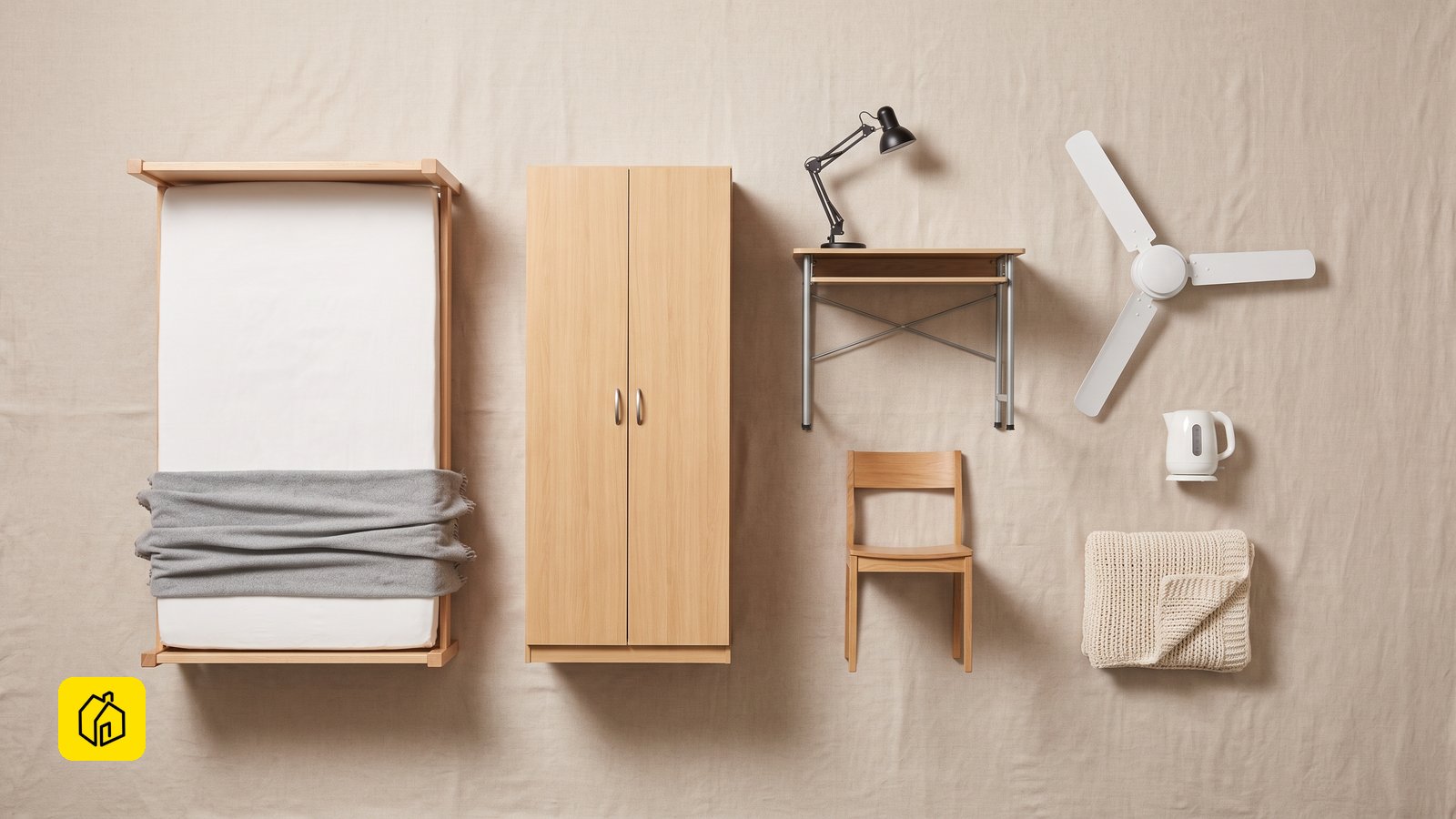
What furniture does a rental home really need?
A Malaysian rental does not need every item fully furnished. It needs safe, working, clearly documented basics: beds where promised, usable appliances, curtains or blinds where needed, lighting, fans or air-conditioning if included, and an inventory signed during handover.
The wrong question is "how many things should I buy?" The better question is "what must be ready so the tenant can move in without arguing about missing or damaged items?"
There is no single statutory furniture list for private residential rentals in Malaysia. The tenancy agreement, listing description and handover inventory decide what the landlord has promised.
SPEEDHOME platform records show that handover documentation — not the furniture list itself — is what separates a clean move-out from a deposit dispute, so the cheapest move a Malaysian landlord can make is photographing the unit at handover, not buying more furniture.
What furnishing baseline should each rental category meet?
The minimum depends on how you market the unit. A bare unit can be valid if advertised honestly. A partly furnished or fully furnished unit must match the listing and inventory.
| Rental type | Minimum expectation | What to document |
|---|---|---|
| Bare unit | Clean empty unit, working lights, basic fixtures, usable doors/windows | Photos of condition, keys, meters and built-in fixtures |
| Partly furnished | Curtains or blinds, fans or air-conditioning if promised, water heater if listed, basic kitchen fixtures | Appliance list, brand/model if available, condition photos |
| Fully furnished | Beds, wardrobes, sofa, dining set, fridge, washing machine and basic kitchen items if advertised | Full inventory with photos, quantity and condition |
| Room rental | Bed, mattress, wardrobe or storage, fan or air-conditioning if promised, access to shared areas | Room inventory plus shared house rules |
| Premium/expat-targeted unit | More complete appliance and comfort set, internet readiness, workstation or extra storage if advertised | Detailed inventory and maintenance responsibility |
Do not describe a unit as fully furnished if the tenant still needs to buy essential items to live there. That gap becomes a dispute later.
What belongs on a room-by-room handover inventory?
Walk the unit room by room on handover day. The standard five rooms — kitchen, bedroom, living, bathroom, laundry corner — each have a short, well-known list of items the tenant will test within the first week.
Most landlord furniture disputes are not about big purchases. They are about small things the tenant expected and the landlord did not write down. Use this room-by-room list as your minimum during handover, then record what is actually in the unit on the inventory.
| Room | Items to confirm and document | Honest landlord question |
|---|---|---|
| Kitchen | Stove / hob (gas or electric), cooker hood, sink and tap, base cabinets or shelving, basic kitchen utensils if advertised | Is the stove safe to use, and is the hood sucking properly? |
| Bedroom | Bed frame, mattress (size and condition), wardrobe or clothes storage, bedside table or shelf, curtains or blinds | Is the mattress clean, and does the wardrobe door close? |
| Living | Sofa, TV console or shelf, coffee table, dining set (table and chairs), curtains or blinds, lights and fan or air-conditioning | Does the fan spin quietly, and are the dining chairs steady? |
| Bathroom | Mirror with hook or shelf, shower head, water heater (if promised), towel rail or hook, toilet roll holder, floor trap clean | Does the water heater heat within a normal wait, and does the floor drain? |
| Laundry | Washing machine (capacity and brand if available), dryer rack or indoor drying line, laundry sink if there is one, plug point and water supply | Does the washing machine complete a full cycle without leaking? |
This list is the realistic working minimum, not a luxury bundle. Cross-check it against the listing photos. Anything in the photos but not in the unit at handover is a written commitment you have to deliver or update the listing for.
What should landlords prioritise first?
Prioritise durable items that reduce complaints: working appliances, mattresses in good condition, curtains, lighting, fans, water heaters and easy-clean furniture. Decorative items matter less than reliability.
A landlord does not need a showroom. Tenants care more about whether the fridge works, the mattress is clean, the washing machine drains properly and the air-conditioning is serviced.
For most urban rentals, the first-priority list is:
- mattress and bed frame where bedrooms are furnished
- wardrobe or clothes storage
- curtains or blinds in bedrooms
- fridge and washing machine if marketed as furnished
- water heater where promised
- lights, fans and air-conditioning that work during handover
- basic sofa and dining set for fully furnished units
- access cards, keys and remotes
Keep receipts and serial numbers when possible. If a tenant damages an item, the landlord still needs proof of the item, its age and condition.
For a visual of what good handover documentation looks like on the actual move-in day, walk through the move-in and move-out checklist — the section on handover day shows the same five anchor items (mattress, wardrobe, curtains or blinds, washing machine, fridge) recorded in photos and condition notes.
What are the four furnishing tiers and what do they mean for rent?
Malaysian landlords usually market a unit as one of four tiers: unfurnished, partial (white goods only), semi-furnished, or fully furnished. Each tier implies a different rent premium, a different tenant expectation, and a different level of move-out reconciliation work.
| Tier | What the tenant expects | Typical rent impact vs unfurnished | Reconciliation load at move-out |
|---|---|---|---|
| Unfurnished (bare) | Empty unit, working lights, fans or air-conditioning, basic fixtures, no appliances | Baseline | Lowest — minimal inventory, fewer dispute triggers |
| Partial / white goods only | Curtains or blinds, water heater, fridge and washing machine only | Small monthly premium, market-dependent | Low — only a handful of items to photo-record |
| Semi-furnished | Partial + bed frame and mattress, wardrobe, basic lighting, fans or air-conditioning | Small monthly premium, varies by unit and area | Medium — bedroom items now in scope |
| Fully furnished | Semi + sofa, dining set, TV console, kitchen basics as advertised, air-conditioning where promised | A small monthly premium that varies by location and furnishing quality | Highest — every advertised item can be disputed |
Furnished units typically command a small monthly premium over unfurnished units; the premium varies by location, unit size, and furnishing quality.
These are directions of travel, not fixed rates. The actual rent uplift for furnished units in Malaysia varies by city, by area, by tenant pool and by the actual condition of the items. Some furnished units in Klang Valley rent for only a small premium; some unfurnished units in a prime location rent for more than a furnished unit in a quieter area. Check live SPEEDHOME listings in your own area for what comparable units are actually asking before committing to a furnishing plan.
The honest link is this: the more you furnish, the more you can ask for, but the more you also have to document, reconcile and replace. A landlord who is unsure whether to furnish should compare the rent uplift with the recurring cost of inventory, replacement and end-of-tenancy dispute time.
Handover inventory template: how to record each item
Use a five-column inventory. The minimum useful template is: room, item, condition, serial (if any), and photo file name. The tenant checks and signs before keys change hands. Anything not in this list is not part of the promise — and anything that is, must be defensible at move-out.
The inventory is more important than the furniture list itself. A cheap but well-documented item is easier to manage than an expensive item with no proof.
| Room | Item | Condition | Serial / receipt | Photo file |
|---|---|---|---|---|
| Bedroom 1 | Queen bed frame, brand X | Minor scratch on left side panel; structure sound | Receipt #2026-04-12; no serial | IMG_B1_bed_wide.jpg + IMG_B1_bed_scratch.jpg |
| Bedroom 1 | Mattress, queen | Light staining on lower right; no sag | n/a | IMG_B1_mattress.jpg |
| Bedroom 1 | Wardrobe, 3-door | Door hinge slightly stiff; closes fully | Brand Y, no plate | IMG_B1_wardrobe.jpg |
| Kitchen | Fridge, 250L | Working, light dent on left side | Plate photo in same frame | IMG_K_fridge.jpg |
| Kitchen | Stove, 2-burner gas | All burners light, hood working | Receipt + regulator note | IMG_K_stove.jpg |
| Laundry | Washing machine, 7kg | Completes a full cycle; minor drum noise | Plate photo in same frame | IMG_LA_washer.jpg |
| Bathroom | Water heater | Heats within normal wait; shower head has limescale | Plate photo in same frame | IMG_BA_heater.jpg |
| Living | Sofa, 3-seater | Light fabric wear on left arm; no tear | n/a | IMG_LI_sofa.jpg |
Two operational rules that decide whether this template actually works:
- Photos are dated at the same time as the inventory. A photo without a verifiable timestamp is weaker evidence than no photo at all. Use the same device for the whole handover, and keep the device's automatic date and time on.
- Serial plates and receipts are photographed in the same frame as the item. A close-up of a serial number in isolation is hard to tie back to the unit; a serial visible next to the appliance or bed frame is much harder to dispute.
Malaysia has no statutory residential rent-deposit cap; deposits are governed by the tenancy agreement, and a landlord's right to retain is limited to proven loss. That makes this evidence essential. Without photos and an inventory, a deduction becomes harder to defend.
As of 2026, Malaysia still has no Residential Tenancy Act in force — as of 4 August 2026, KPKT told the Dewan Negara it is still finalising the Residential Tenancy Bill — so furniture promises live in the TA and the handover inventory, not in statute. That is why the inventory is the only document a court will look at when a tenant challenges a deposit deduction.
On SPEEDHOME's managed platform, the average time from a tenant's first rental default to recovery action is about 31 days — and that clock only runs cleanly when the handover inventory is photo-anchored, because the inventory is the evidence used in the recovery file.
Deposit-refund window and what to photograph at handover
The practical deposit-refund window is set by the TA, not by law — the return window is whatever your tenancy agreement states, less any agreed deductions with evidence. Write the window into the TA at signing so both sides know the deadline. For the full sequence after move-out, see the deposit return process guide.
What to photograph at handover — a short checklist you can run through in one walk-through:
- wide shot of every room from the doorway (proves what was there)
- close-up of each furnished item (mattress, bed frame, wardrobe, sofa, dining set, fridge, washing machine, curtains or blinds, fans, water heater, air-conditioning)
- serial plates and receipts for appliances (proves age and ownership)
- meter readings (water and electricity) at move-in
- keys, access cards and remote controls handed over
- any pre-existing damage, marked clearly with date and timestamp
Pair each photo with a one-line condition note ("minor scratch on left side panel") and a responsibility line ("tenant to keep clean; landlord handles structural defect"). That note + photo pair is what closes a deposit dispute at move-out without a magistrate's court trip.
Worked example — purely illustrative, figures vary with market and unit. A typical KL condominium at a mid-market rent, let to a young professional, needs a focused five-item package: a queen bed and mattress, a wardrobe, curtains or blinds in the bedroom, a washing machine, and a fridge. Depending on market and unit, a landlord might land that package at the budget end of the market in total spend (used or budget new), which protects the listing's "fully furnished" promise without overspending. Skip one of those items — say the wardrobe — and the same landlord can lose a meaningful slice of deposit back at move-out when the tenant argues the room was not properly furnished, plus a multi-week chat trail with no photo proof to back the deduction.
Wear-and-tear vs damage — what the law actually lets you deduct
Two ideas sound similar but decide whether a deposit deduction is lawful: fair wear and tear is gradual deterioration from ordinary use (never deductible), while damage is from a specific breach (recoverable only for proven loss).
Under Section 74 of the Contracts Act 1950, deposit retention is a damages/compensation question — on breach, the injured party may recover compensation for loss that naturally arose in the usual course of things from the breach; remote and indirect loss is excluded. Fair wear and tear is not a breach, because it is the natural result of the tenant being allowed to use the item as intended. Damage is a breach only if it comes from misuse, neglect or unauthorised alteration.
In practice, the distinction is operational, not philosophical. A landlord who keeps dated handover photos and a written inventory can usually defend the call. A landlord who relies on memory at move-out cannot.
| Item | Fair wear and tear (landlord's cost) | Damage from a breach (recoverable from deposit, up to proven loss) |
|---|---|---|
| Mattress | Light body impression, slight discolouration over years | Stains from spills, burns, torn cover, mould from wet mattress left untreated |
| Sofa fabric | Light pilling, gentle fading on the sun side | Large tears, ink or paint stains, broken frame from misuse |
| Curtains | Sun-faded fabric, light dust discolouration | Torn fabric, missing hooks, burns, mould from closed-window damp |
| Washing machine | Normal drum wear, expected noise at end of life | Cracked lid from overloading, dented drum, leaked flooding from unattended use |
| Fridge | Gradual cooling loss after years of use | Broken shelf from impact, dented door, mould from food left to rot |
| Air-conditioning | Annual servicing needed, lower cooling over years | Refrigerant leak from poor maintenance, broken PCB, blocked drain from neglect |
| Walls | Small nail holes, faint scuff marks at corners | Large holes, unapproved paint colour, deep gouges, water damage from ignored leak |
| Tiles | Hairline grout discolouration, minor edge chip with age | Cracks from impact, drill holes without repair, mould from ignored leak |
This table is the everyday version of the legal test. It is not a substitute for legal advice on a specific dispute, but it gives the landlord a defensible default at move-out: the left column does not get deducted; the right column does, and only up to the proven loss the landlord can evidence.
What furniture creates the most dispute risk?
High-use, easy-to-damage items create the most disputes: mattresses, sofas, curtains, dining chairs, washing machines, fridges, air-conditioning units and access devices. Check them during move-in, not after complaints start.
Furniture disputes usually come from three causes. First, the item was already worn but not photographed. Second, the tenant expected an item because it appeared in the listing photos. Third, repair responsibility was not written clearly.
Avoid these mistakes:
- using old listing photos that show items no longer in the unit
- promising "fully furnished" without a complete inventory
- leaving broken appliances in the unit
- giving verbal repair promises without writing them into the handover notes
- skipping end-of-tenancy comparison photos
For repair responsibility, keep the line practical: fair wear and tear belongs to the landlord; tenant-caused damage should be supported by evidence. The rental repair and maintenance guide covers that split in more detail.
Should landlords furnish for every tenant segment?
No. Furnish for the tenant you are trying to attract. Families may value storage and appliances. Students may need durable basics. Expat tenants may expect a more complete move-in setup.
Furniture is a positioning decision. A bare unit may work if the rent is lower and the tenant already owns furniture. A furnished unit may rent faster in areas with young professionals, students or relocation tenants, but only if the items are practical.
| Tenant segment | Useful furniture | Avoid over-spending on |
|---|---|---|
| Young professionals | Bed, wardrobe, washer, fridge, work corner | Fragile decor |
| Families | Storage, dining set, durable sofa, curtains | Too many loose decorative items |
| Students | Bed, desk, fan, simple storage | Premium appliances |
| Expat or relocation tenants | Complete appliance set, clean mattress, internet-ready layout | Heavy personal-style furniture |
| Pet-friendly tenants | Durable sofa fabric, easy-clean flooring, fewer breakables | Delicate rugs or soft furnishings |
If you are unsure whether to furnish, compare the furnished vs unfurnished rental guide and your likely tenant pool.
What are the honest drawbacks of a furnished rental?
Furnishing a unit is a real trade-off. The same items that lift the rent also lift the move-out reconciliation work, the dispute surface and the recurring replacement cost. Landlords who go in knowing the four honest drawbacks manage furnished units better than landlords who do not.
- More damage risk, not less. A furnished unit invites more daily use of landlord-owned items, which statistically means more wear, more accidents and more repair requests. A bare unit shifts that cost to the tenant.
- More deposit disputes. Each item in the inventory is a potential dispute point at move-out. A 30-item fully furnished unit has roughly 30 chances for a deduction disagreement. A bare unit has only the structure and the fixtures.
- More end-of-tenancy reconciliation time. Every furnished item needs to be condition-checked, compared with the handover photo, and either accepted or written up. Inventory-backed tenancies tend to reconcile more smoothly than undocumented ones, but a furnished unit still takes longer than a bare one to close out.
- More recurring replacement cost. Mattresses, sofas, curtains and washing machines have a real service life in a rental, shorter than in owner-occupied use. Plan for replacement of at least the high-use items every few tenancies, and treat that cost as part of the rent math, not a surprise.
None of these drawbacks is a reason to avoid furnishing — the rent uplift can still be worth it for the right unit and the right tenant. The reason to know them is so the landlord prices the furnished option honestly and runs it with the documentation discipline it requires.
What is the SPEEDHOME path for furnished rentals?
The platform helps landlords present the unit clearly, screen tenants and keep the rental process documented. That matters more than stuffing the unit with furniture the tenant may not need.
For landlords, the practical path is simple: decide the furnishing level, photograph the unit accurately, prepare the inventory, and keep the tenancy terms clear. SPEEDHOME's landlord service at /more/landlord/speedhome gives you a more structured rental path from listing to tenancy.
Before move-in, use a documented move-in and move-out checklist. The checklist is what turns furniture from a vague promise into a manageable tenancy record.
FAQ
Is a landlord legally required to provide furniture?
No single furniture list applies to all private rentals. What matters is what the listing, tenancy agreement and inventory say. If you advertise a furnished unit, the unit should match that promise.
What is the minimum for a fully furnished unit?
At minimum, provide the main bedroom furniture, basic living furniture and working appliances that were advertised. The exact list should be in the inventory, not left to memory. A realistic working minimum is a bed and mattress, wardrobe, sofa and dining set, fridge, washing machine, and any kitchen basics that the listing mentioned.
Can a tenant ask for extra furniture after signing?
They can ask, but the landlord is not automatically required to provide extra items unless the agreement says so. If the landlord agrees, write the addition into the inventory with a date, photograph the new item and ask the tenant to sign the updated page.
Can a landlord deduct damaged furniture from the deposit?
Only where the landlord can show proven loss and the deduction matches the tenancy terms. Photos, inventory records and receipts make the deduction easier to justify. The deduction cannot exceed the proven loss from the breach.
Should I buy expensive furniture for rental property?
Usually no. Durable, easy-clean and replaceable furniture is safer than expensive fragile pieces. Rental furniture should survive daily use and be easy to document. A landlord who spends on a designer sofa is buying a recurring dispute surface, not a rent uplift.
Do listing photos count as a furniture promise?
They can create an expectation. If an item appears in the photos but will not be included, state that clearly in the listing and handover inventory. Best practice: every item visible in the listing photo should also be on the handover inventory, or the listing should be updated.
Accuracy note. This page is built on verified primary sources and a dated fact registry; figures are re-verified on each update. Spotted an error? Email [email protected] with this page's link.