
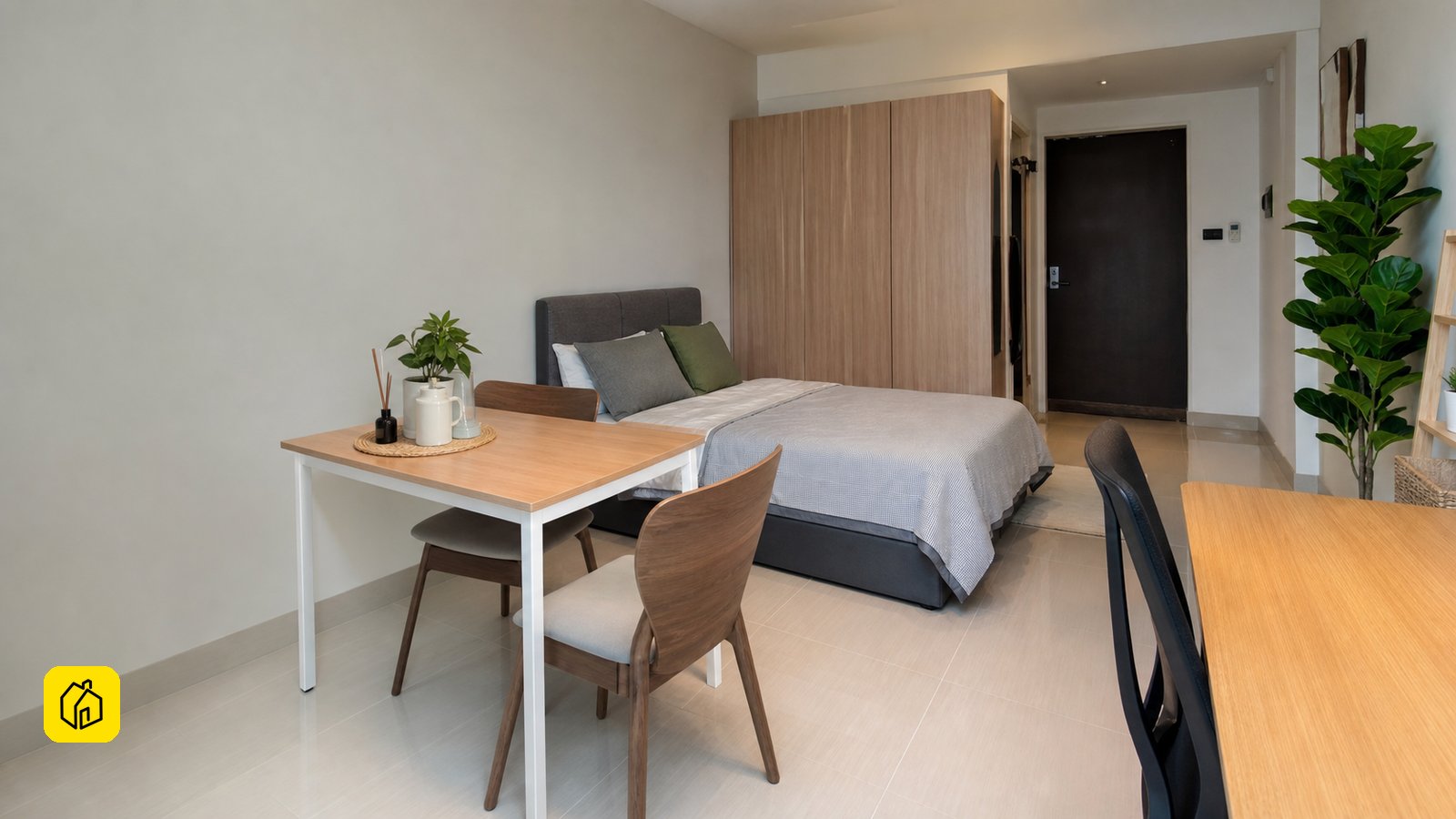
Boulevard 51 is a leasehold commercial-titled mixed development completed around 2018, with compact 350 sqft flexi studio suites and shop components in Jalan SS9A/14, Seksyen 51A / Sungei Way, Petaling Jaya, under MBPJ. The direct owner verdict is whole-unit long-term only. A room, co-living or short-stay plan is not a building-name strategy: it is a later decision that needs the exact parcel plan, title and written management rules. SPEEDHOME's landlord process starts with a lettable, documented home rather than an assumed premium.
What the public record changes for an investor
The recorded 350 sqft flexi studio is a single compact space, not evidence for a new room layout. Its small footprint makes a clean whole-unit offer easier to reverse than a partition-led concept. The investment question is not “how many beds can fit?” It is whether a compact commercial-titled parcel can remain straightforward to let, inspect and exit. That makes title and by-law evidence more valuable than a speculative rent premium.
The project record is useful because it tells an owner what must be checked against the actual parcel. It does not establish current rent, occupancy, room demand, a pet policy, short-stay permission or a building-wide yield. Those are live operating inputs, not facts that can be borrowed from another tower or a listing headline. See the public project references at PropertyGuru and iProperty or the project record; use them to identify the project, then verify the unit file before committing capital. Use the landlord investment decision guide for the acquisition sequence, the room rental and co-living guide for a lawful shared-home framework, and the self-management cost calculator before assuming that more tenants means more owner return.
| Decision item | What is established | What the owner must obtain |
|---|---|---|
| Building identity | a leasehold commercial-titled mixed development completed around 2018, with compact 350 sqft flexi studio suites and shop components | Exact block, floor, parking and parcel plan |
| Use model | whole-unit long-term only | Current management rules for the named parcel |
| Rental economics | No building-wide rent or yield is asserted | Dated like-for-like whole-unit comparables and actual charges |
| Alteration | The recorded layout is the baseline | Written approval for any work outside ordinary repairs |
Is this a whole-unit, room-rental or short-stay investment?
Start with the whole-unit long-term case; it is the only model that does not depend on an unverified additional permission. Do not turn the studio into rooms. Existing approved bedrooms are not part of the recorded layout; any partition or change of use needs the parcel documents and written management approval.
| Model | Decision today | Evidence needed before it can be priced |
|---|---|---|
| Whole-unit long-term | Baseline case | Exact-unit comparables, charges, furnishing list and tenancy terms |
| Existing-bedroom room rental or co-living | Conditional, not a default | Approved plan, written management position, tenant demand and operating plan |
| Short stay | Gated | Written management permission, lawful operating basis and a real operator cost/occupancy case |
Short stay must not be treated as the fallback just because a property is mixed use, near employment or has a compact layout. Management rules can make it unavailable, and an owner should not buy furniture, locks or a service workflow around an assumption. If the written rule says no, the decision reverts to the clean long-term case without trying to relabel the same operation.
What should the calculator prove before any fit-out?
Use the shared calculator to test incremental economic NOI, not to turn an assumed rent increase into “ROI”. Enter the actual purchase price, current comparable rent, annual charges, furnishing scope and the two fit-out scenarios. Keep every rent field as an editable planning assumption until it is supported by a dated comparable for the same component and layout.
Loading the renovation ROI comparison…
The calculator subtracts vacancy, recurring operating cost and an economic replacement allowance before showing the incremental effect of additional spend. Its useful question is simple: after the lean scope, does further capital buy enough sustainable economic NOI to clear the owner's hurdle? If not, the higher-spend line is dominated even if the room photographs better.
A reversible SPEEDRENO decision path
SPEEDRENO should solve condition and letting usability without locking the owner into a prohibited or fragile model. For Boulevard 51, begin with defects, storage, lighting, durable surfaces and furnishing decisions that make the approved layout easier to let as a whole unit. Do not budget a partition, a bedroom conversion, an access-control system or a hospitality setup until the document gate has passed.
This keeps the exit simple. If sharing later proves lawful and commercially sensible, the owner can add only what the written approval covers. If it does not, the unit remains a conventional long-term offering rather than a stranded specialised layout. The calculator's lean and higher-spend scenarios are owner-editable planning assumptions, not building quotations or promised rent outcomes.
Due diligence at the unit, JMB/MC and viewing stages
A verbal “should be okay” is not a control. Obtain the documents before advertising a new operating model.
- Match the sale and title documents to the exact parcel, its use category, accessory parcels and recorded plan.
- Request the current by-laws, house rules and any written circulars on subletting, short stay, pets, renovations, access devices and utility arrangements.
- Read recent AGM minutes, audited accounts, arrears exposure and special-levy notices; include recurring charges in the calculator rather than treating them as an afterthought.
- Inspect the actual unit in daylight: water marks, ventilation, plumbing, electrical load, appliance condition, noise paths, lift-to-door route and parking must match the proposed tenant promise.
- Capture dated condition photos, meter readings, keys/cards and inventory before handover. This is the evidence base for a later move-out discussion.
- Pull current, same-layout whole-unit comparables and record date, furnishing level, asking status and included parking. Do not substitute a room advert, a nearby tower or an old portal result.
Downside and the owner’s stop rules
The main downside is spending for a higher-complexity model that the parcel or rules do not support. The remedy is to keep the whole-unit case viable from day one.
| Trigger | Owner response | Why it stays reversible |
|---|---|---|
| Written rules do not support sharing or short stay | Let the approved unit long term | No partition-led or hospitality-only spend is assumed |
| Same-layout rents do not cover the planned fit-out hurdle | Stop at repair and safety work | Capital is not committed for a cosmetic story |
| Charges or a levy change the holding cost | Re-run economic NOI before signing | The calculator exposes the change rather than hiding it in headline yield |
| Viewing reveals condition work outside the budget | Re-price, renegotiate or walk away | The decision occurs before a tenant promise or irreversible work |
| A shared arrangement creates more disputes than value | Return to a single tenancy at the next lawful break | The original approved layout remains the exit option |
The no-go condition is clear: do not buy or convert on a claimed room premium, short-stay revenue, management consent or title status that you have not seen in the documents. A lower-complexity, evidence-backed whole-unit let is preferable to a model that only works in a spreadsheet.
Matched SPEEDHOME landlord close
Once the parcel, condition and rules pass, use SPEEDHOME to list the compliant long-term unit and screen for a tenancy that matches the model you can actually operate. Start the landlord journey at SPEEDHOME for landlords, with the approved layout, inventory and current comparable evidence ready.
FAQ
Can I assume room rental is allowed at Boulevard 51?
No. Do not turn the studio into rooms. Existing approved bedrooms are not part of the recorded layout; any partition or change of use needs the parcel documents and written management approval. The exact parcel plan and current written management rules decide the model; a building name, agent comment or unrelated listing does not.
Should I use a short-stay forecast to justify the purchase?
No. Keep short stay outside the investment case until written management permission and a real operating case are available. Underwrite the whole-unit long-term case first.
What rent should go into the calculator?
Use a dated, same-layout whole-unit comparable and mark it as an editable planning assumption until evidence is retained. Do not present it as a building-wide rent, yield or guarantee.
What is the first document to request?
Request the parcel title and approved plan together, then the current management rules. Those records determine whether the proposed use and fit-out can be evaluated honestly.