
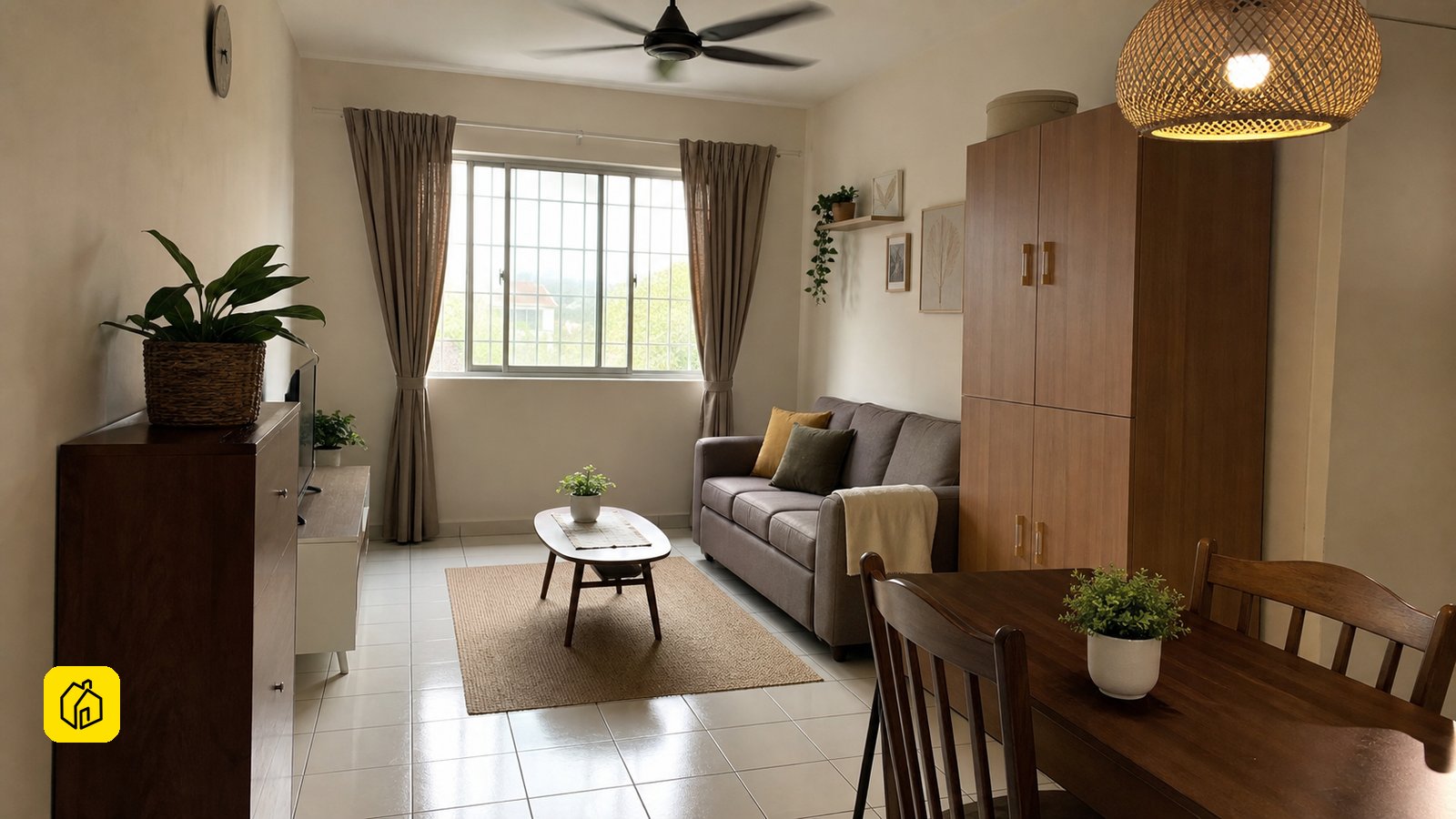
The default at Citizen 2 is a whole-unit 12-month letting — for the recorded 725 sq ft two-bed/one-bath plan, manufacturing a room-rental product is commercially weak, and the 883 sq ft three-bed deserves its own review, not a permission to partition. This is an 837-unit, three-tower freehold estate by Binastra Land on Old Klang Road (around 2020): in a project this size a generic one-year let competes against a deep stack of near-identical compact listings, so the credible scarce-segment play is a durable, pet-friendly whole-unit home — and SPEEDHOME coliving is cat-friendly, cats welcome in our coliving rooms; platform policy, while building by-laws can vary. One bathroom in the 725 sq ft product is a better decision input than the "two-bed" label; no admitted source publishes a current rent — enter your own comparable below.
Three ways to run your unit
Go whole-unit for the evidence default: one household on a conventional long-term tenancy, works on both layouts, no permission beyond the tenancy itself. Go existing-bedroom review only on the 883 sq ft three-bed: sharing is a written-permission question (multi-tenancy, access cards, parking), never a space conclusion — and the 725 sq ft plan is out. Pass on short-stay: nothing here may be underwritten on it, and compact-format condition beats guest-operations theory.
Pick a model card, put in your own numbers, and the answer updates as you type.
Loading the renovation ROI comparison…
How do you make the unit eligible for the scarce segments?
Before the building record, decide which side of the demand line this unit sits on. In an 837-unit, three-tower project on Old Klang Road, a generic one-year let competes against a deep stack of near-identical compact listings. Pet-friendly whole-unit tenancies and properly managed co-living sit on the thin-supply side of Malaysian rental demand. For the recorded 725 sq ft two-bed/one-bath plan especially, the credible scarce-segment play is a durable, pet-friendly whole-unit home rather than a manufactured room product. That scarcity is a decision lens: run it through the calculator below with the unit's real numbers before committing any capital.
The upstream move is fit-out, not marketing. A SPEEDRENO rental fit-out is built for exactly this: a reversible, condition-led renovation that makes the unit eligible for the segment you choose — pet-durable flooring and finishes for the pet-friendly whole-unit play, shared-space standards and hard-wearing common areas for co-living — and the finished unit then lists on SPEEDHOME against that demand. Keep the conversion inside what the management's written position allows; the MC letter gates the model, the fit-out only serves it.
SPEEDHOME's recommendation for Citizen 2: whole-unit 12-month pending the MC letter — SPEEDHOME's default until management's written position arrives.
Verdict: why not turn the compact plan into a room-rental assumption?
Citizen 2 is a whole-unit-first decision because its recorded 725 sq ft two-bed/one-bath layout is compact before furniture, storage and shared-living friction are even tested. The public building record identifies a Freehold, around-2020 development by Binastra Land on Old Klang Road with three towers and 837 units, plus an 883 sq ft three-bed/two-bath alternative. See StarProperty's project record and iProperty's building record . They establish project identity, not an achieved rent, a title category or an MC permission.
The direct call is firm: market the exact parcel as a conventional long-term home until documentary evidence supports anything else. The 725 sq ft unit should not be bought on the theory that two bedrooms equal two independent room products. The 883 sq ft plan deserves a separate existing-bedroom review, but it also does not create permission to partition, submeter, host short stays or add occupants.
Why is the bathroom count a commercial constraint?
One bathroom in the 725 sq ft product is a better decision input than a generic “two-bed” label. It affects household fit, viewing feedback, common-area pressure and the plausibility of any shared occupation. Before a tenant strategy is selected, walk the route from entrance to kitchen, bathroom, bedrooms, laundry and storage with the proposed furniture footprint in mind. A plan can be technically two-bedroom while being commercially weak once everyday circulation is real.
| 725 sq ft, 2 bed/1 bath | One household, practical storage and furnishings | Separate tenant demand or room premium | | 883 sq ft, 3 bed/2 bath | Existing-bedroom privacy and common-area function | Permission to alter or operate coliving | |---|---|---| | Three towers | Exact tower, floor and parking allocation | A building-wide rent or defect condition |
This is why a matched comparable must match layout as well as location. A three-bed listing cannot be used as the revenue basis for the two-bed compact unit; neither can a more lavishly furnished unit be silently treated as the baseline.
What is ready, what needs evidence, and what is blocked
Ready: a whole-unit long-term tenancy with one household, a proper inventory and a current exact-unit comparable. This is the simplest operational route and does not depend on a claim about MC/JMB rules. It is also the cleanest fallback if a more complicated idea is rejected.
Needs evidence: lawful sharing of existing approved bedrooms. The owner must obtain the individual title, the current written management position and a furniture plan that preserves usable common space. The decision also includes service work: multiple applicant checks, household compatibility, complaints, cleaning expectations, collections and staggered exits. The room-rental and coliving guide is a process guide; it is not permission for Citizen 2.
Blocked: short stay, new partitions and submeter-dependent business logic. No building-specific rule is supplied in this record. Until current written evidence says otherwise, these should not appear in the purchase cash flow or renovation brief.
Calculator discipline for a small apartment: what applies?
The calculator should expose whether a compact unit still works after costs, not decorate an unsupported yield claim. Enter the actual transaction price, dated matching rent comparable, annual charges, vacancy allowance, furnishing cost and only a quoted renovation scope. The result is economic NOI after recurring cost and economic depreciation, with marginal return on incremental capital. It cannot make a Citizen 2 rental rate appear.
Run the base case with a durable, whole-unit furnishing plan. Then run a higher-spend case only where each item is expected to improve the tenant experience in this compact layout. If the extra spend does not increase economic NOI, reject it even if the listing photographs better. Use the self-management cost calculator to price the owner time that a simple rent estimate omits.
SPEEDRENO: how to remove compact-unit friction without adding complexity?
The useful the fit-out service brief is a small-space, durable whole-unit scope: storage, worn wet-area items, lighting, appliances and fixtures that reduce move-in objections. It should be tied to the exact parcel and management-approved scope. It should not assume a third sleeping area, a partition wall, smart-lock guest turnover or any short-stay system.
Reversibility is the investor advantage here. If the room-sharing test fails, the completed unit should still show cleanly to a household. If a proposed spend only makes sense for an unapproved model, it is not a renovation investment; it is a contingent bet.
Due diligence at the tower and parcel level: what applies?
Ask questions that distinguish the exact home from the 837-unit project. Confirm the tower, floor, orientation, parking, parcel plan, title, charges statement, current management rules, renovation process and any recent notices or AGM material. Inspect water pressure, drainage, air-conditioning, lifts, windows, doors, bathroom ventilation, kitchen storage, meter position and supplied appliances. Photograph these before repairs or tenant occupation.
The same visit should create a comparable pack. Record dates, layout, floor, furnishing and asking/achieved evidence for every candidate comparable. A price from a different tower or a different plan is research, not an underwriting input.
What is the downside and exit plan?
The two main downside paths are a poor compact-layout fit and an owner who has priced a conditional operation as certain. A bathroom bottleneck, insufficient storage or poor common area can cause longer vacancy or tenant mismatch even where a portal description sounds attractive. A negative management answer removes a room or short-stay scenario; it does not invalidate a correctly priced whole-unit plan.
-
Keep a household long-term plan that works before any sharing scenario.
-
Do not pay for a configuration that needs a partition or unconfirmed rule.
-
Budget repairs and replacement from the actual inspection, not a new-build assumption.
-
Do not reduce rent or add features blindly; first identify whether layout, condition, photographs or tenant fit is the problem.
-
Preserve an itemised inventory so the next handover and any re-let can use the same evidence base.
Who takes the whole journey for the landlord?
If you would rather not run the unit yourself, this is the part where one company takes the whole journey. A contractor leaves after the handover, an agent leaves after the signing, a handyman leaves after one fix — and rent follow-up, tenant problems and repairs fall back on you. Not because anyone failed; because it was never anyone's job in between. SPEEDRENO gets the unit rent-ready for the tenant you actually want (with a clear skip list, so you don't pay for work the market won't reward), SPEEDHOME rents it out and manages the tenancy — rent collection, tenant issues, lawful eviction when needed — and SPEEDFIX handles repairs at one price.
Owners stay with SPEEDHOME because things move fast, and because there is a company with a full-time team behind the tenancy, not an individual agent. The landlord protection plans sit on top of that service — Protect at one month's rent, Protect+ at one and a half, or the flat Standard plan at RM799 + SST a year with no protection cover.
Once the exact Citizen 2 unit is clean, documented and priced from a matching comparable, list the whole-unit tenancy through SPEEDHOME's landlord service . This is the right close because it follows the verified operating model rather than pretending that a building-level name settles management permission.
FAQ
Is the 725 sq ft Citizen 2 unit suitable for room rental?
It is not a default room-rental proposition. The one-bath compact layout should be tested as a household unit first, and any sharing case needs the actual plan and written management evidence.
Can the three-bed layout support a different decision?
It can be reviewed separately because it has a different bedroom and bathroom arrangement, but it does not carry permission for partitions, short stay or coliving. Match the comparable and documents to that exact parcel.
What should I put in the calculator?
Only transaction, rent, cost and quote evidence for the actual unit. The preset intentionally has no Citizen 2 rent, yield or occupancy default.
What is the reversible choice if a conditional plan fails?
A durable whole-unit long-term fit-out remains usable for the next household without undoing specialised work. That is the decision baseline for this compact product.