
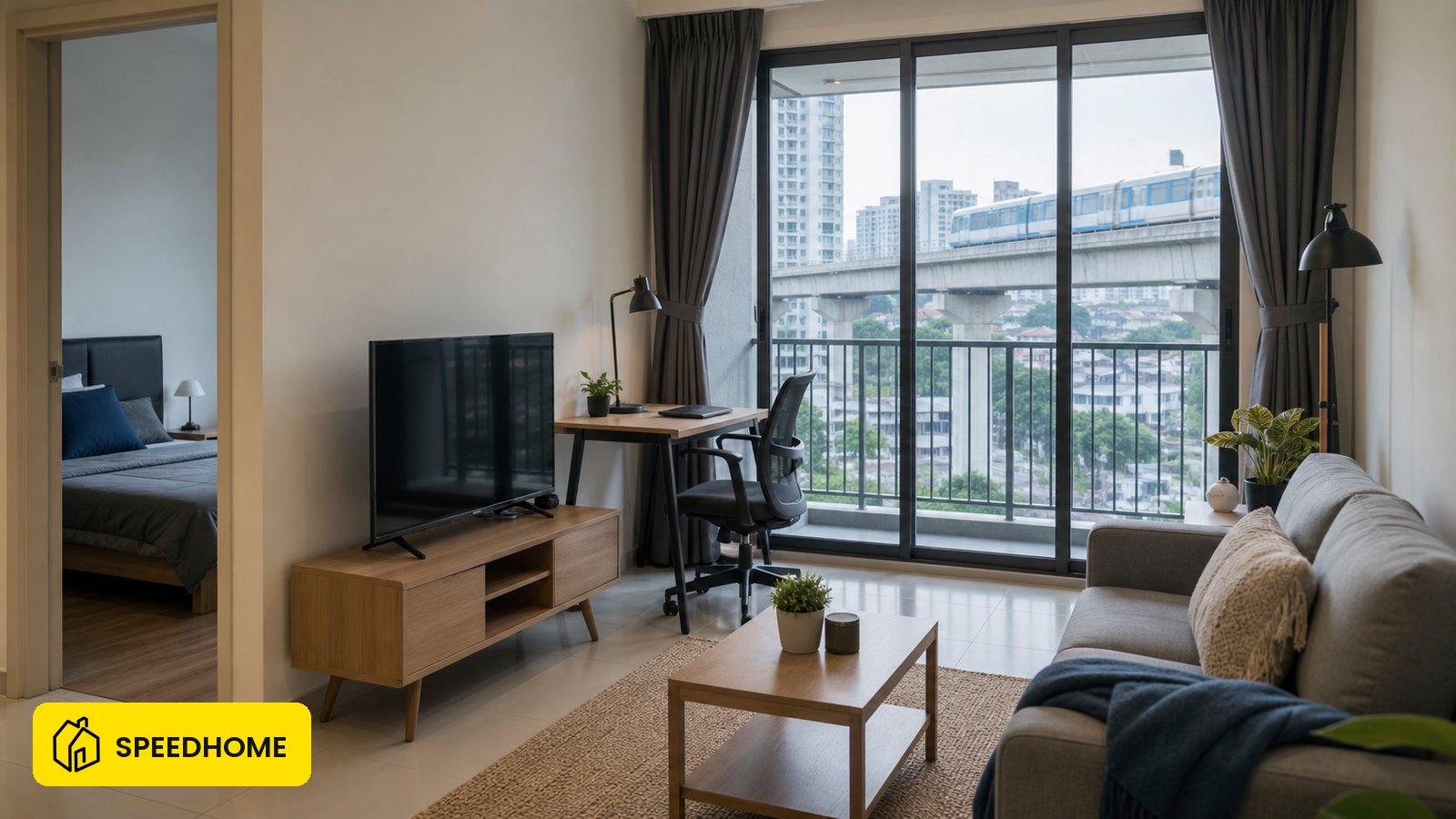
Transit-adjacent condos: the landlord decision
A condo near MRT or LRT earns a genuine rent premium in Malaysia — but only if the unit is ready for the commuter tenant who pays it. The decision is not whether to rent; it is whether to list unfurnished and accept a lower rent or fit out properly and capture the RM200–400 per month uplift that fully furnished transit-adjacent units command.
Malaysia's gross residential rental yield averaged about 5.3% nationally in early 2026, with Kuala Lumpur closer to 4.9% (Global Property Guide, Q1 2026 using PropertyGuru data). That national average assumes no renovation cost in the denominator. Once you add a RM30,000–50,000 traditional fit-out, your effective yield compresses immediately. The only way to capture the transit premium without eroding yield is to spend less getting the unit ready — which is where fit-out method becomes the real decision.
The three choices facing a landlord with an MRT or LRT-adjacent condo:
- List unfurnished and accept the lower rent pool — mostly companies and longer-stay tenants.
- Do a full traditional renovation and furnishing — higher rent ceiling, but high upfront cost and long vacancy.
- Use a managed fit-out at a controlled cost — get furnished quickly, hit the commuter market, preserve yield.
Furnished vs unfurnished: which captures more transit yield?
Fully furnished units near MRT and LRT consistently attract the commuter-professional segment — the tenant most likely to pay a rail-access premium and stay. Unfurnished units near transit are not unrentable, but they miss the highest-paying tenant group and typically rent for 10–20% less in KL and Petaling Jaya prime corridors.
The 10–20% furnished premium in KL and Petaling Jaya prime areas and 5–10% in secondary markets is a general market range cited by iProperty (2026). What it means in practice for an MRT-adjacent unit:
| Option | Typical tenant | Relative rent level | Time to tenant | Fit-out upfront cost |
|---|---|---|---|---|
| Unfurnished | Corporates, long-stay families | Base | Longer — narrower pool | Nil or minimal |
| Partially furnished (semi) | Mixed — families, some professionals | Mid — 5–10% above unfurnished | Moderate | RM5,000–15,000 |
| Fully furnished, durable fit-out | Commuter professionals, expats, short-to-mid stay | Highest — 10–20% above unfurnished | Fastest — widest pool | RM16,000–35,000 depending on method |
| Fully furnished, fragile/decorative reno | Commuter professionals initially | High — then vacancy as damage costs rise | Depends | RM30,000–50,000+ traditional |
An 83% majority of tenants want a clean, furnished, ready unit (SPEEDHOME platform records). That signal is most pronounced in transit-adjacent buildings where tenants arrive with minimal personal furniture and prioritise commute time over unit customisation.
The unfurnished option is not wrong — it suits landlords managing a corporate pipeline, or those whose unit sits in a building where furnished stock is already oversupplied. But for a standard Klang Valley MRT/LRT-corridor condo in the RM1,500–4,000 rent bracket, furnished is the yield-maximising choice if the upfront cost is managed correctly.
When each option wins
Unfurnished wins when the building has a strong corporate or embassy tenant pipeline and long minimum tenancy norms — typically 24+ month commitments that offset the lower rent ceiling. Furnished wins when the building sits in a commuter corridor and tenants are mobile professionals who prefer ready-to-live units.
| Situation | Unfurnished | Semi-furnished | Fully furnished |
|---|---|---|---|
| Building near MRT/LRT with high commuter demand | Loses rent potential | Moderate capture | Maximum yield capture |
| Corporate or embassy tenant target | Often preferred | Acceptable | Depends on corporate policy |
| Landlord wants minimal upfront spend | Best choice | Middle ground | Requires managed-cost approach |
| High tenant turnover risk area | Risky — long empty periods | Better tenant pool | Best tenant pool if fit-out is durable |
| Older building with dated interiors | Unfurnished may hide weakness | Risky — tenants see worn stock | Only works if durable upgrades are done |
| New unit near transit corridor | Leaves money on table | Partial capture | Full capture of transit premium |
The trap to avoid: spending RM35,000–50,000 on a traditional renovation and then pricing the unit at RM2,400 per month when comparable unfurnished units rent for RM2,000. That RM400 monthly premium gives you a payback period of over 7 years — and that is before vacancy, maintenance calls, and damage to fragile finishes.
The RM40,000 premium renovation versus RM20,000 smart fit-out comparison is instructive: an extra RM20,000 spent on aesthetics rather than durability yields roughly RM200 per month more in rent, meaning the extra RM20,000 takes 8 years to recover. A landlord who spends RM20,000 on a smart, durable fit-out and rents for RM200 per month less captures better net yield by year three.
Cost, yield and risk for transit-adjacent condos
The true yield formula includes renovation and furnishing in the denominator — not just purchase price. A RM400,000 condo with a RM40,000 traditional reno has an effective entry cost of RM440,000. At RM2,400 per month rent, the gross yield is 6.5% before vacancy, tax and maintenance. The same unit with a RM18,000 fit-out at RM2,200 per month rent yields 5.9% — but carries lower repair risk and is easier to re-tenant.
| Fit-out path | Starting cost | Typical timeline | Rent level (RM1,500–4,000 corridor) | True yield impact | Key risk |
|---|---|---|---|---|---|
| Unfurnished | Nil | Immediate | Base (e.g. RM1,800) | Highest yield on paper — no reno cost | Narrower tenant pool; longer vacancy in competitive corridors |
| DIY furnishing | RM10,000–20,000 | Self-managed: 6–12 weeks | Mid (e.g. RM2,000) | Good if time cost is not counted | Your time is not free; coordination risk with contractors |
| Traditional renovation + furnish | RM30,000–50,000 | 8–16 weeks managed | High ceiling (e.g. RM2,300–2,500) | Often erodes yield due to high upfront cost | Fragile finishes; high damage risk; 7–8 year payback on premium spend |
| SPEEDRENO managed fit-out | From RM16,000 | 30 days typical | Competitive fully furnished rate | Better preserved yield at lower cost base | Not every design preference is accommodated — built for durability and tenant appeal, not personalisation |
Malaysia's gross residential yield averaged about 4.9% in Kuala Lumpur in early 2026. Net yield — after maintenance, vacancy and repairs — is materially lower. The EPF dividend for 2025 was 6.15%, which means even a gross yield at the national average sits below EPF returns before any costs. Managing the cost of the fit-out is not a nice-to-have; it is how a landlord stays positive.
The risk specific to transit-adjacent condos: commuter tenants have high mobility. They move when employers relocate, when they buy, or when a better unit appears nearby. A RM50,000 fragile renovation in a high-turnover transit building is a repeated damage liability. Durable, neutral, replaceable finishes reduce that cost per tenancy cycle.
For Zero Deposit eligibility: selected SPEEDHOME listings support Zero Deposit renting. Zero Deposit is a managed rental-risk system, not a financial guarantee product. It replaces the upfront cash deposit; in the rare case of severe end-of-tenancy damage the recoverable amount can be limited, so it is not a blanket guarantee. Eligibility is per listing — check the live listing to confirm.
The SPEEDHOME path for MRT/LRT condo landlords
SPEEDRENO prepares your transit-adjacent unit for rent using durable, neutral finishes at a starting cost below the basic investor renovation tier — then the SPEEDHOME platform lists, screens, collects and manages it. The fit-out, listing and management steps are one system, with no gap between them.
SPEEDRENO starts from RM16,000 — below the RM25,000–50,000 basic investor renovation range cited by independent market references (PropCashflow.my, 2026). It is calibrated for rental durability, not decoration. The same finishes that hold up through multiple tenant cycles also make a unit ready for pet-permitted letting, which can add a further rent premium.
The SPEEDHOME landlord stack for a transit-adjacent condo:
- SPEEDRENO — fit-out in 30 days, durable and neutral
- SPEEDHOME listing — verified listing with no agent fee for the tenant, Zero Deposit where eligible
- SPEEDFIX — maintenance managed so you do not take repair calls
For a landlord with an MRT or LRT-adjacent unit in the Klang Valley, the question is not whether transit location adds value — it does. The question is whether your fit-out method preserves enough of that value after costs. See how SPEEDHOME works for landlords at /more/landlord/speedhome.
Related reading: 12 condominiums near LRT covers the tenant-side commute check for Klang Valley buildings. For cost detail, how much to spend renovating a rental and furnished vs unfurnished cover the numbers.
FAQ
Does a condo near MRT or LRT command higher rent in Malaysia?
Yes, transit-adjacent condos typically earn a rent premium, but it depends on the actual walkable route, building condition, and furnishing level. Fully furnished units near LRT or MRT in KL and Petaling Jaya prime corridors can attract 10–20% more rent than comparable unfurnished units, per general market data (iProperty, 2026). The premium is not automatic — a tenant paying for rail access expects a ready, well-maintained unit.
What is the true yield on an MRT-adjacent condo after renovation?
True yield = (annual rent minus operating costs) divided by (purchase price plus renovation plus furnishing). The mistake is dividing rent by purchase price alone and ignoring what you spent on fit-out. A RM400,000 condo with a RM40,000 renovation has an effective entry cost of RM440,000. Malaysia's gross residential yield averaged about 4.9% in KL in early 2026 — net yield after costs is materially lower, so managing the fit-out budget directly protects your return.
Is SPEEDRENO only for new condos, or can it work on older transit-adjacent units?
SPEEDRENO works on both new and older units — the approach is to replace fragile or dated elements with durable, neutral finishes rather than cosmetic decoration. For an older MRT or LRT-adjacent condo where the kitchen and bathrooms show wear, targeted SPEEDRENO upgrades can restore the unit's appeal to commuter tenants without the full cost of a traditional renovation.
Should I list unfurnished first to avoid the upfront cost, then furnish later?
Listing unfurnished first can work if you have a specific corporate or longer-stay tenant in mind, but it typically means a lower rent ceiling in commuter corridors. Once a tenant is in place unfurnished, it is harder to re-price to furnished rates. If the unit is vacant and near transit, spending on a managed fit-out before listing is usually the better yield decision — provided the fit-out cost is controlled.
What is the payback period for furnishing a condo near MRT?
Payback period = fit-out cost divided by monthly rent premium earned. At a RM200 per month premium on a RM18,000 fit-out, payback is 7.5 years gross before vacancy and damage. At RM300 per month premium, payback is 5 years. The key is keeping the fit-out cost low enough that the premium genuinely shortens the payback — a RM50,000 fit-out earning RM300 per month more takes nearly 14 years to recover. That is why fit-out method, not furnishing decision alone, determines the yield outcome.