
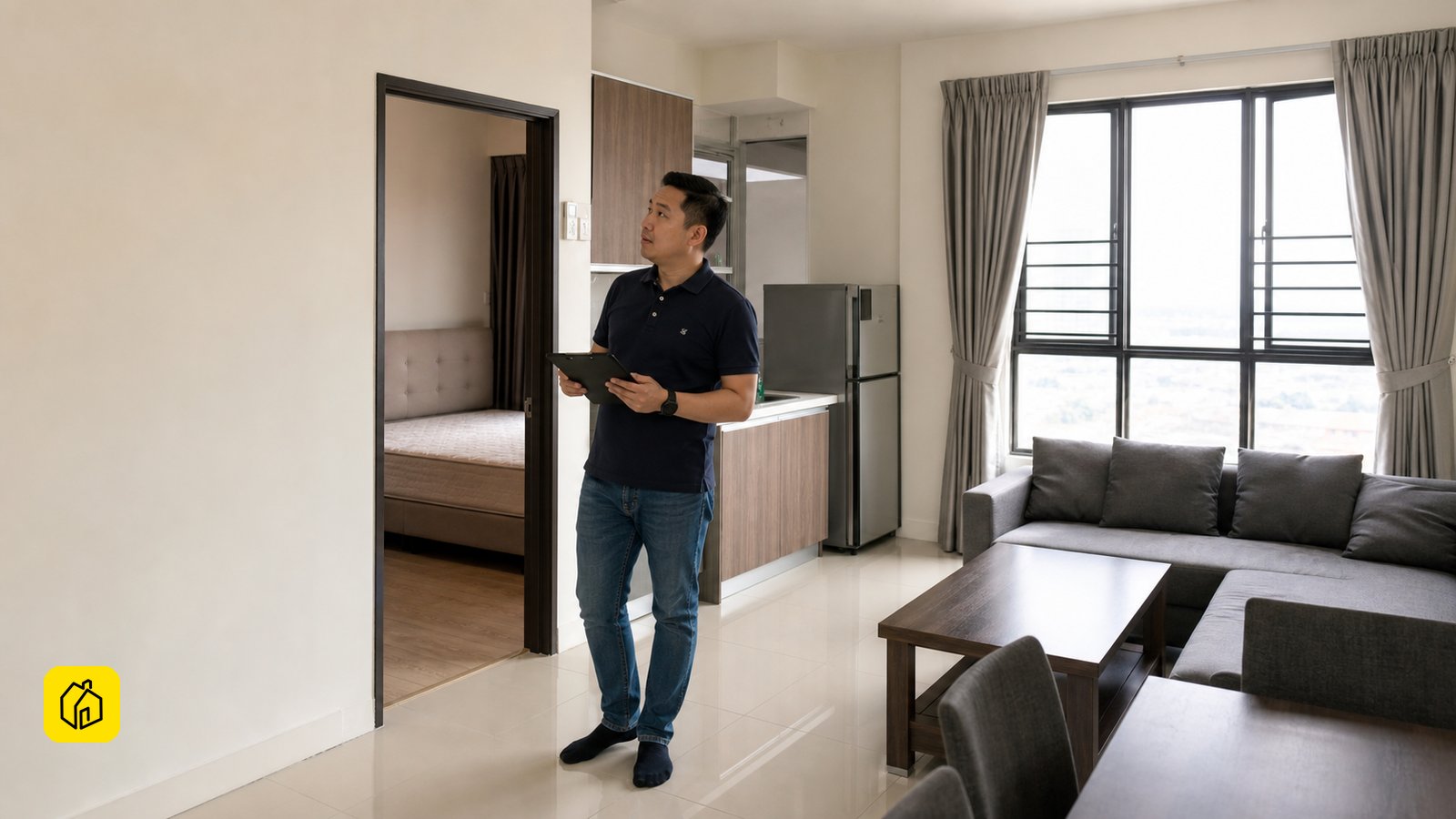
Cubic Botanical must be underwritten as two different products. The project record identifies a freehold Pantai Dalam serviced residence, completed in Q4 2022, with 1,161 units across two 37-storey blocks. It includes 518 sqft one-bedroom and 900 sqft three-bedroom layouts. The defensible default for either parcel is a whole-unit long-term tenancy. Do not call the three-bed a room-rental asset, or the one-bed a short-stay asset, until the actual plan, dated comparable and current management rules are in the file.
The unit size changes the tenant and the decision
The 518 sqft one-bed is a single-household proposition; the 900 sqft three-bed is a different household proposition, not a building-wide yield multiplier. The published record places Pantai Dalam KTM roughly 350–400 metres away, with one stop to Mid Valley and two to KL Sentral. It also describes a pool, gymnasium, botanical garden, multipurpose hall and podium amenity zones. See the project source and DBKL. These facts make the viewing more specific; they do not prove current rent, occupancy, short-stay permission or a multi-tenant right.
For the one-bed, test whether the kitchen, storage, work surface, bathroom condition and furniture layout support one tenant or couple without overfilling the space. For the three-bed, test whether all approved bedrooms, shared living area and bathrooms work for one household before considering any shared arrangement. A layout that has three labelled rooms can still fail the privacy, storage or circulation test once furnished.
Whole unit first; other models remain gated
A conventional whole-unit lease has the fewest unverified dependencies for this development. It uses the lawful parcel as delivered, one tenancy agreement and one household. The downside is a full-unit vacancy when that household leaves, but the operating model does not require a claim about partitions, separate billing or hotel-like turnover.
Room rental is not rejected because the three-bed is small or large; it is conditional because the management position and approved configuration are not in the source record. Written confirmation must cover the actual arrangement, renovation scope and any downstream utilities. If the answer is absent, value the unit solely as a whole-unit home. A 518 sqft one-bed should not be reconfigured to force a room model.
Short-stay is blocked until written management permission is obtained. Being near a KTM station makes access easier; it does not authorise nightly use. Do not buy smart locks, linen stock or hospitality furniture for an option that has not cleared the building rule.
Walk the route, then inspect the parcel
The claimed rail proximity should be tested on foot with the exact block, exit and route—not converted into a marketing sentence. Walk from the intended unit’s lobby to Pantai Dalam KTM at the time the prospective tenant would travel. Note crossings, shelter, access control, noise and the condition of the approach. Then inspect the parcel at a different time for lift queues, heat, street noise, water marks, ventilation, appliance condition and parking access.
The deal file should include the individual title, latest maintenance statement, AGM minutes, special-levy notices, approved floor plan and current by-laws. Ask management in writing about contractor deposits, permitted work, existing-bedroom leasing, pets, short stays and submeters. Keep the reply, not a verbal summary. For a newer high-density project, block, floor, facing, lift experience and actual furnishing condition can materially change tenant appeal even where the development facts are identical.
Use current evidence in the shared economic-NOI calculator
The calculator is for comparing incremental economic NOI after vacancy, operating cost, downtime and replacement allowance; it is not a generator of Cubic Botanical rent. Enter a current comparable for the exact one-bed or three-bed, its furnishing condition and the actual owner costs. Do not borrow an asking rent from another layout or call a nearby project’s result a Cubic Botanical fact.
Loading the renovation ROI comparison…
The cubic-botanical preset retains rent and unit-level commercial inputs as owner evidence. Compare no change, a lean refresh and a higher-spend option. Reject the higher option when it adds capital without additional economic NOI. That is especially important in the 518 sqft format, where over-furnishing can reduce usable space, and in the 900 sqft format, where unapproved partitioning can make the exit harder.
SPEEDRENO fits as a reversible scope: repair defects, clean, repaint, improve light and use movable furniture for the confirmed whole-unit tenant. Defer bespoke joinery, partitions and short-stay equipment until both the tenant case and management permission are proven. A conventional whole-unit relaunch must remain possible if the initial plan changes.
Downside and stop conditions
The real risk is paying for an operating model whose essential evidence never arrives. The one-bed can suffer if its usable space is compromised by the wrong furniture. The three-bed can suffer if a buyer assumes separate-room income, then discovers management or layout constraints. Both formats can suffer a vacancy, repair issue or strata cost that was not inspected before exchange.
Stop or reprice if the title, floor plan or management reply conflicts with the intended use; if the dated comparable does not support the purchase and fit-out case; or if the condition requires irreversible work before the tenant model is proven. A whole-unit model is a fallback only when it was underwritten from the start. It is not a rescue for a speculative room or short-stay purchase.
Handover discipline protects the next tenancy
A photographed handover and a simple repair list are more valuable than an optimistic rent assumption. Before advertising, record the meter readings, keys, access cards, parking allocation, appliance serial numbers and visible defects. For the one-bed, confirm that furniture does not prevent normal circulation or storage. For the three-bed, record each approved bedroom and the common areas so the next tenant has a clear baseline. Put any contractor warranty, management approval and inventory together with the tenancy file. This reduces disputes at move-out and makes the unit easier to relaunch after a vacancy without redesigning the strategy.
Matched landlord next step
Once the exact layout, walk, management response and current comparable support a whole-unit tenancy, the next question is placement and operating workload. Use SPEEDHOME’s landlord route for that step. The landlord investment decision guide, self-management cost calculator and room-rental guide are decision aids, not permission substitutes.
Before you commit
Can I price the one-bed and three-bed from one rent band?
No. They serve different household and furnishing jobs. Use comparable evidence that matches the exact layout, condition and furnishing level.
Does the KTM access prove demand or yield?
No. It is a location fact to test on foot. It does not prove achieved rent, occupancy or an approved operating model.
What if management will not confirm room use?
Underwrite only the conventional whole-unit tenancy or walk away. Do not spend on partitions, locks or utilities for an undocumented option.
FAQ: Cubic Botanical owner questions
Does the 900 sqft three-bedroom format make Cubic Botanical a room-rental promise?
No. The one-bedroom and three-bedroom formats require separate whole-unit comparisons. Any shared-bedroom arrangement remains conditional on the actual plan and current written management rules.
Can the Pantai Dalam KTM walk be treated as a rent uplift?
No. It is an inspection and tenant-experience fact, not proof of a current rent or yield. Use a dated comparable that matches the exact parcel instead.
What capital should be spent before permissions are clear?
Only reversible work that supports a conventional long-term unit. Hold partitions, special utility arrangements and short-stay equipment until their evidence gates are met.