
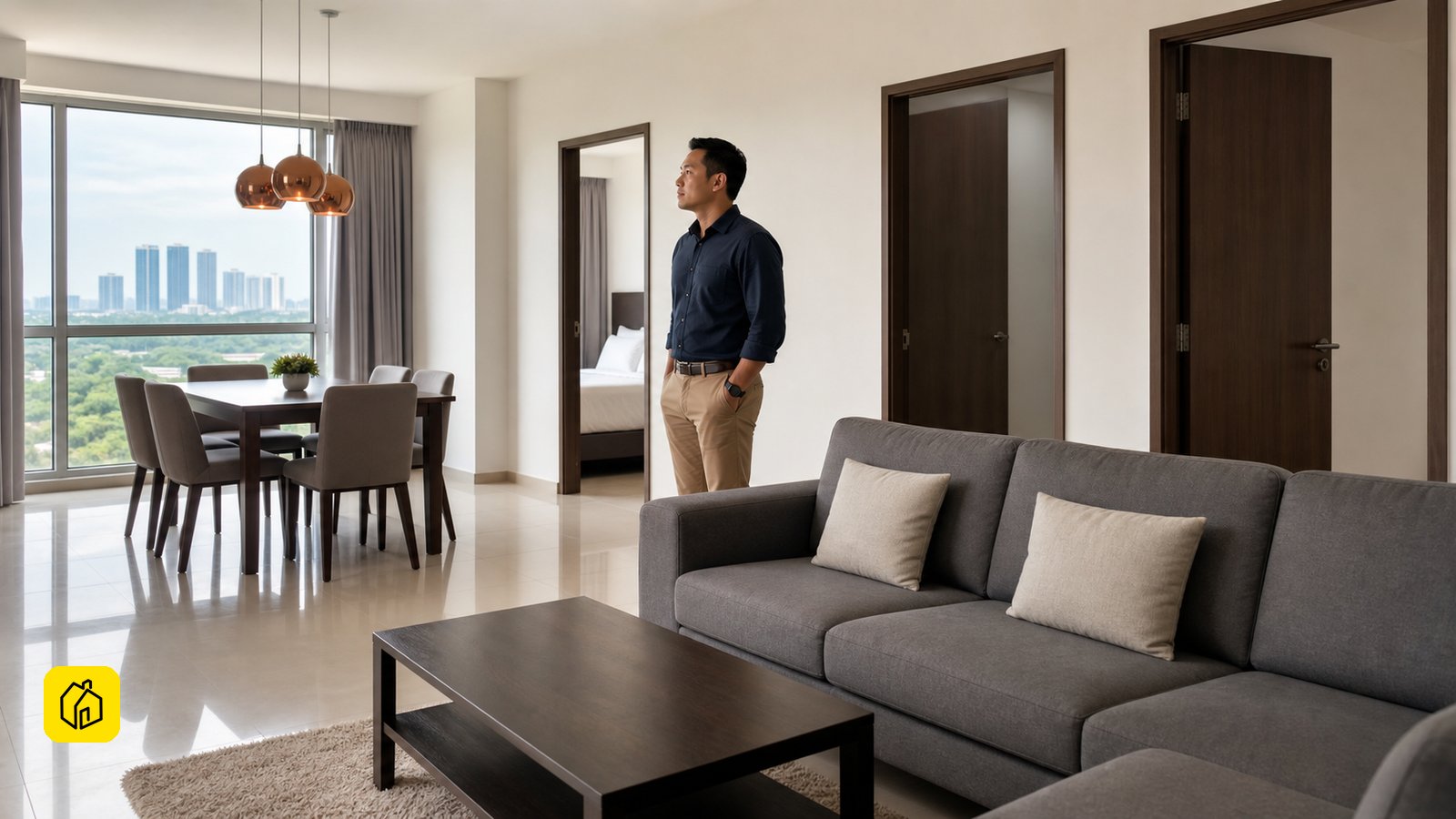
Cyberia Smarthomes is not a single rental decision. Its public fact record identifies a mature, freehold Cyberjaya project completed in 2002: 1,188 condominium units and 372 town villas, with a 1,024 sqft three-bed condominium and a 1,715 sqft four-bed town-villa layout among the recorded formats. The owner should underwrite the actual parcel as a whole-unit long-term home first. Room use requires existing approved bedrooms and written management confirmation; short-stay remains unavailable until written permission exists.
A condo and a town villa do not have the same operating risk
The 1,024 sqft condominium and 1,715 sqft town villa should not share one rent assumption, furnishing plan or maintenance budget. The building record names MK Land Holdings Bhd (Paramoden), a multi-block low-rise form and an established Cyberjaya location near Multimedia University. Read the bound project source and the local-authority reference as identity evidence. They do not prove present rent, demand, management permission or a particular title restriction for the individual parcel.
The condominium inspection focuses on common access, lift or stair route, parking, water pressure, kitchen, bathrooms and the effect of furniture on a 1,024 sqft household layout. The town-villa inspection adds private circulation, stairs, exterior surfaces, each floor’s air-conditioning and the handover condition across a larger home. More area is not automatically more income; it can mean more repair surface, more furnishings and a narrower tenant fit.
Use whole-unit underwriting as the control case
One household in the existing lawful layout is the model with the fewest unsupported assumptions. It has one agreement, one set of move-in standards and an exit that does not depend on partitioning or guest turnover. A town villa may suit a larger household; a condominium may suit a smaller one. Both require a dated comparable for the exact format and condition.
Existing-bedroom room rental is a conditional model only. The page does not claim that Cyberia Smarthomes permits it. Obtain the current by-laws and a written management response covering the proposed use, renovation process and any utility treatment. If the answer is missing, value the unit as a conventional whole-unit tenancy. Do not buy locks, partitions or billing equipment on the basis of bedroom count.
Short-stay is blocked. A Cyberjaya location or a nearby university is not a written management permission. A short-stay launch would introduce guest turnover, linen, support and rule-change exposure that this source package does not authorise.
Viewing and documentary DD must match the format
The purchase file should prove the specific parcel, not merely repeat the development name. Obtain the individual title, approved plan, latest maintenance statement, AGM minutes, special-levy notices and current by-laws. Ask management in writing about contractor deposits, renovation hours, pets, existing-bedroom leasing, submeters and short stays. Keep the reply with the deal file.
Photograph the meter readings, keys, parking allocation, appliances, wet areas and visible defects before any works. For the villa, record the condition by level and identify anything that would make a future whole-unit relaunch harder. For the condominium, verify practical access and common-area condition at the times a tenant would use them. A verbal assurance is not a decision input; a dated written record is.
Economic NOI decides whether a refresh is worth doing
Use current owner evidence to test incremental economic NOI after downtime, vacancy, operating cost and replacement allowance. Do not use an old advertisement, a different layout or a generic Cyberjaya figure as Cyberia Smarthomes rent. The shared calculator deliberately keeps unit-specific rent and cost fields as owner inputs.
Loading the renovation ROI comparison…
The cyberia-smarthomes preset compares no change, a lean reversible refresh and higher spend. Reject the premium option when added capital does not add economic NOI. SPEEDRENO should begin with repair, cleaning, paint, light and movable furniture for the confirmed whole-unit tenant. Postpone partitions, hospitality equipment and other irreversible work until both demand and management evidence clear.
Downside and reversibility
The main downside is paying for a model that cannot survive a vacancy, repair or management refusal. A whole-unit vacancy is concentrated but operationally simple. A room model adds multiple occupants, common-area wear and more collections. A town villa adds more inspection and repair points; a condominium depends more on strata access and common condition.
Reprice or walk away if the title, floor plan, management reply or dated comparable contradicts the intended model. Preserve a conventional whole-unit exit. The owner should not need a room-rental premium or a short-stay allowance to make the purchase case work.
A practical first-tenancy handover plan
The first tenancy should create evidence that makes the next vacancy cheaper and easier to manage. Before marketing, make an inventory that follows the actual parcel rather than a generic furnished-home checklist. Record the entry route, parking, keys, access cards, meter readings, appliance serial numbers, window condition, air-conditioning controls and every existing defect. In a condominium, include the lift or stair access and any common-area condition that affects move-in. In a town villa, make the inventory floor by floor: stairs, bathrooms, wet areas, exterior-facing openings and each air-conditioning point.
Ask a contractor to separate remedial work from optional improvement. Remedying leaks, failed fittings, unsafe electrical items or worn locks is a holding requirement. A feature wall, a new partition or hospitality equipment is a commercial choice and must wait until it has both an economic case and any required management approval. Keep invoices, photographs and warranties with the signed tenancy. At renewal or move-out, this record lets the landlord identify normal wear, decide whether the unit needs only a refresh, and avoid re-litigating the whole operating model. This discipline is particularly useful for an older, mixed-format estate because the age of the project does not tell an owner the condition of the exact parcel.
For a town villa, separately test upper-floor water pressure during viewing; it directly affects the handover standard and repair reserve.
Matched landlord next step
After the exact parcel, documents and current comparable support a conventional tenancy, the next decision is placement and operating workload. Use SPEEDHOME’s landlord route after that DD. The Cyberjaya rental guide and self-management cost calculator are useful context, not permission substitutes.
Questions before you proceed
Is the town villa automatically better because it has four bedrooms?
No. It has a different tenant fit and a larger maintenance and furnishing surface. Compare a dated like-for-like whole-unit comparable and the actual condition.
Can I treat the management rule as the same for every parcel?
No. Obtain the current written rule and apply it to the precise proposed use. This page makes no building-wide permission claim.
What is the safest initial fit-out?
A lean, reversible whole-unit refresh. It protects the landlord’s ability to relaunch conventionally if the shared or short-stay option never clears.
FAQ: Cyberia Smarthomes owner questions
Why must the condominium and town-villa parcels be assessed separately?
The recorded three-bedroom condominium and four-bedroom town-villa are different products. Their layout, condition and comparable evidence should not be mixed into one Cyberia assumption.
What is required before existing-bedroom sharing is tested?
The exact approved plan and a written current management response. This guide does not establish building-wide room, pet, submeter or short-stay permission.
What should the first fit-out preserve?
Preserve a conventional whole-unit re-let: repair defects, use durable movable furnishing, and test higher spend only against actual inputs in the shared calculator.