
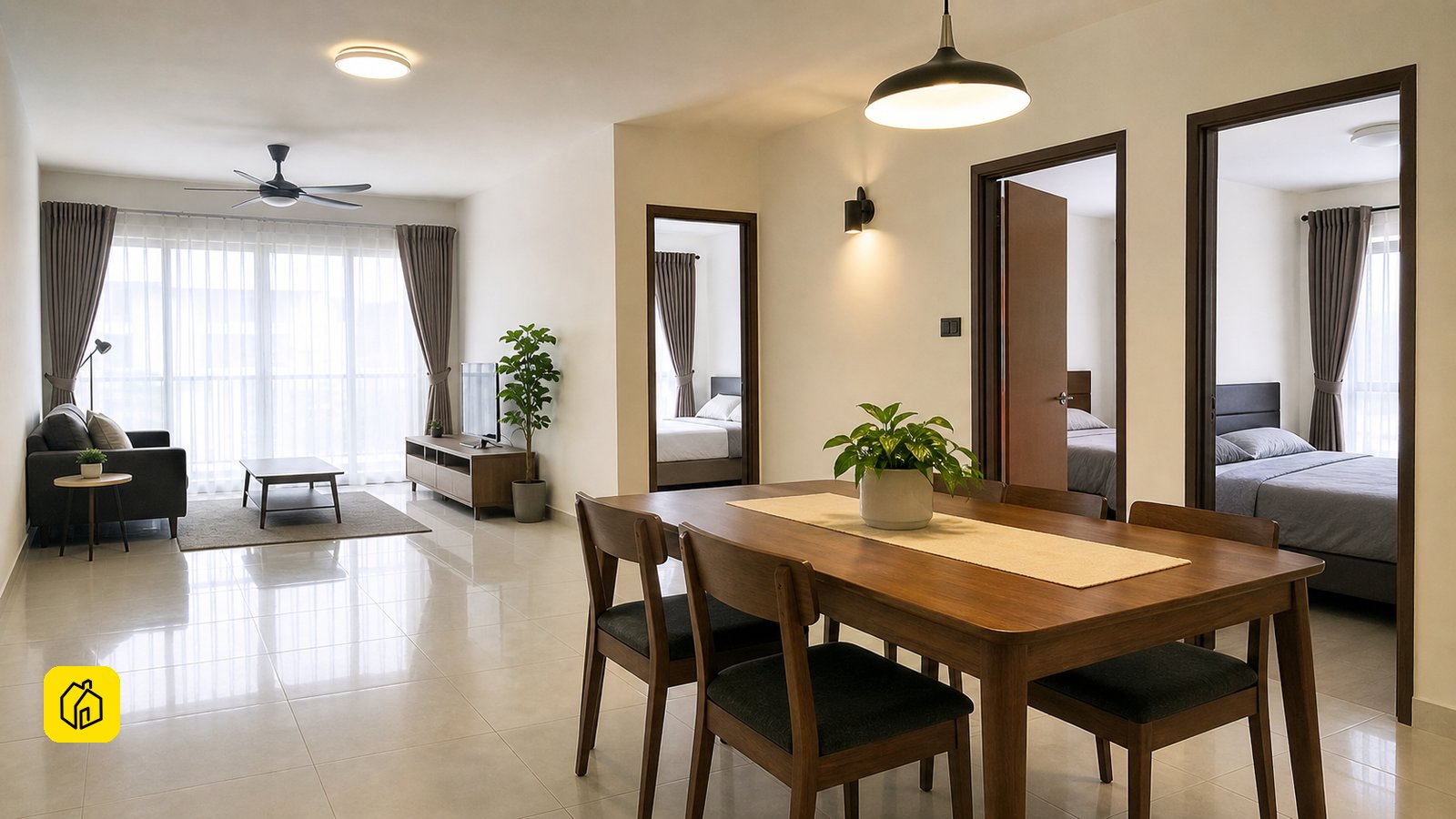
The Desa Impiana verdict
Underwrite Desa Impiana as a whole-unit, long-term tenancy first. The recorded 1,068 sqft Type A has three bedrooms and two bathrooms; the 1,890 sqft duplex has four bedrooms and three bathrooms. That is enough to compare two real parcel formats, but not enough to promise room demand, a rent premium, or permission to alter the unit. The project record also describes a Freehold development completed at the end of 2007, with 702 units across eight 14-storey blocks. See the public project records from PropertyGuru and RealEstateMy for the underlying building identity.
The 1,068 sqft three-bed is the cleanest conventional-tenancy decision: retain the approved layout, furnish for one household and price from current comparable listings for that exact format. The larger duplex deserves its own underwriting sheet; its extra bedroom and multi-level condition can change furnishing, wear and viewing checks. Do not transfer a rent or cost conclusion from one format to the other.
| Recorded format | Default decision | What can change it |
|---|---|---|
| 1,068 sqft, three-bed / two-bath Type A | Whole-unit long-term tenancy | Exact condition, current comparable, written management rules |
| 1,890 sqft, four-bed / three-bath duplex | Separate whole-unit underwriting | Parcel plan, stairs/condition, furnishing scope, current comparable |
| Existing-bedroom room or co-living | Conditional only | Written management position and real room-demand evidence |
| Short stay | Do not underwrite | Explicit written by-law permission and operator evidence |
Who this investment fits—and who should walk away
It fits an owner who wants a conventional rental asset and will do unit-level diligence before spending. The sensible first scenario is a household tenancy with no internal partition. It is a lower-complexity operating model: one condition record, one tenancy arrangement and one set of common-area expectations.
It does not fit an investor whose return depends on splitting rooms, adding partitions, running short stays, keeping pets, installing private submeters, or assuming a building-wide rent. Those are not project facts. A plan that needs any of them should pause until the specific unit's title and the current management position are in writing. Start with the broader landlord investment decision guide, then use this page to decide whether the exact Desa Impiana parcel clears that standard.
Whole unit, existing bedrooms, co-living, and short stay are different bets
Whole-unit long term is the only model this page can recommend before management due diligence. It uses the approved parcel as it stands and leaves the owner with a straightforward fallback if the market response is weaker than expected.
Existing-bedroom room rental is not the same as converting a unit. It can only be tested after the owner has confirmed that the intended use of the existing bedrooms is acceptable to management and has viewed the common area, storage, bathroom access and actual tenant demand. No extra bedroom, partition, or private utility arrangement should be assumed. The relevant operating trade-offs are covered in the room-rental and co-living guide.
Co-living adds a service model: house rules, shared-area standards, screening and more frequent handovers. Treat it as a separate operating business, not a higher-yield version of a normal tenancy. Short stay is a separate gate again. Do not buy furniture, locks or linen for it unless the current written by-law expressly permits the intended activity and the owner has a support and cost plan. A verbal answer from a guard, agent or previous owner is not enough.
The calculator is for economic NOI, not a headline yield
Enter an exact-unit comparable and actual costs; the calculator shows whether extra capital earns a marginal return. It keeps purchase price, renewal work, furnishing, annual operating cost and current rent as editable planning assumptions. That matters because the recorded project facts do not establish today's rent, vacancy, management charges for a particular parcel, or the cost of a particular scope.
Loading the renovation ROI comparison…
Use the calculator in this order:
- Enter the actual acquisition basis and a dated comparable for the same format, block and condition.
- Enter the quoted repair, furnishing and annual operating costs rather than a generic building average.
- Compare a lean, whole-unit-ready scope with a higher-spend scope. If the additional spend does not improve economic NOI enough to justify itself, it is dominated.
- Add a room or co-living scenario only after the management and demand gates have cleared. Keep short stay off unless written permission and operator evidence are in hand.
For the rest of the ownership costs that the building record cannot answer, use the real cost of self-managing a rental as the supporting model. The result is a decision range, not a promise of yield.
A reversible SPEEDRENO path
Use SPEEDRENO only for a conventional, reversible whole-unit refresh after the model is confirmed. The decision is not “spend more because the unit has more rooms.” It is whether repairs, durable finishes and furnishing solve a visible handover or tenant-fit problem for the selected format.
Start from the viewing evidence: dated photos of every room, floor, wet area, fixture and appliance; the parcel plan; and a written list of works that management allows. Keep structural changes, partitions and any work subject to approval outside the base case. That preserves a practical fallback: if room use never clears, the owner can still let a clean, compliant whole unit on the next cycle rather than carrying a stranded conversion.
Exact due diligence before an offer or fit-out
The title, management record and physical parcel—not a portal profile—decide whether this is investable. Ask for these items before committing capital:
- Specific unit and title: the issued title, parcel plan, block, floor, car parks and any restriction or endorsed condition. Do not infer the title category from the project name.
- JMB/MC records: the current by-laws or house rules, current renovation procedure, and written answers on existing-bedroom multi-tenancy, pets, short stay and submeters. The fact record does not establish any of those positions.
- Strata financial record: the current maintenance and sinking-fund statement, recent AGM material, and any notified special assessment or major works. This is a request for evidence, not an assumption about the building's finances.
- PBT check: confirm the current local-authority and use position for the actual parcel through the relevant council channel; the public project record places the development under the historical MPSJ/Subang Jaya jurisdiction, but that is not a substitute for the unit documents or current council advice.
- Viewing record: photograph condition, water evidence, plumbing, electrical points, ventilation, windows, access route and common areas. For the duplex, add stairs, upper-level water marks and the usable furniture path.
- Comparable evidence: capture dated, same-format long-term comparables and the condition differences. Ask SPEEDHOME for the current listing evidence rather than treating old asking prices as a rent fact.
Downside and the stop rules
The core downside is spending for an operating model that the unit or management will not support. The protection is sequencing: do not pay for partitions, short-stay equipment, pet positioning or private billing until the relevant written clearance and demand evidence exist.
If management does not support the intended room arrangement, revert to the whole-unit plan. If a renovation quote grows beyond the calculator's marginal-return case, reduce the scope to condition-critical work. If the duplex condition is materially worse than the three-bed comparison, re-price the acquisition or walk away; it is not evidence that the smaller format carries the same costs. Preserve the viewing inventory and handover record whichever model you choose—those records make the next tenancy, repair dispute or sale discussion more reversible.
FAQ
Is the 1,068 sqft three-bed automatically suitable for room rental?
No. The recorded layout establishes three existing bedrooms, not management permission, tenant demand, privacy or utility arrangements. Keep the base case as a whole-unit long-term let until written management evidence and the actual parcel viewing support another model.
Does the 1,890 sqft duplex justify a premium fit-out?
Not by size alone. Enter the duplex's own comparable rent, condition and quote in the shared calculator. Proceed only when the additional capital produces a decision-changing improvement in economic NOI.
Can an owner run short stay at Desa Impiana?
This page does not assert that short stay is permitted. Obtain the current written by-law and management position for the intended activity before acquiring short-stay-specific equipment or marketing the unit that way.
What must be verified with management?
Ask for the current written rules and approval process covering renovation, existing-bedroom multi-tenancy, pets, short stay and submeters. Those are unit- and building-governance decisions, not assumptions in the calculator preset.
Matched SPEEDHOME landlord close
Once the parcel clears title, management, condition and comparable checks, list the compliant long-term unit with SPEEDHOME. The next action is a landlord listing and tenant-placement conversation—not a claim that any gated operating model is already approved. List with SPEEDHOME after you have the selected format, a dated comparable and a documented scope.