
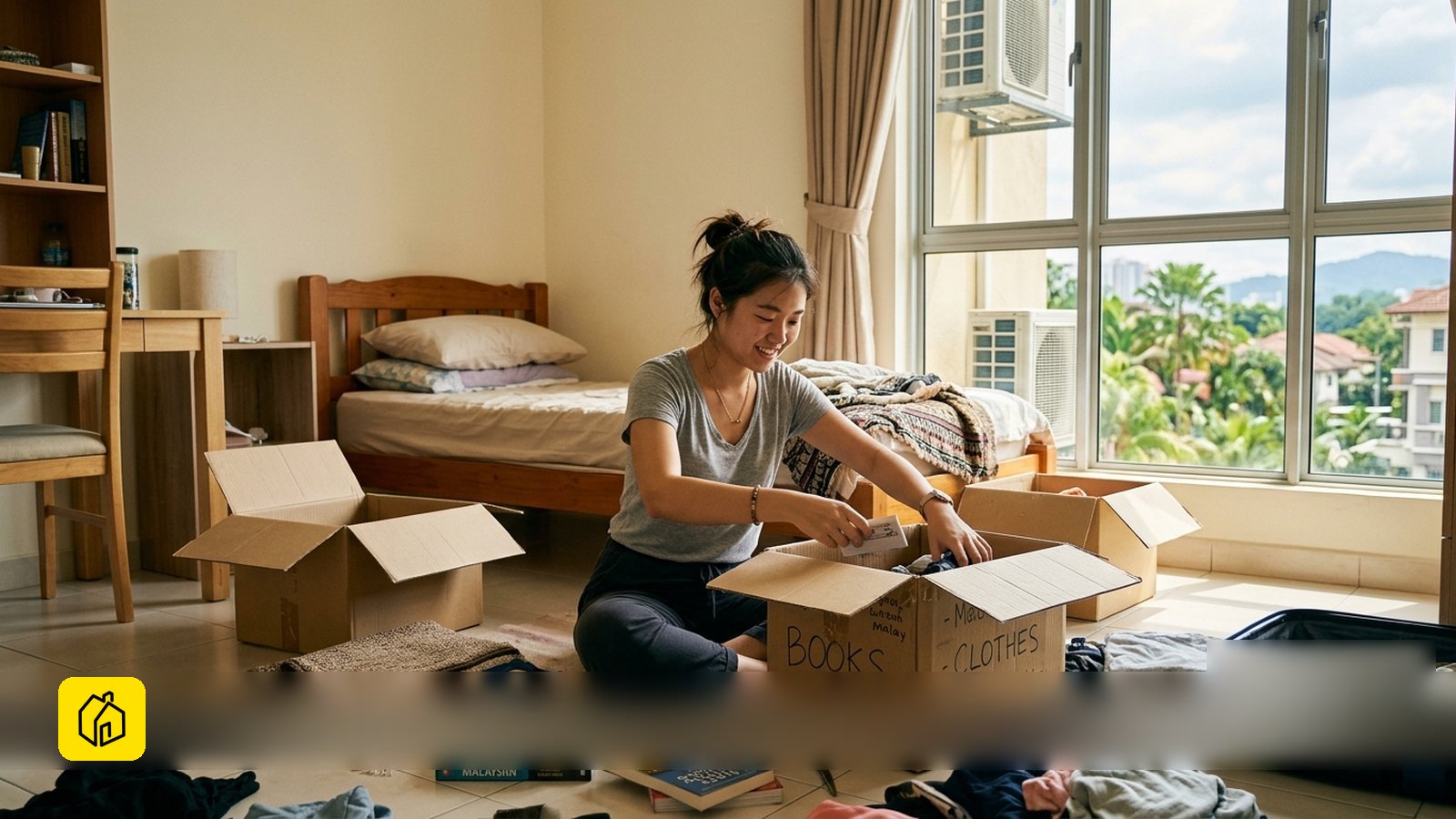
Where do Egyptian students in Malaysia usually rent?
Most Egyptian students in Malaysia are anchored to IIUM's Gombak campus, and the practical choice is between two clusters: Gombak itself — closer to campus, quieter, lower-budget — and Taman Melati, one LRT stop south, which trades a slightly higher rent for retail, Arab restaurants and easier transit into the city.
IIUM Gombak runs 17 Mahallah (residential colleges) housing roughly 17,000 students, according to the university's Residential and Services Department. Mahallah is Arabic for neighbourhood, and the colleges are built to be self-contained. Arriving alone, that buys integrated utilities and structured community with no landlord to negotiate with in month one — but allocation is not automatic and room types are fixed. Ask the Mahallah Management Unit about availability for your intake rather than assuming a bed exists.
Off-campus, the two clusters differ in ways a map will not show. Gombak sits closer to campus, many units within walking distance. Taman Melati is on the LRT Kelana Jaya Line between Gombak and Wangsa Maju, and its Jalan Melati Utama strip has established Arab restaurants — Qasar Balqis, a Yemeni and Arabic restaurant, sits at number 1. Note the distinction: that is a broadly Arab (largely Yemeni and Hadhrami) cluster, not specifically Egyptian, so map your own shopping and dining rather than trusting an "Arab area" label.
Be wary of any guide handing you a fixed RM band for a room near IIUM. Property portals consistently position Gombak as a lower-budget Klang Valley north-corridor pocket than Setapak or Wangsa Maju, reflecting the longer last-mile from the LRT Gombak terminus and IIUM-driven demand for shared rooms and studios. But asking prices shift weekly with the semester cycle and each unit's condition — check live listings on the day you search. Filter by commute to your faculty first: several sub-areas (Taman Sri Gombak, the IIUM-side pockets, Hulu Gombak) are not walkable to the station and need a feeder bus, e-hailing trip or car.
How do I get deposit money from Egypt to a Malaysian landlord?
Assume your Egyptian bank card will not pay your Malaysian deposit. HSBC Egypt has stopped international transactions on EGP debit cards since 24 October 2023 — except cards linked to a foreign-currency account — and caps overseas cash withdrawals on EGP-account credit cards at about USD 250 per month. Plan a documented bank transfer instead.
This is the biggest difference between your move and that of most other international students, and it is why timing matters more for you. Do the arithmetic: a Malaysian tenancy wants close to three and a half months' rent before you get keys (see below). A USD 250 monthly cash ceiling does not reach that, and you cannot simply land at KLIA and pull the deposit from an ATM.
What works, in rough order of reliability:
- A documented bank transfer. Egyptian banks generally require documentation of a transfer's purpose — an invoice or enrolment confirmation — before approving foreign currency, and education is a recognised purpose. Your EMGS documents and offer letter unlock this. Ask your branch what they need before you need the money.
- A foreign-currency account. HSBC Egypt's international block does not apply to debit cards linked to an FX account, and FX-account withdrawals escape the monthly cap. If family will fund you across the degree, set this up early rather than mid-crisis.
- Education supporting documents raise credit-card travel purchase limits — HSBC Egypt's standard EGP 200,000 monthly purchase limit rises to EGP 250,000–500,000 by card tier when travelling with documents. Useful for living costs; still not a deposit mechanism.
Two caveats. These are HSBC Egypt's published limits, not a Central Bank of Egypt rule — every Egyptian bank sets its own caps and they have changed repeatedly since 2022, so verify with your own branch rather than budgeting off any article, including this one. (We could not access the CBE's own site to confirm, so nothing here is attributed to the CBE.) And build a buffer of several weeks between "landlord says yes" and "money must arrive".
That buffer is also scam protection: the gap between a landlord wanting cash now and your transfer clearing later is exactly the pressure a scammer manufactures.
How does the Malaysian deposit structure compare with renting in Egypt?
There is no statutory cap or floor on tenancy deposits in Malaysia. Market practice is roughly 2 months' rent as a security deposit, plus about 0.5 month's rent as a utility deposit, plus 1 month's rent paid in advance before move-in — so most new tenants pay close to 3.5 months' rent upfront.
The part that surprises Egyptian students runs opposite to expectation: Malaysia's upfront requirement is likely higher than at home, not lower. Egyptian practice reportedly sets deposits at around one to two months' rent, with a 12-month contract term, post-dated cheques covering the lease, and a broker (semsar) fee of up to a month's rent. That 12 months is the contract length, not a lump sum handed over on day one. In Malaysia you will not generally be asked for a year of post-dated cheques — you will be asked for a bigger pile of cash at the start.
| Component | Typical Malaysia practice | Notes for Egyptian students |
|---|---|---|
| Security deposit | ~2 months' rent | Refundable, subject to fair wear-and-tear deductions |
| Utility deposit | ~0.5 month's rent | Held by landlord or paid to the utility provider |
| Advance rent | 1 month, paid before move-in | Not a post-dated cheque series for the year |
| Total upfront | ~3.5 months' rent | Confirm the exact split in writing before paying anything |
Because these are market-practice figures rather than a legal rule, the split is negotiable and varies by landlord and property type. Get the payment schedule and refund conditions in writing, especially what counts as fair wear-and-tear. Treat the Egypt-side comparison as directional — it comes from Egyptian agency guidance, not a statutory source, and Cairo, Alexandria or a compound market may differ.
For the fuller set of documents, fees and screening steps landlords apply to any foreign or student tenant, see the foreigner and student rental guide.
What happens to my deposit if my Student Pass (EMGS) application is rejected?
There is no official EMGS or Immigration Department rule that automatically voids or refunds a tenancy if your Student Pass application is rejected — EMGS's published refund policy covers only its own processing and immigration fees, not your accommodation. A signed tenancy is a binding private contract under Malaysian law regardless of your visa outcome, so your protection is a clause you negotiate in writing before you sign, not a statutory backstop.
Before committing, ask whether the landlord or platform will accept a conditional booking, a shorter initial term, or a written clause allowing termination on proof of visa rejection with defined deposit treatment. Landlords who rent to international students are used to the request. Keep your EMGS reference and any rejection letter — that is the documentation a reasonable landlord will want.
This compounds the money problem above: a rejection can strand a deposit that took weeks and a documentation trail to move out of Egypt. The negotiated clause matters more for you than for a student who can simply tap a card.
On verification, Malaysia has no public portal where a landlord can look up your visa status — the EMGS tracker (visa.educationmalaysia.gov.my) is applicant-facing and you show it yourself. Expect a landlord to physically sight your passport and pass sticker or approval letter. That is standard practice, not suspicion of you.
How do I check the kitchen and housemates before I sign?
Ask directly at viewing: is there a separate cooking area, are surfaces and cookware shared with non-halal food, can you keep your own utensils, and what do current housemates actually cook? These are logistics questions, not impositions, and any landlord who has housed international students will answer them.
One clarification, because guides get this wrong: Malaysia's halal certification system covers commercial premises and products — it does not certify a housemate's shared kitchen, so there is no certificate to ask for in a private unit. Inspect and agree instead: a separable cooking space, your own pans and clear storage do more real work than any label. Shared units also churn, so what was a fully Muslim household last semester may not be this one — ask about the current housemates, not the building's reputation.
If cooking is central to your budget, see Is renting a room in Malaysia a good option for students? for rooms versus whole units.
How do I avoid rental scams as an international student?
Never transfer a deposit or advance rent before you have physically viewed the unit or verified the landlord's identity and ownership — PDRM-recorded rental scam cases rose from 184 in 2023 to 922 in 2025, a roughly 5x increase, with reported victim losses of approximately RM2.5 million over that period. International students are targeted precisely because scammers assume you cannot view in person before arriving and can be pressured to wire money quickly.
Egyptian students carry an extra vulnerability worth naming. When your money moves only through a documented, slow, bank-approved channel, a "send it now or lose the room" demand hits harder — and a scammer who learns you are waiting on a transfer from Cairo knows which lever to pull. A genuine landlord will wait for a documented international transfer. A scammer will insist you find a faster route: a personal account, or a friend's card.
The checks that catch most scams: insist on a live video walkthrough if you cannot attend; match the landlord's name against the title deed or a recent utility bill; if an agent is involved, check their REN or REA registration number against the official public register of registered estate agents and negotiators before paying; never wire to a personal account for a platform-listed unit; and treat a price well below market as a warning, not a win. Informal Egyptian and Arab student networks are useful for finding units but circulate unverified listings too — verify independently before funds move, however trusted the sender.
SPEEDHOME verifies every listing and landlord before it goes live, and has had zero reported rental scams on the platform since April 2026. As SPEEDHOME puts it: "If a landlord cannot wait for a bank transfer to clear, that is not a landlord problem — that is your warning." SPEEDHOME also uses Zero Deposit — a managed rental-risk system, not a financial guarantee product, that replaces the upfront cash deposit so tenants move in without tying up cash while landlords stay protected through rental protection instead of holding a deposit — which directly reduces what you must move out of Egypt before you get keys. Browse verified listings near your campus on SPEEDHOME's rental search, and the Arab students renting in Malaysia hub covers how this differs for Sudanese and Yemeni classmates.
FAQ
Can I pay my Malaysian deposit with my Egyptian debit card?
Generally no. HSBC Egypt has blocked international transactions on EGP debit cards since 24 October 2023, except cards linked to a foreign-currency account. Limits are set bank by bank and change often — confirm with your own branch, and plan a documented transfer instead.
What documents do I need to transfer money from Egypt for my studies?
Egyptian banks typically require documentation of the transfer's purpose, such as an invoice or enrolment confirmation. Your university offer letter and EMGS paperwork are the usual basis. Ask your branch for their exact list before you need the funds.
Is there Arab food near IIUM Gombak?
Yes, around Taman Melati — Jalan Melati Utama has established Arab restaurants, including Qasar Balqis, a Yemeni and Arabic restaurant at number 1. It is a broadly Arab rather than specifically Egyptian cluster, so check a map for what you actually want before choosing a unit.
Can I sign a tenancy agreement before my Student Pass is approved?
Yes — contract validity is separate from immigration status in Malaysia. The risk sits entirely in the deposit and termination terms if your pass is later rejected, so negotiate that clause before you sign.
Is it normal to pay a full year's rent in advance in Malaysia?
No. Standard practice is 1 month's rent in advance plus a security deposit and utility deposit, not a lump-sum annual payment or a year of post-dated cheques. Be cautious of anyone insisting on a full year upfront.
Guarantor requirements, document checklists and landlord screening steps apply to all foreign tenants and are covered in the foreigner and student rental guide.
Accuracy note. This page is built on verified primary sources and a dated fact registry; figures are re-verified on each update. Spotted an error? Email [email protected] with this page's link.