
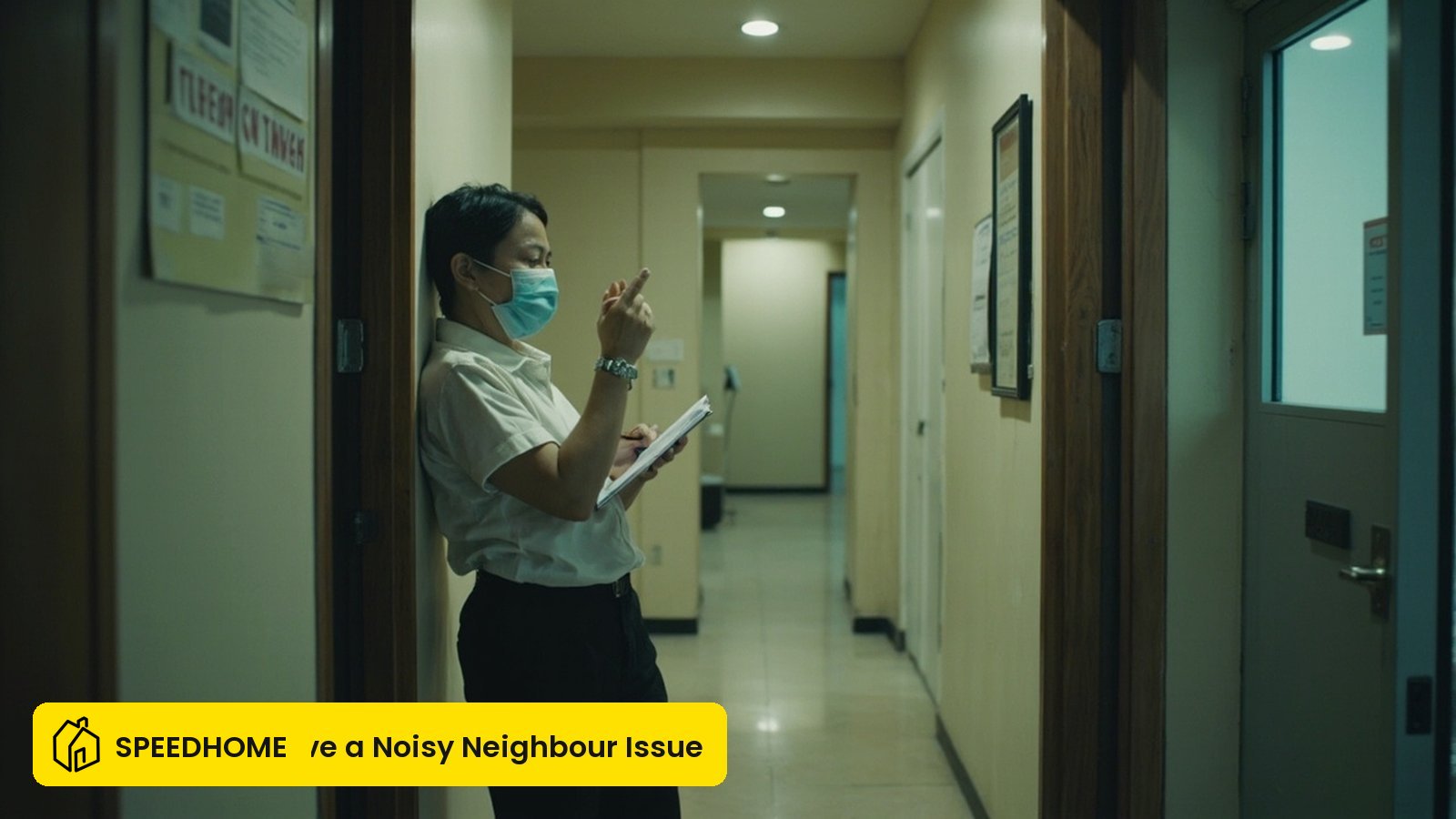
How do I resolve a noisy neighbour issue in Malaysia?
Start with a direct, calm approach before escalating. Document every step. Most noise issues in Malaysia are resolved at the management body (JMB or MC) level without involving any court. If the noise breaches local authority by-laws, a written complaint to DBKL, MBPJ, or the relevant city or municipal council is your next lever.
Most Malaysian tenants don't realise: there is no dedicated residential tenancy tribunal, and the tenancy agreement usually says nothing about neighbour noise. Resolving the issue means knowing which body has authority at each stage and keeping a written record throughout, so the complaint is taken seriously.
SPEEDHOME has managed 30,000+ tenancy agreements across Malaysia. Across that operator dataset, noise and neighbour-conduct complaints are a recurring theme in strata-managed buildings, and the cases that resolve at the management-body level are the ones where the resident submitted specific dates, times, and the type of noise — not a vague verbal complaint.
Step 1 — approach the neighbour directly (and document it)
A brief, calm, in-person conversation resolves the majority of noise complaints before any formal process is needed. Keep the interaction short, factual, and non-confrontational.
Knock on the door at a neutral time — not during the noise — and let the neighbour know the specific times and type of sound that affects you. Most people do not realise how much noise travels through concrete-frame Malaysian high-rises. Give the neighbour a chance to fix the problem.
If you are not comfortable approaching in person, or if previous verbal requests have been ignored, send a short written message (WhatsApp is acceptable) noting the date, the type of noise, and when it occurs. Save the message. This written record matters at every subsequent stage.
Do not threaten, record the neighbour inside their unit, or copy in third parties on a first contact.
Step 2 — report to the building management body
In a strata development — condominium, apartment, or serviced suite — the Joint Management Body (JMB) or Management Corporation (MC) has formal authority to enforce house rules and by-laws against parcel owners and occupiers.
Many strata buildings in Malaysia include a noise or nuisance clause in their house rules; check yours (the management office or building's resident portal usually keeps a copy). Submit your complaint in writing — email or the building management's complaint channel — and include:
- Your unit number and the neighbour's unit number
- The date(s) and time(s) the noise occurred
- The type of noise (renovation work after hours, music, parties, machinery)
- Whether you already approached the neighbour and what happened
Under the Strata Management Act 2013 (Act 757), the management body can issue a written demand against a breach of house rules and, where the breach continues, escalate to the Strata Management Tribunal. Noise-rule enforcement sits in the house-rules regime — separate from the s.34 unpaid-charges recovery process the same Act sets out for maintenance arrears — so cite the house-rules clause (or the building by-laws), not the charges-recovery section, when you write. A written complaint from a resident is the trigger for the management body to act. See the maintenance fee and management body guide for a full overview of what your JMB or MC is responsible for.
Keep a copy of every submission and every reply. If the management body does not act within a reasonable period (typically 14 days), you have a paper trail to escalate.
Step 3 — complain to the local authority
If the noise constitutes a public nuisance or breaches local noise by-laws, the relevant local council — DBKL for Kuala Lumpur, MBPJ for Petaling Jaya, MBSA for Shah Alam, and equivalents elsewhere — can issue a warning or compound notice against the noisy unit.
Noise by-law enforcement is a local-authority function in Malaysia. Each city or municipal council has its own nuisance or public-health by-law that sets permitted noise levels and time restrictions; the exact thresholds and quiet hours vary by council, so check your council's website for the by-law applicable to your address (for example, the DBKL By-Laws 1982 on Nuisance for Kuala Lumpur, the MBPJ nuisance by-laws for Petaling Jaya, or the MBSA by-laws for Shah Alam).
File a complaint at the council's online portal or counter. Provide your written log of dates, times, and attempts to resolve the matter. Some councils act faster on complaints that include evidence that the management body has already been notified.
Step 4 — escalate through legal channels
If the noise causes you real loss — for example, you are unable to sleep, your health is affected, or the landlord refuses to address a condition that makes the unit uninhabitable — you have two routes: ask your landlord to act, or pursue a civil nuisance claim.
| Route | When to use | Claim limit | Lawyers needed? |
|---|---|---|---|
| Ask your landlord to act | Management body is unresponsive; your tenancy agreement has a quiet-enjoyment clause | Depends on the TA | No — written request to landlord |
| Small claims (Magistrates' Court) | Private nuisance causing measurable loss; claim ≤ RM5,000 (Rules of Court 2012, Order 93) | RM5,000 | No |
| Magistrates' Court | Civil claims up to RM100,000 | RM100,000 | Optional |
| Strata Management Tribunal | Breach of strata by-laws or house rules; claim ≤ RM250,000 (SMA 2013 s.105(1)) | RM250,000 | No |
| Sessions Court | Civil nuisance claims up to RM1,000,000; unlimited for landlord-tenant distress actions (Distress Act 1951) | RM100,000–RM1,000,000 | Recommended |
Tier limits above are statutory: Magistrates' small claims ≤ RM5,000 (Rules of Court 2012, Order 93); Magistrates' Court civil jurisdiction up to RM100,000; Sessions Court up to RM1,000,000 in civil cases and unlimited for landlord-tenant distress; Strata Management Tribunal up to RM250,000 (SMA 2013 s.105(1)). Malaysia has no dedicated residential tenancy tribunal as of 2026. All routes above go through the ordinary civil courts or the Strata Management Tribunal (for strata buildings only). No Malaysian statute currently allocates quiet-enjoyment obligations between neighbours — disputes are governed by general contract and tort law.
Your tenancy agreement may contain a quiet-enjoyment clause. If so, write to your landlord and ask them to raise the issue with the building management body. Keep the written request. If the landlord does nothing and the noise makes the unit materially less liveable, this may affect the landlord's duty under the agreement.
What to document throughout the process
Keep a short log: date, time, type of noise, duration, and any action taken. This log is your strongest asset at every stage — management body, local authority, or court.
| Stage | What to record | Why it matters |
|---|---|---|
| Every noise incident | Date, time, type, duration | Establishes a pattern; management bodies and tribunals respond to patterns |
| Direct approach | Date, method (in person / WhatsApp), neighbour response | Shows you attempted resolution before escalating |
| Management body complaint | Date submitted, reference number, written reply | Needed for Strata Tribunal or local authority escalation |
| Local authority complaint | Date filed, officer name or reference, outcome | Creates a formal public record |
| Landlord notification | Date, method, landlord reply | Needed if you raise a quiet-enjoyment claim |
Recordings taken from inside your own unit (not the neighbour's) are generally acceptable as supporting evidence.
Legal pitfall — do not record inside another person's unit without consent. Audio or video captured inside a neighbour's unit without their consent can breach the Personal Data Protection Act 2010 and the Communications and Multimedia Act 1998 (s.233, improper use of network/service). It can also be excluded as evidence. Record from your own unit only, and if you can, use a dated log instead.
The SPEEDHOME tenant angle
Reducing exposure before you sign a tenancy:
- Mid-floor units in corners or end positions typically share fewer walls and receive less corridor noise than central-stack units.
- Buildings with active JMBs are more likely to enforce noise rules after you move in. Ask at the viewing whether the management body is active and how complaints are handled.
- Verified listings on SPEEDHOME include building and contact information so you can check the management body before committing.
Zero Deposit is a managed rental-risk system, not a financial guarantee product. It replaces the upfront cash deposit; in the rare case of severe end-of-tenancy damage the recoverable amount can be limited, so full recovery is not assured. Noise disputes do not affect Zero Deposit eligibility, but they are a reason to document your tenancy well from day one.
Browse verified rentals at /rent, read the maintenance fee guide to understand what the building management body is responsible for, or check the who pays for repairs guide for broader context on landlord and tenant maintenance duties.
FAQ
Who is responsible for noisy neighbours in a Malaysian rental — the landlord or the management body?
The management body (JMB or MC) handles noise between units in strata buildings. Your landlord is not directly responsible for a neighbour's behaviour but may have a duty under the tenancy agreement's quiet-enjoyment clause to take reasonable steps. Write to the management body first, then your landlord if the management body fails to act. For non-strata landed rentals, your landlord is the only in-building escalation path — and the local authority (council) is the next lever.
Can I terminate my tenancy early because of noise?
Only if the noise renders the unit materially uninhabitable and you have documented attempts to resolve it that the landlord has ignored. Withholding rent or handing in notice without a written record and reasonable attempts to escalate usually loses you the deposit. Get written legal advice before you give notice.
Is there a noise curfew in Malaysian residential areas?
Each local council sets its own rules under its nuisance or public-health by-law; the time threshold (commonly late evening into early morning) and the specific hours vary by council. Check your local council's website for the by-law applicable to your address — DBKL By-Laws 1982 (Federal Territory), MBPJ nuisance by-laws (Petaling Jaya), MBSA by-laws (Shah Alam), MPSJ (Subang Jaya), MPK (Kuantan), and so on.
What is the Strata Management Tribunal and can it handle noise complaints?
The Strata Management Tribunal hears disputes between strata parcel owners/occupiers and the management body, including failures to enforce house rules. It can hear claims up to RM250,000. It is not a landlord–tenant deposit forum and does not hear private civil nuisance claims between neighbours. If your noise complaint is rooted in the management body's failure to enforce by-laws, the Tribunal is the right forum. If it is a direct nuisance claim against the neighbour, use the civil courts.
What if the noisy neighbour is the owner and the JMB does nothing?
File a complaint with the local authority and keep the paper trail. If the noise causes you measurable loss, a civil nuisance claim through the Magistrates' Court (up to RM100,000) or Sessions Court is available. For strata buildings, the Strata Management Tribunal is an alternative for rule-breach complaints against the management body. Malaysia has no dedicated tenancy tribunal as of 2026 — all civil routes go through the ordinary courts.
Can I reduce the rent I pay because of noise?
Not unilaterally. If you reduce rent without agreement, the landlord can treat it as a breach. If the noise materially affects your use and enjoyment, write to the landlord, document the issue, and negotiate a rent reduction in writing. If agreement is not reached and the issue is serious, seek legal advice before withholding rent.
Sources cited in this guide: Strata Management Act 2013 (Act 757), s.34, s.105(1), s.123 — AGC verbatim (Act 757). Rules of Court 2012, Order 93 (small claims ≤ RM5,000). Distress Act 1951 (Sessions Court unlimited jurisdiction for landlord-tenant distress). Personal Data Protection Act 2010; Communications and Multimedia Act 1998 s.233 (recording-without-consent). SPEEDHOME operator data — 30,000+ tenancy agreements.