
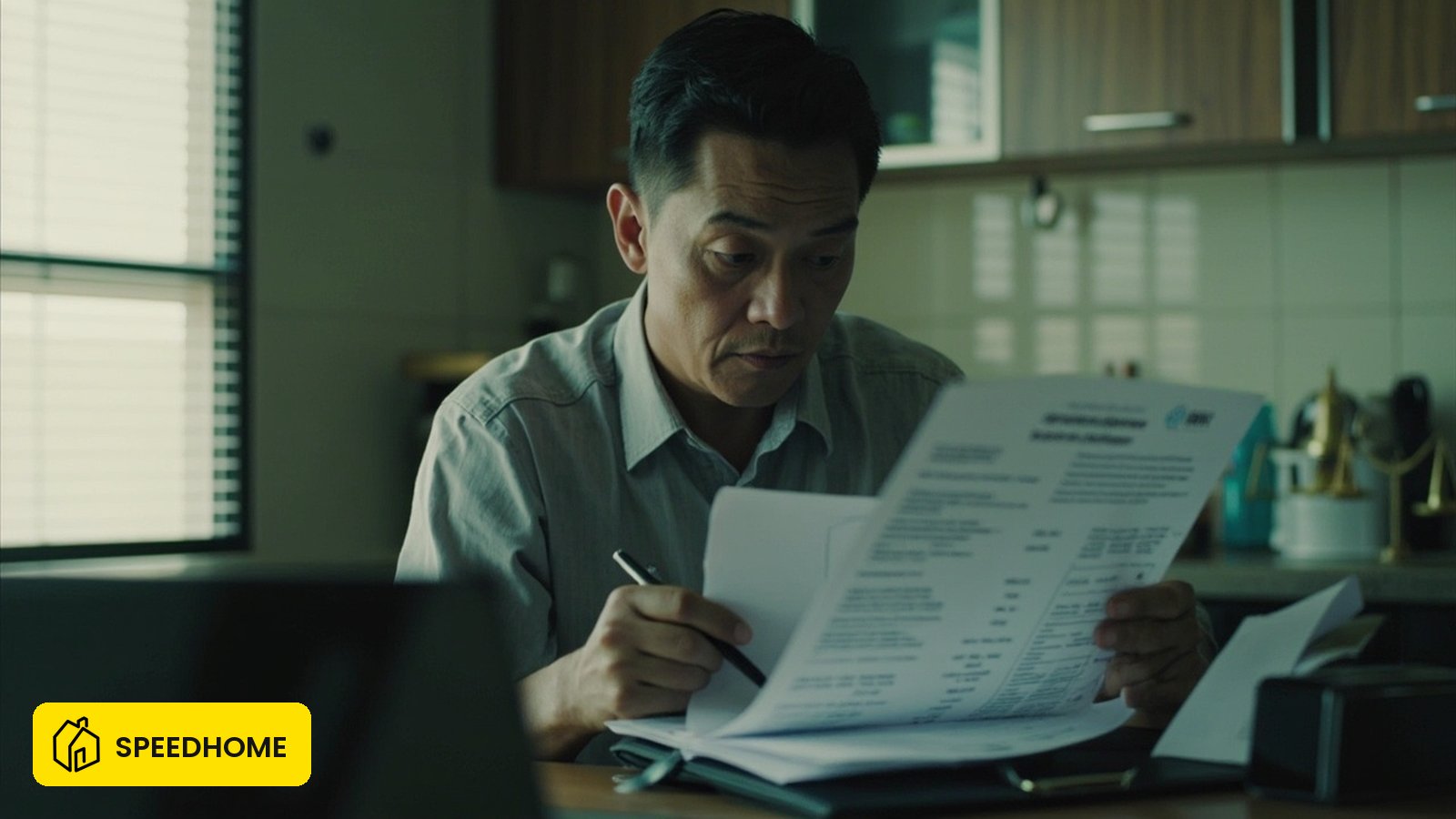
Who pays the Indah Water (IWK) sewerage bill in a Malaysian rental?
The Indah Water Konsortium (IWK) sewerage account is registered to the property owner, not the tenant — so the landlord is the one IWK chases for payment. Whether the tenant ultimately reimburses that cost depends on what the tenancy agreement (TA) says. If the TA names IWK and requires reimbursement, the tenant pays the landlord. If the TA is silent or only says "utilities", the landlord absorbs the bill.
This is the single biggest source of confusion in Malaysian rental utility billing, because TNB electricity and the state water account can both be transferred to the tenant's name at move-in. IWK does not run a routine residential change-of-account process. The sewerage bill follows the property — not the person living there — for the entire tenancy.
How does IWK billing actually work in a rental?
IWK bills the registered property owner every four months for connected premises in Peninsular Malaysia. The tenant is not a party to the IWK service account, and the provider looks to the landlord — not the occupant — for payment.
| Utility | Whose name is the account in | Who the provider chases | How to handle it in a rental |
|---|---|---|---|
| TNB electricity | Tenant name (after Change-of-Tenancy) or landlord | Account holder | Transfer at move-in via myTNB / Kedai Tenaga; record meter reading |
| Air Selangor / state water | Tenant name or landlord | Account holder | Transfer at move-in via the water provider's service centre |
| IWK sewerage | Property owner — does not transfer to the tenant | Property owner (landlord) | Landlord pays IWK; TA clause decides whether tenant reimburses |
| Internet / broadband | The subscriber — landlord or tenant | Subscriber | State in the TA who subscribes and who pays the early-exit penalty |
The practical implication for landlords: an unpaid IWK account sits with the property owner regardless of who was living in the unit when the bill ran. If the tenant agreed to reimburse and then skipped, the debt to IWK is still the landlord's — recovering it from the tenant is a separate civil question.
For tenants: IWK is not your direct bill. If your landlord asks you to pay or reimburse IWK, the first thing to check is the TA. If IWK is not named, you have no contractual obligation. If it is named, pay and keep receipts for the move-out accounting.
For the full utility picture — TNB, water, internet, and IWK as one workflow — read the managing utility bills in Malaysia guide.
What should the tenancy agreement say about IWK?
The TA should name IWK (Indah Water) sewerage charges specifically, state who is responsible for the amount, and set out how reimbursement works if the landlord pays IWK first. A vague clause — or no clause — usually means the landlord absorbs IWK, because the account stays in the landlord's name and there is no statutory mechanism to shift liability without a written agreement.
Because IWK bills the owner, landlords usually pick one of three approaches:
- Absorb IWK into the rent — the rental price already covers IWK. The tenant pays nothing separate. Clean and dispute-free.
- Tenant reimburses landlord monthly or quarterly — the TA states the tenant must pay the landlord the IWK amount on production of the bill. Keep receipts both ways and reconcile at move-out.
- Landlord retains full IWK responsibility — the TA imposes no IWK obligation on the tenant. The landlord treats IWK as a property cost.
A common failure mode is the TA saying "tenant pays all utilities" without naming IWK. In Malaysian rental practice, "utilities" typically means TNB electricity and the state water bill. IWK is a separate sewerage charge. A landlord trying to deduct unpaid IWK from the deposit on the strength of a generic "utilities" clause will struggle in a deposit-deduction dispute. For a deeper cut at this clause problem, see Indah Water bill: landlord or tenant pays?.
What happens if the IWK bill goes unpaid?
Unpaid IWK charges accumulate against the property owner, not the tenant. IWK's enforcement route runs against the registered account holder. A landlord cannot lawfully disconnect sewerage service, lock the tenant out, or otherwise use self-help to recover IWK reimbursement that a tenant owes under the TA — that path is barred under the Specific Relief Act 1950 s.7(2), the same rule that applies to electricity and water.
If the TA contains an IWK reimbursement clause and the tenant has not paid, the lawful recovery steps are: keep the bill, send a written demand, and if needed pursue the amount as a civil debt through the courts. Do not let IWK charges accumulate silently on the property — they can complicate future sales, refinancing, or strata dealings for the owner.
For landlords managing this risk across multiple properties, the landlord's guide to preventing unpaid utility bills covers the broader prevention workflow, and the page on whether a landlord can cut electricity or water explains the self-help boundary in detail.
The SPEEDHOME angle — utility clarity written into the tenancy
SPEEDHOME's managed tenancy framework ships a standard tenancy agreement that addresses utility responsibility line by line — TNB, water, IWK, broadband — so the IWK question is settled at signing, not discovered at move-out.
On SPEEDHOME-listed homes, the tenancy template gives the landlord a clear way to specify whether IWK is absorbed into rent or reimbursed by the tenant on bill production. The rental security deposit is separate from any IWK or utility reimbursement. If the tenant leaves with an outstanding IWK amount covered by the TA, any deposit deduction has to be tied to the documented bill and the contract clause — not an assumed entitlement.
Zero Deposit is a managed rental-risk system, not a financial guarantee product. It replaces the upfront cash deposit so the tenant moves in without tying up cash while the landlord stays protected through the platform's rental protection framework. For severe end-of-tenancy damage beyond fair wear and tear the standard protection claims process applies. Utility reimbursement disputes — including IWK — are still resolved through the TA and, if needed, civil channels.
Browse rental homes on SPEEDHOME to find listings where the utility clauses and tenancy framework are already in place.
FAQ
Who is the IWK account holder in a Malaysian rental?
The property owner. IWK registers the account in the owner's name and bills that person directly. The sewerage account does not transfer to a tenant at move-in the way a TNB or state water account can.
Can the IWK account be transferred to the tenant's name?
IWK does not run a routine residential change-of-account process for tenancies. If you need confirmation of IWK's current process or any change-of-occupant form, contact IWK directly at iwk.com.my — do not rely on undated guides.
What if the tenancy agreement says "tenant pays all utilities"?
That clause typically covers TNB electricity and the state water bill. It does not automatically include IWK sewerage, which is a separate charge. If IWK is not named, the landlord has a weak basis to deduct unpaid IWK from the deposit.
Can a landlord use the security deposit to cover unpaid IWK?
Only if the TA contains an IWK-reimbursement clause, the tenant has not paid, and the landlord can show the bill. The deduction has to be tied to a proven, documented shortfall — not an assumed entitlement.
Can a landlord cut sewerage if the tenant refuses to pay IWK?
No. Disconnecting water or electricity to recover a TA debt is self-help, and a landlord cannot lawfully evict or pressure a tenant by disconnecting water or electricity under the Specific Relief Act 1950 s.7(2). Recover TA debts through written demand and civil channels.
What is the current IWK sewerage tariff?
IWK's sewerage tariff varies by property type, connection status, and the current billing cycle. Do not cite 2021-era figures. Verify the current tariff directly with IWK (iwk.com.my) or the latest bill before putting any number in the TA or a dispute.