
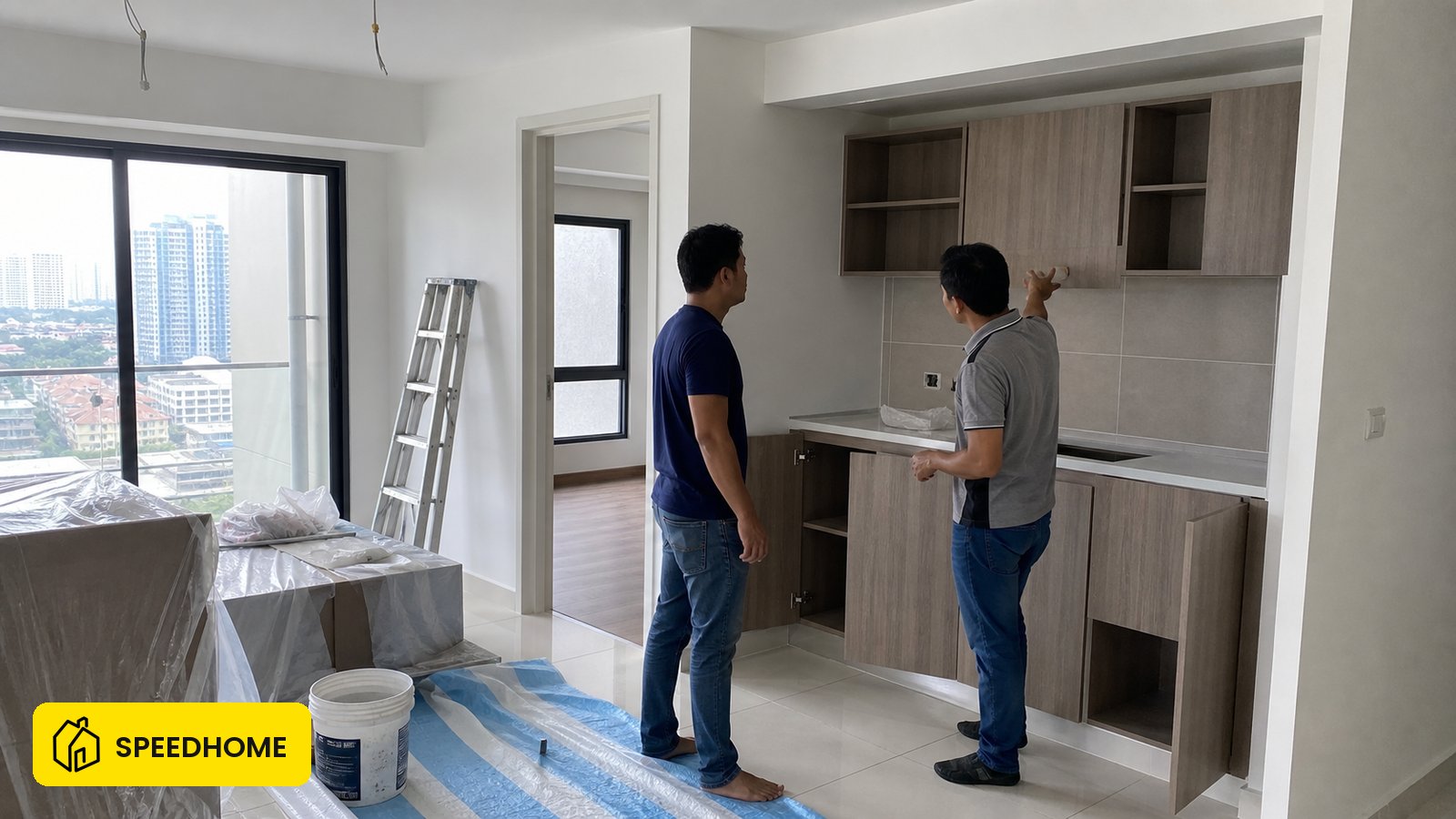
SPEEDRENO is a rental-yield fit-out product, not a "prettier" renovation. The best reno for rent is the one that leaves the unit refreshed and tidy — deep clean, repaint, fixture-cosmetic recovery, declutter, curb appeal — and aesthetic upgrades are the low-ROI foil. The fit-out service's median all-in fit-out cost runs about RM18,000 per unit (starting from about RM16,000 for smaller units). A comparable traditional renovation through a contractor plus agent typically runs RM30,000-50,000. A DIY fit-out may cost from RM10,000 up to RM20,000 upfront but trades the landlord's own time and carries higher ongoing defect risk. The platform survey data indicates that 83% of tenants want a clean, furnished, and ready unit, so for a mass-market unit the durable, tenant-ready fit-out is usually the better-value spend. On a RM2,000 mass-market unit, the fit-out service's published worked example shows that spending RM40,000 on a 'pretty' fit-out typically lifts achievable rent to about RM2,200 a month, while spending RM20,000 on a 'smart' (durable, neutral) fit-out typically lifts achievable rent to about RM2,000 a month — an 8-year payback on the extra RM20,000 of pretty fit-out spend, before financing, vacancy or maintenance.
Across more than 30,000 tenancy agreements the platform has managed in Malaysia, the durable + neutral fit-out is the same fit-out that holds up to tenant wear and welcomes a pet owner — the "pretty reno fails twice" framing in plain words. The rest of this page breaks the cost band, the payback math, the headline-number trap and the durable-into-pet-friendly moat that any landlord weighing a fit-out should see before signing a quote.
| Fit-out route | Upfront cost band | Strategic fit & scope | Operational risk & landlord burden |
|---|---|---|---|
| SPEEDRENO rental fit-out | RM16,000-20,000 (median all-in ~RM18,000; starting from ~RM16,000 for smaller units) | Rental-yield calibrated package; durable, neutral, tenant-ready fit-out paired with managed rental | Adheres to strict rental skip lists instead of bespoke aesthetic customization |
| Traditional contractor + agent | RM30,000-35,000 for comparable scope (RM30,000-50,000 for full ID) | Custom interior design and owner-occupier finish | Scope creep, extended vacancy, and unrecoverable capital expenditure |
| DIY landlord fit-out | RM10,000-20,000 upfront | Self-sourced trades and direct retail fixture purchases | Trades extensive landlord time; higher ongoing defect risk and maintenance friction |
Cost comparison benchmarked as at 2026-06-24 (speedreno-cost-band-2026, speedreno-cost-comparison-band-2026).
What is the real difference between the fit-out service and traditional renovation?
The fit-out service is a rental-yield fit-out path; traditional renovation is usually a broader design-and-contractor path. The commercial question is not which looks more premium, but which gives a rentable unit at the lowest sensible total cost.
Landlords often compare only quotation price. That misses the actual business problem. A rental renovation has to help the unit rent faster, survive tenant use, stay neutral enough for a broad tenant pool and avoid surprise maintenance. The prettiest package is not automatically the best yield package.
The platform separates yield from risk. Yield is set before keys through furnishing, fit-out and rent readiness. Risk is set at the gate through tenant screening, a complete tenancy agreement and collection discipline. The fit-out service sits on the yield side. It makes the unit easier to rent. It does not pretend to fix bad-tenant risk.
Traditional renovation can still be correct when the landlord is targeting own-stay quality, a premium rental segment, major defect correction or a design-led unit where aesthetics genuinely command rent. The mistake is applying that premium logic to the volume rental segment — roughly the mass-market volume segment — where tenants usually reward clean, furnished and ready over expensive design detail.
| Path | Best use | Main risk |
|---|---|---|
| DIY / ad hoc contractors | Small refreshes where the landlord has time and contractor control | Hidden coordination cost, delay, inconsistent finish |
| the fit-out service | Mass-market rental readiness where durable neutral finish matters | Needs clear scope discipline; not for luxury customization |
| Traditional renovation | High-end, owner-stay or major redesign projects | Over-spend, long payback, vacancy during works |
What does the fit-out service cost band look like in 2026?
The fit-out service's median all-in fit-out cost runs about RM18,000 per unit, starting from about RM16,000 for smaller units. A comparable traditional renovation through a contractor plus agent typically runs RM30,000-50,000. A DIY fit-out may cost from RM10,000 up to RM20,000 upfront but trades the landlord's own time and carries higher ongoing defect risk.
These figures come from the fit-out service published product material and apply to a comparable scope on a comparable Malaysian rental unit. The DIY line is not a free option — the product material explicitly pairs it with "your time + ongoing risk." A landlord who chooses DIY without pricing either will usually discover both at handover.
| Fit-out path | Typical 2026 all-in band | What the landlord actually trades for the lower number |
|---|---|---|
| the fit-out service | About RM16,000 (start) to RM18,000 (median) per unit | Standardised durable scope; no personal-taste customisation; less hand-holding on every fitting |
| Traditional renovation (contractor + agent) | About RM30,000-50,000 per unit | Design-led finish, longer timeline, more change-orders, more vacancy risk |
| DIY / ad hoc | About RM10,000 up to RM20,000 upfront | Your own time, supervision, contractor coordination, ongoing defect risk |
The same three numbers look different in a 3-year all-in view. The fit-out service pairs with the platform's managed-rental path (rent collection, tenant screening, maintenance), so a landlord comparing "headline fit-out cost" against "all-in cost to keep the unit occupied" is comparing two different things. A traditional reno at RM35,000 plus 2 months of vacancy plus a 10% agent fee is not the same number as RM18,000 for the fit-out service plus the platform collection and screening. The headline number is the easy one to compare. It is also the one that misleads.
Which option gives better rental yield?
Yield is set by the option that improves occupancy and rent enough to repay renovation cost within a sensible period. the fit-out service's published worked example shows an 8-year payback on the extra RM20,000 of a pretty fit-out over a smart fit-out, so for most mass-market rentals, controlled spend beats premium design.
A landlord can be right about rent increase and still wrong about yield. On the fit-out service worked example, the pretty fit-out raises achievable rent by about RM200 a month over the smart fit-out. The extra RM20,000 takes more than eight years to recover before counting financing, vacancy and maintenance. That is not a rental strategy; it is a capital trap. Illustratively, a headline gross yield can drop several percentage points once renovation and furnishing costs sit in the denominator — not a market survey figure, but a reminder to run the full cost stack before quoting a yield number.
The stronger rental-yield decision usually has three traits. First, it makes the unit acceptable to the widest pool of tenants. Second, it avoids delicate finishes that are expensive to repair. Third, it gets the unit listed quickly enough that vacancy does not eat the theoretical rent gain. How much to spend renovating a rental in Malaysia is the landlord-side question that decision eventually serves.
What is the headline-number trap landlords fall into?
The headline-number trap is comparing the cheapest fit-out quote against the cheapest operator fee, then inheriting coordination gaps the landlord pays for later. A low-fee operator with hidden coordination cost is more expensive than an all-in fit-out-service plus platform system with a higher stated number.
The trap shows up in three places:
- Fit-out only. A landlord books the cheapest "renovation package" and discovers that furnishing, appliances, basic air-conditioning service and end-of-tenancy rectification are billed separately. The headline package price becomes materially higher once the unit is actually rent-ready.
- Management only. A landlord books a full-commission agent on rent, then pays separately for tenant screening, stamp duty, deposit handling, repairs and eviction support. The "cheap" fee becomes the headline rate for an unbundled service.
- The all-in fit-out-service plus platform system. Fit-out, tenant screening, rent collection, deposit handling, repairs coordination and end-of-tenancy dispute support sit under one roof. The stated number is higher per line item. The system is cheaper when the unit is actually occupied, screened, and maintained.
The 83% of tenants who want a clean, furnished, and ready unit also want their tenancy to run without chasing the landlord for repairs, refund delays or screening errors. A fragmented stack of "cheap" vendors is not the cheapest way to get there. The all-in system is.
Why is the fit-out service part of a system, not a one-off reno?
The fit-out service prepares the unit; the platform rents, screens and collects; the repair service maintains. The three together close the landlord's full lifecycle — preparing, renting, maintaining, re-listing — and the integration is the real moat, not any single product in isolation.
Treating the fit-out service as a standalone renovation is the most common misread. By itself, the fit-out service is a durable fit-out. Inside the platform landlord system it is the first step of a four-stage landlord lifecycle:
| Lifecycle stage | What it covers | Product that runs it |
|---|---|---|
| Prepare | Durable, neutral, tenant-ready fit-out so the unit is rent-ready on day one | the fit-out service |
| Rent | Tenant screening, complete stamped tenancy agreement, rent collection, default handling | the platform (landlord) |
| Maintain | Single-item or few-item repairs during the tenancy and at end of tenancy | the repair service |
| Re-list | Refresh + re-list after the tenancy ends, with renewal of the same fit-out and tenant pipeline | the fit-out service, the platform and the repair service together |
The bundling matters because the typical "RM2,000 renovation" or "RM200 tenant" problem in isolation is usually a hand-off problem at the boundary. A landlord who builds the four stages into one workflow has one contract, one point of accountability, one documentary trail from fit-out to deposit refund. A landlord who stitches four separate vendors has four of each.
How should landlords compare total renovation cost?
Compare renovation cost by adding direct quotation, vacancy during works, furnishing, rectification risk, coordination time and future maintenance — not the headline renovation number alone.
The direct quote is only the first number. By illustration, a mass-market unit that loses two extra months of works delay costs the landlord two extra months of rent before the tenant even moves in. If the premium package then adds fragile fixtures, future repair cost keeps reducing the net yield. The renovation ROI calculator for rental property walks the same line items against your purchase price and rent band.
DIY can look cheap because the landlord does not price their own time. That is fine for an experienced landlord with reliable contractors and spare capacity. It is dangerous for a new landlord who has a day job and no site discipline. The "standard rental-readiness checklist" is what the landlord is really missing — without one, contractors default to the easiest scope, not the most rent-ready one, and the unit comes back to the landlord at handover with the same list of small items tenants notice during viewing.
| Cost item | Why it matters | How to judge it |
|---|---|---|
| Direct renovation quote | Cash out before listing | Compare scope, not just headline price |
| Vacancy during works | Lost rent while unit is not live | Multiply monthly rent by delay months |
| Furnishing and appliances | Often excluded from renovation quotes | Include essentials in true yield denominator |
| Repairability | Affects future EOT cost | Prefer replaceable, standard parts |
| Landlord time | Real cost if you coordinate DIY | Price your own supervision honestly |
When is traditional renovation still the better call?
Traditional renovation is the better call when the unit has structural or major condition issues, targets a premium renter, or needs a design standard that a rental-fit-out package cannot reasonably cover.
A high-end unit above the mass-market band may need a different logic. Tenants paying a premium may care more about design coherence, branded appliances, lighting, built-in storage and a stronger first impression. In that segment, aesthetics can differentiate. The landlord should still calculate payback, but the rent ceiling may justify deeper spend. Above the top of the mass-market reference band, the fit-out service's product rules split into a different set.
Traditional renovation also makes sense when the property has major defects: water damage, unsafe wiring, poor plumbing, rotten cabinets, failed waterproofing or layout issues that affect habitability. A light rental refresh cannot hide a bad base. Fix the property properly before treating it as a yield exercise. The landlord guide for Malaysia sets out when repair, refresh and full renovation are the right scope choices.
What should the fit-out service focus on for rental units?
For rental units, the fit-out service focuses on clean handover, durable finishes, neutral colours, tenant-ready furnishing and lower future repair friction — not on winning a design award.
Neutral colours widen the tenant pool. Durable flooring, practical cabinets and washable surfaces reduce move-out disputes. Standard fittings make replacement easier when something breaks. The unit photographs better, shows cleaner and creates fewer objections during listing. Tile is the dominant surface choice for Malaysian rental fit-out — floors, wet zones and skirting at scratch height — because it is scratch-proof, easy-clean and deposit-safe.
Does renovation replace tenant screening?
No — yield and risk are two separate levers. Renovation sets the floor (yield, before keys); screening and a complete stamped tenancy agreement control who walks in and what is enforceable (risk, at the gate). Confusing the two is the most common landlord mistake.
A common landlord mistake is thinking a nicer unit attracts only better tenants. It may attract more tenants, but it does not replace income checks, background screening, clear house rules, inventory documentation and a signed agreement. The yield lever and risk lever must stay separate, because even the best renovation cannot recover from a defaulting tenant who never paid a ringgit.
Once the unit is rent-ready, the landlord should document condition with photos and video before handover. That protects both sides and reduces arguments later. Then screening decides who gets the keys. If the landlord skips screening, even the best renovation can become an expensive repair bill. The "pretty reno fails twice" frame — once on tenant wear, twice on pets — is why the durable fit-out also wins the screening-adjacent deposit-dispute count.
How should a landlord brief any renovation vendor?
Brief the vendor around rental outcome: target tenant, expected rent, handover date, durability standard and must-fix defects. Start from the commercial target, not from design taste, because the wrong plan against the right goal still loses.
The fit-out service's product framing calls this the goal-action mismatch — the highest-leverage way to see why renovation spends often fail. A weak brief creates expensive scope creep. The landlord says "make it nice," the contractor suggests upgrades, and the final unit may look better without renting faster.
| If your goal is… | But your plan is… | Then you are working against your goal |
|---|---|---|
| Rent fast | Full cantik reno | Slower to market. Every empty month is RM2,000+ gone. |
| Better monthly rental | Simple whole-unit rental, no targeted upgrade | Under-optimising the asset for its segment. |
| Less hassle | DIY because it is cheaper | You just bought yourself a second job. |
| May sell later | Overbuild / too specific | Harder to sell. Locked into one layout. |
The brief should separate essential works from optional upgrades. Essential works include safety, plumbing, electrical reliability, leaks, broken cabinets, lighting, locks, air-conditioning and basic cleanliness. Optional upgrades include premium finishes, feature walls, custom furniture and design choices that may not increase rent. Solve essentials first, then add optional upgrades only if the rent band can repay them.
Timeline discipline matters as much as price. A cheaper quote that delays listing by two months may cost more than a slightly higher quote that gets the unit tenant-ready quickly. Landlords should ask for a clear scope, delivery sequence, handover assumptions and what is excluded from the quote.
Why is the durable fit-out also the pet-friendly one?
Pretty fails twice — once on tenant wear, twice on pets. The same tile floor, washable matt wall and scratch-resistant edges that survive a normal tenancy is the one that welcomes a cat owner, so the durable fit-out IS the pet-friendly fit-out, not a separate upgrade tier.
This inversion is the conceptual moat of the fit-out service cluster. Conventional wisdom says "pretty reno = higher rent, pets damage pretty." The opposite is closer to true: aesthetic-pleasing finishes are fragile finishes, and fragile finishes get scratched, dented and disputed at move-out. Many landlords reject pet owners outright, narrowing their tenant pool unnecessarily. The fit-out service internal testing (April 2026) indicates that pet-friendly listings on the platform's managed platform fill faster than comparable non-pet units, with a directional rent uplift of 10–20% (use 15% as the midpoint, roughly RM200–400/month on a RM2,000 unit) — and there is a queue rather than a glut for the right durable fit-out. The platform has managed over 30,000 tenancy agreements across Malaysia on that same fit-out-plus-platform discipline.
The same design choices — tile floors, washable matt walls at cat-scratch height, scratch-resistant edges, modular furniture — are pet-friendly by default. The fit-out service does not have a "pet tier" because the default is already the right one. The pet-rent premium is a yield lever, not a niche-tolerance concession, and the the rental fit-out in Malaysia guide walks the same choices walks through the same fit-out choices in full.
What proof should be kept after renovation?
Keep invoices, warranty notes, before-after photos, appliance details and a handover inventory. Renovation without documentation becomes harder to defend during tenancy disputes.
After renovation, record the finished condition before viewings and again before tenant handover. Photograph floors, cabinets, appliances, walls, bathrooms, lights, air-conditioners and any new fixtures. Keep invoices and warranty documents in one folder. The same folder separates tenant-caused damage from product defects, contractor issues or normal wear at end of tenancy.
Documentation supports future yield decisions too. If a certain material wears badly after one tenancy, replace it with a more durable option next cycle. If a particular upgrade creates no rent premium or viewing benefit, cut it from future scopes. A landlord who records outcomes from cycle to cycle picks the right material and the right scope on the second unit without re-paying the first unit's learning cost. The platform has managed over 30,000 tenancy agreements across Malaysia on the same documentary discipline.
How should landlords decide between repair, refresh and renovation?
Use repair for broken items, refresh for rent-blocking condition issues, and renovation only when the current unit cannot meet the target tenant standard. Choose the smallest intervention that makes the unit safe, clean, rentable and aligned to the target rent band.
Not every tired unit needs renovation. Some units need repair: a leaking tap, weak air-conditioner, broken lock, faulty light or cabinet hinge. Some need refresh: repainting, cleaning, curtain replacement, appliance replacement or small furnishing changes. Full renovation is the heavier path and should be reserved for units where layout, condition or core finishing blocks rental demand.
Inside the refresh bucket, rank by refresh-ROI: deep clean first, then repaint in a neutral washable finish, then fixture-cosmetic recovery (taps, handles, mirrors, lights, grout), then declutter, then curb appeal and the entrance. Those five move viewings the most per ringgit spent. Aesthetic upgrades — premium refits, new flooring over sound tile, feature walls — sit at the bottom of the ranking as the low-ROI foil. The cost-effective renovation ideas page walks the ranked list with the numbers.
This distinction protects cash. A landlord who treats every defect as a renovation opportunity can spend beyond the rent ceiling. A landlord who treats a serious condition issue as a small repair may keep losing tenants during viewing. The correct scope is the smallest intervention that makes the unit safe, clean, rentable and aligned with the target rent band.
The fit-out service's strongest role is not to make every unit expensive. It is to impose rental-readiness discipline. That means the landlord should know what is included, what is excluded, what must be fixed before listing and what can wait until after tenant feedback. The framing is practical: the unit should be rent-ready, not staged.
What mistakes do landlords make when planning a renovation?
The same four mistakes show up on repeat: asking "how much is the reno" before deciding the rent target, assuming a pricier finish automatically earns higher rent, locking the unit into built-in furniture that cannot adapt, and judging a fit-out on first impressions instead of how it lets faster. Each one is fixable before a quote is signed.
Mistake 1: Asking "how much is the reno" first instead of last
The renovation budget should be the last question, not the first. The first question is the rent target and, for a 3+ bedroom unit, whether to rent it whole-unit or by-room — that decision changes the layout, the furniture count and the fit-out scope before a single quote is requested. A landlord who calls contractors before fixing the rent target ends up reverse-engineering a budget around a quote, instead of sizing the quote around a commercial target. Settle the rent target and the whole-unit-vs-by-room call first; the renovation budget follows from that, not the other way round.
Mistake 2: Assuming a nicer renovation automatically means higher rent
A pricier finish does not automatically command a higher rent. The market generally does not pay more for finishing choices the tenant never asked for — a feature wall, a branded appliance upgrade, or a custom built-in rarely shows up as extra rent the tenant is willing to commit to, especially in the mass-market band. the fit-out service's own published worked example makes the same point with numbers: the extra spend on a "pretty" fit-out over a "smart" one takes years to earn back in rent, before vacancy or maintenance. Price the upgrade against what the market actually pays for it, not against what it looks like it should be worth.
Mistake 3: Built-in furniture that cannot be replaced or repurposed
Built-in furniture and fitted wardrobes are a one-way bet. When a single panel, hinge or drawer is damaged, the landlord usually has to replace the whole built-in unit, not just the broken part — and the layout is now fixed, so the next tenant inherits a configuration they did not choose. Loose, swappable furniture behaves differently: a damaged piece is replaced on its own, the layout can be reconfigured between tenancies, and the fit-out adapts to whatever a 3+ bedroom unit needs to do next — whole-unit or by-room. This is the actual fit-out-service approach: loose furniture and appliances backed by 3-year furniture/appliance insurance, so single-item damage is a repair, not a renovation.
Mistake 4: Judging the fit-out by finish quality instead of how it lets
What actually moves the needle for how fast a unit lets is rarely the renovation spend. Sharper, more complete listing photos help a unit rent faster across more tenant searches than a pricier renovation typically does on its own — the photos are what a prospective tenant evaluates before ever seeing the unit in person, and a durable, clean, well-photographed unit at a controlled spend usually outperforms an expensive one that is harder to show off well. Spend the marginal ringgit on getting the unit photo-ready and listed quickly before spending it on a finish upgrade the tenant pool was never asking for.
What should you do this week before spending on renovation?
Run five checks against the reno decision this week, in this order, before you sign any quote: scope, vacancy cost, payback, brief, and a documentary baseline.
- Get two independent quotes on the same scope. Compare the scope line by line, not the headline number — items left out of one quote often appear as variations later. Time and cost: 2–3 hours per quote; zero RM cash beyond phone calls and a site visit.
- Price the vacancy cost of any delay. Multiply the expected monthly rent by the number of months the unit will not be tenant-ready if the project slips, then add that to the quote you are comparing. Time and cost: 5 minutes with a calculator; no cash.
- Decide which upgrades the rent band will not pay back. If the unit is in the mass-market volume band, drop premium finishes that need more than three years of incremental rent to recover. Time and cost: 1 hour against the fit-out service worked example; no cash.
- Brief the vendor around rental outcome, not design taste. Target tenant, expected rent, handover date, durability standard, must-fix defects. Skip the brief that opens with "make it nice." Time and cost: 2 hours to write a one-page brief; no cash.
- Keep all invoices, warranty notes and before/after photos from day one. Dated move-in condition photos are the single biggest determinant of whether a deposit dispute escalates. Time and cost: 30 minutes to set up a shared folder; no cash.
What should you do next?
If your rental unit needs a durable, tenant-ready refresh before listing, use the fit-out service plus the platform landlord system to plan the fit-out, tenant screening, rent collection and maintenance together. See the fit-out service product · Run the renovation ROI calculator.
The fit-out service vs traditional — when each makes sense, and how to read the quotation
The right choice between the fit-out service and a traditional renovation depends on the unit and the rent target, not on which sounds more premium. The fit-out service fits the mass-market, durable, tenant-ready band; traditional renovation fits the owner-stay, premium, or major-defect path. A clean quotation from either path itemises the same four things — scope, materials, timeline, and defect-liability-period — and a landlord who reads it on those four lines avoids the headline-number trap entirely.
The fit-out service is calibrated to a specific job: making a unit tenant-ready on durable, neutral surfaces for the mass-market rent band. It is not a design-led renovation, not a premium finish upgrade, not a structural fix, and not a mid-tenancy repair. The right comparison is a unit in the same rent band, fitted to the same tenant expectation, with a clean written scope. If the unit is in the mass-market band and the target is "let faster, durable, neutral," the fit-out service is the right path. If the unit is owner-stay, premium, or a major redesign where the design itself commands rent, a traditional renovation with a design-led contractor is the right path. The mistake is applying premium logic to volume rentals, or volume logic to premium units — both produce a unit that does not match its tenant pool.
Traditional renovation still wins on three specific cases: a unit the landlord intends to occupy and wants finished to personal taste, a unit in the premium rental segment where the tenant pool genuinely pays for design detail, and a unit with a major defect or layout change that goes beyond a fit-out (structural, plumbing behind walls, layout reconfiguration). In each of these, the fit-out service scope is the wrong tool — it is calibrated to surfaces, not to structure, and the cost band reflects that. A landlord who forces the fit-out service into a structural job pays twice: once for the fit-out that did not solve the structural problem, and once for the contractor who has to come back and fix it.
How to read either quotation, line by line. A clean quotation — The fit-out service or traditional — should itemise four things, and a landlord who checks all four before signing is the landlord who does not pay for surprises later. The first is scope: what is included, what is excluded, and what is "while we are at it" versus "extras billed separately." The second is materials: brand, grade, and quantity, with substitution rules stated. The third is timeline: start date, handover date, delay penalties, and what counts as a landlord-side delay. The fourth is the defect-liability-period: how long the contractor stands behind the work, what is covered, what is excluded, and the process for raising a defect. A quotation that does not itemise these four is one a landlord should not sign, regardless of the headline number.
Two specific things to watch. First, "a stated price" without a written scope almost always turns into variations during the work. A quoted total is only as good as the scope it is fixed against. Second, a promised-completion timeline is rarely enforceable in practice; what is enforceable is a delay-penalty clause and a definition of what counts as a delay. Read those two lines, not the timeline headline. The same four-line itemisation — scope, materials, timeline, defect-liability-period — applies to the fit-out service quotation and to a traditional contractor quotation; the right read is the one that lets the landlord compare them on the same axis.
Specific RM figures for the fit-out service are held until the current quotation is in hand — verify the latest figure directly with the fit-out service rather than relying on a published number that may have moved. The cost band and the worked example on the rest of this page sit alongside the fit-out service rental fit-out guide, and the right next step is a current quotation against the unit, not a number from a past article. Get the fit-out service quotation for the unit you are weighing; the team will tell you whether the right answer is the fit-out service, the repair service's single-trade repair, or a wait-and-renovate-at-vacancy plan — and they will itemise the same four lines (scope, materials, timeline, defect-liability-period) so you can compare it against any traditional quotation on the same axis.
What the line items actually are: fit-out scope vs traditional interior design
A rental fit-out deconstructs property preparation into essential yield-driving scopes — deep clean, repaint, fixture-cosmetic recovery, decluttering, and curb appeal — while intentionally eliminating low-ROI luxury modifications. Traditional interior design firms often quote extensive structural carpentry, feature lighting, and decorative wall treatments that add substantial cost without generating higher rental income.
In a disciplined rental renovation, the investment targets tenant-facing functionality and durability:
- Deep cleaning and sanitation: Eliminates past tenant residues, restores grout, and ensures move-in readiness.
- Full repaint in neutral tones: Brightens interior spaces and refreshes high-traffic wall surfaces.
- Fixture and cosmetic recovery: Repairs cabinet hinges, door handles, silicon seals, and sanitary hardware.
- Declutter and curb appeal: Clears obsolete bulky items and enhances entryway presentation.
- Itemised market rates: Baseline trade pricing varies across trades according to RESEARCH-NEEDED(per-item market renovation price table).
The financial divergence between these philosophies is evident in capital payback calculations. According to the SPEEDRENO product deck worked example (speedreno-deck-worked-example-2026), spending RM40,000 on a 'pretty' fit-out typically lifts achievable rent to about RM2,200 per month, whereas spending RM20,000 on a 'smart' durable fit-out typically lifts achievable rent to about RM2,000 per month. The additional RM20,000 invested in luxury styling delivers only RM200 in monthly rental gain, requiring an 8-year payback period before accounting for financing, maintenance, or vacancies.
Furthermore, optimizing for durable materials enables landlords to tap into underserved renter demographics. Platform operational observations demonstrate that pet-friendly listings fill faster with a directional rent uplift of 10-20% (roughly RM200-400 per month on a RM2,000 per month unit, speedreno-pet-friendly-rent-uplift-10-20pct). Across more than 30,000 tenancy agreements managed across Malaysia (speedhome-agreements-volume), clean, fully furnished, and move-in-ready units achieve a 16-day median fill time (speedhome-16day-median-fill-2026).
Landlords seeking a transparent, fixed-price scope can request a quote directly through the SPEEDRENO landlord portal.
FAQ
Is the fit-out service cheaper than traditional renovation?
The fit-out service's median all-in fit-out cost runs about RM18,000 per unit (starting from about RM16,000 for smaller units). A comparable traditional renovation through a contractor plus agent typically runs RM30,000-50,000. The right comparison is total yield impact, including vacancy, furnishing and future maintenance, not the renovation line item alone.
Should I renovate before renting out my condo?
For a RM2,000 mass-market unit, the fit-out service worked example shows the extra RM20,000 on a premium fit-out takes roughly 8 years to repay even before vacancy and maintenance. Renovate or refresh only when the unit is not yet rent-ready, the rent band will pay back the spend, or there is a major condition issue a refresh cannot fix. If the unit is already clean and functional, refresh — paint, fittings, deep clean — rather than renovate.
Does premium renovation always increase rent?
No. In the mass-market segment, the platform survey data indicates that 83% of tenants want a clean, furnished, and ready unit — durable, neutral finishes rent faster and survive more tenancies. Premium spend can take too long to recover, and illustratively a headline gross yield can drop several percentage points once renovation and furnishing costs sit in the denominator.
Does renovation replace tenant screening?
No. Renovation affects yield before keys. Screening and a complete stamped tenancy agreement control risk at the gate. The two levers must stay separate: yield is what the unit delivers, risk is who you let in. A pet-friendly durable fit-out does not stop a defaulting tenant; a complete stamped tenancy agreement and collection discipline do.
Is renovating a rental property worth it in Malaysia?
It is worth it when the unit is not yet rent-ready and the spend is sized to the rent band — the fit-out service median of about RM18,000 typically pays back faster than a traditional RM30,000-35,000 reno because it targets durability and tenant readiness over design upgrades the market does not pay extra for. It is usually not worth it when the unit is already clean and functional, or when the planned spend is on finishes the target tenant pool was never asking for. Run the rent-target and whole-unit-vs-by-room decision first, then size the renovation to what that target can actually repay.
Why isn't my renovated unit getting higher rent?
The most common reason is that the renovation upgraded finishes the tenant pool does not pay extra for — a feature wall, a custom built-in, or a premium appliance — instead of the things that actually move rent and let-speed: a clean, durable, neutral fit-out and listing photos that show the unit at its best. Built-in furniture also locks the unit into one layout, which can work against a broader tenant pool. Compare your renovation line items against what tenants in your rent band are actually asking for before assuming the spend itself was the problem.
What is the primary difference between a rental renovation and owner-stay renovation?
A rental renovation focuses exclusively on durability, swift tenant placement, and capital recovery. While an owner-stay project often costs RM30,000-50,000 for customized aesthetics, a rental fit-out prioritises high-wear finishes and clean presentation within a practical RM16,000-20,000 band (median all-in ~RM18,000).
How do I compare high-end renovation firms malaysia options against a dedicated rental fit-out?
When you compare high-end renovation firms malaysia options, evaluate whether the proposed custom woodwork and premium fittings command commensurate rental premiums in your micro-market. For investment assets, consult the comprehensive SPEEDRENO rental fit-out guide to benchmark fixed-scope packages against variable contractor quotations.
What should an investor budget for overall renovation cost on a Malaysian rental property?
An investor should budget between RM16,000 and RM20,000 for a comprehensive rental fit-out, with smaller units starting near RM16,000. Spending RM40,000 instead of RM20,000 requires an 8-year payback on the extra RM20,000 spend, making disciplined scope management essential to preserving net yields.