
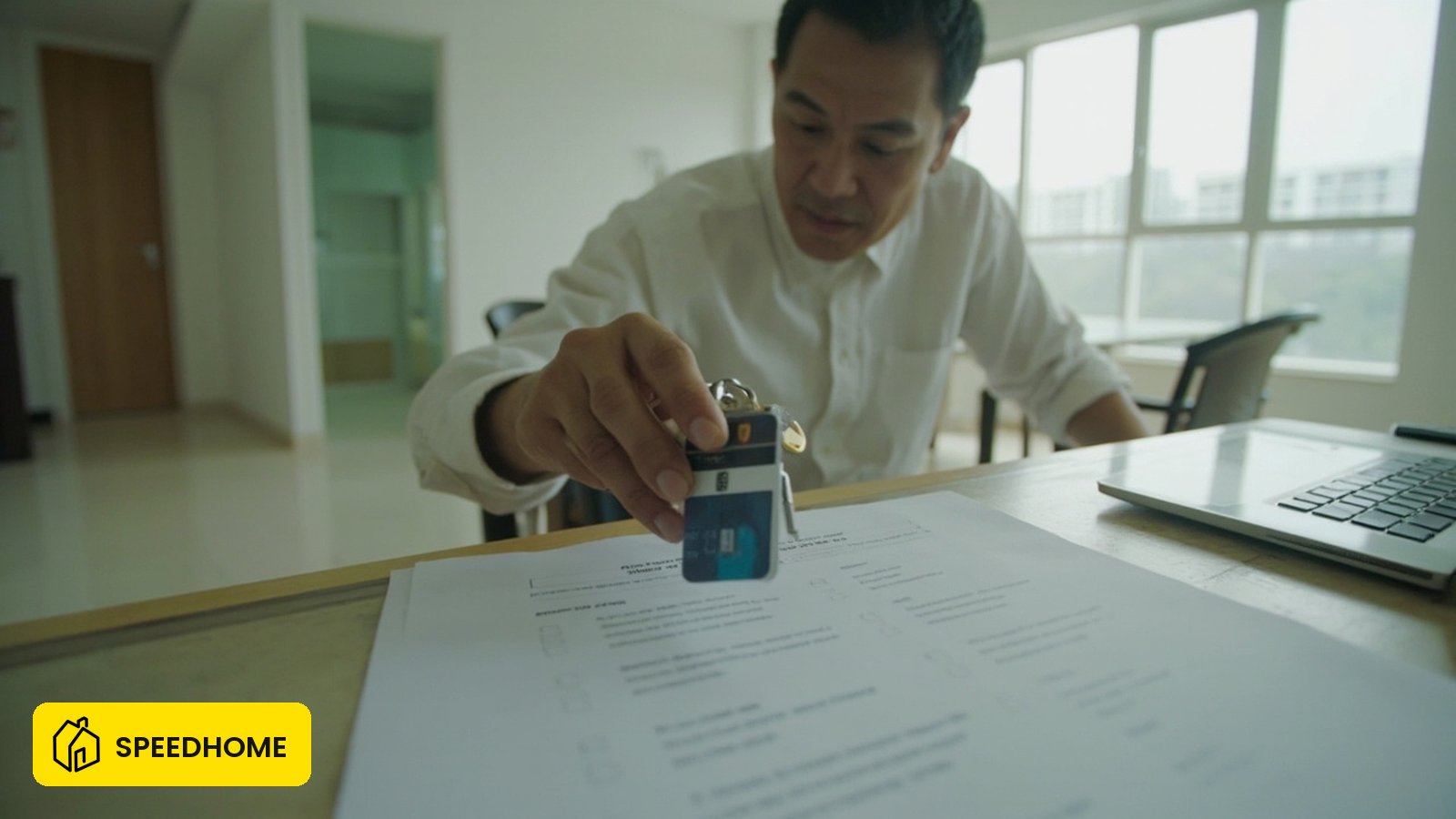
What does a tenant need to do when moving out in Malaysia?
A Malaysian tenant moving out must give written notice, settle rent and utility bills, deep-clean and repair any tenant-caused damage, do a joint inspection, photograph every room, return all keys and access cards, and get written acknowledgment. Done in order, this closes most deposit disputes before they start. For the cleaning step itself, the 5 essential cleaning tips before moving out show what actually protects the deposit at inspection.
Malaysia has no Residential Tenancy Act in force as of 2026. Your move-out rights and obligations flow entirely from the tenancy agreement, the Contracts Act 1950, and what you can prove. A landlord's right to retain any part of the deposit is limited to proven loss — and loss is proven by evidence, not by assertion. The checklist below is built around the evidence standard, not just the to-do list.
Over 30,000 tenancies managed on the SPEEDHOME platform show a consistent pattern: the single biggest driver of deposit disputes is not the condition of the unit but the absence of a joint inspection report that both parties signed. Get the inspection right and the rest usually resolves itself.
Key figures for 2026 (deadlines and dispute routes current as of 2026-10):
| Item | 2026 figure / status |
|---|---|
| When to start the move-out process | 30 days before your move-out date |
| Statutory deposit-return deadline | None — the timeline lives in the TA; 30 days after key handover is the common contractual norm and court benchmark |
| Small-claims route for a deposit dispute | Claims up to RM5,000 (Magistrates' Court, no lawyer) |
| Deposit cap or fixed deduction rules | None in statute — deductions are limited to proven loss |
What the law says about moving out and deposits
Malaysia has no statutory deposit cap and no statutory deposit-return deadline. The tenancy agreement governs what can be deducted, and a landlord's right to retain is limited to proven loss under general contract law (Contracts Act 1950). Without proof of damage, a deduction cannot stand.
As of 2026, there is no Residential Tenancy Act in force. The proposed RTA remains a draft Bill — it has not been tabled in Parliament or gazetted — so residential tenancies are governed by the tenancy agreement together with general law: the Contracts Act 1950, Civil Law Act 1956, and the Specific Relief Act 1950.
What this means in practice:
- There is no law that fixes how much deposit a landlord may take — that is in the TA.
- There is no law that requires a landlord to return the deposit within 14, 21 or 30 days — that timeline is in the TA. Where the TA is silent, "reasonable time" applies and 30 days after key handover is the common contractual norm and court benchmark.
- A landlord cannot deduct for wear and tear — only for damage beyond fair use, supported by evidence.
- Without a stamped tenancy agreement, your protections are harder to enforce in court.
How does the 30-day move-out countdown run?
Start the process 30 days before your move-out date. The earlier you act, the more control you keep over the timeline, evidence, and negotiation.
| Timing | Action | Evidence to keep |
|---|---|---|
| 30 days before | Give written notice as required in your TA; confirm handover date in writing | Written notice + landlord's written acknowledgment |
| 21 days before | Schedule the joint inspection date with landlord or property manager | Agreed inspection date in writing (email or WhatsApp) |
| 14 days before | Settle all outstanding rent; arrange final utility readings | Bank transfer receipts; TNB / Air Selangor account screenshots |
| 7 days before | Deep-clean unit; repair any tenant-caused damage; photograph every room | Timestamped photos of final cleaned condition |
| Day 0 (handover) | Joint inspection; return all keys, access cards and parking cards; get written receipt | Signed joint inspection report + written keys-received acknowledgment |
| Day 1–7 post-handover | Chase final utility bills and forward to landlord; note meter readings shared | Final TNB, water, and management-charge bills |
| Day 14 post-handover | If no refund or itemised deduction statement received, send a formal written demand | Registered-mail or email with read-receipt confirming delivery |
| Day 30 post-handover | If unresolved, escalate — see the dispute section below | All documents above |
Give notice in whatever form the TA specifies. If the TA says "written notice", a WhatsApp message is acceptable but registered mail provides a cleaner proof trail.
What counts as fair move-out condition
Fair wear and tear is the gradual deterioration from normal everyday use over the tenancy term. A landlord cannot deduct for it. Damage beyond fair use — broken items, large wall holes, stains from neglect — is different. Evidence is what decides the line.
There is no statutory Malaysian definition of fair wear and tear. It is governed by what your TA says and what common-law reasonableness means for the item's age, use, and expected lifespan. For a room-by-room breakdown of exactly how clean a unit needs to be at handover, see Move Out Conditions: How Clean Should It Be?
| Item | Fair wear and tear — cannot deduct | Tenant damage — can deduct with evidence |
|---|---|---|
| Paint | Slight fading or discolouration after 2+ years | Large holes, crayon or pen marks, unauthorised colour changes |
| Floors | Minor scuffs from normal foot traffic | Burns, deep scratches, broken tiles, carpet stains from spills |
| Appliances | Reduced efficiency from age and normal use | Broken parts, cracked casing, damage from misuse |
| Door handles and locks | Normal wear from daily use | Broken locks, bent hinges, damage from forced entry |
| Bathroom fittings | Slight yellowing of ageing white fittings | Cracked fixtures, broken tiles, mould caused by blocked ventilation |
| Windows | Natural weathering of frames or seals | Cracked or broken glass |
| Furniture (if furnished) | Faded upholstery, minor scratches from normal use | Burns, large tears, structural damage, missing items |
Evidence is what resolves the line between wear and damage. Move-in photos and a signed inventory are your proof that a condition existed before you arrived.
The joint inspection: how to do it right
The joint inspection is the most important event in the move-out process. Both parties walk through the property together, note every condition, sign a written report, and hand over keys. A signed report locks in what was agreed — and what was not disputed.
No Malaysian law mandates a joint inspection, but it is the most powerful protection a tenant has. Landlords who refuse a joint inspection create their own evidentiary problem: any deduction they claim later is much harder to defend if there is no signed record of the condition at handover.
What to do at the joint inspection:
- Walk room by room with the landlord or their representative.
- Use the same angle as your move-in photos for comparison.
- Note any item where you and the landlord disagree — write it on the inspection report alongside both of your initials.
- Do not sign anything that lists deductions you have not agreed to.
- Get a written receipt for every key, access card, parking sticker, and mailbox key returned.
- Keep a copy of the signed report for yourself.
If the landlord does not attend the inspection, send a written message — before and after — asking to reschedule. Keep those messages. If you cannot agree on a time and you hand over keys anyway, photograph the unit immediately before handing over and send a timestamped record to the landlord.
Evidence checklist — what to gather before you leave
Your deposit protection depends entirely on your evidence. Collect these before and at handover — you cannot retrieve them after you leave.
Before move-out, make sure you have:
- [ ] A copy of the stamped tenancy agreement (including all addenda)
- [ ] Receipt for every deposit payment you made
- [ ] Move-in photos or video (with original file timestamps)
- [ ] A signed inventory list from move-in (if one exists)
- [ ] Written record of any repairs reported during tenancy and landlord's responses
- [ ] Rent payment receipts for the full tenancy period
- [ ] Utility payment records and final bills
- [ ] Final TNB and water meter readings (photographed on handover day)
- [ ] Written notice you gave to the landlord
- [ ] Landlord's written acknowledgment of notice
- [ ] Signed joint inspection report (from handover day)
- [ ] Written keys-received acknowledgment from landlord
- [ ] Move-out photos (same angles as move-in, timestamped)
Store copies in two places — your phone and cloud storage — before you hand over the unit.
On the morning you hand back the keys, read both meters, photograph both with the timestamp, request the final bill, pay it, get the final-bill receipt, and save everything in the tenancy file. COT (Change of Tenancy) is the move-IN transfer of the TNB account to the new tenant as Registered User; final-bill close is the move-OUT close — you settle the last bill, get the receipt, and save it. They are different procedures, and a final-bill close is not a "COT on move-out".
How does the 6-step final-meter workflow run on move-out day?
On the morning of the last day of the tenancy, run the 6-step workflow at the same time of day, ideally at the moment of key handover. Photograph, request the final bill, pay, get the receipt, save the file. The 6 steps close the utility account in your name and protect you from any later arrears claim, even if the landlord's name is still on the TNB account.
Step 1 — Read the TNB meter and the water meter at the same time of day. Two meters, one timestamp, one reader (the tenant). Use a torch if the meter box is dark. Read each meter to the last digit. If the meter has a cycling display, wait for the digits to settle, or take a short video so the cycling can be confirmed later.
Step 2 — Photograph both meters with the timestamp, the serial number, and a coin or ruler for scale. The 5-photo evidence standard is below. The five photos go into the tenancy file with a one-line caption: "Final meter reading on DD-MMM-YYYY at HH:MM, handover day, unit address, tenant + landlord signatures".
Step 3 — Request the final bill from the relevant provider. For TNB, the final bill is requested through the myTNB portal or at the nearest Kedai Tenaga. For water, the request goes to Air Selangor (KL/PJ), PBAPP (Penang), Ranhill SAJ (JB), or the relevant state provider. Verify the current portal on the provider's official site on the day you make the request — do not rely on a cached URL.
Step 4 — Pay the final bill before the due date. The final bill is usually lower than a normal bill because it covers a partial month, but it can be higher if the partial month is into a higher tariff block. Pay in full, and keep the payment reference.
Step 5 — Get the final-bill receipt. TNB portal screenshot, water provider portal screenshot, or counter receipt. The receipt is the proof that you closed the account in good standing.
Step 6 — Save the final-bill receipt, the meter photos, and the final meter readings in one folder with the tenancy file. Keep the folder for at least three years. If the landlord's name is still on the TNB account (the sub-scenarios below), the file is the defence against any later arrears claim.
The temptation to skip a step ("we'll just leave it, it's only a small bill") is the move-out equivalent of skipping a joint inspection. The cost of the step is small; the cost of skipping it shows up later as a deposit dispute, an arrears claim, or a "you used electricity in October 2026" letter from a collection agency.
COT vs final-bill close: the distinction most tenants get wrong — how do they compare?
COT (Change of Tenancy) is the move-IN transfer of the TNB account to the new tenant as Registered User. Final-bill close is the move-OUT close: settle the last bill, get the receipt, save it. The two procedures do not overlap — you cannot do a "COT on move-out" because there is no incoming tenant to take the account on the day you leave.
The COT owner — the TNB change of tenancy (COT) page — is the canonical reference for the move-IN procedure: documents, fees, deposit, the myTNB portal flow, the three-day to one-week processing time, the COT vs account-in-landlord's-name scenarios. The move-OUT is a different procedure because the Registered User position on the TNB account is not "transferred" on move-out; the account is closed in the Registered User's name, the final bill is settled, and the next Registered User (whether the landlord or the next tenant) opens a fresh account.
In practical terms:
- At move-IN, do a COT. The TNB account becomes yours as Registered User. You are liable to TNB for electricity used during the tenancy; the landlord is not.
- At move-OUT, do a final-bill close. The TNB account is settled in your name, the final bill is paid, and the receipt is filed. If the next tenant moves in and does a fresh COT, the next tenant becomes the new Registered User. If the unit sits empty, the landlord is the next Registered User (because the account was originally in the landlord's name) or the account sits as a "no current Registered User" state until the next tenant or the landlord re-registers.
The two procedures meet at one point: if you do a COT at move-IN, the COT reference number and the move-IN reading are the data you use at move-OUT to reconcile the final bill. The COT reference number should be in your move-IN file. Pull it out on move-out day and have it ready when you call or visit the provider.
What to photograph on the day: the 5-photo evidence standard
The 5-photo standard turns a verbal "I read the meter" into a record the deposit-return defence can rely on. Five photos, one timestamp, one caption, one folder. The standard is the difference between a clean move-out and a deposit dispute.
The 5 photos, in order:
| # | What to photograph | Why |
|---|---|---|
| 1 | TNB meter face, close-up, with the serial number and the current reading visible | The serial number ties the photo to the specific meter; the reading is the start of the final-bill calculation |
| 2 | Water meter face, close-up, with the serial number and the current reading visible | Same logic for the water provider |
| 3 | TNB meter wide shot, showing the unit number / box / surrounding wall | Proves the location — disputes often hinge on "is this the right meter" |
| 4 | Water meter wide shot, showing the unit number / box / surrounding wall | Same logic for the water meter |
| 5 | The timestamp — either the camera roll time on the photo metadata, or a phone screen showing the date and time | The timestamp is what ties the reading to the moment of key handover |
The 5 photos go into the tenancy file with a one-line caption: "Final meter reading on DD-MMM-YYYY at HH:MM, handover day, unit address, tenant + landlord signatures". If the joint inspection produces a move-out report (it should), the same 5 photos are referenced in the move-out report. The two records cross-link each other.
A short video of the meters (5-10 seconds each) is a useful supplement. The video confirms any cycling display, shows the reader pointing at each digit in turn, and ties the reading to the moment.
The Indah Water / IWK edge: what is it on move-out?
Indah Water Konsortium (IWK) does not have a tenant transfer for residential rentals. The sewerage charge is on the water bill, not a separate IWK account. The move-out procedure is: confirm the IWK component is included in the final water bill, pay the final water bill in full, and save the receipt. There is no "IWK transfer on move-out" to do.
This is the move-out side of the IWK edge. At move-IN, the IWK component is already embedded in the water bill — the tenant does not open a separate IWK account, the tenant does not pay IWK separately, and the move-IN water provider account is the only utility account the tenant opens. At move-OUT, the same logic applies: there is no IWK account to close, no IWK procedure to run, no IWK deposit to recover. The IWK component ends when the water bill ends.
If the final water bill appears unusually high, the line items usually include (a) the partial-month water charge, (b) the partial-month IWK charge, and sometimes (c) a small fixed fee. The IWK charge is set by IWK, not by the water provider; the provider collects it on IWK's behalf. If the IWK component is missing from the final bill, contact the water provider — it should be there.
The page does not invent an IWK portal URL or an IWK phone number. Verify the current contact on the IWK portal on the day you need it; the IWK component is also visible on the water provider's portal as a separate line item on the final bill.
What to do if the landlord's name is still on the TNB account on move-out
The COT was done at move-in and the account is in your name — the move-out is just the final-bill close above. The COT was NOT done at move-in and the account is still in the landlord's name — the tenant should not close the account (it is not the tenant's to close). Pay the final bill in full, photograph the receipt, share the receipt with the landlord, and the evidence file is the protection. The tenant has no TNB liability if the account was in the landlord's name; the move-out evidence protects the tenant from a later arrears claim.
Three sub-scenarios:
- Sub-scenario A — COT was done at move-in (account in your name). Run the 6-step workflow. Settle the final bill, get the receipt, save it. Done.
- Sub-scenario B — COT was NOT done at move-in (account still in the landlord's name). You cannot close the account because you are not the Registered User. Read both meters, photograph both, send the readings to the landlord in writing with the photos, ask the landlord to settle the final bill and share the receipt. The landlord is the Registered User and remains liable to TNB. The move-out evidence file (your photo set + the message thread) protects you from any later arrears claim attributed to your tenancy period.
- Sub-scenario C — You don't know whether COT was done. Check your move-IN file. If you do not have the COT reference number, log in to myTNB and check the account status under your IC. If the account is in the landlord's name, follow sub-scenario B. If the account is in your name, follow sub-scenario A.
The COT owner's TNB account in owner name when tenant runs off page is the landlord-side mirror — it covers the same TNB registered-user liability principle from the landlord's perspective. The two pages are mirrors, not duplicates.
Which water provider serves each of the 4 cities?
KL and PJ use Air Selangor. Penang uses PBAPP. JB uses Ranhill SAJ. Verify the current portal on the provider's official site on the day you request the final bill; the page does not lock a specific portal URL because the URLs change and a cached URL is a wrong URL.
| City | Water provider | Note |
|---|---|---|
| KL (Kuala Lumpur) | Air Selangor | Most KL postcodes are within the Air Selangor area; verify on the bill or on the Air Selangor portal |
| PJ (Petaling Jaya) | Air Selangor | Same provider as KL; the Air Selangor portal handles both KL and PJ accounts |
| Penang (George Town, Jelutong, Batu Ferringhi, Bayan Lepas) | PBAPP (Perbadanan Bekalan Air Pulau Pinang) | Penang mainland and island are both under PBAPP; the bill format is different from Air Selangor |
| JB (Johor Bahru, Mount Austin, Bukit Indah, Iskandar Puteri) | Ranhill SAJ (Syarikat Air Johor) | Most of Johor is under Ranhill SAJ; verify the postcode on the bill |
The other 9 states are out of scope for this page; the 13-state water provider table is a separate P1 gap and is not created here. For tenants outside KL/PJ/Penang/JB, the same workflow applies — read, photograph, request, pay, get receipt, save — with the state provider substituted in.
The 4-city quick reference is the answer-engine extractable; the workflow above is the playbook.
When the final bill does not arrive in 30 days
If the final bill has not arrived 30 days after handover, send a written reminder to the landlord (or to the provider if the account is in your name). If the account was in the landlord's name, your evidence file is the protection — not the final bill, which the landlord's account generates on the landlord's billing cycle. The tenant can also close the myTNB portal session and remove the saved card, but the account in the landlord's name continues to bill the landlord.
The 30-day no-final-bill path is a sub-scenario of the move-out pillar's 30-day timeline. The move-out pillar already says "30 days after key handover is the common contractual norm". The deeper logic:
- Account in your name (COT was done). You should have a final bill within 30 days. If not, log in to myTNB and check; the bill may have been generated but you missed the email. If the bill is genuinely missing after 30 days, contact TNB through the myTNB portal and request a final-bill statement. The TNB registered-user liability framework means the bill is your responsibility to chase.
- Account in the landlord's name (COT was not done). The bill is the landlord's. The landlord is the Registered User; the bill goes to the landlord's billing cycle. Your role is to share your photo evidence with the landlord and ask the landlord to forward the final-bill receipt. If the landlord does not respond in 14 days, send a written reminder. The 30-day mark is the right escalation point.
The page does not promise a specific TNB response time. TNB's published response times change; the tenant's protection is the photo evidence, not the provider's response time.
What if the landlord demands you pay the final bill even after the deposit has been returned
The tenant is not liable for bills the landlord did not forward during the tenancy. The move-out evidence file (your photo set, your message thread, the COT reference number, the final-bill receipt if you have one) is the defence. The deposit-return process and the final-bill close are two separate matters; the deposit return does not waive any future bill, and the final bill does not extend any deposit claim.
The cleanest defence is the move-in record, the move-out photo set, the COT reference number (or the message thread showing COT was not done), and the final-bill receipt. If the landlord later claims the tenant owes money for bills during the tenancy, the evidence file is the answer.
The escalation path for an unjustified post-deposit demand is the deposit refund page (for claims up to RM5,000 using the Magistrates' Court small-claims procedure under Order 93) and the demand-letter playbook (for larger claims). The page does not re-derive the demand-letter template here; it cross-links to the existing playbook.
Which deductions can a landlord make from your deposit?
A landlord can only deduct for proven loss: unpaid rent, utility arrears, tenant-caused damage beyond fair wear, and missing items listed on the signed inventory. Deductions require evidence — the landlord must provide an itemised statement and supporting proof.
| Deduction | Allowed | What the landlord needs to prove |
|---|---|---|
| Unpaid rent | Yes | Rent records and arrears amount |
| Utility arrears (TNB, water) | Yes | Final utility bills unpaid at handover |
| Tenant-caused physical damage | Yes, with evidence | Move-in and move-out photos showing the change; repair quote or receipt |
| Missing inventory items | Yes, with evidence | Signed inventory from move-in; evidence items were present and are now absent |
| Fair wear and tear | No | Cannot deduct — general contract law limits retention to proven loss |
| Cleaning (if unit was clean at handover) | No | If unit was clean and documented, no deduction is supported |
| Pre-existing defects | No | Landlord must show the defect was not present at move-in |
| Penalty for giving proper notice and leaving on time | No | A properly noticed move-out is not a loss event |
The landlord should provide an itemised deduction statement. If they do not, your demand letter should ask for one alongside the refund.
See the deposit deduction guide for a deeper breakdown of what counts as evidence.
What to do if the landlord withholds your deposit
If the landlord does not return your deposit or provide an itemised deduction statement within the time agreed in the TA, start with a written demand letter. Malaysia has no dedicated residential tenancy tribunal — deposit disputes are private contract matters decided in the civil courts.
| Step | Action | Cost | When to use |
|---|---|---|---|
| 1 | Written demand letter (registered mail or email with read-receipt) | Postage or free | Always the first step — many disputes resolve here |
| 2 | Magistrates' Court small-claims procedure | RM20 filing (Order 93, Form 198) | Small claims up to RM5,000; no lawyer required |
| 3 | Magistrates' Court civil claim | Filing fee scales by claim amount | Magistrates' Court up to RM100,000; lawyer optional |
| 4 | Sessions Court | Higher filing + legal fees | Sessions Court — unlimited jurisdiction for landlord-and-tenant and distress claims (s.65(1)(a)); its RM1,000,000 ceiling (s.65(1)(b)) applies only to other civil actions; lawyer strongly advised |
What the law actually provides: Malaysia has no dedicated residential tenancy tribunal. A deposit dispute is a private contract matter decided in the civil courts. Claims up to RM5,000 use the Magistrates' Court small-claims procedure (no lawyer needed). Larger claims go to the Magistrates' or Sessions Court. The Tribunal for Consumer Claims does not hear a private residential tenancy deposit dispute, because a tenancy is an interest in land and a deposit claim is a chose in action — both excluded from its jurisdiction.
Your demand letter should state: the deposit amount, the date of handover, the TA clause requiring return, what itemised deduction statement you received (or that none was received), and a clear deadline — typically 7–14 days — for payment or written response.
For advice on tenant rights in Malaysia beyond the deposit, including quiet enjoyment and what the landlord cannot do, see the rights hub.
Move-out with Zero Deposit: what changes and what does not
If you are on Zero Deposit, you skip the upfront cash deposit — so there is no lump sum held by the landlord to dispute at move-out. The inspection and evidence process is identical. End-of-tenancy damage above fair wear is still assessed and can be charged.
Zero Deposit is a managed rental-risk system, not a financial guarantee product. It replaces the upfront cash deposit. In the rare case of severe end-of-tenancy damage the recoverable amount can be limited, so it is not a blanket guarantee. Not every SPEEDHOME unit qualifies — check the listing before assuming.
What changes with Zero Deposit:
- No large cash sum at risk in a dispute.
- No argument about whether the landlord has "returned" money — there is no held sum.
- End-of-tenancy damage is still assessed through the same joint inspection.
- The same documentation habits — photos, signed report, written receipts — protect you on a Zero Deposit tenancy as they do on a cash-deposit tenancy.
The structural advantage of Zero Deposit is that it removes the asymmetry of a landlord holding your cash while a dispute is pending. Browse SPEEDHOME rentals to find Zero Deposit-eligible units in your area.
If you are leaving early: what the TA says governs
Early termination is governed by your tenancy agreement clause, not by statute. Where the TA is silent, general contract-law principles apply. Leaving early without consent typically results in forfeiture of the security deposit under the TA clause; with the landlord's consent, the outcome is negotiated.
For the full early-termination process — notice, conditions, what happens to your protection plan, and how to negotiate — see the early termination of tenancy guide.
FAQ
Does Malaysian law give tenants 30 days to get the deposit back?
No. There is no law that sets a fixed deposit-return deadline. The timeline in your tenancy agreement governs. Where the TA is silent, "reasonable time" applies — 30 days after key handover is the common contractual norm and what courts treat as the practical benchmark, but it is not a statutory right.
Can a landlord deduct for repainting the whole unit?
Not for normal fading after a long tenancy. A landlord can deduct for repainting if there is documented damage — large holes, unauthorised colour changes, or marks beyond normal use — supported by move-in and move-out photos. Repainting the whole unit after a two-year or longer tenancy purely due to fading is a wear-and-tear cost, not a tenant damage cost.
What if the landlord refuses to do a joint inspection?
Attempt to schedule it in writing at least twice. If refused, photograph the full unit yourself immediately before handover and send a timestamped record to the landlord by WhatsApp or email. Note in writing that you requested a joint inspection and the landlord did not attend. Keep all of this for court if needed.
Can the landlord use the Tribunal for Consumer Claims for a deposit dispute?
No, and neither can the tenant. The Tribunal for Consumer Claims does not hear a private residential tenancy deposit dispute. A tenancy is an interest in land and a deposit claim is a chose in action — both are excluded from its jurisdiction. Deposit disputes go through the civil courts: the Magistrates' Court small-claims procedure (no lawyer needed) for claims up to RM5,000, and the Magistrates' or Sessions Court for larger amounts.
What documents do I need to take the landlord to court over the deposit?
At minimum: the stamped tenancy agreement, the deposit receipt, move-in and move-out photos, the demand letter you sent, the landlord's response (or proof of non-response), and the joint inspection report if one exists. The Magistrates' small-claims procedure (claims ≤RM5,000) does not require a lawyer and is the lowest-cost escalation route.
Does Zero Deposit mean I cannot be charged anything at move-out?
No. Zero Deposit replaces the upfront cash deposit; it does not waive liability for tenant-caused damage. End-of-tenancy damage beyond fair wear and tear is still assessed. The difference is that there is no cash held by the landlord in dispute — the managed rental-risk system handles assessed damage through its own process. Zero Deposit is not a financial guarantee product and the recoverable amount can be limited in cases of severe damage.
Related guides
- Hak Penyewa Rumah: Tenant Rights in Malaysia Explained (2026)
- Fixture vs Fitting in a Malaysian Tenancy: Who Owns What at Move-Out
- Hak Penyewa Rumah: Tenant Rights in Malaysia Explained (2026)
- Fixture vs Fitting in a Malaysian Tenancy: Who Owns What at Move-Out
Accuracy and corrections. The law on this page is cited from Contracts Act 1950, Civil Law Act 1956 and Specific Relief Act 1950. Numbers are registry-bound and re-verified with each update. Found a mistake? [email protected].