
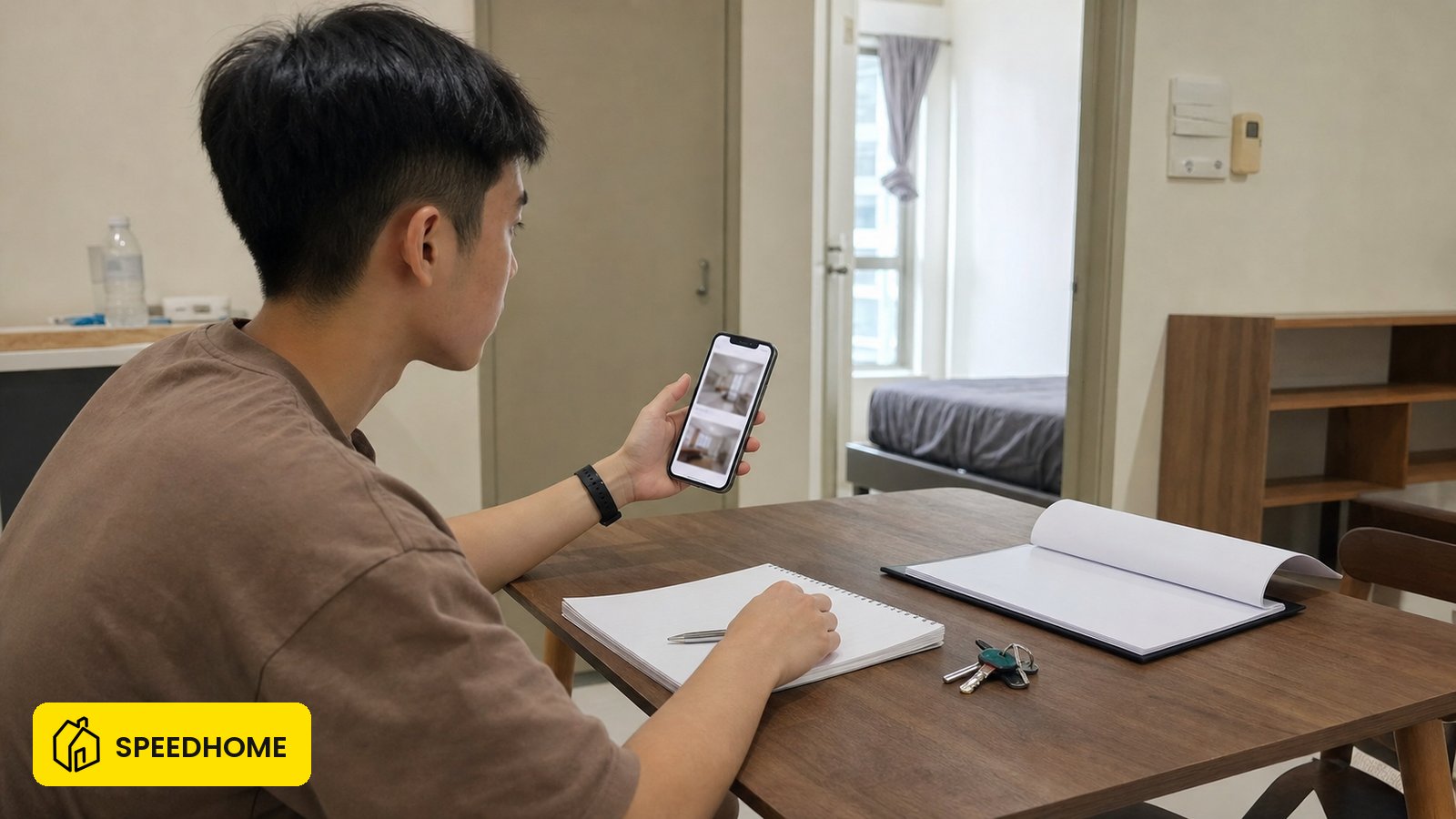
Tips for finding a room for rent in Malaysia as a student
The single most useful tip for a Malaysian student hunting a room for rent is to decide first which trade-off matters most to you — minutes to lecture, cash out in week one, or what happens if the arrangement breaks mid-semester — because that choice collapses "bilik sewa untuk student" into one of three products: purpose-built student accommodation (PBSA), managed co-living, or an informal room (almost always a sublet). Once the trade-off is fixed, every other tip on this page follows from it.
If you typed tips cari bilik sewa untuk student into a search bar, you are weighing the same three things most students weigh: how close to campus, how much cash goes out before week one, and what happens if the living setup falls apart in week eight. This guide gives you the trade-off framework first, then the practical tips that survive contact with Malaysian campus rental reality. For broader area context, see where to rent in Malaysia; for a campus-specific shortlist, see rooms near university on SPEEDHOME.
Pick the right room type before you pick the room
"Bilik sewa untuk student" is three different products in one phrase. The trade-off you fix first — commute, cash, or safety net — points to one of them.
| Your first priority | Best-fit product | Why it wins on that priority | Where it loses |
|---|---|---|---|
| Minutes to lecture, predictable semester schedule | PBSA (purpose-built student accommodation) | Single corporate counterparty; utilities and WiFi bundled; move-in dates match the academic calendar | Highest monthly rent; early-exit penalties can be stiff |
| Lower upfront cash with a written, stamped agreement | Managed co-living room | Operator holds the head tenancy; deposit terms negotiable; some SPEEDHOME listings are Zero Deposit eligible | Kitchen and bathrooms shared; rules on guests and quiet hours apply |
| Cheapest display rent you can find this week | Informal room — almost always a sublet | Lowest headline price | No written agreement is common; your only counterparty is the main tenant; if the head tenancy ends, your stay ends with it |
For an extended side-by-side comparison of PBSA, managed co-living and informal rooms, see PBSA, co-living or sublet compared. The rest of this guide assumes you are choosing between managed co-living and an informal room — the actual decision most Malaysian students face after the cheapest PBSA options are full.
Verify the offering party before you pay anything
The single highest-leverage tip is to confirm who you are paying and whether they have authority to rent you the room. Everything else — deposit, stamping, move-in date — depends on this.
| Document or signal | What it tells you | What to do if it is missing |
|---|---|---|
| The offering party's IC or business registration | Confirms a real counterparty exists | Walk away — unverified social-media listing channels carry no platform accountability |
| The head tenancy agreement and a written sublet consent from the owner | Confirms a sublet is lawful (informal rooms) | Your stay ends the moment the head tenancy ends; the main tenant cannot guarantee your right to remain |
| A sample tenancy agreement stamped via e-Duti Setem on MyTax | Confirms the operator runs a real letting workflow | An unstamped agreement is admissible but harder to use in court if a dispute arises |
| A Zero Deposit label on a SPEEDHOME listing | Confirms SPEEDHOME's managed rental-risk system applies to that specific unit | Zero Deposit is SPEEDHOME's managed rental-risk system — not a financial guarantee product — and not every unit qualifies; confirm the label on the active listing before you assume full coverage |
For listings shared through messaging apps or community boards, the verification burden falls entirely on you. Cheap rooms advertised on unverified channels often carry costs that only appear after you move in.
Budget the move-in stack, not just the monthly rent
The displayed rent is rarely the cash that leaves your account in week one. Budget the move-in stack — advance rent, deposit, stamping, utility deposits — before you commit.
| Cost line | What it covers | Approximate size in a typical student room |
|---|---|---|
| Advance rent | First month of occupancy | One month's rent |
| Refundable deposit | Security the landlord holds against damage and unpaid bills | Usually one to two months' rent; no statutory residential rent-deposit cap applies, so the amount is contract-based |
| Stamp duty | Finance Act 2024 scale via e-Duti Setem on MyTax | RM1, RM3, RM5 or RM7 per RM250 of annual rent, depending on lease term; the former RM2,400 annual-rent exemption was removed in January 2025 |
| Utility deposits (TNB, water, internet) | Activation credit held by each provider | Varies by provider and room |
| First-week living buffer | Food, transport, textbooks while the first rent clears | One to two weeks of personal expenses |
The move-in stack typically lands between two and three months' rent for a standard deposit arrangement. On SPEEDHOME listings that show the Zero Deposit label, the cash deposit line is replaced — leaving advance rent, stamp duty and utility deposits as the main week-one cash items. Confirm Zero Deposit eligibility on the active listing; not every unit qualifies.
For the stamp duty rate table, see the SPEEDHOME stamp duty calculator for tenancy agreements; the scale has been updated for the January 2025 removal of the annual-rent exemption.
Check the commute honestly, not optimistically
Most students who regret their room choice in week three regret the commute, not the rent. Check it at the actual class-hour time, not at 2pm on a Sunday.
- For walking distance, count the minutes from the building lift to your lecture-hall door — not the building entrance to the campus gate. A "10-minute walk" on a listing usually means the former, not the latter.
- For public transport, time the actual ride from the nearest LRT/MRT/KTM station to campus during the hour you will commute. If the station is not within walking distance, plan for feeder bus or e-hailing cost.
- For driving or being driven, confirm the parking situation. Many student-area condos charge visitor parking hourly, and overnight parking for a second car may not be included.
If you are choosing between two rooms of the same rent, the one with the shorter, more reliable commute wins on total cost of living — even if its monthly rent is RM50 higher.
Read the tenancy agreement before you sign
An unstamped or verbally agreed arrangement is harder to enforce if a dispute arises. A stamped, written tenancy agreement is your single best protection as a tenant.
The tenancy agreement should at minimum cover:
- The two parties — usually you and the landlord or operator, with full name and IC or registration number.
- The unit address and which parts of the property you have exclusive access to.
- The tenancy start and end date, and the notice period either side must give to end the tenancy early.
- The monthly rent, due date, and the late-payment grace period (if any).
- The deposit amount, the conditions for deductions, and the refund timeline at move-out.
- Who pays for utilities — TNB electricity, water, Indah Water, internet — and how shared utilities are split.
- A clause on subletting: most standard agreements prohibit it without the landlord's written consent. Adding a roommate without written approval can breach the agreement the same way an unauthorised sublet can.
- The stamp duty treatment — typically paid by the tenant through e-Duti Setem on MyTax within 30 days of signing.
For a full checklist of what to check before you sign, see the first-time tenant checklist.
Know what happens if the arrangement breaks
Even with the best preparation, a student room can fall apart — the main tenant disappears, the owner decides to sell, or the operator changes its terms. Plan the worst case in advance.
- If your room is an informal sublet and the head tenancy ends, your stay ends with it — regardless of any private agreement you made with the main tenant. Keep a fallback housing contact (a friend, a family member, or a verified PBSA application) ready.
- If a deposit dispute arises, it is a private contract matter decided in the civil courts. Claims up to RM5,000 can use the Magistrate's small-claims procedure without a lawyer. The Tribunal for Consumer Claims does not hear a private residential tenancy deposit dispute.
- If the landlord tries to recover the room outside the lawful tenancy process — by attempting to lock you out, removing doors or disconnecting water or electricity — that is unlawful self-help; recovery of possession must go through the court process.
Malaysia still has no Residential Tenancy Act in force as of 2026. The proposed bill remains a draft — it has not been tabled in Parliament or gazetted — so every student room rental is governed by the tenancy agreement and general law (Contracts Act 1950, Civil Law Act 1956, Specific Relief Act 1950).
FAQ
What is the most important tip when looking for a room for rent as a student in Malaysia?
Decide first which trade-off matters most — commute time, upfront cash, or what happens if the arrangement breaks. That single choice points you to PBSA, managed co-living or an informal room, and makes every other tip on this page easier to apply. Without that anchor, students usually default to the cheapest display rent and discover the missing cost layer (stamp duty, deposit, utilities) only in week one.
How can a student avoid room rental scams in Malaysia?
Verify the offering party's identity and authority before paying anything. Ask to see the head tenancy agreement and any written sublet consent from the owner, confirm the listing on a verified platform, and never transfer a deposit to a personal bank account without seeing the unit in person. Listings shared through unverified social-media listing channels carry no platform accountability — if a deposit dispute arises later, your only recourse is against the person you paid.
Should a student choose PBSA or a co-living room?
PBSA is worth the higher rent when campus distance is your daily landmark and you want utilities bundled in one invoice. If a 20-minute commute is acceptable and you want a written, stamped agreement with a verifiable operator, managed co-living is usually on par with PBSA for paperwork and lower for monthly total cost. The right choice depends on whether your priority is minutes to lecture or cash out per month.
Does Zero Deposit work for student rooms on SPEEDHOME?
On selected SPEEDHOME listings, Zero Deposit replaces the upfront cash deposit so move-in cash drops from two to three months' rent down to about one month's rent. Zero Deposit is SPEEDHOME's managed rental-risk system — it is not a financial guarantee product, and not every unit qualifies. Confirm the Zero Deposit label on the active listing before you assume that option applies.
What stamp duty applies to a student room tenancy agreement?
The Finance Act 2024 scale applies at every rental tier: RM1, RM3, RM5 or RM7 per RM250 of annual rent, depending on the lease term. The former RM2,400 annual-rent exemption was removed in January 2025. Stamping is done via e-Duti Setem on MyTax (mytax.hasil.gov.my). An unstamped agreement is admissible but harder to use in court if a deposit dispute arises.
Can a student sublet their room to a classmate for a semester?
Only with the landlord's or operator's written consent. Most standard tenancy agreements prohibit subletting without written approval, and adding an unregistered roommate can breach the agreement the same way an unauthorised sublet can. Always ask the landlord or operator in writing before you sublet, and keep a copy of the consent. If the head tenancy ends, your sub-tenancy ends with it — regardless of any private agreement.