
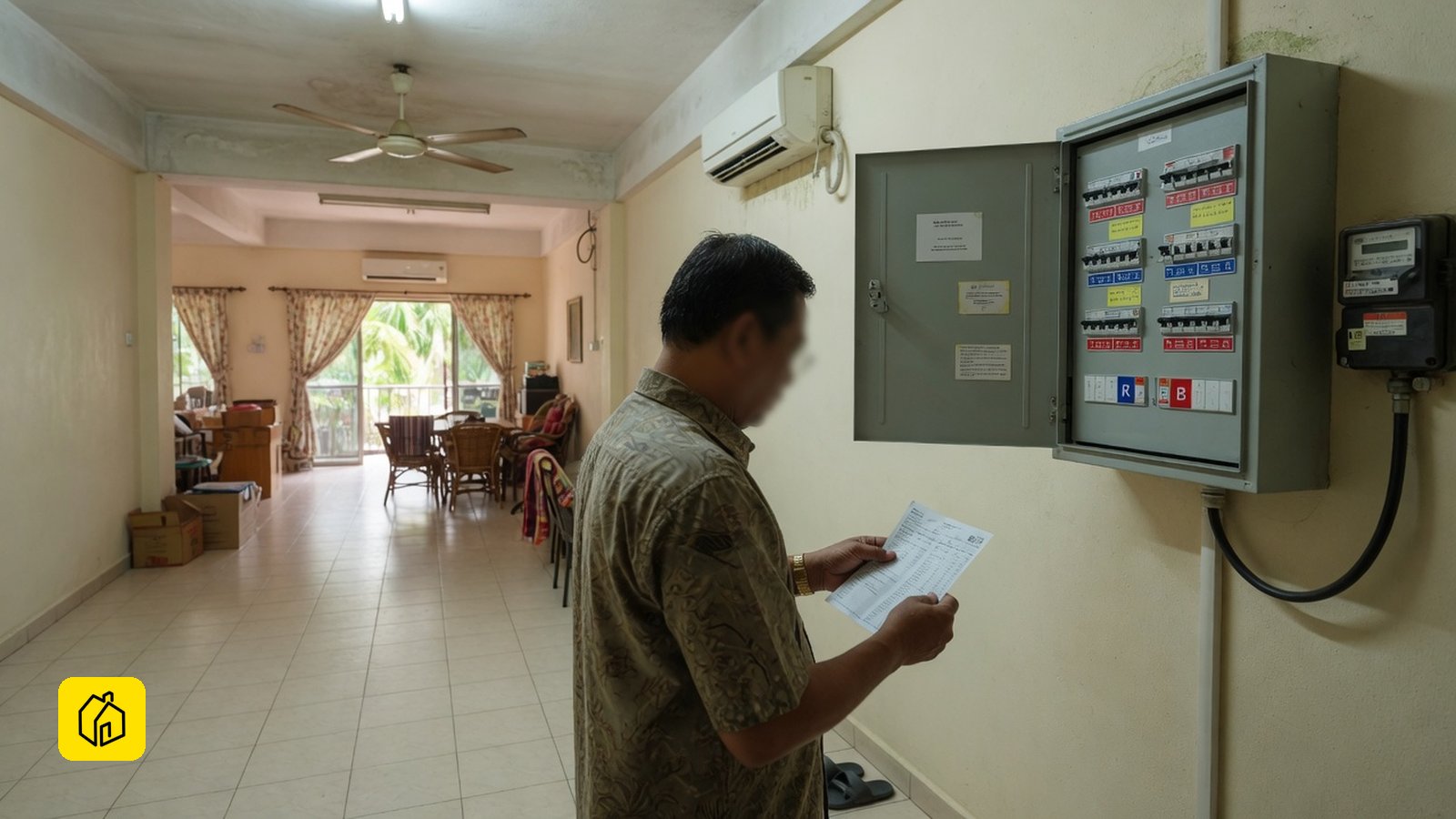
TNB 3-phase electricity (415V, 4-wire) is a high-capacity power supply for premises with heavy electrical loads like central air-conditioning. In Malaysian rentals, it is billed under commercial tariff schedules with additional capacity and network charges. Legal liability for unpaid bills under the Electricity Supply Act 1990 belongs strictly to the TNB Registered User, not the property owner automatically.
If your large unit — a bungalow, semi-D, shop-lot, or any home with heavy air-conditioning and appliance load — is connected to a 3-phase or commercial-grade TNB supply, your tenant's monthly electricity bill will likely be far higher than either of you expected. Liability for unpaid bills follows the TNB Registered User, not the physical occupant. If the account is in your name, you are the liable party.
Why is my tenant's electricity bill so much higher than expected?
The most common reason is a 3-phase or commercial-grade supply, which is billed under a different TNB tariff schedule than a standard single-phase home — with additional capacity and network components that push the total cost up significantly even at similar usage hours. Large units, older bungalows, shop-lots, and any premise with a 3-phase distribution board or a monthly capacity demand measured in kVA will attract commercial Low Voltage (LV) or Medium Voltage (MV) tariff components that do not apply to an ordinary single-phase residential meter.
What is the difference between single-phase and 3-phase supply?
Single-phase supply (240V, 2-wire) covers standard landed homes and apartments. Three-phase supply (415V, 4-wire) serves premises with high-demand equipment — central air-conditioning plant, lifts, heavy kitchen appliances, or any large motor load — and is billed under TNB's commercial tariff schedule, not the residential schedule.
A 3-phase supply is not inherently more expensive per unit of energy, but the billing structure includes components absent from the residential schedule: capacity charges tied to peak demand (kVA), network charges, and a mandatory monthly retail charge. These extras are separate line items — not folded into a simple sen/kWh rate — so a tenant who moves from a standard apartment into a large bungalow with a 3-phase board will see a structurally higher bill even if their personal usage habits did not change.
| Billing element | Single-phase residential | 3-phase / commercial LV |
|---|---|---|
| Energy charge | Component-based per kWh (RP4) | Component-based per kWh (commercial schedule) |
| Capacity / demand charge | Not applicable | Applies (kVA-based peak demand) |
| Network charge | Applies (residential rate) | Applies (commercial rate) |
| Monthly retail / fixed charge | Waived below 600 kWh (RP4) | Applies regardless of usage |
| Automatic Fuel Adjustment (AFA) | ±3 sen/kWh cap | Applies under RP4 framework |
| Who sets the rate | TNB / Suruhanjaya Tenaga under RP4 | TNB / Suruhanjaya Tenaga — separate commercial schedule |
From 1 July 2025, TNB restructured tariffs under the RP4 framework, replacing the old tiered block system with separately stated generation, capacity, network, and retail components. Both residential and commercial Low Voltage tariffs changed; the exact sen/kWh figures for commercial LV are published at mytnb.com.my/tariff — verify the live schedule before quoting numbers.
Am I, the landlord, liable if my tenant runs up a big bill?
Yes — if the TNB account is in your name. Liability under the Electricity Supply Act 1990 follows the TNB Registered User: the party whose name is on the supply contract for the premises. If the Registered User is the tenant, the landlord is not liable for the tenant's arrears. If the Registered User is the landlord, the landlord is liable for every ringgit the tenant accumulates — even without the landlord's knowledge.
There is only one Registered User per premises at any time. TNB's official tenant-landlord guidance makes this clear: a departing tenant who was the Registered User takes the liability with them; TNB cannot demand the next occupant pay the previous user's arrears. But the reverse is also true — when the landlord holds the account, the landlord absorbs all arrears regardless of which tenant ran them up.
This is why the single most important utility action before a tenant moves in is a TNB Change of Tenancy, transferring the account into the tenant's name. On a 3-phase or commercial-grade supply, where monthly bills can run several hundred ringgit, the landlord's exposure from staying as Registered User is proportionally greater.
What does a TNB Change of Tenancy require for a 3-phase supply?
The process is the same as a standard Change of Tenancy — the 2026 process runs through the myTNB portal or in-person at a Kedai Tenaga — but the deposit, stamp duty, and processing fee are calculated differently for medium- or high-voltage premises and may be substantially higher than the low-voltage residential figure.
Documents needed: - Copy of IC of the new account holder (marked "For TNB Purpose Only") - TNB Declaration Form (current version on myTNB — verify the form version on the day of application) - Proof of tenancy (tenancy agreement)
The deposit is calculated on the premise's estimated electricity usage. On a 3-phase supply with high usage, this deposit will be materially higher than on a standard residential meter. The processing fee for medium- or high-voltage premises is also in a different bracket from the low-voltage residential fee — verify the live fee schedule on myTNB before telling your tenant what to budget.
Note: if a previous occupant left the address with unpaid TNB arrears, the address-level flag must be cleared before a new clean account can be opened — even after a Change of Tenancy. The address blacklist follows the premises, not the person; arrears must be settled with TNB first.
How do I find out whether my unit has a 3-phase supply?
Check the distribution board (DB box or fuse box) in the unit. A 3-phase board will have a 4-wire input (three live phases plus neutral) and typically a larger main breaker — often 60A, 80A, or 100A per phase rather than the 40–63A single breaker of a standard residential board. The TNB meter itself will also be labelled with the voltage class and tariff category. If you are unsure, call TNB (1-300-88-5454) or check the account details on myTNB — the tariff category field will show whether the premises are billed as residential (domestic) or commercial Low Voltage.
What should a landlord do before letting a large or high-consumption unit?
- Verify the tariff category on myTNB before advertising the unit. If it is commercial LV or 3-phase, include an honest note when listing your property on the platform that bills will be higher than a standard apartment.
- Do the Change of Tenancy before move-in. Do not allow a tenant to occupy while the account is still in your name. On a high-usage supply, one month of exposure is a significant amount.
- Check for prior arrears. Request the current bill from TNB and confirm there is no address-level block before the Change of Tenancy is processed.
- Use the repair service inspection at handover. the repair service inspection confirms the condition of the electrical installation, identifies any fault loads that will drive up the bill unexpectedly, and creates a documented baseline if a dispute arises later. Landlords using the platform's management service have the repair service available as part of the handover workflow — phone support is available 10am–6pm Monday to Friday (closed 1–2pm), with Homerunners available 7 days a week.
FAQ
Q: My unit has central air-conditioning on a 3-phase system. Is the tenant obligated to pay the full bill?
A: Yes, if the tenancy agreement requires the tenant to pay TNB bills directly and the account is transferred into the tenant's name. The tenant is the Registered User and is therefore the party TNB looks to for payment. If the bill is unexpectedly high, the tenant's recourse is to check the usage, verify meter readings, and dispute with TNB if there is an error — not to withhold payment.
Q: Can I pass the TNB deposit cost on to the tenant?
A: This is a negotiable term in the tenancy agreement. Common practice is for the tenant to pay the deposit to TNB directly as part of the account transfer, since the deposit is held in their name. Confirm the arrangement in writing in the TA before the Change of Tenancy is processed.
Q: What happens if the tenant defaults and leaves with unpaid TNB arrears?
A: If the tenant was the Registered User, TNB pursues the departed tenant — not the landlord and not the next incoming tenant. The address-level arrears flag, however, will block a clean new account at that address until the outstanding balance is settled. So even though the landlord is not personally liable, the landlord will be unable to re-let the unit without getting TNB to first clear the address, which in practice means the arrears are settled before a new tenancy can begin.
Q: What is the commercial Low Voltage tariff rate from 1 July 2025?
A: The exact component rates for commercial LV are published at mytnb.com.my/tariff and must be verified live — the RP4 restructure introduced component-based billing (generation, capacity, network, retail) with an Automatic Fuel Adjustment mechanism capped at ±3 sen/kWh. No specific sen/kWh figure for commercial LV is anchored here; check the live TNB tariff page before quoting numbers to a tenant.
Q: Does SPEEDHOME handle the TNB Change of Tenancy for landlords?
A: Under SPEEDHOME's management model, SPEEDHOME (as master tenant) coordinates the utility handover as part of the tenancy setup. Landlords retain the ability to verify that the account has been transferred before the tenancy commences. Contact the SPEEDHOME team via phone support (10am–6pm Mon–Fri, closed 1–2pm) for specifics on your unit's handover flow.
How this page stays accurate. Statements rest on verified sources; figures are checked against a dated fact registry at every update. Report an error: [email protected].