
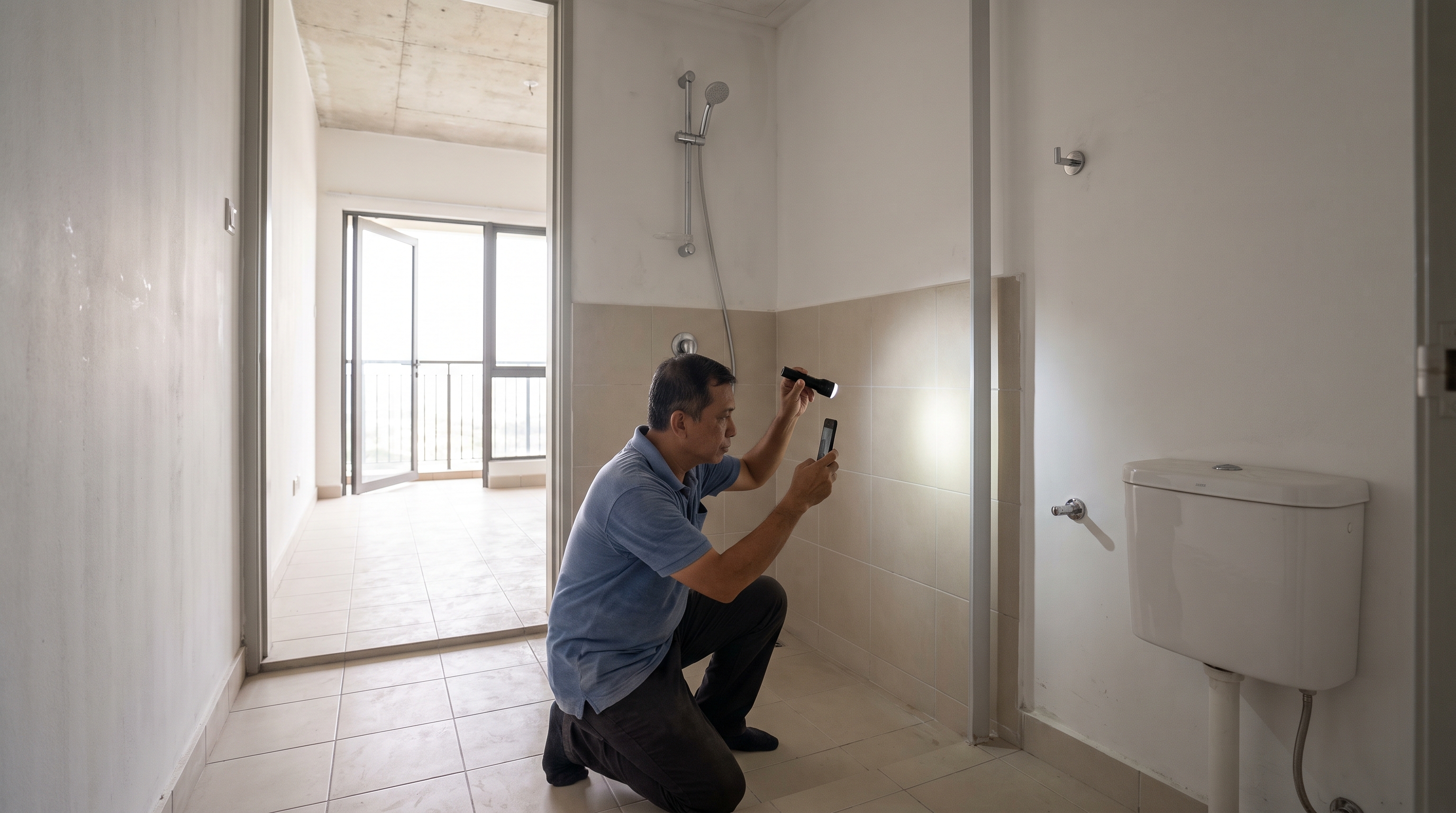
Vacant possession defect walk — what should a landlord check in the first 48 hours?
A vacant possession defect walk in Malaysia is a landlord's room-by-room inspection conducted within 48 hours of key handover to document developer workmanship defects before undertaking renovation or leasing. Owners test hollow tiles, bathroom ponding, window seepage, electrical fixtures, and SPA fittings, issuing a timestamped report to enforce developer rectification before booking the fit-out service.
Walk the unit inside the first 48 hours of getting the keys, run a six-line check on every room, write a dated photo list, and send any workmanship defect to the developer first — do not convert it into paid renovation. The unit only enters the SPEEDRENO fit-out lane after the walk clears, and only after any developer route is honestly closed. The walk is the WHAT (what to find in the unit); the inspect-before-renovate sequence is the ORDER (inspect, route the developer, then fit-out). The two pages are complementary, not rivals.
Why the first-48-hours walk matters
Because most workmanship defects are easier to argue with the developer in writing inside the first 48 hours than they are six months later over a contractor's quote. The walk is the move that captures the developer's attention, not a paid inspection receipt. A new owner usually gets keys, signs the SPA handover list under time pressure, takes a few phone photos, and walks out. Three weeks later, when the reno crew is on site, the same owner finds hollow tiles, a window that drips, a socket that does not trip, a bathroom that fails the ponding test. By then the developer's warranty conversation is harder, the contractor has quoted a "while we are at it" tile re-lay, and the free fix has quietly turned into a paid one.
The walk is cheap (your time, a torch, a phone camera, a flat-head screwdriver for the sockets, a chair for the ceiling). It turns the developer's "we have not received any complaint" into "we received a dated list on day 1, please respond" — the closer to the handover date the list lands, the harder it is to argue the defect is tenant damage or wear.
| Skip the walk | What actually happens | What it costs |
|---|---|---|
| Walk in, sign handover list, leave, start reno 3 weeks later | Developer's workmanship defects blend with reno scope; contractor quotes the same wall twice | The developer fix becomes a paid fix; warranty position weakens |
| Walk in, no photos, rely on memory | A month later, the developer says "we never received a complaint" | Defect falls into the landlord's column by default |
| Walk in, photos only, no dated written list | Photos are evidence, but a developer can argue date and context | Disputes drag, "what date was this" becomes the central question |
| Walk in, run the six-line check, send a dated list to the developer within 48 hours | Defect trail is timestamped; developer route is opened in writing; reno scope is set against a clean baseline | The cheapest defensible path: developer first, paid reno only for the tenant-ready fit-out |
The 48-hour window is not a statute line. It is a landlord-sense line — the earlier the dated list lands, the cleaner the developer conversation, and the cleaner the reno quote.
What does the walk table show: six checks, four columns?
This is the printable table no competitor productises. Run it room by room, fill the four columns on your phone, photograph each fail with a coin or ruler in the frame for scale, and send the dated list to the developer within 48 hours. Use a flat-head screwdriver to tap tiles (a hollow ring vs a solid ring is the entire test), a phone torch for the ceiling, a cup of water for the ponding test, a phone charger in every socket, and a chair to look at the ceiling stain line above any downstairs neighbour's reported drip.
| Check | How | Fail looks like | Next |
|---|---|---|---|
| Hollow tiles (空鼓 / jubin kosong) | Tap every floor and wall tile with a screwdriver handle; listen for a hollow ring vs a solid ring | Hollow ring on floor or wet-area wall tile; cracked grout that moves under a fingertip | Photograph with a coin for scale, mark the room + tile grid on a sketch, send to the developer if the unit is in the developer's workmanship window; do not pay a contractor to re-lay yet |
| Bathroom ponding | Close the floor waste, pour 2–3 cm of water, leave for ~24h, then check the water level and the ceiling below | Water level has dropped (the floor is not flat or the drain is leaking through the slab), or there is a new stain / damp patch on the ceiling of the unit below | This is no longer a DIY decision once the downstairs ceiling is involved — see the inter-floor leak page; do not pay for an "injection per point" fix without a second opinion (see the waterproofing scam page) |
| Window / door seepage | Hose-test the frame and sill (or wait for a heavy rain), then run a dry hand along the internal sill and the floor below the frame | Damp patch on the internal sill, water mark on the wall below the frame, swelling at the skirting | If the unit is still in the developer's window, log the date of the rain, photograph the sill, send in writing; if tenanted, route to SPEEDFIX, not a paid re-seal quote |
| Sockets, DB, lights | Run every switch, plug a phone charger into every socket, look at the distribution board for tripped breakers or scorch marks | A dead socket, a dead light, a breaker that does not reset, a scorch mark around a switch or the DB | Photograph the DB panel (breaker labels readable is fine), photograph the dead switch, book a single-trade sparkie — this is not a reno item, it is a SPEEDFIX item, not a SPEEDRENO item |
| Fittings vs SPA / handover list | Walk the unit with the developer's SPA or handover list open, tick off every promised fitting (water heater, kitchen hood, hob, aircond indoor units, fans, lights, mirrors, shower sets, door stops, gate, intercom) | A promised fitting is missing, swapped to a lower spec, or visibly damaged; the developer verbally said "standard" but the list says something else | Itemise the missing or downgraded fittings, send the list in writing within 48 hours, do not accept "standard" verbally; the SPA list is the contract |
| Ceiling stain / inter-floor drip | Look up at every ceiling, especially above wet areas (bathroom, kitchen, aircond condenser); for stratified units, check the upstairs neighbour's wet-area location above any stain | Brown ring, yellow stain, active drip, peeling paint, or a musty smell that points upstairs | This is the inter-floor / Form 28 path, not the reno path — see the inter-floor leak page; the upstairs owner's insurer / management is the correct route, not a SPEEDRENO quote |
The "Next" column is the move that turns a finding into an action. A walk without a "Next" is just a photo album.
QLASSIC: what is a CIDB workmanship SCORE, and why is it not your defect list?
QLASSIC is a workmanship SCORE under CIDB CIS 7 — it rates how a project was built, not how your unit was handed over. A high project score is not a per-unit defect list, is not the developer's warranty, and is not a passing mark you can sue on. QLASSIC is a construction quality assessment run at the project level (sample of units, sample of works). Two practical implications for the walk:
- QLASSIC does not replace the dated unit-level walk. The developer can point to a project QLASSIC score and still hand you a unit with a hollow tile or a failed ponding test.
- QLASSIC does not shorten or extend the developer's workmanship obligation. That obligation is independent of the QLASSIC score, and it is your dated unit-level list that opens the conversation.
QLASSIC is what the developer's brochure quotes; the dated walk is what your file holds.
When to stop DIY and pay a defect walk
Book a paid defect walk when the room-by-room findings start to compound — many hollow tiles, a failed ponding test, an inter-floor ceiling stain, or the developer has already pushed back on the dated list. A single-trade sparkie for a dead socket is not a defect walk; that is the repair service ticket. A paid walk is the right move when the situation has crossed from "I can argue this from photos" to "I need an independent report in writing to put on the developer's desk." Use it for the developer conversation, not as a precondition for any work.
Before booking any contractor off the back of the walk, run the CIDB-registered contractor check — a real CIDB check takes 2 minutes on the official portal, costs nothing, and filters out the fly-by-night operators before you hand over a deposit. The walk tells you WHAT is wrong; the CIDB check tells you who is allowed to touch it.
| DIY is fine | Book a paid walk |
|---|---|
| A handful of hollow tiles, no other failures | Hollow tiles across multiple rooms, plus a failed ponding test, plus a window drip |
| A single dead socket or light on its own breaker | Multiple dead circuits, scorch marks at the DB, breaker that will not reset |
| One window with a small sill damp after rain | Multiple windows seeping, swelling at skirting, water mark on the wall |
| Minor hairline crack at a ceiling cornice | Brown ring, active drip, musty smell pointing upstairs — inter-floor zone |
| Defect list sent to the developer, no response in 14 days | Developer disputes the list, asks for an independent report, or the unit is honestly outside the workmanship window |
The paid walk is the developer-route document, not a reno quote. A contractor who offers a paid walk and a renovation quote in the same visit is mixing two jobs.
What to do with the defect list: developer first, then SPEEDRENO
Send the dated list to the developer first, in writing, with photos attached. If the developer fixes it (or the defect is honestly outside their window), the unit is clean. The fit-out service enters only as the fit-out the landlord owes the next tenant, not as a cover for an unfixed defect. The full sequence lives on the inspect-before-renovate page — inspect, route developer defects, single-trade repair if needed, then the fit-out service for the tenant-ready surface, not for a pretty reno.
The one-line rule: if the unit is still in the developer's workmanship window, the developer fixes it; SPEEDRENO fits out what the landlord owes the next tenant, not what the developer skipped. A contractor who says "just bundle it into the reno" is converting a free fix into a paid one.
One CTA before FAQ
Run the walk this weekend, send the dated list to the developer within 48 hours, and keep the inspection photos, the developer correspondence, and a current unit condition note in one folder. When the developer route closes (or the unit is honestly outside the window), start the SPEEDRENO path through SPEEDHOME with that folder ready. If the walk finds one isolated thing — a tap, a tile, an aircond — see /more/landlord/speedfix for the single-trade arm. SPEEDRENO is for the fit-out; SPEEDFIX is for the one-off repair.
FAQ
Is a hollow tile automatically the developer's problem?
No. A hollow ring under a tap-test is a finding, not a verdict. Whether it is the developer's problem depends on the unit's age, the warranty window, the location of the tile (floor vs wall, wet vs dry), and whether the same tile was disturbed after handover. Photograph it, mark the room, send the dated list to the developer, and let the developer respond. Do not pay a contractor to re-lay a hollow tile before the developer's response is on file.
Can I renovate during the developer's warranty period?
Inspect first, then route any workmanship defect to the developer in writing. Once a paid contractor touches the same surface, the warranty conversation becomes harder to argue. The right order — inspect, developer route, then SPEEDRENO — is the inspect-before-renovate sequence. The unit is fit-out-grade for SPEEDRENO only after the developer's obligation is closed (or the defect is honestly outside their window).
Is QLASSIC a legal standard I can sue on?
No. QLASSIC is a CIDB workmanship score under CIS 7 — a project-level quality assessment, not a statute and not a per-unit defect list. It does not give you a passing mark for your specific unit, and it does not replace the developer's separate workmanship obligation. The walk table on this page is your per-unit tool; QLASSIC is the developer's brochure metric. They are different documents for different jobs.
The ponding test failed and a contractor quoted a per-point injection price — is that the fix?
Probably not. Injection-per-point is one of the more common waterproofing upsells in Malaysian condos, and the price line ("per point, per drill") is built to balloon. See the waterproofing injection-per-point scam page before you pay for any injection job on a ponding-test fail. A failed ponding test with a downstairs ceiling stain is no longer a DIY decision — that is the inter-floor leak path.
A leak is dripping from the upstairs unit — is that the developer's warranty or Form 28?
For a stratified unit, an inter-floor leak runs through the strata / Form 28 process, not the developer's workmanship warranty. The right page for that conversation is the inter-floor condo water leak page — it is the downstairs owner's path, not a SPEEDRENO item. The walk table flags a ceiling stain as a routing step, not as a defect to fix with paid reno.
Accuracy note. This page is built on verified primary sources and a dated fact registry; figures are re-verified on each update. Spotted an error? Email [email protected] with this page's link.