
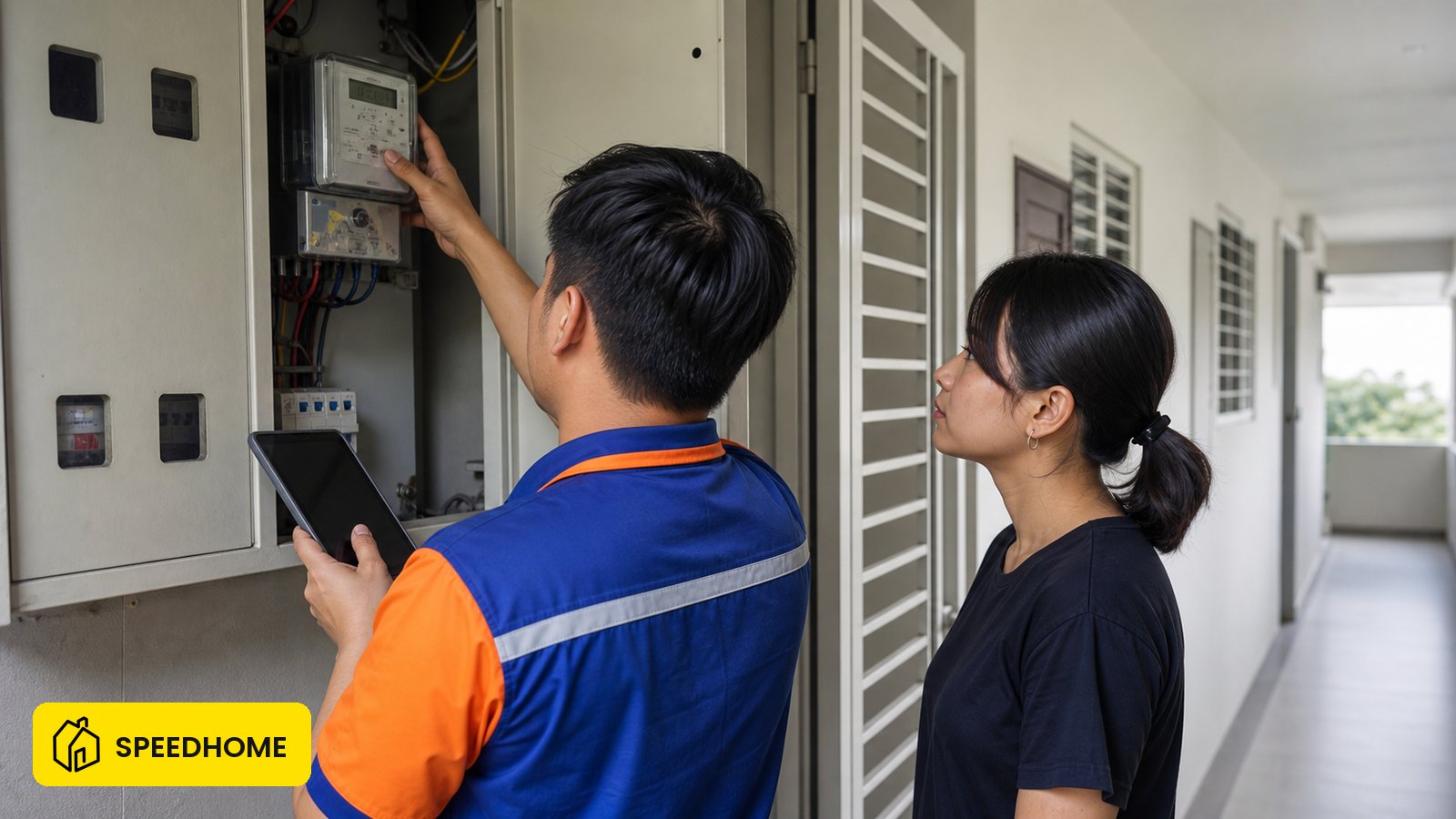
TNB smart meters transmit real-time usage without manual reads. Under the RP4 component structure introduced in July 2025, residential bills include a 27.03 sen/kWh base generation charge and an RM10 monthly retail charge. Verify your digital LCD display to ensure actual, non-estimated billing via myTNB.
What is a TNB smart meter and does your home have one?
A TNB smart meter (Meter Pintar) is a digital electricity meter that sends usage readings directly to TNB over a wireless network — no meter-reader visits, no estimated bills. TNB has been progressively rolling out smart meters across Peninsular Malaysia under its Advanced Metering Infrastructure (AMI) programme; coverage varies by area and building age, so check your unit directly rather than assuming based on location. If your unit has a digital display with an LCD screen and no rotating disc, you likely already have one.
The shift matters for renters and landlords. A smart meter records your actual consumption in near-real time. TNB reads it remotely, so the bill you receive reflects what you actually used — not an estimate corrected two months later with a surprise "adjustment charge." That single change removes one of the most common rental disputes: a tenant moving out and receiving a catch-up bill that was partly from the previous occupant's estimated period.
What types of TNB meters are installed in Malaysian homes?
There are three main meter types in Malaysian homes: the older electromechanical (spinning disc) analog meter, the digital static meter, and the newer smart meter with two-way communication. The type installed depends on your building age and TNB's rollout progress in your area.
| Meter type | How it records usage | How TNB reads it | Estimated bills possible? |
|---|---|---|---|
| Electromechanical (analog) | Rotating aluminium disc; dials or digits on face | Physical meter-reader visits | Yes — if the reader misses your visit, TNB estimates |
| Digital static meter | Electronic measurement; LCD display | Physical read or handheld device at the meter | Yes — still requires a site visit |
| Smart meter (Meter Pintar / AMI) | Electronic measurement; two-way wireless communication | Remotely, over the AMI network — no visit needed | No — reads are actual, not estimated |
Source: TNB AMI programme documentation; verify your meter type at myTNB or with Kedai Tenaga.
If you are unsure which meter your unit has, look for a serial number panel or check the myTNB app — your account page will typically show if your meter is AMI-enabled.
What are the benefits of a smart meter for tenants and landlords?
Smart meters end estimated billing, give you access to real usage data through myTNB, and allow TNB to enable a prepaid electricity option. For landlords managing multiple units, the remote-read capability means you can monitor whether a unit's consumption has spiked abnormally — a useful early signal for issues like crypto-mining or equipment left running.
Key benefits in practice:
- No estimated bills. TNB reads your actual consumption every billing cycle. Catch-up "adjustment" charges become rare.
- Real-time usage data on myTNB. You can log into the myTNB app or portal and view your consumption by day or time block. Useful for spotting a faulty appliance, air-conditioner left on, or a water heater that is drawing power continuously.
- Prepaid electricity option. Smart meters support TNB's prepaid programme. You top up credit and the meter disconnects automatically when credit runs out. Suitable for short-stay or furnished rental units where the landlord wants to avoid utility arrears.
- Faster fault detection. TNB can detect meter tampering, outages, or abnormal load remotely, sometimes before the account holder notices.
- Cleaner handover between tenants. Because readings are logged digitally with timestamps, a move-in and move-out reading is on record. This reduces disputes about who used what.
In Malaysian rental practice, bill disputes often surface at tenancy changeover when a unit's meter was read via estimate. Smart meters with timestamped remote reads close that gap — landlords managing multiple units are encouraged to add the property to myTNB and set up usage alerts after each Change of Tenancy is completed.
How to read a TNB smart meter display
Press the display button or wait for the auto-scroll. The main reading shown is your cumulative kilowatt-hour (kWh) total. Write down the full number including leading zeros — that is the figure TNB uses to calculate your bill.
Smart meter LCD screens cycle through several display fields. Here is what you will typically see:
| Display code / label | What it means | What to do with it |
|---|---|---|
| kWh (e.g. 001234.56) | Total electricity consumed in kilowatt-hours from meter installation | This is your main reading — write it down at move-in and move-out |
| kW or Demand | Current power demand in kilowatts | For reference — TNB uses this for tariff checks on commercial meters |
| V / Volts | Supply voltage at the meter | Normal residential supply is around 240V; significant deviation is worth reporting |
| A / Current (Amperes) | Live current draw | High reading when few appliances are on may indicate a problem |
| Date / Time | Meter clock | Verify this matches the actual date — a wrong meter clock can affect time-of-use tariff calculations on applicable accounts |
| TOU block labels | Time-of-use tariff periods (where enabled) | Residential Tariff B/C customers — check your tariff category |
Move-in and move-out meter reading tip: take a date-stamped photo of the kWh reading the day keys are exchanged. For smart-metered units, you can cross-check this against the myTNB portal reading history. A discrepancy between your photo and the bill is a concrete basis to query TNB.
How to understand your TNB electricity bill
From 1 July 2025, TNB replaced the old tiered block residential tariff with a component-based RP4 structure: Generation Charge 27.03 sen/kWh (≤1,500 kWh) or 37.03 sen/kWh (>1,500 kWh), plus Capacity Charge 4.55 sen/kWh, Network Charge 12.85 sen/kWh, and a Retail Charge of RM10/month (waived if total monthly usage is below 600 kWh). The Automatic Fuel Adjustment (AFA) mechanism caps automatic adjustments at ±3 sen/kWh; any change beyond that cap requires government approval. Verify the live figures at mytnb.com.my/tariff before relying on them, as components are subject to revision.
A standard Malaysian residential electricity bill shows:
| Bill section | What it means |
|---|---|
| Account number | Tied to the registered account holder's NRIC — the person TNB chases for unpaid bills, regardless of who lives in the unit |
| Meter reading (previous / current) | The kWh values TNB used; "Actual" means a real read, "Estimated" means TNB projected usage |
| Units consumed (kWh) | Current reading minus previous reading — the basis of your charge |
| Energy charge breakdown | From 1 July 2025, Malaysian residential billing uses the RP4 component structure — energy charge plus capacity, network and retail charges, with a fuel adjustment (AFA). Always verify the current published rates with TNB or myTNB at mytnb.com.my/tariff, as they are revised periodically |
| Fixed charge | A base charge regardless of usage — verify current amount with TNB |
| Surcharges / rebates | ICPT (Imbalance Cost Pass-Through) surcharge or rebate that adjusts for fuel cost fluctuations — the amount varies by billing period |
| Due date | Pay by this date to avoid late fees; TNB may proceed to disconnection after a period of non-payment |
One rule that renters must know: TNB bills whoever is the Registered User on the supply contract — not the property title and not the tenancy agreement. A clause in your TA saying "tenant pays electricity" does not bind TNB. If the account is in the landlord's name, TNB deals with the landlord, and the landlord then recovers from the tenant privately. See the TNB Change of Tenancy guide for how to correctly put the account in the tenant's name.
What to do if your meter reading or bill looks wrong
If your bill shows "Estimated" instead of "Actual", or the kWh reading does not match your meter photo, contact TNB through myTNB, call TNB Careline, or visit Kedai Tenaga to request a re-read or a formal meter inspection.
Steps when a reading looks wrong:
- Check your meter photo. Compare the reading you photographed at move-in (or last month) against the bill's previous reading. A large discrepancy is the first signal.
- Check if the bill is marked "Estimated". On smart-metered premises this should be rare, but if the AMI connection dropped, TNB may have estimated. An adjustment charge on the next bill is likely.
- Request a meter re-read via myTNB. Log in, go to your account, and raise a meter reading dispute. This is typically the fastest channel for most cases.
- Call TNB Careline. The current TNB Careline number is 1-300-88-5454 — verify this is current at mytnb.com.my before calling, as contact numbers can change.
- Visit Kedai Tenaga with your bill, your IC, and your meter photo. Counter staff can inspect the account record and initiate a meter check.
- Escalation ladder if the issue is not resolved. If counter staff apply an incorrect policy, ask for a supervisor. If still unresolved: myTNB portal complaint → Energy Commission (Suruhanjaya Tenaga) regulatory complaint → TTPM tribunal (consumer violation) → Magistrates' Small Claims Court (claims up to RM5,000).
Note that this escalation path is separate from tenancy disputes generally: Malaysia has no dedicated residential tenancy tribunal. A TNB billing dispute follows TNB's own ladder above, not a landlord-tenant forum — claims up to RM5,000 can use the Magistrates' small-claims procedure, and the Tribunal for Consumer Claims (up to RM50,000) applies only where the matter genuinely fits a consumer/service framing.
If you suspect meter tampering — whether by a previous tenant or unknown party — do not attempt to access the meter enclosure yourself. Report it to TNB. Under the Electricity Supply Act 1990, meter interference is a criminal offence, and any resulting debt stays with the Registered User on the account. TNB v Chew Thai Kay [2022] 2 MLJ 25 (FC) established that after TNB rectifies a tampered meter, it must recover the debt civilly and cannot use disconnection as a collection lever — but the debt itself does not disappear; it remains owed by the Registered User.
For the specific scenario of a tenant running crypto-mining equipment that has caused an unusually high bill, see the TNB crypto-mining risk guide.
SPEEDHOME is one option worth comparing alongside the routes above.
Smart meter and rental — what should landlords know?
If the TNB account is in your name (no Change of Tenancy was done), you are fully liable to TNB for any unpaid electricity — regardless of what the tenancy agreement says. A smart meter makes this easier to monitor, but it does not change the liability rule.
Smart meters give landlords a practical advantage when managing units remotely:
- Add the property to myTNB under your account (if the account is in your name) to get usage alerts and bills directly.
- Set up an unusual-usage alert. If monthly consumption jumps from a normal residential band to several hundred units above it, investigate before the bill grows further. Crypto-mining and illegal sub-letting are the two most common culprits in Malaysian rental units.
- Request a Change of Tenancy before move-in so the account transfers to the tenant. Once the tenant is the Registered User, TNB pursues the tenant's NRIC for any default — the landlord is not liable. See the complete TNB Change of Tenancy guide.
- For foreclosure or auction property purchases, old arrears in a previous owner's name are a separate channel. Smart meter rollout does not clear those debts. See TNB electricity on foreclosed or auction property in Malaysia for how to re-apply correctly.
If you manage multiple units and want a structured system for tracking utility handovers, meter readings, and COT documentation, SPEEDHOME's landlord management service keeps those records aligned with each tenancy. See how SPEEDHOME works for landlords.
FAQ
What is a smart meter in TNB Malaysia?
A TNB smart meter (Meter Pintar) is a digital electricity meter that communicates usage data wirelessly to TNB under its Advanced Metering Infrastructure (AMI) programme. It replaces estimates with actual reads, gives account holders access to consumption history through myTNB, and supports prepaid electricity. Check whether your unit has a smart meter by looking at the meter display — a digital LCD screen with no rotating disc is the clearest indicator, or confirm via the myTNB app.
What are the benefits of a TNB smart meter?
The main benefits are: no estimated electricity bills (TNB reads the meter remotely), access to real usage data by day or time block through the myTNB app, support for prepaid electricity top-up, faster fault and tampering detection, and cleaner move-in/move-out readings with a digital timestamp. For landlords, the ability to monitor usage remotely helps catch abnormal consumption early.
How do I read my TNB smart meter?
Press the button on the meter face or wait for the display to auto-scroll. The key figure is the kWh total — the cumulative electricity used since the meter was installed. Write this number down in full. Take a date-stamped photo at move-in and move-out; you can cross-check it against your myTNB account reading history to verify the bill is correct.
Why is my TNB bill marked "Estimated" if I have a smart meter?
If your AMI network connection dropped or the meter had a communication fault, TNB may fall back to an estimate for that cycle. An "Estimated" label on a smart-metered account is unusual — contact TNB via myTNB or Kedai Tenaga to request an actual re-read and to correct the record. A large estimate followed by an adjustment charge on the next bill is the most common downstream effect.
Who is liable for an unpaid TNB electricity bill in a rental unit?
TNB bills the Registered User on the supply contract — the person whose name and NRIC is on the account. The property title and the tenancy agreement do not bind TNB. If the account was transferred to the tenant via a Change of Tenancy, TNB pursues the tenant. If the account stayed in the landlord's name, the landlord is fully liable to TNB and must recover from the tenant privately. This rule applies regardless of whether the meter is a smart meter or an older type.
Can a TNB smart meter be tampered with?
Yes, meter tampering is a criminal offence under the Electricity Supply Act 1990. TNB's AMI documentation states smart meters carry tamper-detection capability and can flag interference remotely. If tampering is found, TNB will rectify the meter and calculate the debt owed by the Registered User. TNB v Chew Thai Kay [2022] 2 MLJ 25 (FC) confirmed TNB must recover such debts civilly, not by using disconnection as leverage — but the Registered User's liability for the unpaid amount remains.
How do I request a meter reading dispute with TNB?
Log into the myTNB portal or app and raise a meter reading dispute through your account. Alternatively, call TNB Careline at 1-300-88-5454 (verify the current number at mytnb.com.my) or visit the Kedai Tenaga nearest to your premises with your IC, your bill, and a photo of the meter reading. If counter staff do not resolve the issue, escalate to a supervisor, then to the Energy Commission (Suruhanjaya Tenaga) if needed.