
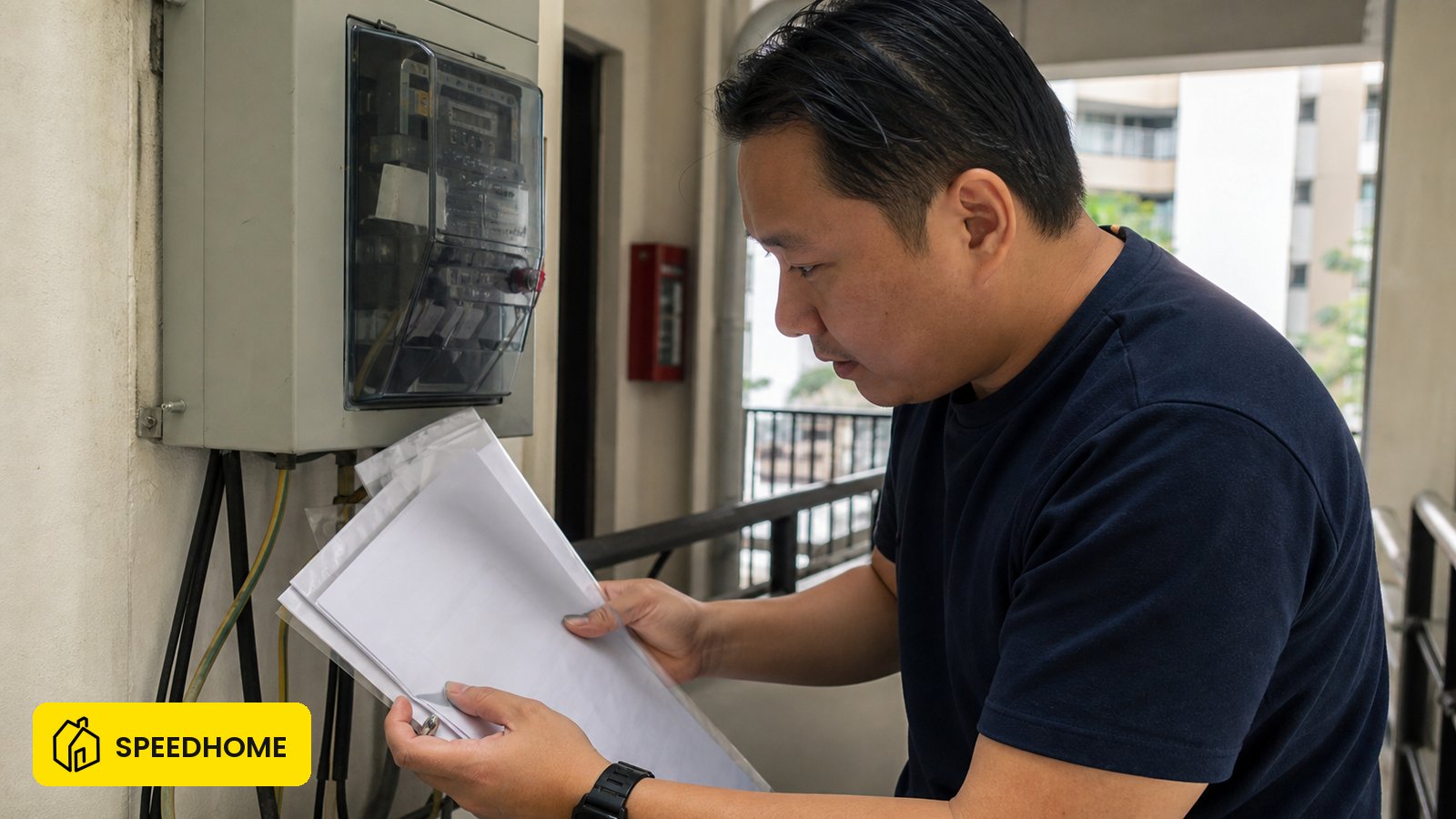
The two-channel rule every foreclosure buyer must read first
Winning a foreclosure or auction property in Malaysia puts you into two separate liability systems at once — TNB and the auction itself. "You're exempt" is only half right, and the wrong half can cost you five figures before you hold a single key.
Here is how those two channels actually work:
Channel 1 — TNB. TNB's own Landlord-Tenant Booklet (2018) states that TNB cannot require a new owner to pay the previous user's arrears as a condition of supply. The liability principle is confirmed in case law: TNB v Chew Thai Kay [2022] 2 MLJ 25 (FC) affirms that TNB's legal recourse runs against the registered user who consumed the electricity, not against a subsequent owner who had no part in that consumption. In documented foreclosure purchases, prior electricity debts of five figures have been confirmed by Kedai Tenaga as the prior user's obligation once ownership documents are shown — the old debt does not transfer to the new owner. With a stamped Proclamation of Sale or Court Order plus your IC, you apply as a new customer — not as someone taking over old debt.
Channel 2 — The Proclamation of Sale and management office. The Proclamation of Sale (POS) you signed at auction is a separate contract between you and the bank. It routinely includes a clause making the purchaser responsible for all outstanding utilities, quit rent, assessment, and maintenance charges as a completion condition. For landed or individual-title properties, this often has no practical bite from the management side. For strata or condo units, the joint management body (JMB) or management corporation (MC) independently controls access cards and consent-to-transfer, and will not grant either until all maintenance arrears are cleared — regardless of TNB's separate stance. Those strata arrears are owed to the management, not to TNB, and can run into five figures.
Bottom line: If you bought a landed, individual-title property, you can typically register fresh with TNB and walk away from the old TNB arrears. If you bought a strata or condo unit, read your POS and visit the management office before assuming "exempt." Both checks take one morning. Skipping them does not.
Scenario A — You bought a foreclosed or auction property and need electricity connected
Apply to TNB as "Start Electricity → Existing Premise" — not as a Change of Tenancy. Change of Tenancy only works cleanly when the previous account holder cooperates; for a foreclosure, the previous owner is not cooperating and the account may be suspended or in arrears. Walk in to Kedai Tenaga.
Documents to bring
| Document | Why TNB needs it |
|---|---|
| Proclamation of Sale (full pages, stamped) — or Court Order for judicial sale | Proves ownership via auction; accepted by TNB as the equivalent of a title deed during the settlement period before individual title is issued |
| Original title / stamped SPA (if individual title already issued) | Alternative ownership proof once title is in your name |
| Your IC, both sides — cross both copies with "Untuk Kegunaan TNB Sahaja" | Identity verification; the crossing limits misuse if copies circulate |
| Completed application form + declaration form | At Kedai Tenaga or downloadable from myTNB; confirms you are not attempting to continue the old account |
How to apply
- Go to Kedai Tenaga in person. Do not attempt to start fresh on myTNB online for a disconnected or arrears-flagged premise — the portal silently blocks on accounts with outstanding balances. The counter can override the system flag once you show ownership documents.
- State clearly you are applying as a new owner via auction or foreclosure and want to start a fresh account on the existing premise.
- Present all documents above. TNB does not need the previous owner's consent, cooperation, or signature.
- Pay your own new deposit (calculated based on the premise's estimated electricity usage — verify the current figure with TNB), a stamp duty, and a processing/reconnection fee for low-voltage supply (exact RM amount depends on premise type and voltage class — check TNB's current published fee schedule on the myTNB portal).
- If the meter and cable are intact and no load change is needed, there is no electrical contractor step.
- Collect your new account number and confirmation receipt. Keep these with your POS.
If TNB staff insist you must pay the old arrears
That position contradicts TNB's own Landlord-Tenant Booklet, which states TNB cannot bill the new owner for the old user's arrears. Do not pay at the counter under pressure. Show the booklet reference, ask to speak with the Kedai Tenaga (KT) supervisor, and escalate if needed.
| Level | Action | Contact / When |
|---|---|---|
| 1 | Request KT supervisor — show ownership docs and the Landlord-Tenant Booklet clause | At the counter, same visit |
| 2 | TNB Careline — log a complaint with your case reference number | 1-300-88-5454 (verify this number is current before calling) |
| 3 | myTNB portal — submit a written complaint with document scans | Bypasses counter staff; leaves a paper trail |
| 4 | Energy Commission (Suruhanjaya Tenaga) — regulatory complaint | st.gov.my; use when TNB's own channels fail |
| 5 | TTPM (Tribunal Tuntutan Pengguna Malaysia) — consumer complaint | For amounts within the tribunal's jurisdiction |
| 6 | Magistrates' Court Small Claims — recover from the previous owner | Claims up to RM5,000; Sessions Court above that |
Master reference — who pays what, by property type
Use this table before assuming you are either fully exempt or fully liable. Your answer depends on whether the property is landed or strata, and on what your POS says.
| Scenario | Pay old TNB arrears? | Pay management/strata arrears? | Key documents | How to apply for TNB |
|---|---|---|---|---|
| Foreclosure — landed / individual title | NO — present ownership docs at Kedai Tenaga; old account stays with prior owner | Usually not applicable; check POS conditions with bank | Stamped POS or Court Order; IC crossed "TNB Sahaja"; application form | Kedai Tenaga → Start Electricity, Existing Premise |
| Foreclosure — strata / condo | NO to TNB directly — but POS may require buyer to clear all outstanding charges as a completion condition | Often YES — management office blocks access cards and consent-to-transfer until cleared (can run into five figures) | Same as above + visit management office with POS before completion | Kedai Tenaga → Start Electricity, Existing Premise — clear management gate first |
| Tenant moved out, paid and closed account (happy path) | N/A — account closed cleanly | N/A | Tenant's final TNB receipt / proof of closure | Confirm account closed; next tenant applies fresh |
| Tenant absconded — account in tenant's name | Tenant owes it, not you; TNB pursues the registered user | N/A for TNB; separate civil recovery from tenant | Proof of ownership + expired/terminated TA; file police report if tenant abandoned unit | Kedai Tenaga → force-terminate the old account, then re-register fresh |
The strata gate — what to do before you assume "exempt"
For condo and strata units, the management office's position is independent of TNB's. Clearing TNB does not clear the JMB or MC. Read the POS for the specific outstanding-charges clause before you complete the purchase.
The POS clause varies by bank and auction house, but common wording makes the purchaser bear "all outstanding charges, rates, assessments, quit rent, maintenance fees, service charges, and utilities" as a condition of completing the purchase. For a condo that has been vacant or mismanaged for two to three years, unpaid maintenance, sinking fund contributions, and utilities can run into five figures.
Under the Strata Management Act 2013, a JMB or management corporation recovers unpaid maintenance charges by first serving a written demand giving at least 14 days to pay (s.34(1)). If still unpaid, it may sue in court or file a claim at the Strata Management Tribunal, or recover by seizing the owner's movable property by warrant of attachment (s.34(2)/s.35). The Strata Management Tribunal hears these disputes — including unpaid maintenance charges and failures by the management body — where the amount claimed does not exceed RM250,000 (s.105(1)). It cannot hear a claim where title to land is in question, and it is not a landlord-tenant deposit forum.
The management office controls two things that matter to you as an investor:
- Access cards and fob keys — they will not issue these until arrears are cleared.
- Consent to transfer — some strata buildings require management consent before the state land office will process the title transfer to your name.
Budget for this before bidding. A pre-auction call to the management office, quoting the unit address and asking for the outstanding balance as of today, takes fifteen minutes and can save a five-figure surprise.
Costs at a glance (Scenario A — fresh TNB registration after auction)
| Item | Approximate amount | Note |
|---|---|---|
| Security deposit | Calculated based on the premise's estimated electricity usage | TNB calculates per premise; no single national RM figure; verify current figures at Kedai Tenaga or myTNB |
| Stamp duty | Applies per TNB's current fee schedule | Keep the receipt |
| Processing / reconnection fee (low-voltage) | Set by TNB's current published fee schedule | Medium/high-voltage premises differ; check your premise type and verify on the myTNB portal |
| Total to apply | Deposit plus stamp duty plus processing fee | Deposit is the variable; fees are small fixed amounts — verify all figures with TNB before paying |
| Old TNB arrears | NO — not your liability with ownership docs | Confirm with KT supervisor if counter staff insist otherwise |
| Strata / management arrears | Varies — can run into five figures for long-vacant units | Check POS clause and call management office before auction day |
All fee figures should be verified directly with TNB at the time of application. TNB's published fee schedules on the myTNB portal are authoritative.
After electricity — getting the unit rent-ready
Once TNB supply is confirmed in your name, the unit is ready for the next step: finding a tenant and arranging a proper Change of Tenancy so you — as the new owner — never carry TNB liability again.
This is where auction buyers often leave money on the table. Getting supply in your name is step one. The full investor workflow is:
- Register fresh TNB supply in your name (this guide, above).
- Conduct a basic defect inspection and arrange any repairs before marketing.
- Screen and onboard a tenant with a stamped tenancy agreement.
- Before or at move-in, do a TNB Change of Tenancy so the account transfers to the tenant — from that point, the tenant is the registered user and TNB liability shifts.
- Collect a utility deposit (0.5–1 month's utility estimate, separate from the TNB security deposit) held in your favour until the tenant closes the account on move-out.
SPEEDHOME works with landlords who have newly acquired auction units — tenant screening, digital tenancy agreements, and utility handover built into the process so the investor holds the asset and SPEEDHOME handles the tenancy lifecycle. If you want a rent-ready unit without carrying ongoing TNB exposure, see how SPEEDHOME manages landlord onboarding.
Also read the managing utility bills guide and the landlord guide to preventing unpaid utility bills for the ongoing management side once a tenant is in place.
FAQ
Do I have to pay the previous owner's TNB arrears if I buy a foreclosure property in Malaysia?
No — TNB cannot require a new owner to pay the prior user's electricity arrears as a condition of supply. This is confirmed in TNB's own Landlord-Tenant Booklet and supported by the Federal Court in TNB v Chew Thai Kay [2022] 2 MLJ 25. Present your stamped Proclamation of Sale or Court Order plus IC at Kedai Tenaga and apply as a fresh customer. If counter staff insist otherwise, escalate to the KT supervisor and cite the Landlord-Tenant Booklet.
What is the difference between "Start Electricity" and "Change of Tenancy" at TNB?
Change of Tenancy transfers an active account from one holder to another — it requires the outgoing holder's cooperation, which a foreclosure seller typically cannot or will not provide. "Start Electricity → Existing Premise" registers a completely new account on a premise that has had a prior account. Use the new-account route for foreclosure and auction properties.
Why does my condo management office say I owe maintenance arrears even though TNB cleared me?
TNB and the management office are entirely separate creditors. TNB's clearance only covers electricity debt owed to TNB. The JMB or MC collects maintenance fees, sinking fund contributions, and service charges that the previous owner accumulated — and those are owed to the building management, not to TNB. Your Proclamation of Sale may make you contractually responsible for clearing these as a purchase condition. Call the management office before auction day to get the outstanding balance.
Can I apply for TNB online (myTNB) for a foreclosure property?
The myTNB portal works for straightforward cases. However, if the previous account has outstanding arrears or was suspended/disconnected, the portal may silently block the application or prevent online processing. In these cases, go to Kedai Tenaga in person — counter staff have tools to handle flagged accounts with ownership documents that the portal does not expose to the public.
What documents do I need to bring to Kedai Tenaga for a foreclosure auction property?
Bring the complete stamped Proclamation of Sale (or Court Order for a judicial sale), your IC with both sides crossed "Untuk Kegunaan TNB Sahaja," and the completed TNB application form plus declaration form (current versions downloadable from myTNB). No consent from the previous owner is required.
How long does it take to get electricity connected after applying?
For an existing premise with intact wiring and meter, reconnection after a successful fresh application is typically same-day or within a few working days. Timelines vary; verify at the counter when you submit. If the meter or internal wiring was damaged during the vacancy, an electrical contractor inspection may be required before supply is energised.
I'm selling — what if the buyer delays transferring the TNB account into their name and keeps using my account?
Liability follows the TNB Registered User, not the property, so if the account is still in your name, you are still the one TNB can bill for consumption on it — regardless of who is actually living there or using the power. This is the same principle that governs landlord-tenant handovers: TNB does not track occupancy, only the registered account holder. A buyer who moves in (or lets a new tenant move in) without applying for a fresh TNB registration is effectively running up charges on your account. Do not leave this open-ended after completion. Confirm the buyer has either completed a Change of Tenancy into their name or applied fresh at Kedai Tenaga, get the new account number or confirmation receipt, and only then treat your exposure as closed. If a buyer stalls, request the transfer confirmation in writing and escalate to TNB Careline with your case reference if the account is still showing under your name weeks after handover.
What about the TNB crypto-mining clause — could I inherit that liability?
No. Under the Electricity Supply Act 1990, the registered user who tampered with the meter or conducted unauthorised high-consumption activity bears the civil liability — a principle the Federal Court applied in the Chew Thai Kay case cited above. Once you register fresh under your own name with ownership documents, you are a new account holder — not a successor to the prior user's liability for meter tampering or abnormal consumption. That prior debt remains with the prior registered user. For more on how TNB treats high-consumption situations and landlord exposure, read the TNB account in my name if tenant runs off guide.