
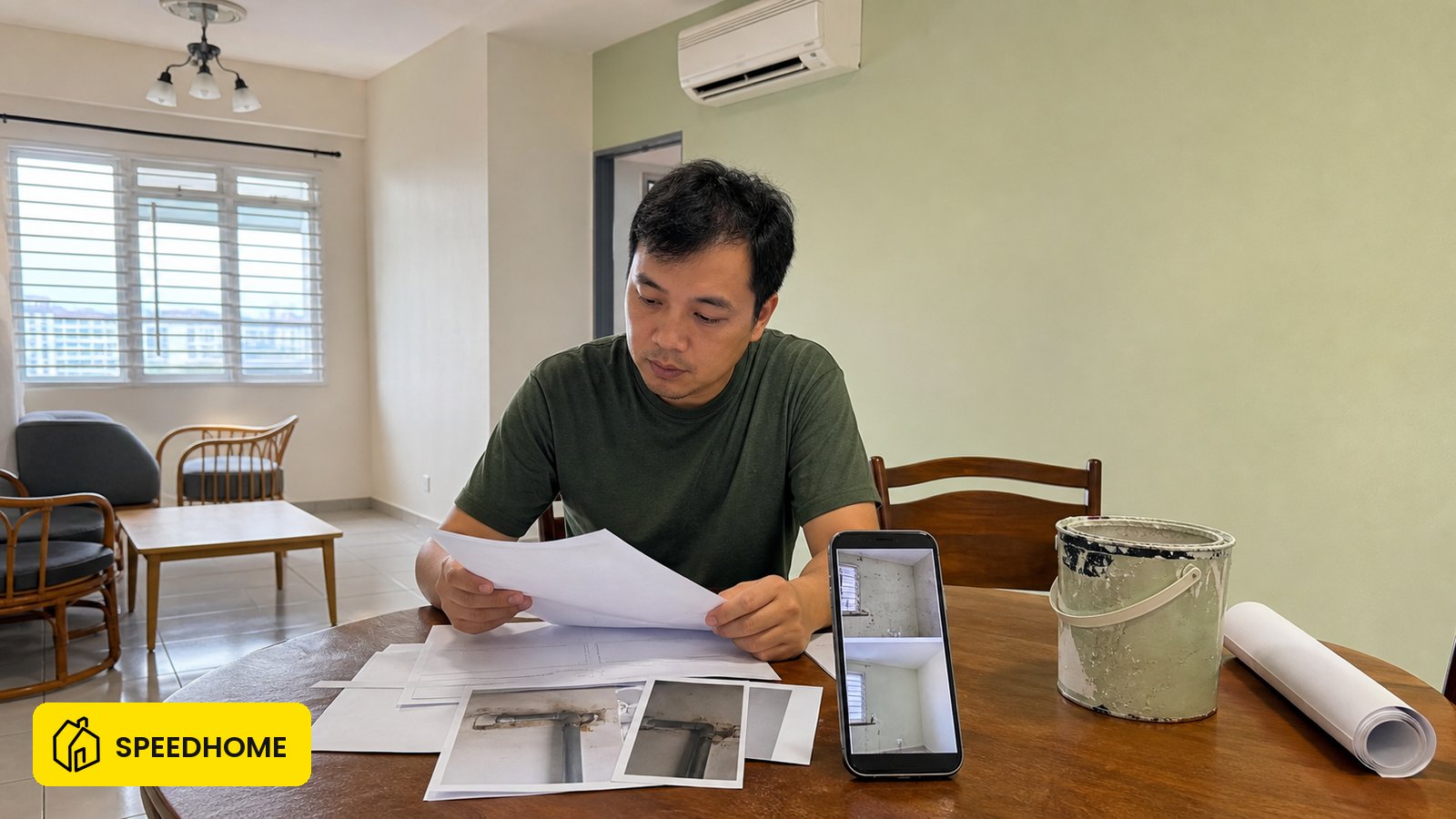
Are repainting and repair costs tax deductible from rental income?
Yes, if the repainting or repair restores the rental property to its existing condition. Under LHDN Public Ruling No. 12/2018, ordinary residential letting under Section 4(d) can deduct direct expenses wholly and exclusively incurred to produce rental income. Upgrades, capital improvements, and first-tenant preparation costs are not deductible.
The line is not "did the landlord pay?" or "was the invoice expensive?" The line is why the work was done. Fixing a leaking pipe after a tenancy is usually a repair. Repainting a wall back to the original colour after tenant damage can be a repair. Repainting the whole unit in a new colour before the first tenant moves in is an initial or capital cost, not a rental-income deduction.
SPEEDHOME has managed 30,000+ tenancy agreements across Malaysia, and the practical pattern is simple: landlords who keep stamped tenancy records, rent records, invoices, and move-in or move-out condition photos have a much cleaner tax file than landlords who try to reconstruct everything from bank transfers at year end.
What LHDN rule decides whether the cost is deductible?
For ordinary residential letting, LHDN treats rental income as Section 4(d) investment income unless the landlord provides comprehensive and active services. Under Section 4(d), repair and repainting costs are deductible only when they are direct costs incurred to produce rental income and keep the property in its existing state.
Most Malaysian landlords are in the Section 4(d) bucket: one or a few residential units, long-term tenancy, no hotel-style services, and no active serviced-accommodation operation. LHDN Public Ruling No. 12/2018 allows direct expenses such as assessment and quit rent, loan interest, fire insurance, rent collection or enforcement costs, renewal or subsequent-tenant costs, and repairs to maintain the property in its existing state.
Section 4(a) is different. It applies only when rental is run more like an active business with comprehensive maintenance and support services. That classification can affect deductions and capital allowances, but it is not the default just because a landlord owns more than one property.
| Rental model | Usual tax source | Repainting or repair treatment | What does not fit |
|---|---|---|---|
| Long-term passive residential letting | Section 4(d) | Deductible when it restores the property to its existing state and relates to rental income | First-tenant setup, upgrades, renovation, capital improvement |
| Active serviced or short-stay letting with comprehensive support | Section 4(a), if facts support it | May be deductible as business expense; capital allowance analysis may also matter | Do not assume business treatment without tax-agent review |
| First-time letting after purchase or renovation | Initial source creation | Not deductible against rental income under PR 12/2018 initial-expense treatment | Advertising, first tenancy legal cost, first stamp duty, first agent commission |
If you need the broader framework before deciding on one invoice, start with the Malaysia rental income tax guide for landlords. For the narrower repair test, the companion guide on repairs tax deductible in Malaysia breaks down common examples.
How do you classify a repainting or repair invoice?
Classify each invoice by purpose: restore, replace like-for-like, improve, or prepare the first letting. Restore and like-for-like repair can be deductible. Improvement and first-letting preparation are not current-year rental deductions.
The fastest safe method is to write one short reason beside every invoice before giving it to your tax agent. "Repair leaking pipe reported by tenant on 4 March" is stronger than "plumbing works." "Repaint bedroom wall to original colour after move-out inspection" is stronger than "painting."
| Invoice type | Likely tax treatment under Section 4(d) | Evidence to keep |
|---|---|---|
| Leaking pipe fixed during tenancy | Deductible repair | Tenant message, contractor invoice, photo of leak, payment record |
| Broken water heater replaced with same-spec unit | Deductible ordinary repair | Fault report, invoice showing like-for-like replacement, warranty card |
| Repaint wall back to original colour after tenant damage | Deductible repair, if supported | Move-in photo, move-out photo, contractor invoice, condition report |
| Repaint whole unit in a new colour before listing | Not deductible as repair | Keep in property file, but do not treat as current repair deduction |
| Add partition, new bathroom, built-in cabinet, or premium finish | Capital improvement, not ordinary repair | Contractor scope split between repair and improvement if mixed |
| First-tenant advertising, first tenancy legal fee, first stamp duty, first agent commission | Initial expense, not deductible against rental income | Keep records, but do not claim as direct rental expense |
Mixed invoices need discipline. If a contractor fixes a leaking pipe and also expands the bathroom, ask for the invoice to split the repair portion from the upgrade portion. Without a split, the safer tax position is harder to defend.
What records make the deduction defensible?
The strongest file connects four things: the rental unit, the defect, the repair work, and the payment. LHDN does not just need a receipt; it needs enough context to see that the cost was wholly and exclusively incurred to produce rental income.
A repair invoice is strongest when it sits beside the tenancy agreement, stamped where applicable, condition photos, tenant messages, and bank payment record. That is why platform records matter. A managed rental file does not change the tax rule, but it reduces the chance that a legitimate deduction fails because the paper trail is scattered.
Keep these records by property and by assessment year:
| Record | Why it matters |
|---|---|
| Contractor invoice or receipt under the landlord's name | Proves the cost and scope |
| Before and after photos with dates | Shows whether the work restored or improved the property |
| Tenant complaint, inspection report, or move-out record | Links the work to the rental activity |
| Tenancy agreement and rental period | Shows the unit was producing rental income |
| Bank transfer or payment proof | Supports the amount actually paid |
| Separate quote lines for repair vs improvement | Lets a tax agent allocate mixed work safely |
For a full deduction map beyond repairs, use the landlord tax deductions guide. If the question is whether the same invoice is repair or capital allowance territory, read capital allowance vs repair for Malaysian landlords.
What changes for non-resident landlords?
A non-resident individual landlord is taxed at a flat 30% on net Malaysian rental income from Year of Assessment 2020. The key word is net: allowable rental expenses remain deductible, and the 30% applies after deductions, not to gross rent.
Non-residents do not get personal reliefs, rebates, or resident graduated rates. But that does not mean every ringgit of gross rent is taxed without deduction. If a repainting or repair cost qualifies under the rental-expense rules, it reduces the rental income base before the 30% rate applies.
| Item | Example |
|---|---|
| Gross annual rent | RM24,000 |
| Deductible repainting to original colour after tenancy | RM2,800 |
| Deductible pipe repair | RM650 |
| Deductible same-spec air-conditioner replacement | RM1,500 |
| Other direct deductible rental expenses | Interest, assessment, quit rent, fire insurance, qualifying renewal or collection costs |
| Tax base for a non-resident individual | Net rental income after allowable deductions |
Do not stretch this into a resident relief claim. The approved position is narrow: allowable rental expenses reduce net rental income, but non-residents do not get personal reliefs or resident tax bands.
Where does SPEEDHOME fit in this workflow?
SPEEDHOME does not change LHDN's deduction rules. It helps landlords keep the practical evidence together: tenancy agreements, rental records, renewal history, condition reports, and repair context, so tax filing is based on records instead of memory.
The conversion point is record discipline. Many landlords lose safe deductions not because the law is hostile, but because the invoice does not explain the rental link. A managed file gives the tax agent a cleaner trail: what unit, what tenancy, what defect, what invoice, and which year.
Use SPEEDHOME for landlords if you want the tenancy workflow, tenant screening, rent records, and condition evidence kept in one place. For tax filing, still give the final numbers to a qualified tax agent; tax treatment depends on your complete facts.
Residential rent itself is outside the scope of service tax, so a normal residential landlord does not charge SST on rent. Service tax applies to commercial and certain non-residential rental or leasing services, at 6% from 1 January 2026, once the provider exceeds the RM1.5 million taxable-turnover registration threshold. Do not import commercial SST assumptions into a normal residential tenancy.
FAQ
Can I deduct a full repaint after every tenancy?
Yes, if the repaint restores the unit to the colour and condition before the tenancy. Keep move-in photos, move-out photos, the contractor invoice, and the reason for the repaint. A new colour or upgraded finish is not the same thing.
Can I deduct repair costs before the first tenant moves in?
No, not if the cost is part of getting the first tenant or creating the rental source. LHDN PR 12/2018 treats first-tenant advertising, first rental legal cost, first tenancy stamp duty, and first agent commission as initial expenses, not deductible rental expenses.
What if one contractor invoice mixes repair and renovation?
Split it. The repair portion can be analysed as a possible deduction; the renovation or improvement portion should not be treated as an ordinary repair. Ask the contractor for separate line items before the job starts where possible.
Can a non-resident landlord still deduct repainting and repair costs?
Yes, if the cost qualifies under the rental-expense rules. A non-resident individual landlord is taxed at 30% on net Malaysian rental income, so allowable expenses reduce the base before the rate is applied.
Is repainting deductible if I do it myself?
Materials may be easier to support than your own labour. Keep receipts for paint and supplies, photos of the condition, and the reason for the work. A contractor invoice is usually easier to defend than an unsupported self-estimate.
Does SST on rent affect repair deductibility?
For ordinary residential letting, rent is outside the scope of service tax. The repair deduction question is separate: classify the cost under LHDN PR 12/2018 and keep the supporting records.