
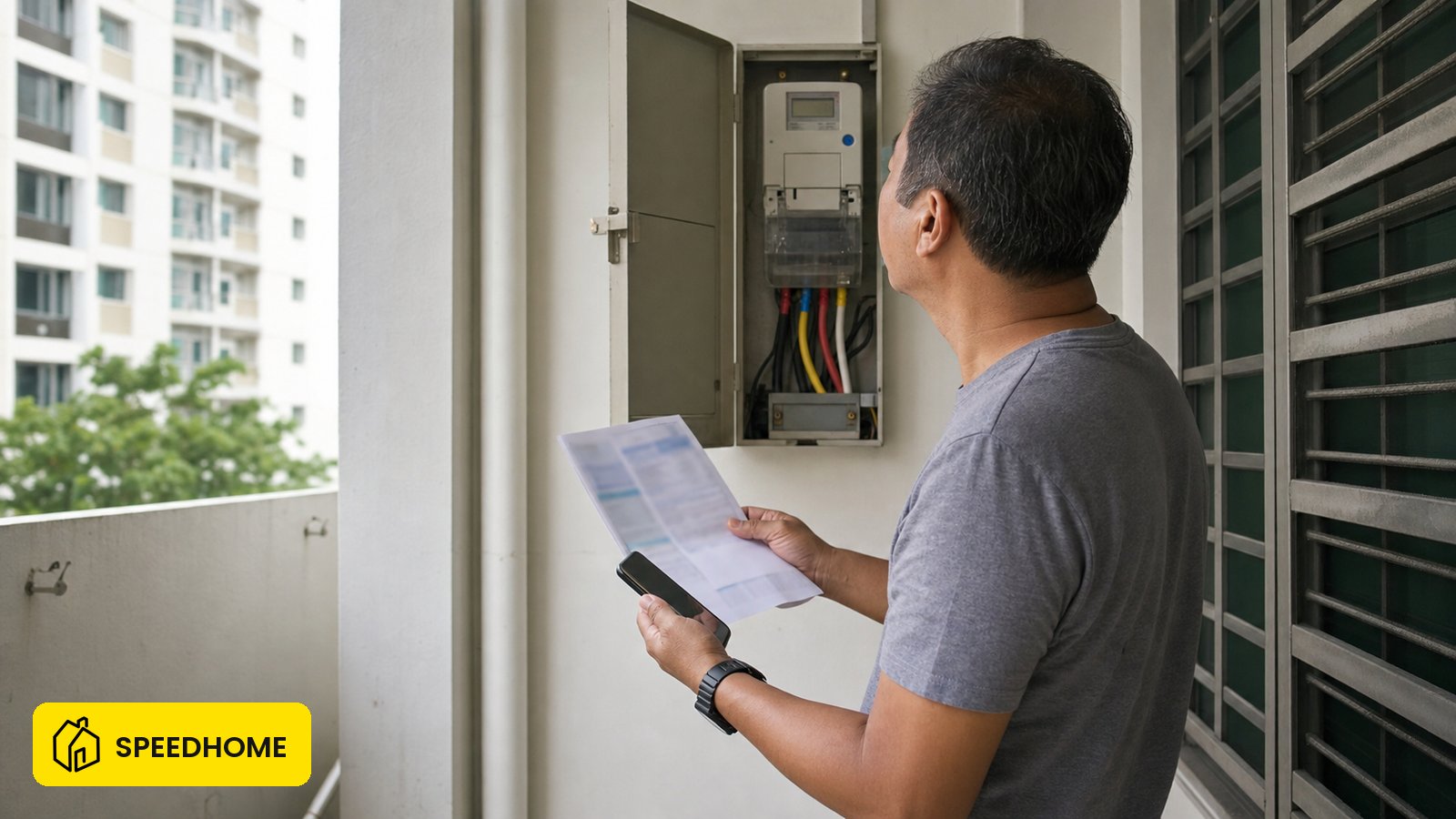
Who does TNB actually bill — the owner or the tenant?
TNB bills whoever is the Registered User on the electricity supply contract — not the property owner, not the tenancy agreement, and not the title deed. A "tenant pays electricity" clause in a tenancy agreement does not bind TNB (TNB was never a party to that agreement); it only gives you a right to sue the tenant if they default. If the account stays in the owner's name, the owner is fully liable to TNB regardless of what the TA says.
This is the single rule that explains almost every electricity dispute between Malaysian landlords and tenants. Before diving into tariff bands and bill calculations, fix this in your mind: name on the supply contract = the person TNB pursues. Everything else — tariffs, ICPT surcharges, room rates — builds on top of that foundation.
SPEEDHOME processes tens of thousands of tenancy agreements across Malaysia, and the most common utility dispute at move-out is not a disputed final-bill amount. It is that the account was never properly transferred to the tenant's name before move-in, leaving the landlord liable for months of usage they did not consume. A documented TNB Change of Tenancy on possession day is the fix — and the tariff understanding below helps both sides verify the bill is correct.
How does TNB's domestic electricity tariff work in Malaysia?
Since 1 July 2025, TNB bills domestic (Tariff D) supply using a component-based RP4 structure — a Generation Charge, Capacity Charge, Network Charge, and Retail Charge — which replaced the old tiered block rate. The Generation Charge still steps up once usage passes 1,500 kWh/month (27.03 sen/kWh below that, 37.03 sen/kWh above), so heavier users still pay more on the incremental kWh.
Before RP4 (pre-1 July 2025), the domestic tariff was a progressive "step rate" — higher bands applied only to usage above each threshold, not the whole bill. Under RP4, the Generation Charge works the same way (27.03 sen/kWh up to 1,500 kWh, 37.03 sen/kWh above), plus the flat Capacity Charge (4.55 sen/kWh) and Network Charge (12.85 sen/kWh) on every unit, and a fixed monthly Retail Charge (waived under 600 kWh/month).
The exact rates per kWh and the threshold for each block are published by TNB and are subject to revision by the Energy Commission (Suruhanjaya Tenaga). Always verify the current rate table directly on the TNB website or myTNB portal before budgeting or disputing a bill — the figures change with tariff reviews and any ICPT surcharge adjustment.
| RP4 component | Rate (domestic Tariff D, from 1 July 2025) | How it scales |
|---|---|---|
| Generation Charge | 27.03 sen/kWh up to 1,500 kWh/month; 37.03 sen/kWh on the units above 1,500 kWh | Steps up once usage passes 1,500 kWh — heavier users pay more on the incremental kWh only |
| Capacity Charge | 4.55 sen/kWh | Flat, on every unit consumed |
| Network Charge | 12.85 sen/kWh | Flat, on every unit consumed |
| Retail Charge | Fixed monthly charge | Waived when usage is below 600 kWh/month |
The exact figures above come from the RP4 tariff restructure effective 1 July 2025 and are subject to revision by the Energy Commission (Suruhanjaya Tenaga), including ICPT adjustments. Always verify the current tariff schedule on tnb.com.my or myTNB before quoting any figure to a tenant or landlord.
Worked examples: what a month of electricity costs
| Monthly usage | Typical profile | Applicable rate components | Calculation structure |
|---|---|---|---|
| 300 kWh | Studio / room, fan + light AC | 27.03 + 4.55 + 12.85 sen/kWh | 300 kWh × 44.43 sen/kWh (Retail Charge waived) |
| 600 kWh | 2-bedroom flat, moderate AC | 27.03 + 4.55 + 12.85 sen/kWh + Retail Charge | 600 kWh × 44.43 sen/kWh + monthly Retail Charge |
| 1,000 kWh | 3-bedroom condo, daily AC | 27.03 + 4.55 + 12.85 sen/kWh + Retail Charge | 1,000 kWh × 44.43 sen/kWh + monthly Retail Charge |
| 2,000 kWh | Large unit, multiple AC units | Generation steps up above 1,500 kWh + Capacity + Network + Retail | (1,500 × 27.03 + 500 × 37.03) + (2,000 × 17.40) + monthly Retail Charge |
(44.43 sen/kWh = Generation 27.03 + Capacity 4.55 + Network 12.85 for usage within the 1,500 kWh threshold.) These examples show the practical shape of the RP4 tariff: below 1,500 kWh the per-unit rate is effectively flat, and the bill scales roughly linearly with consumption; past 1,500 kWh the higher Generation rate kicks in on the excess units only.
What is the ICPT surcharge (Imbalance Cost Pass-Through)?
The ICPT is a cost-pass-through mechanism that adds or subtracts a surcharge from your bill every six months, reflecting whether fuel and generation costs were above or below the baseline assumption used to set the standard tariff. When fuel costs spike, you pay an ICPT surcharge; when they fall, you may receive a rebate.
The Energy Commission reassesses the ICPT twice yearly (January and July cycles). It is displayed as a separate line item on your TNB bill. For renters and landlords budgeting electricity, treat the ICPT as a variable band of ±a few sen per kWh on top of the published RP4 tariff rate — it is small relative to base tariff but material for high-usage units.
A landlord who sets a fixed room electricity rate without accounting for possible ICPT surcharge increases can find themselves out of pocket in a surcharge period. The safer approach is to pass through actual kWh consumed at the TNB meter rate, not a fixed per-room amount.
Is there a Service Tax on electricity bills?
Residential electricity bills do not attract Service Tax (SST). SST applies to commercial and certain non-residential supplies. A normal residential landlord renting out a home, condo, or room does not need to add SST on top of the TNB bill they pass through to tenants.
If your unit is used for short-term commercial purposes or registered under a commercial tariff, different rules apply — confirm with TNB and RMCD.
How is a TNB electricity bill actually calculated?
A standard TNB domestic bill has four main components: (1) the energy charge (kWh consumed × the applicable RP4 rate components — Generation, Capacity, and Network Charge), (2) the minimum charge if usage falls below a minimum, (3) any ICPT surcharge or rebate for the billing period, and (4) fixed fees such as the meter-rental charge where applicable. The total is the sum of these four, before any late-payment penalty.
Step-by-step: reading a domestic TNB bill
- Find the meter readings. Your bill shows a "present reading" and a "previous reading." The difference is your kWh consumed for that billing period (usually one month).
- Apply the RP4 rate components. Multiply your kWh by the Generation Charge (steps up above 1,500 kWh/month), then add the flat Capacity and Network Charges and the Retail Charge. TNB's billing system does this automatically; you are checking whether the total looks consistent with your usage.
- Add or subtract ICPT. The ICPT line shows whether a surcharge (positive) or rebate (negative) applies for this period.
- Check for a minimum charge. Very low-usage months may still attract a minimum charge — TNB's fee schedule states this.
- Add any late-payment charges. Late-payment charges (check current TNB terms) apply to overdue bills. This accumulates quickly on large outstanding balances.
If the bill looks wrong, the first step is always to photograph the physical meter and compare it against the previous reading on file. A sudden spike is often explained by estimated readings being corrected, a tenant's high-consumption appliance (air conditioning 24/7, water heater, server rack), or — in worst-case scenarios — tampered or bypassed meters.
| Bill component | What drives it | Who is liable to TNB |
|---|---|---|
| Energy charge | kWh consumed × current RP4 rate components | Registered User on supply contract |
| ICPT surcharge / rebate | Energy Commission 6-monthly review | Registered User on supply contract |
| Minimum charge | Low usage months | Registered User on supply contract |
| Late-payment charge | Overdue outstanding balance | Registered User on supply contract |
| Reconnection fee | Disconnected supply restored | Registered User on supply contract |
The liability column never changes. Even if your tenancy agreement says the tenant pays, TNB's legal claim is against the Registered User. Under the Electricity Supply Act 1990, TNB is entitled to disconnect for non-payment and to pursue the registered account holder civilly for any outstanding debt.
On catastrophic bills: the Federal Court in TNB v Chew Thai Kay [2022] 2 MLJ 25 held that where TNB rectifies a tampered meter, it cannot use disconnection as a continuing lever to force payment — it must pursue the debt through civil proceedings. The debt itself remains with the Registered User; the ruling limits TNB's enforcement method, not the underlying liability.
How should a landlord set a fair room electricity rate?
A landlord charging room tenants for electricity should pass through the actual kWh rate on the TNB bill, not a flat markup. The fairest method is a sub-meter per room (or per unit) so each tenant pays for their own consumption at the TNB rate. A flat bundled amount is simpler but exposes the landlord to loss when ICPT surcharges rise or tenants use more than estimated.
Option 1: Individual sub-meters
A sub-meter measures consumption per room or per unit. The landlord reads the sub-meter monthly, multiplies by the blended average rate from the TNB bill (total bill ÷ total kWh), and charges each tenant accordingly. This is the most defensible method because it is tied to actual TNB readings. For the full mechanics on splitting bills fairly across rooms, see how landlords split utility bills fairly between room tenants.
Option 2: Flat monthly amount
A fixed RM-per-month electricity component bundled into rent is common for rooms and small units. The risk is that it does not track ICPT changes or seasonal usage spikes. If you use a flat amount:
- Set it based on the actual average kWh for that room over 3–6 months, not a guess.
- Review it annually or when ICPT surcharges change materially.
- State it clearly in the tenancy agreement as a "utilities contribution" — not as an inflated rent disguising a utility markup.
- Never charge a markup above the actual TNB rate. Profiting on electricity resale without an electricity distribution licence is a legal risk under the Electricity Supply Act 1990.
Option 3: Landlord pays, tenant reimburses
The landlord pays TNB and the tenant reimburses based on the bill. Clean and transparent, but requires the landlord to chase each month. Works best when the account is in the tenant's name (Change of Tenancy done) — then the tenant pays TNB directly and there is no reimbursement loop.
| Method | Fairness | Admin load | Risk to landlord |
|---|---|---|---|
| Sub-meter per room | Highest — pays for actual use | Monthly reading required | Lowest — actual TNB rate passed through |
| Flat monthly amount | Medium — works if set correctly | Lowest — set and forget | Medium — exposed to ICPT surcharges and usage spikes |
| COT to tenant name | Highest — tenant deals with TNB directly | Lowest for landlord post-COT | Lowest — landlord off the TNB hook |
How should a renter budget for electricity in Malaysia?
A Malaysian renter's electricity cost depends on three things: the size of the unit, how much you use air conditioning, and whether you are billed at the TNB rate directly (account in your name) or charged a bundled amount by the landlord. Monthly electricity costs vary based on usage patterns and appliance efficiency — verify past meter history directly on the myTNB portal before setting a monthly budget.
The single biggest variable is air conditioning. A 1-horsepower split-unit running 8 hours a day adds roughly 12–15 kWh per day (verify with the unit's EEF rating). Under the current RP4 tariff, continuous heavy AC use across multiple rooms will push total monthly consumption into higher generation charge blocks.
Practical steps for renters before signing
- Ask to see the last 3 months of TNB bills for the unit. This shows the actual usage history, not an estimate.
- Confirm whose name the account is in. If it is in the owner's name, do a Change of Tenancy before or on move-in.
- Photograph the meter on move-in day. This is your baseline reading — it protects you from being charged for the previous tenant's usage.
- Clarify in the TA how electricity is billed. Is it at the TNB rate? Is it a flat amount? Is it included in rent? Get the method in writing.
- Check the ICPT status. If an ICPT surcharge is in effect, your bills will be higher than the base tariff — factor this into your budget.
What happens if a tenant runs off leaving a large TNB bill?
If the account is in the tenant's name, TNB pursues the tenant's NRIC — the landlord is not liable. If the account stayed in the owner's name (no Change of Tenancy was done), the owner is fully liable for the full outstanding amount, regardless of the tenancy agreement's electricity clause.
For a detailed walkthrough of liability by scenario — including what to do when the account stayed in your name and the tenant has vanished — see TNB account in owner name when tenant runs off with unpaid bills.
The escalation path when things go wrong:
- Kedai Tenaga supervisor — if TNB counter staff apply the wrong policy (e.g. insisting you pay a previous owner's arrears when they should not)
- TNB Careline 1-300-88-5454 — for case reference and escalation
- myTNB portal — to bypass counter queues and log disputes online
- Energy Commission (Suruhanjaya Tenaga) — regulatory complaint for unresolved billing disputes
- TTPM tribunal (Tribunal Tuntutan Pengguna Malaysia) — consumer dispute resolution for eligible utility service billing disputes
- Magistrates' Court Small Claims — civil debt recovery track for self-represented claims without a lawyer
Documented utility arrears cases demonstrate how quickly unpaid electricity balances accumulate when no Change of Tenancy was completed and the account remained in the landlord's name across tenancies. Always complete the Change of Tenancy at move-in.
How do landlords eliminate TNB arrears risk effectively?
The single most effective protection is requiring a Change of Tenancy into the tenant's name on possession day before handing over keys.
Once the account is registered to the tenant's NRIC, TNB's supply contract is with the tenant directly. A landlord who maintains utility verification in their move-in checklist avoids inheriting months of unmonitored electricity debt. For managing multiple properties, establish a standard move-in handover procedure requiring proof of account registration before key handover.
FAQ
Does a "tenant pays electricity" clause in the TA protect a landlord from TNB?
No. A tenancy agreement clause binds the tenant to the landlord — TNB was never a party to that contract and cannot be bound by it. If the electricity account is still in the landlord's name, TNB will chase the landlord for any unpaid balance. The clause only gives the landlord a right to sue the tenant in the Magistrates' Court or Sessions Court to recover what they paid.
What is Tariff D and who qualifies for it?
Tariff D is TNB's domestic (residential) electricity tariff category. It applies to premises used as private residences — houses, condos, apartments, rooms, and small studios. Since 1 July 2025, Tariff D is billed using TNB's RP4 component structure (Generation, Capacity, Network, and Retail Charges) rather than the old tiered block rate. Commercial and industrial premises use different tariff categories.
Can a landlord charge more than the TNB rate for electricity?
A landlord should not profit from electricity resale above the actual TNB cost. Charging a markup above the TNB rate without an electricity distribution licence creates exposure under the Electricity Supply Act 1990. The safe and standard practice is to pass through actual kWh consumed at the blended TNB rate from the bill.
What is the ICPT and does it appear on my bill?
ICPT stands for Imbalance Cost Pass-Through. It is a mechanism that adjusts your electricity tariff every six months to reflect whether TNB's fuel and generation costs were above or below the baseline used to set the standard rate. When costs exceed the baseline, a positive ICPT surcharge appears on your bill; when they fall below, a rebate reduces your bill. It appears as a separate line item; the Energy Commission reassesses it each January and July.
How do I check if my TNB bill is correct?
Read your current and previous meter readings from the bill — the difference is your kWh consumed. Multiply by the published RP4 rate components to verify the energy charge. Then check for any ICPT line and the minimum charge. If the reading looks wrong, photograph your physical meter immediately and call TNB Careline (1-300-88-5454) or log a dispute on the myTNB portal. Verify current figures directly with TNB, as tariff rates and ICPT amounts change periodically.
What happens to a TNB debt after a property is auctioned or foreclosed?
TNB's claim follows the Registered User, not the property title. A foreclosure buyer generally does not inherit the previous owner's TNB arrears — they start fresh with their own account. However, in strata and condo properties, the management office may have outstanding charges connected to access or common-area utilities that are linked to the unit. For the full foreclosure and auction scenario, see TNB electricity and foreclosure auction property Malaysia.
How long before TNB disconnects for non-payment?
TNB can disconnect a supply for non-payment under the Electricity Supply Act 1990 after giving notice. The typical timeline is approximately two months of outstanding bills before disconnection action begins, but verify current TNB policy directly — timelines can vary. Under TNB v Chew Thai Kay [2022] 2 MLJ 25 (Federal Court), TNB cannot use threatened disconnection as ongoing leverage to force payment of a tampered-meter debt — it must sue civilly. The debt itself remains with the Registered User.
For the complete guide, see Who Pays What in a Malaysian Tenancy — Complete 2026 Guide.