
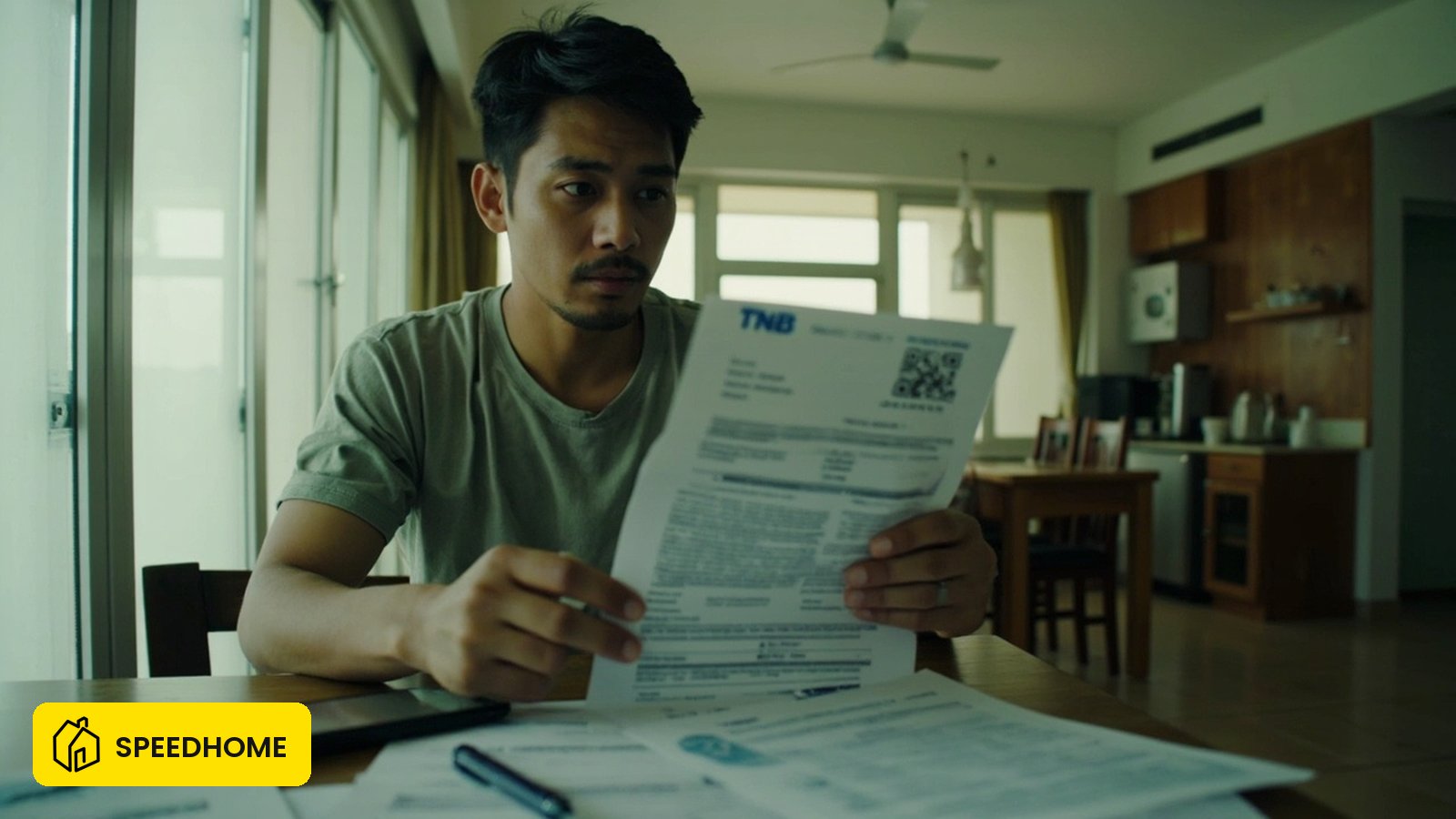
TNB account is in my name — if the tenant runs off with unpaid bills, who pays?
Your liability to TNB depends entirely on one thing: whose name is on the supply contract. TNB bills the registered account holder, never the property title and never whoever physically used the electricity. If the account stayed in your name when the tenant moved in, you owe TNB the full arrears — even if a clause in the tenancy agreement says the tenant pays electricity. That clause only lets you sue the tenant; it does not bind TNB, which was never a party to your tenancy agreement.
Read the TNB Change of Tenancy guide to understand the full account-transfer process. This page focuses on the three liability scenarios landlords face when a tenant absconds with an unpaid TNB balance.
The one rule that governs all three scenarios
TNB bills the Registered User named on the supply contract — full stop. This flows from the Electricity Supply Act 1990 and TNB's published Landlord-Tenant Booklet. The Registered User is TNB's legal customer: the entity TNB can bill, disconnect for non-payment, and pursue for outstanding arrears.
A tenancy agreement clause that says "tenant is responsible for utility bills" is enforceable between you and the tenant — but it creates zero obligation on TNB. The practical effect: whoever is the Registered User when the bills go unpaid is the person TNB chases. Identifying which scenario applies to your unit is the first step in deciding what you owe TNB and what you can recover from your former tenant.
CASE 1 — Account in the tenant's name: landlord is NOT liable
If the account was properly transferred into the tenant's NRIC name before they moved in, you have no liability to TNB. TNB will pursue the tenant directly using their NRIC details. The security deposit the tenant paid TNB when they registered the account will offset part of the arrears.
| Step | Who does it | What happens |
|---|---|---|
| 1. Tenant absconds | Tenant (departed) | Account arrears build; TNB will chase the registered NRIC holder |
| 2. TNB bills the tenant | TNB | TNB applies the tenant's deposit against the balance; chases the tenant for any shortfall |
| 3. New tenancy | Landlord + new tenant | New tenant applies for a fresh TNB account — a clean start, no inherited debt |
| 4. Supply continuity | New tenant | New account is registered in the new tenant's name before or on handover day |
Your only action is to provide the new tenant with a clean handover: a current meter reading, the address, and confirmation that the old account has been closed or is being processed. You are not responsible for chasing the runaway tenant on TNB's behalf — that is TNB's civil debt recovery matter.
CASE 2 — Account stayed in the owner's name, no Change of Tenancy: landlord is 100% liable
If you never completed a Change of Tenancy and the account remained registered to you throughout the tenancy, you are the Registered User and you owe TNB every sen of the outstanding arrears. This is the most damaging scenario for landlords, and unfortunately one of the most common.
The "tenant pays electricity" clause in your tenancy agreement does not shift TNB's legal claim to the tenant. It only establishes an internal obligation between you and your former tenant — one you can enforce civilly after you have cleared the debt with TNB.
| Immediate action | Why |
|---|---|
| Settle the full arrears with TNB | Arrears in your name damage your credit standing and TNB may disconnect supply, affecting the next tenancy |
| Request an itemised statement from TNB | Establishes the exact debt; needed for any civil claim against the tenant |
| Re-register the account or transfer to the new tenant | Prevents the same problem recurring; see the Change of Tenancy guide |
| File a civil claim against the former tenant | Recover what you paid under the tenancy agreement's utility clause; amounts ≤RM5,000 use the Magistrates' Court small-claims track |
Recovery route: if the outstanding amount is RM5,000 or less, the Magistrates' Court simplified small-claims procedure (no formal pleadings, no need for a lawyer) is the practical route. Keep every TNB receipt, your tenancy agreement, and any meter-reading photos as evidence.
CASE 3 — Arrears exceed the deposit and the tenant has vanished
When the unpaid TNB balance is larger than whatever deposit you hold and the tenant cannot be found, you face a gap between what the deposit covers and what you actually owe TNB. This scenario often occurs when a tenant has been absent for several billing cycles without anyone noticing.
| Situation | Account registered to | Your exposure | First action |
|---|---|---|---|
| Arrears > deposit, tenant in name | Tenant (departed) | Nil to TNB; gap is TNB's recovery problem against tenant's NRIC | Verify account name at Kedai Tenaga; arrange new account for next tenant |
| Arrears > deposit, owner in name | Owner (you) | 100% of arrears | Settle TNB immediately; lodge police report documenting the tenant's disappearance; file small-claims for recovery ≤RM5,000 |
If the account is in your name and the tenant is unreachable, a police report serves two purposes: it creates an official record of the tenancy and the tenant's departure, and it can support any subsequent civil or small-claims action. It does not itself shift TNB's claim away from you — only clearing the arrears and re-registering the account does that.
For the next tenant, their fresh application to TNB creates a brand-new supply contract. Arrears on the previous account do not automatically attach to a new occupant unless they assume the same account registration.
Why you can still get stuck even when the account was in the tenant's name
Even in CASE 1 above — account properly transferred to the tenant, TNB pursuing the tenant's NRIC, no debt in your name — you can still get stuck if the property address itself gets flagged. TNB's arrears block applies to the property address, not only to the individual account holder. If your absconding tenant's unpaid balance causes TNB to flag the address, a new tenant who applies for a fresh account at that same address will hit the same address-level block, and a routine Change of Tenancy does not clear it. The address-level arrears have to be settled with TNB first before a clean new account can be opened there — which in practice means you, as the owner, end up dealing with the old balance to get the unit re-supplied, even though the account itself was never in your name.
This is a different problem from CASE 2's landlord liability: it is not TNB billing you as the Registered User, it is TNB refusing a new connection at that address until the arrears clear. Ask Kedai Tenaga to check the address status, not just the account name, before you hand the unit to a new tenant — a clean account-name check is not the same as a clean address check.
Escalation ladder when TNB staff apply the wrong policy
If a Kedai Tenaga counter officer applies incorrect policy — for example, incorrectly insisting the landlord must pay arrears already registered to a departed tenant — escalate in this order:
- Kedai Tenaga branch supervisor — ask for the supervisor on the day; most policy errors are resolved here.
- TNB Careline 1-300-88-5454 — national customer service line (verify the current number with TNB before calling, as contact details may change).
- myTNB portal complaint form — submit in writing so you have a record of the date, issue, and TNB's response.
- Energy Commission (Suruhanjaya Tenaga) — the regulator; accepts formal complaints about licensee conduct.
- Tribunal for Consumer Claims (TTPM) — handles consumer disputes; verify current jurisdiction and filing fees at the TTPM portal.
- Magistrates' Court small-claims — for civil money claims ≤RM5,000; covers disputes with the tenant after you have settled with TNB.
Most landlord-TNB disputes resolve at steps 1–3. Document every interaction: date, officer name or call reference, and the response given.
Force-terminating the account at Kedai Tenaga
If a departed tenant registered the account in their name and will not cooperate with a formal Change of Tenancy, you can visit a Kedai Tenaga branch as the property owner and request account closure — but you cannot simply take over the account without the former tenant's cooperation on a standard COT. Bring:
- Your proof of property ownership (title deed or strata title)
- Your NRIC
- Evidence that the tenant is no longer in residence (termination letter, vacant possession letter, or police report)
TNB's internal process for owner-initiated account closure versus standard Change of Tenancy differs by branch; explain the abandonment situation to the supervisor. If the former tenant's deposit offsets the arrears and the account can be closed, TNB will issue a zero-balance confirmation. A new tenant then applies for a fresh account.
For a more detailed walkthrough of the standard transfer process before it reaches this stage, see How to recover an unpaid final TNB bill after a tenant moves out.
Preventing the same problem with the next tenant
| Prevention step | When to do it | Why it matters |
|---|---|---|
| Complete Change of Tenancy into tenant's name | Before or on handover day | Removes you as Registered User; TNB chases tenant's NRIC if they default |
| Record meter reading on handover day (dated photo) | Handover day | Establishes the opening balance you are not responsible for; evidence in any dispute |
| Include a utility-liability clause in the tenancy agreement | At signing | Creates a contractual right to recover utility arrears from the deposit or via civil action |
| Check TNB account name at mid-tenancy renewal | Every renewal | Catches cases where an early COT lapsed or was not completed |
| Monitor for unexplained consumption spikes | Ongoing | Early warning for over-use, subletting, or equipment running against the tenancy agreement — see TNB bill spike and crypto-mining risk |
SPEEDHOME landlord management handles the utility handover checklist, meter-reading documentation, and tenancy agreement utility clauses as part of the managed service — reducing the chance of this situation arising with a future tenant. See how SPEEDHOME landlord management works.
FAQ
Does a "tenant pays electricity" clause in the tenancy agreement protect me from TNB? No. That clause is enforceable between you and the tenant but it does not bind TNB — TNB was never a party to your tenancy agreement. TNB bills the Registered User on the supply contract regardless of what your TA says. The clause gives you the right to recover the amount from the tenant civilly; it does not shift TNB's claim away from you.
If the account is in the tenant's name, do I have to pay their unpaid TNB bill? No. TNB pursues the Registered User on the account — the tenant's NRIC holder. Your only task is to arrange a fresh account registration for the next occupant and ensure your own name is not on the supply contract.
The tenant's deposit doesn't cover the full arrears — what happens to the gap? If the account is in the tenant's name, the gap is TNB's civil recovery matter against the tenant — not your debt. If the account is in your name, the gap is yours to settle with TNB; you can then try to recover it from the former tenant through small-claims court for amounts up to RM5,000.
Can I report the runaway tenant to a credit bureau? Reporting a tenant's conduct to a credit reference agency requires written consent under the terms of the tenancy agreement or at reporting time. Without consent, you risk a PDPA exposure. For utility arrears in the tenant's name, TNB's own debt recovery process runs on the tenant's NRIC — you do not need to file a separate credit report for the TNB debt itself.
Can TNB cut off supply to my unit to force a landlord to pay the tenant's debt? TNB v Chew Thai Kay [2022] 2 MLJ 25 (Federal Court) held that after rectifying a tampered meter, TNB cannot use disconnection as leverage to compel payment — it must pursue the debt civilly. Verify how this ruling applies to your specific situation with a Malaysian solicitor; the debt itself remains recoverable by TNB against the Registered User.
How do I know if the COT was actually completed when my tenant moved in? Visit any Kedai Tenaga branch with your property address or account number and request confirmation of the current Registered User. This check takes minutes and is the only definitive way to confirm your name is no longer on the supply contract.
What if the tenant registered the account but used a fake NRIC? This is a fraud matter. File a police report and report the identity discrepancy to TNB. TNB's ability to pursue the actual individual depends on the accuracy of the NRIC supplied. Your best protection at onboarding is verifying the tenant's NRIC against the original document — SPEEDHOME's screening process does this as part of the managed tenancy.
For TNB foreclosure or auction property electricity questions, where do I go? See the TNB electricity on a foreclosed or auction property guide — arrears attached to strata properties and new supply applications after auction work differently from a standard tenancy change.