
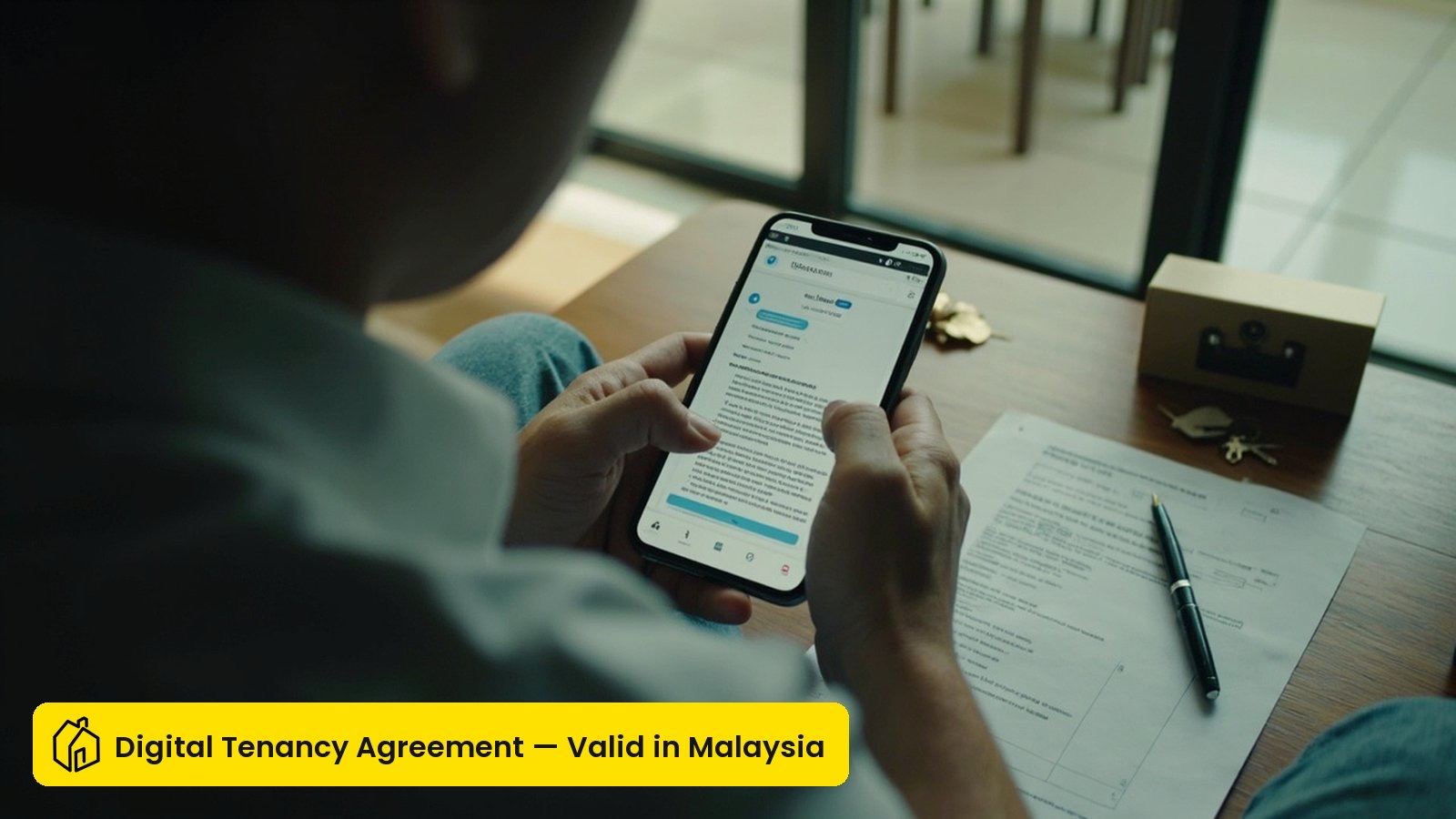
Why Malaysian landlords lose money without a tenancy agreement — and what a 30-minute digital TA actually does
A landlord in Malaysia without a properly signed and stamped tenancy agreement is exposed to rent arrears, end-of-tenancy damage, and a much harder time proving anything in court. The good news: a lawyer-reviewed digital tenancy agreement can be signed and queued for LHDN stamping in roughly 30 minutes — and it is fully admissible as evidence under Malaysian law when the agreement is stamped.
The pattern is the same in every landlord story that goes wrong — collapsed ceilings, broken sofa frames, missing plug points, tenants who leave in the night with the washing machine. The harder part is what comes next: a landlord with no document to point to has almost no leverage, no claim, and no clean way forward. The early protection is what keeps the protection working for the rest of the tenancy.
Paper tenancy agreement vs. digital tenancy agreement — which is safer?
Both formats are legally valid in Malaysia, but a lawyer-reviewed digital tenancy agreement is faster, harder to lose, and harder to dispute later because every signature carries an automatic timestamp. SPEEDHOME internal operator data (2026, most recent measured period) shows that roughly 30% of tenancy applicants are rejected at SPEEDHOME's screening step before any tenancy agreement is signed — and the largest single driver of escalated rental default in SPEEDHOME's managed portfolio is a condition dispute that escalates into non-payment. That is why the screening-plus-lawyer-reviewed-TA pairing does the protective work: the agreement starts clean, the conditions are on the record, and the default-cause data point explains why a written, signed, stamped TA is not paperwork theatre.
| Feature | Paper tenancy agreement (print + sign) | Digital tenancy agreement (e-agreement) |
|---|---|---|
| Time to complete | 1–3 days (draft, print, meet, sign) | ~30 minutes (online, e-signature) |
| Lawyer review | Depends on who you appoint | Included in the platform flow |
| LHDN stamping | Manual trip to LHDN counter or separate e-Duti Setem submission | Handled inside the platform; stamped copy emailed back in ~2 weeks |
| Record keeping | Risk of loss, water damage or fading | Stored digitally; downloadable any time |
| Admissible in court | Yes, if signed correctly and stamped | Yes, when stamped — same evidential weight as a witnessed paper document |
| Cost | Lawyer fees + stamp duty | Platform fee + stamp duty |
A digital tenancy agreement does not remove the requirement to pay LHDN stamp duty — it only removes the trip to the counter.
What does a tenancy agreement actually protect?
A tenancy agreement protects both parties: it gives the landlord written proof of the rent, the damage procedure, and the eviction notice; it gives the tenant protection against arbitrary action. Without it, every dispute — from a withheld deposit to broken furniture — becomes a "he said, she said" problem that is hard to win in court.
A complete tenancy agreement for a Malaysian landlord should cover:
- Monthly rent amount, due date, and accepted payment method
- Deposit amount (a common Malaysian norm is 2 months' rent + half-month utility deposit — confirm against current market for your unit type) and the conditions for deductions
- Tenancy length, renewal terms, and notice period
- Maintenance responsibility split (who pays for what)
- Damage clause and the deposit claim procedure (with move-in inventory)
- Eviction notice procedure and re-letting rules
- Default-reporting clause with the tenant's written consent — so the landlord has lawful recourse if arrears become serious
Is a digital tenancy agreement valid in Malaysian law?
Yes — a digital tenancy agreement is fully valid in Malaysia when it carries an electronic signature and is stamped by LHDN. Established Malaysian electronic-transactions and digital-signature legislation gives electronic signatures the same legal effect as handwritten ones and allows contracts to be formed by electronic means. A stamped digital tenancy agreement is therefore admissible in Malaysian courts on the same footing as a paper agreement signed in person.
For the landlord, the practical question is not "is it legal" but "can I prove it later" — and the stamped, timestamped digital copy is usually easier to produce than the original paper.
Risks Malaysian landlords run without a written tenancy agreement
Without a tenancy agreement, every legal step becomes more expensive, slower, and less certain of outcome. The table below shows the most common scenarios landlords run into:
| Scenario | Without a tenancy agreement | With a stamped tenancy agreement |
|---|---|---|
| Tenant leaves owing rent | No written proof of the arrears; hard to claim in court | The contract is the basis of a Magistrates' Court claim |
| Damage to the property | No basis to deduct from deposit or claim damages | Deposit clause + move-in inventory become the evidence |
| Tenant refuses to leave | Court process is longer and weaker without documents | Written notice + contract speeds up the proceedings |
| Default reporting to a credit reporting agency | Cannot proceed — no consent clause to rely on | A clear consent clause in the TA makes a verified report lawful |
| Utility or maintenance disputes | No record of who was responsible | Utility and maintenance clauses settle the question |
A landlord who wants the option to report a defaulting tenant to a licensed credit reporting agency needs the tenancy agreement to carry the tenant's clear written consent. This is a statutory requirement under the Credit Reporting Agencies Act 2010, not a choice.
How SPEEDHOME protects the landlord's position
SPEEDHOME's tenancy agreement is drafted by a registered Malaysian lawyer, signed electronically by both parties, and queued for LHDN stamping inside the same flow — the whole process takes roughly 30 minutes and the landlord does not need to leave home. SPEEDHOME has managed 30,000+ tenancy agreements across Malaysia, so the document templates and the e-signature flow have been pressure-tested at portfolio scale.
The landlord's path through SPEEDHOME:
- List the unit on SPEEDHOME's landlord service — structured tenant screening runs before any agreement is generated
- Tenancy agreement drafted and reviewed by SPEEDHOME's in-house legal team before signature
- Electronic signature by landlord and tenant — the whole signing flow takes ~30 minutes
- LHDN-stamped copy emailed to both parties in roughly 2 weeks
- Document stored on the platform — downloadable at any time during and after the tenancy
Alongside the tenancy agreement, SPEEDHOME Zero Deposit is a managed rental-risk system — not a financial guarantee product, and not every unit qualifies. Check unit eligibility directly on the platform. For a broader walkthrough of the SPEEDHOME landlord process, see the landlord guide for Malaysia.
For maintenance issues that arise during the tenancy, SPEEDFIX offers a 5-working-day SLA for repair jobs — proper documentation of the issue makes any later deposit claim much cleaner.
Common questions Malaysian landlords ask about digital tenancy agreements
Can a digital tenancy agreement signed online be used in a Malaysian court?
Yes — and what matters more than the format is the evidence you can produce. Bring the stamped PDF, the e-signature audit trail with timestamps, the LHDN stamp certificate, and the move-in inventory. A private residential tenancy dispute is decided in the civil courts, so claims up to RM5,000 can use the Magistrates' small-claims procedure (no lawyer needed) and larger claims go to the Magistrates' or Sessions Court. Keep the original printed TA as well, in case the court wants a hard copy.
How long does it take to sign a digital tenancy agreement?
The information-entry and e-signature flow takes roughly 30 minutes. The LHDN-stamped copy is emailed back to both parties in about 2 weeks.
Can a landlord report a non-paying tenant to a credit reporting agency?
Yes, but only through a licensed credit reporting agency, and only when the tenancy agreement carries the tenant's clear written consent. A lawful report to a licensed credit reporting agency with the tenant's consent is a legitimate step — it is different from publishing the tenant's details on a public page, which has no legal basis.
Who pays the cost of a digital tenancy agreement?
The cost has two parts. The LHDN stamp duty follows the Finance Act 2024 scale of RM1 / RM3 / RM5 / RM7 per RM250 of annual rent by lease duration — that cost falls on the parties as they agree in the tenancy agreement (commonly the tenant, but it is negotiable). The platform or lawyer fee for drafting, signing and queueing the agreement is separate and varies by provider; ask each platform for a written quote before signing.
What needs to be in a tenancy agreement so that the deposit can be deducted for damage?
The agreement must contain a move-in inventory (a written list of the condition of furniture and fittings at handover), a deposit clause that states the claim procedure, and move-in / move-out photo documentation. Without a written move-in inventory, damage claims are very hard to prove.
Can a standard tenancy agreement be used for a single room rental?
Yes. A room-only rental is a separate contract from a whole-unit tenancy. The same principle applies: a written, signed, and LHDN-stamped contract. The same lawful screening standard applies at the room-rental level — assess the applicant on the tenancy-relevant factors (income, employment, prior tenancy reference, identity), not on race, religion or national origin; race-based refusal has no safe-harbour defence in Malaysian tenancy law.