
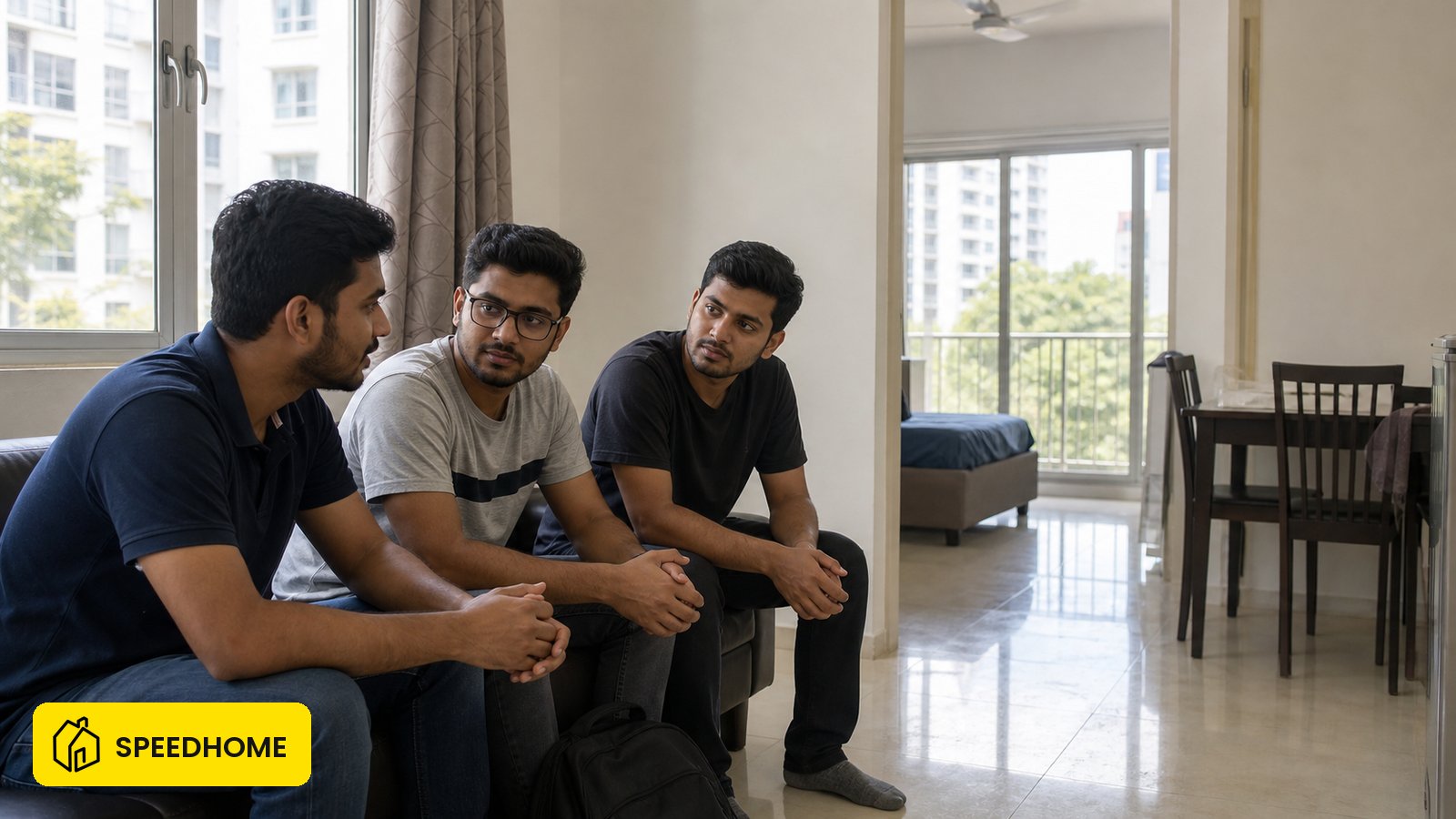
Bangladeshi students in Malaysia rent within commuting distance of their own campus, not in one "Bangladeshi area" — EMGS application data put Bangladesh second among source countries in 2023 with 6,570 applications, up 94% on 2022, behind only China's 26,630. Verify your campus address on your offer letter before choosing where to rent.
S1: Where do Bangladeshi students in Malaysia usually rent?
Bangladeshi students rent within commuting distance of their own campus — not in one "Bangladeshi area". Malaysia's private universities are scattered across the Klang Valley, so your campus address, printed on your offer letter, decides your rental map before any other factor does.
Bangladesh is a major source of students for Malaysia. EMGS application data reported by ICEF Monitor put Bangladesh second among all source countries in 2023, with 6,570 applications — up 94% on 2022, the fastest growth of any country that year, behind only China's 26,630. That volume is why Bangladeshi student housing demand is now concentrated enough to have its own rhythm around certain campuses.
Campus locations, verified. The private universities that come up most often in Bangladesh-facing agent listings sit in five very different places. We checked each campus location against the institution's own website:
| University | Campus location | Rental catchment |
|---|---|---|
| MSU (Management and Science University) | No. 4, Persiaran Olahraga, Section 13, 40000 Shah Alam | Section 13 and wider Shah Alam |
| Lincoln University College | Jalan SS 6/12, 47301 Petaling Jaya | SS6 / Kelana Jaya and PJ |
| IUKL (Infrastructure University Kuala Lumpur) | Unipark Suria, Jalan Ikram-Uniten, 43000 Kajang | Kajang and the Serdang fringe |
| UCSI University | Taman Connaught, Cheras, Kuala Lumpur | Taman Connaught and Cheras |
| APU (Asia Pacific University) | Taman Teknologi Malaysia, Bukit Jalil, 57000 Kuala Lumpur | Bukit Jalil and Technology Park |
Two honest caveats on that table. First, this is not a ranking of where Bangladeshi students actually enrol — Malaysia publishes no data breaking enrolment down by university and nationality, so anyone who tells you "most Bangladeshis go to X" is guessing. Second, IUKL's current website publishes under the name Kuala Lumpur University of Science and Technology (KLUST) while still serving IUKL email and learning systems, so check which name appears on your own offer letter. Verify your campus address on your offer letter, not on a blog.
Do the total-cost maths, not the rent maths. Cheaper areas further out are real, but a unit that saves RM100 a month and adds an hour each way rarely wins. Before committing to a distant unit, add your realistic monthly transport cost to the rent and compare that number — not the asking rent — against a closer unit.
S2: what happens with your EMGS Student Pass, the SEV, and arrival?
Bangladeshi nationals need two separate approvals before flying: the EMGS Visa Approval Letter (VAL), then a Single Entry Visa (SEV) from a Malaysian mission. EMGS lists Bangladesh among the countries requiring an SEV. Your passport must have at least 18 months' validity.
Three things about the EMGS process routinely surprise first-time applicants:
- Your institution applies, not you. EMGS states that the institution submits the student's visa application through the EMGS online system with the documents and processing fees. Chasing EMGS directly when your university hasn't submitted yet achieves nothing.
- The published benchmark is 14 days. EMGS gives 14 days as its processing time, running from a complete submission. It is a benchmark, not a promise, and issuing the VAL is at the Immigration Department's discretion. Treat any agent who guarantees you a date as a warning sign.
- The SEV is a separate step, after the VAL. It happens at a Malaysian embassy or high commission and sits outside the 14-day window. Budget time for it.
Passport validity is the cheapest failure to avoid. EMGS's guidelines state plainly that for a new Student Pass application, "Passport validity duration must be 18 months and above." Renewing a passport in Bangladesh takes time you may not have once an intake date is fixed — check this first, before you pay anything to anyone.
What landlords will ask to see. Expect to show your passport, your EMGS approval or Student Pass, and your offer letter. As of 2026 Malaysia has no general public portal where a landlord can look up a foreign tenant's immigration status — the official systems are applicant-facing. In practice that means the landlord sights your passport and pass in person and notes the expiry date, and you may be asked to open the official EMGS tracker in front of them. This isn't singling you out; it applies to every international tenant. Keep clean digital and printed copies for viewings.
S3: The deposit — and why it lands harder on Bangladeshi students
There is no statutory cap or floor on residential tenancy deposits in Malaysia. Market practice in tenancy agreements is roughly two months' rent as security deposit, plus about half a month's rent as utility deposit, with the first month's rent paid in advance — around 3.5 months' rent before you get a key. These are market conventions, not legal requirements.
Here is the part most guides miss. This structure is not merely more expensive than what you know from home — it is the opposite of what Bangladeshi law provides for. Bangladesh's House Rent Control Act 1991 (বাড়ী ভাড়া নিয়ন্ত্রণ আইন, ১৯৯১; Act No. 3 of 1991), at section 10, says that on letting, renewing or extending a tenancy, a person may not:
- (ক) demand, receive, or ask to be paid any premium, salami, security (জামানত) or any like sum in addition to the rent; or
- (খ) demand or receive, without the Controller's prior approval, any sum exceeding one month's rent as advance rent.
So the letter of Bangladeshi law prohibits the security deposit outright and caps advance rent at a single month. Malaysia has no equivalent prohibition at all — the 2 + 0.5 + 1 convention is simply what the market does, and it is enforceable because the parties agreed it. Whatever the practice you actually experienced in Dhaka or Chattogram, the legal starting point you're arriving from is one where a security deposit isn't contemplated. Malaysia will ask for three and a half months up front. Plan for that number, not for the one your instincts expect.
Protect the deposit you do pay. Photograph every room, appliance, wall and piece of furniture on move-in day, get the landlord or agent to sign off on that condition record, and keep it. Your agreement — not a general rule — governs when and how the deposit comes back and what can be deducted, so read those clauses before signing rather than after.
The Zero Deposit alternative. SPEEDHOME's Zero Deposit is a managed rental-risk system — not a financial guarantee product — that replaces the upfront cash deposit, so tenants move in without tying up cash while landlords stay protected through rental protection instead of holding a deposit. For severe end-of-tenancy damage beyond fair wear and tear, the standard protection claims process applies. You still pass the landlord's screening and still pay your first month's rent. What changes is that months of rent aren't frozen in someone else's account while your taka sits in a currency-control queue.
SPEEDHOME's view: for a Bangladeshi student, the deposit isn't just a big number — it's the one cost you must move across a border, under exchange-control rules, before you've even seen the room.
S4: Sharing a unit — what actually governs it
Sharing with course mates is common and cuts cost, but the limit on how many people may live in a unit comes from your tenancy agreement and the building's house rules, which are the two documents you can actually read before signing.
Don't rely on a verbal side-arrangement between students. Ask the landlord directly how many tenants the unit is let for, then get that number and every occupant's name written into the tenancy agreement. A named agreement protects you if there's later a dispute over damage, noise, or unpaid utilities, and it matters at renewal: a landlord who discovers undisclosed extra occupants generally has grounds to end the tenancy. An overcrowded, undocumented unit can end in a mid-semester eviction that costs far more than the rent it saved. Other South Asian student communities weigh the same trade-off — Pakistani students run the same shared-versus-private maths.
S5: Rental scams and how to protect yourself
Rental fraud is rising, not rare: PDRM recorded rental scam cases rising from 184 in 2023 to 922 in 2025 (a roughly 5x increase over two years). PDRM-recorded rental scam losses totalled approximately RM2.5 million between 2023 and 2025. PDRM's data shows rental fraud recovery below 0.5% of reported cases.
That recovery rate is the number to internalise. Money sent to a rental scammer is, in practice, gone. Prevention is the entire strategy.
The tactics are documented. The Star reported in November 2025 on syndicates targeting foreign students in the Klang Valley — the students described in that reporting were Chinese, not Bangladeshi, but the mechanics are nationality-blind and worth knowing:
- Fraudsters pose as agents using the credentials and photos of real, legitimate negotiators.
- Airbnb apartments are advertised as long-term rentals — the scammer has genuine short-term access to the unit, so a viewing "checks out".
- Accomplices meet the victim instead of the person from the ad, often someone who doesn't share the victim's language, limiting questions.
- Paperwork is falsified using real agencies' names.
- Payment is collected via QR codes linked to wallets named almost identically to a genuine agency — in one case differing only by an ampersand.
Read that list again and notice what it defeats: a viewing, a plausible agent, a professional-looking agreement, and a company-branded payment screen. So the rule cannot be "does it look legitimate".
Verification steps that survive those tactics. The core rule: never transfer anything — deposit, first month, "booking fee" — before you've verified the unit, the person, and the account.
- Check the agent's registration number yourself. Malaysia's property-agent regulator publishes a public register of REA (agent) and REN (negotiator) numbers. Ask for the number and look it up on the official register — then check the registered name matches the person you are actually talking to. Cloned credentials only work if nobody cross-checks the human.
- Insist on a live video walkthrough, not photos or a recording. Ask them to open cupboards, show the unit number at the door, and answer questions about house rules in real time.
- Verify the address independently. Cross-check building name and unit against the agreement, and contact the building's management office directly to confirm the unit exists and is genuinely available for long-term let. This is what catches the Airbnb-as-long-let trick.
- Interrogate the payment destination. Match the account or wallet name character by character against the registered agency or the landlord's own name. A near-match is a red flag, not a typo.
- Read the agreement in full — occupancy, notice periods, deposit treatment — and get anything unclear clarified in writing before signing.
Legitimate landlords and agents do not manufacture urgency around deposits. If you are being rushed, that is the signal.
A growing number of students start on platforms like SPEEDHOME, which verifies every listing and landlord before it goes live and has had zero reported rental scams on the platform since April 2026. That doesn't replace reading the agreement yourself — but it removes the step where you wire months of rent to a stranger's account. For a wider walkthrough, see rental scam prevention for international students.
S6: Paying for it all from Bangladesh — how the money actually leaves
Education money leaves Bangladesh through an Authorized Dealer (AD) bank under a "student file" — not through WorldRemit, Western Union or bKash, which serve remittances into Bangladesh. Bangladesh Bank's FE Circular No. 37 (30 September 2025) sets the rules.
This is the section that changes how you should plan, so it's worth being precise. Under paragraph 29 of that circular:
- Your bank releases foreign exchange "as per estimate furnished by the educational institution." The circular requires the institution's estimate of annual tuition, board and lodging, insurance and incidental expenses. Your housing money is authorised against that estimate — so if your university's estimate understates accommodation, that's a problem to fix early, with your university.
- Rent money is generally released to you, not wired to a landlord. The circular says exchange payable to the institution goes to the institution, but where board and lodging or incidental costs aren't compulsorily payable to the institution, that exchange "may be issued in favor of the student in the form of international card." In plain terms: expect to arrive with a card and pay your landlord locally — not to send a deposit from Dhaka to a Malaysian landlord's bank account.
- One bank branch, one academic year at a time. Foreign exchange "will not be admissible for more than one academic year at a time", and all purchases for the whole course "should be from one AD bank branch". Your student file stays with the bank and is never handed to you.
- Documents: the Appendix-6 application, admission letter, the institution's estimate, attested educational certificates, and a valid passport.
And the constraint that should shape your whole plan: under paragraph 9, release of foreign exchange above USD 200 requires a valid visa. Practically, you cannot move a meaningful sum out of Bangladesh under the travel entitlement until your visa is in hand. A departing passenger may also carry only up to BDT 10,000 in cash.
Read that against Section 3 and the shape of the problem is obvious: Malaysia's market wants ~3.5 months' rent before you get a key, and Bangladesh's rules won't release the money until your visa exists. That squeeze is exactly why "pay the deposit now to hold the unit" pressure should be treated as a scam signal rather than a plan — and it is the specific reason a zero-deposit route is worth checking before you commit to a unit that demands 3.5 months up front.
On exchange rates: check the live BDT/MYR rate on the day with your AD bank rather than trusting a figure in any article, including this one — rates move, and quoted rates go stale.
| Cost item | Typical range (market practice) | When it's paid |
|---|---|---|
| Security deposit | ~2 months' rent | Before move-in |
| Utility deposit | ~0.5 month's rent | Before move-in |
| First month's rent | 1 month's rent | Before move-in |
| Agent fee (if any) | Varies | Before or at signing |
| Monthly rent | 1 month's rent | Usually 1st of month |
For the full breakdown of what a Malaysian landlord can ask a foreign tenant for, the complete foreigner and student rental guide covers it end to end, and is renting a room a good option for students is worth reading before choosing a shared unit over a private one.
SPEEDHOME is one option worth comparing alongside the routes above.
Frequently asked questions
Can I pay a Malaysian rental deposit from Bangladesh before I arrive? Usually not straightforwardly. Education foreign exchange moves through an AD bank student file against your institution's estimate, and money for board and lodging is typically issued to you on an international card rather than wired to a landlord. Bangladesh Bank's FE Circular No. 37 also requires a valid visa to release more than USD 200. Plan to pay locally on arrival.
Do I need a guarantor to rent in Malaysia as a Bangladeshi student? Most landlords letting to international students don't require a local guarantor, but some do for larger units or longer leases — it varies by landlord, not by a fixed rule. Your university's international office can sometimes act as a reference.
Can I sign a tenancy agreement before I arrive in Malaysia? Yes, agreements can be reviewed and signed remotely. But treat any request to pay a full deposit before you've verified the unit, the person and the account as a red flag — and note that Bangladesh's own exchange rules make a large pre-visa transfer difficult anyway.
What happens to my deposit if my EMGS application is rejected after I've paid? Neither EMGS nor the Immigration Department publishes guidance on what happens to a private tenancy if a Student Pass application is rejected; EMGS's published refund policy covers only its own processing and immigration fees, not accommodation. A signed tenancy remains a binding private contract even if a visa is refused. The practical protection is a written clause agreed up front allowing termination on proof of visa rejection, with defined deposit treatment.
How many roommates can I share a unit with? It depends on the unit and the building's house rules, not a single national number. Ask the landlord what the unit is let for and get the agreed headcount, with every occupant named, written into the tenancy agreement.
What financial proof does EMGS need, and does it cover my rent? EMGS's published guidelines don't state a fixed public bank-balance figure — requirements are set through your institution, so ask your university's international office rather than relying on figures quoted on agent blogs. Either way, treat visa financial proof and your housing budget as separate money: proving funds is not the same as being able to remit them.
How do I verify an agent is legitimate before paying anything? Ask for their REA or REN registration number, look it up on the official public register, and check the registered name matches the person in front of you — scammers clone real negotiators' credentials. Then match the payment account name exactly against the registered agency. A near-identical name is the scam, not a typo.
Accuracy note. This page is built on verified primary sources and a dated fact registry; figures are re-verified on each update. Spotted an error? Email [email protected] with this page's link.