
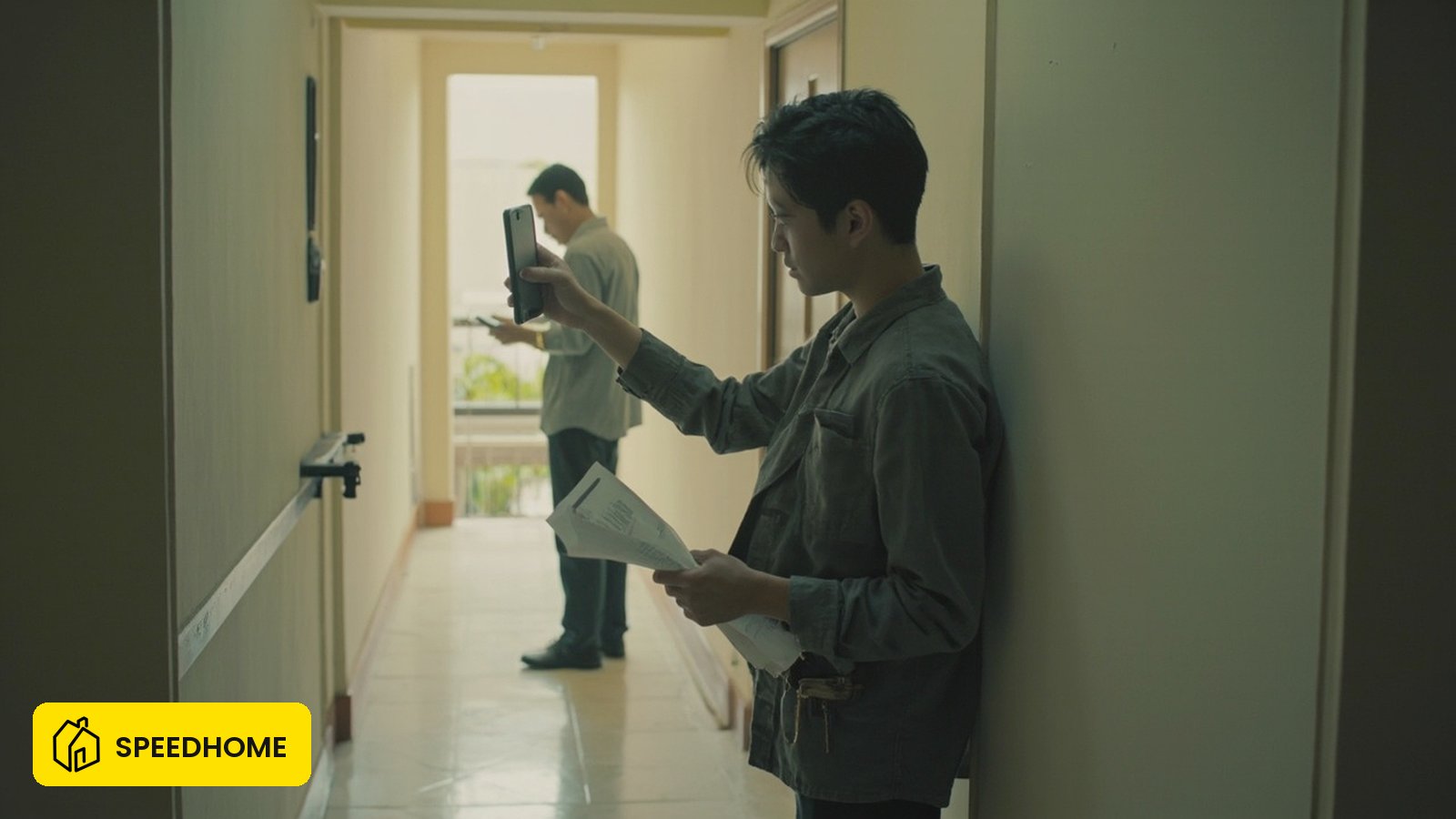
How do you protect your security deposit in Malaysia?
Protect your security deposit by documenting the unit's condition at move-in, insisting on a stamped tenancy agreement that specifies the refund timeline and lawful deduction grounds, and keeping receipts and utility records throughout. Malaysia has no statutory cap or refund deadline — the tenancy agreement is the only document that binds the landlord. SPEEDHOME platform data (Q1 2026) shows move-out deposit disputes that escalate to legal action share one root: no timestamped move-in photo evidence in roughly 8 of 10 cases.
Do this before you hand over a single ringgit
- Stamp and sign the tenancy agreement (TA), with refund deadline and deduction grounds spelled out.
- Walk the unit on video, timestamped, and WhatsApp it to the landlord the same day.
- Pay every deposit by bank transfer to the named landlord or agent account and keep each receipt.
Tenants in Malaysia are routinely surprised at move-out: a landlord claims the whole deposit for "cleaning and painting," no itemised list appears, and the 30-day return window slips by. Most disputes are not malicious — they collapse because the tenant has no timestamped move-in photo, no demand-letter trail, and no itemised accounting to rebut a vague "damages" claim. The protection steps below close each of those gaps before the dispute starts.
What Malaysian law says about your deposit (and what it does not)
Malaysia has no statutory cap on deposit amounts and no Residential Tenancy Act in force. The tenancy agreement and the Contracts Act 1950 govern everything — deposit amount, refund timeline, and what a landlord may lawfully retain.
This means the deposit rules are whatever the two parties wrote into the agreement. A landlord can ask for two months, three months, or more; the 2+1+½ formula (2-month security + 1-month advance rental + ½-month utility deposit) is market convention, not law. See what you have to pay for when renting a house for the full upfront cost picture beyond the deposit itself.
The refund deadline is also contractual. The "30 days after move-out" norm is a drafting standard, not statute. The "14 days" figure some portals quote is a clause option — if your agreement is silent, "reasonable time" under contract law applies, which is vague and hard to enforce.
When things go wrong, there is no dedicated residential tenancy tribunal. Deposit disputes are private contract matters decided in the civil courts: small-claims procedure for amounts up to RM5,000 (Magistrates' Court, Order 93 of the Rules of Court 2012); Magistrates' Court up to RM100,000; Sessions Court above that. The Tribunal for Consumer Claims does not hear private residential tenancy deposit disputes — a tenancy is an interest in land, outside that tribunal's jurisdiction.
See the full security deposit Malaysia guide for the legal background and the 2+1+½ stack table in detail.
Step 1: read and negotiate the tenancy agreement before signing
Read every deposit-related clause — refund deadline, deduction grounds, fair-wear exclusion, and notice period — before signing. All four clauses are negotiable — what you sign is what binds you.
Most tenants sign the agreement the landlord's agent presents without reading it. That document becomes the only rulebook for every future deposit dispute. Four clauses that protect you:
| Clause | What to look for | What to push for if absent or vague |
|---|---|---|
| Refund deadline | How many days after move-out? 14 days is better than 30; more than 30 is weak | Add "within 14 calendar days of the tenant's move-out, less lawful deductions" |
| Deduction grounds | Listed specifically, or just "as the landlord sees fit"? | Demand a specific list: unpaid rent, unpaid utilities, tenant-caused damage with receipts |
| Fair wear and tear | Does the clause acknowledge normal wear is not deductible? | Add "fair wear and tear is excluded from the landlord's right of retention" |
| Early termination | What is the notice period and penalty? | "Tenant to give 2 months' notice; penalty limited to 1 month's rent if notice is given" |
Stamp it within 30 days of signing — and keep your copy. An unstamped agreement still counts as evidence in court, but the court will not let you produce it until you have paid the late penalty. Make sure the landlord's copy and yours match word for word.
Step 2: pay into the right account and get official receipts
Pay every deposit by bank transfer to the named landlord or authorised agent company account — never cash to an individual — and obtain a signed receipt for each payment. If the payee name does not match the title on the property documents, stop paying immediately and verify ownership before continuing.
| Payment type | Safe method | What your receipt should show |
|---|---|---|
| Earnest / booking deposit | Bank transfer or online transfer | Payee name, amount, date, which deposit it is, unit address |
| Security deposit (2 months) | Bank transfer at TA signing | Same as above; linked to the signed TA |
| Utility deposit (½ month) | Bank transfer at TA signing | Same as above; note it is the utility deposit |
| Advance rental (1 month) | Bank transfer at TA signing | "First month's rent: [period]" |
Cash payments with no receipt are legally traceable but practically difficult to prove in court. A bank transfer screenshot plus a WhatsApp confirmation from the landlord is strong evidence. Keep every payment record in a folder you can access in five years — deposit disputes sometimes arise long after the move-out date.
For a full guide on verifying the landlord before paying, see how to verify a landlord before paying a deposit.
Step 3: photograph and document the unit at move-in
On move-in day, take a timestamped video walkthrough of every room — walls, floor, ceilings, fittings, appliances, and meter readings. Send it to the landlord by WhatsApp or email the same day and ask for written acknowledgement. This record decides who bears the cost of pre-existing damage at move-out.
A 10-minute phone video is worth more than any subsequent argument. A landlord cannot claim the tenant caused damage that existed before move-in if the move-in video shows it clearly, timestamped. Without the video, the landlord's word against the tenant's is the only evidence the court has.
What to capture at move-in:
- Every wall and corner of every room (pan slowly)
- Floor surface, especially grout lines, tiles, and carpets
- All built-in fixtures: kitchen units, bathroom fittings, cabinets, hinges, locks
- All appliances: air-conditioning remote, fridge condition, water heater, oven, washing machine
- Meter readings: electricity meter (TNB), water meter (Air Selangor or your local water authority), gas if applicable — photograph the display
- Any pre-existing defect: note in a written list ("scratch on bedroom door," "stain on ceiling," "warped cabinet door") and include a photo close-up
If the landlord provides a printed inventory checklist, complete it and keep a signed copy. If they do not provide one, write your own and ask the landlord to countersign it. If they refuse, your video and the WhatsApp acknowledgement are your fallback.
Step 4: maintain written records throughout the tenancy
Every rental payment, maintenance request, and communication with the landlord should be in writing — a WhatsApp message is sufficient. A paper trail of on-time payments and prompt defect reports blocks the two most common deposit-deduction claims: rent arrears and damage you supposedly caused.
Tenants who pay by bank transfer have an automatic paper trail. Tenants who pay cash should still get a signed receipt for each payment — a screenshot of a WhatsApp message from the landlord saying "rent received for [month]" is usable evidence.
For repairs and maintenance, report in writing, even if you also call. A WhatsApp message saying "the kitchen tap is dripping — sent on [date]" documents that you reported the issue promptly and that the landlord was aware. If the landlord fails to fix it and deducts the repair cost from your deposit at move-out, your message proves they knew it was not new damage.
Keep a simple monthly payment log with three columns: month, amount paid, and a one-line landlord acknowledgement (WhatsApp or bank confirmation). An unbroken log eliminates the "outstanding rent" deduction at move-out, which is the most common basis landlords cite for retaining a deposit.
Step 5: give proper notice and settle utilities before move-out
Serve notice in writing within the period the tenancy agreement requires — typically two months. On move-out day, take final meter readings, settle all utility bills, and obtain a zero-balance receipt or screenshot wherever possible. Unsettled bills are a lawful deduction ground.
Utility arrears are the easiest deduction to dispute — and the easiest to prevent. TNB, Syabas/Air Selangor, TM, and telco providers all issue billing statements. Taking meter photos on move-out day and comparing against the first-day reading gives you an independent record of consumption that can be cross-checked against the final bill.
Move-out checklist:
| Task | Evidence to keep |
|---|---|
| Written move-out notice to landlord | WhatsApp / email with date |
| Joint inspection with landlord | Completed checklist, signed by both; or video |
| Return all keys and access cards | WhatsApp confirmation or signed receipt |
| Final TNB meter reading | Timestamped photo |
| Final water meter reading | Timestamped photo |
| Final internet/telco bill settled | Payment confirmation |
| Comparison video (move-in vs move-out) | Same room-by-room sequence as the move-in recording |
If the landlord refuses to do a joint inspection, conduct and document your own walkthrough on video, send it to the landlord, and note in writing that you attempted a joint inspection. Note in writing that you attempted a joint inspection; their refusal is on the record.
Step 6: know your rights — and the dispute path
If a landlord withholds the deposit without an itemised deduction list and supporting receipts, send a written demand. If unresolved after 14 days, file a claim at the Magistrates' Court using the small-claims procedure (Order 93, Rules of Court 2012) for amounts up to RM5,000 — no lawyer is needed. SPEEDHOME platform data (Q1 2026) shows tenants who file a written demand within 14 days recover their deposit in roughly 7 of 10 cases where the landlord cannot produce itemised receipts, and roughly 6 to 9 of 10 deposit disputes settle after a written demand letter without ever reaching a court filing.
Tenants commonly assume deposit disputes require a lawyer or months in court. The small-claims procedure was designed precisely for this kind of low-value civil dispute: the filing fee is approximately RM20, no lawyer is mandatory, and the process is straightforward for a tenant who arrives with documented evidence.
| Dispute path | When to use | Key details |
|---|---|---|
| Written demand letter | First step, always | State the amount, the return deadline in the TA, and request an itemised deduction list with receipts within 14 days |
| Magistrates' Court small-claims (Order 93) | Claims up to RM5,000; individuals only | Filing fee ~RM20; no mandatory lawyer; bring evidence file |
| Magistrates' Court (general civil claim) | Claims RM5,001–RM100,000 | Lawyer advisable but not mandatory at all stages |
| Sessions Court | Claims RM100,001–RM1,000,000 | Lawyer strongly advisable |
Small-claims hearings are typically scheduled 4–8 weeks after filing. Bring (1) the stamped TA, (2) move-in photo/video, (3) WhatsApp receipts of payment, (4) meter readings, (5) any demand-letter thread. The magistrate asks for documents in order — paper trail wins.
The landlord's burden is to prove each deduction is valid — not yours to prove you caused no damage. If they cannot produce an itemised list with receipts and photos for every deduction, the small-claims court will typically order the contested amount returned. See the step-by-step guide on what a landlord can legally deduct from your deposit and how to get your deposit back in Malaysia for the full claim walkthrough.
Is Zero Deposit a way to protect your deposit?
Zero Deposit replaces the upfront cash deposit with SPEEDHOME's managed rental-risk system — backed by an Experian credit and income check, a stamped TA with handover photos, and the platform's protection plan under current terms. Eligibility is set per listing, not blanket-approved.
Zero Deposit shifts the move-in cash from 3.5 months to roughly one month (advance rental only). On a RM1,800/month unit, that is the difference between RM6,300 upfront and approximately RM1,800.
| Cost line | Traditional 2+1+½ (RM1,800/mo unit) | SPEEDHOME Zero Deposit (where eligible) |
|---|---|---|
| Security deposit (2 months) | RM3,600 | RM0 |
| Utility deposit (½ month) | RM900 | RM0 (per current plan terms) |
| Advance rental (1 month) | RM1,800 | RM1,800 |
| Cash before keys | RM6,300 | ~RM1,800 |
What replaces the cash buffer: an Experian-backed credit and income check, a signed tenancy agreement with photographic evidence at handover, and the platform's protection plan under current terms and limits. SPEEDHOME Zero Deposit screening (Q1 2026) approves roughly 7 of 10 applicants — meaning roughly 30% of applicants do not qualify for the Zero Deposit route, and move in via the standard deposit path instead.
For tenants, the step-by-step deposit protections in this guide apply equally to Zero Deposit tenancies: document the move-in condition, settle utilities, give proper notice. The absence of a large refundable deposit at move-out is the difference — you are not waiting for your own cash to be released.
Browse Zero Deposit verified rentals on SPEEDHOME and confirm eligibility on the individual listing page before committing.
Frequently asked questions about protecting your deposit
Does Malaysia have a law that limits how much deposit a landlord can charge?
No statutory cap exists. The proposed Residential Tenancy Act has been a draft Bill for several years — as of 2026 it has not been tabled in Parliament, so the 2+1+½ stack remains market convention rather than a legal ceiling. Until the RTA is in force, treat the deposit amount as a negotiating line: the landlord names a figure, you counter, and whatever you both sign is what binds. Check our running RTA tracker note in the security deposit Malaysia guide for any status update before you sign.
When must a landlord return the security deposit?
There is no statutory deadline. If your tenancy agreement is silent, "reasonable time" under contract law applies — six to eight weeks is commonly treated as the upper bound of "reasonable" for a straightforward move-out with no damage dispute; longer without justification starts to look like retention. Pin a specific date in the TA before you sign — "within 14 calendar days of move-out" is the strongest wording.
What can a landlord legally deduct from my deposit?
Only documented, proven losses: unpaid rent (with a rent ledger), unpaid utility bills (with final statements), tenant-caused damage beyond fair wear and tear (with move-in/out photos and repair receipts), breach of a specific tenancy agreement clause, early termination penalty per the clause, and agreed restoration costs. Fair wear and tear — faded paint after normal occupancy, minor scuffs, worn flooring — is not lawfully deductible. See what a landlord can legally deduct from your deposit for the full breakdown.
My landlord won't return my deposit — what do I do?
Send a written demand (WhatsApp or email) requesting an itemised deduction list with receipts within 14 days. If unresolved, file a small-claims case at the Magistrates' Court (Order 93, Rules of Court 2012) for amounts up to RM5,000 — no lawyer is required and the fee is approximately RM20. For amounts above RM5,000, file in the Magistrates' or Sessions Court. Malaysia has no dedicated tenancy tribunal; the civil courts are the correct forum.
Does a stamped tenancy agreement help protect my deposit?
Yes, significantly. A stamped tenancy agreement is fully admissible as evidence in court without penalty; an unstamped one is admissible only after paying late-penalty stamp duty. Stamping confirms the terms are locked — neither party can claim the agreement was altered after signing. Both parties should keep identical stamped copies.
My agency only returned a fraction of my deposit (e.g. RM250 of RM1,300) — how do I demand an itemised justification?
Send a written demand immediately, addressed to the agency and (if different) the landlord, asking for two things: an itemised list of every deduction with the amount, and supporting receipts or evidence for each item. The landlord's side carries the burden of proving each deduction is valid — a lump-sum "cleaning and other costs" figure with no breakdown is not enough. Give a short deadline (14 days is reasonable) for the itemised list to arrive; if it does not, or the items on it are not backed by receipts or photos of damage beyond fair wear and tear, that unsupported balance is what you claim back. Because the disputed amount in a case like this typically sits well under RM5,000, the Magistrates' Court small-claims procedure (Order 93, Rules of Court 2012) is the forum — no lawyer required, a filing fee of approximately RM20, and the court looks for exactly the documents in Steps 1–5 above: the stamped TA, move-in photos or video, payment receipts, and your written demand thread. See what a landlord can legally deduct from your deposit and how to get your deposit back in Malaysia for the full claim walkthrough.
Is it true that landlords can deduct for repainting after a long tenancy?
No. Repainting an entire unit to restore it after years of normal occupancy is fair wear and tear — a maintenance cost the landlord bears, not the tenant. A landlord can only charge for repainting if the tenancy agreement specifically requires the tenant to repaint on departure, or if the tenant caused specific, documented damage to wall surfaces beyond normal use (e.g., a hole from a removed shelf, smoke staining, or unapproved paint colour). SPEEDHOME platform records (Q1 2026, cases where the tenancy agreement lacked a repaint clause) show full-unit repaint disputes resolved in the tenant's favour in roughly 8 of 10 small-claims cases.