Tenant Move-Out Checklist Malaysia: 30/14/7-Day Countdown (2026)
Start the move-out the right way and you protect your deposit: give written notice on time, settle the final utility bills, clean the place back to how you got it, take dated photos, do a joint walk-through with the landlord, hand over the keys with a signed acknowledgement, and give your bank details for the refund. Do those seven things in order and you leave with evidence on your side, not excuses against you. SPEEDHOME, one of Malaysia’s largest tenant-first rental platforms, sees the same pattern in deposit disputes every month: tenants who get their deposit back are the ones who documented the move-out, while the ones who “just left” lose the argument because they kept no proof. This guide walks you through the full sequence, with a checklist you can follow room by room.
SPEEDHOME Editorial Team · Last updated May 2026 · Based on SPEEDHOME platform experience and current Malaysian rental practice.
Your deposit is your money — the move-out is how you prove you should get it back
The deposit is yours, held by the landlord as security, and it comes back unless you leave a real reason to keep part of it. In Malaysia there is no single rental law for homes, so no government rulebook sets out move-out steps — what happens to your deposit comes entirely from the tenancy agreement you both signed. That cuts both ways: the landlord can only deduct for a genuine breach, and you can only defend your deposit if you can show the unit went back clean, undamaged, and with bills settled.
There are usually two refundable sums: the security deposit (often two months’ rent) and the utility deposit (often half a month). If a landlord keeps your deposit without a fair, itemised reason, you can take the case to the Small Claims court yourself, with no lawyer, for up to RM5,000. But the court decides on evidence — so the work you do on move-out day is what wins or loses the refund.
The SPEEDHOME rule for tenants moving out: Your deposit is your money the landlord is holding, not a fee you pay to leave. You get it back by handing the unit over clean and undamaged, with bills settled. Document the condition, do a joint walk-through, and get a signed key handover — then the refund is a formality, not a fight.
The Malaysian street advice — and why “just leave” costs you your deposit
In tenant chats and from friends who have moved before, you will hear the same shortcut: “just leave and let them sort it out.” Drop the keys, walk away, and assume the deposit comes back on its own. It feels easy. It is the single fastest way to lose your deposit.
Here is why it backfires. The moment you hand over the unit with no photos, no joint inspection, and no signed acknowledgement, you have given up every piece of evidence you had. If the landlord later claims the walls were marked, the unit was filthy, or a fixture was broken, you have nothing to show it was fine when you left — and at the Small Claims court, the side with no proof usually loses. “Let them sort it out” really means “let them decide how much of my money to keep.”
The fix is not confrontational. You do not need to argue with anyone — you just need a paper trail: dated photos, a joint walk-through, and a signed key handover. That is the difference between a deposit back in weeks and one you chase for months, or never see again.
Worth remembering: “Just leave and let them sort it out” is the advice that loses you your deposit. Walk away with no photos, no joint inspection, and no signed key handover, and you have thrown away your only evidence. If the landlord then claims damage or dirt, you cannot prove the unit was fine — and the side with no proof usually loses at the Small Claims court.
The move-out checklist: seven steps that protect your deposit
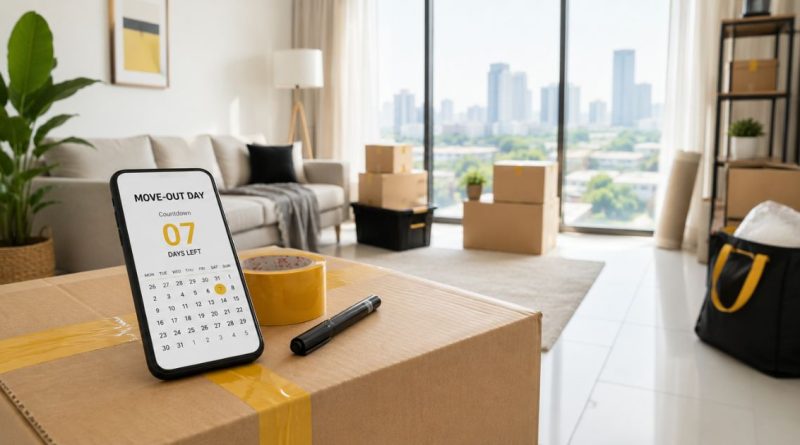
Work through these in order, starting two months before you leave. Each step builds the evidence that gets your full deposit back. The table is your at-a-glance version; the sections below explain each one.
| Step | What to do | Why it protects your deposit | When |
|---|---|---|---|
| 1. Give notice | Send written notice for the full period your agreement requires | A late or verbal notice can cost you a month’s deposit | 1â2 months before |
| 2. Settle bills + final readings | Pay water, electricity, internet to the last day; record final meter readings | Unpaid bills in the landlord’s name are a fair deduction | Final week |
| 3. Clean to move-in standard | Return the unit as clean as you got it | A unit left filthy is a deduction; a clean one is not | Final days |
| 4. Dated move-out photos | Photograph every room, fixture, and meter with the date on | Your proof the unit was fine when you left | Move-out day, before keys |
| 5. Joint inspection | Walk through with the landlord, agree the condition | Stops disputes about damage after you have gone | Move-out day |
| 6. Hand over keys + get acknowledgement | Give all keys, access cards, remotes; get it in writing | Proof of when you returned possession | Move-out day |
| 7. Give bank details | Provide your account number for the refund | No bank details, no transfer — this is the actual refund step | At handover |
Step 1 — Give proper written notice
Send your notice in writing for the full period your agreement names — usually one to two months — and keep proof you sent it. Late or spoken-only notice is the most common reason a landlord keeps part of the deposit. If your agreement asks for two months and you give six weeks, the landlord can charge you for the shortfall. Send it by a channel that timestamps it — a chat message, an email, or the platform you rented through — so you can show the date later.
Step 2 — Settle the final utility bills and get final meter readings
Pay every utility account to your last day, and record the final meter readings on move-out day. Water, electricity, internet, and any service charge must be cleared. If the account is in the landlord’s name, an unpaid closing bill is a fair deduction — and that bill often arrives after you leave, so the landlord may hold part of the deposit until it lands. Photograph the meters on the day. SPEEDHOME flags this because the bill follows the account holder: if the account is in your name, close it; if it is the landlord’s, get your share confirmed in writing.
Step 3 — Clean the unit back to move-in standard
Return the unit as clean as it was when you got the keys — not spotless beyond that, but not filthy. You are not charged for normal wear: faded paint, a worn carpet path, small nail holes. You can be charged if you leave it genuinely dirty — a grease-caked kitchen, a mouldy bathroom, rubbish left behind — and the agreement asks for it back clean. Clean the kitchen and bathroom, clear all your belongings, and take out the rubbish. If unsure, match the standard in your own move-in photos.
Step 4 — Take dated move-out photos
Before you hand over a single key, photograph every room, fixture, appliance, and meter, with the date visible. This is your strongest piece of evidence — photos of a clean, undamaged unit on the day you left defeat any later claim that you damaged or dirtied it. Use your phone’s date stamp, and cover the same spots your move-in inventory covered for a clear “before and after” pair.
Step 5 — Do a joint inspection with the landlord
Walk through the unit with the landlord present, agree the condition out loud, and note anything flagged in writing. A joint inspection is where most disputes are settled before they start. If the landlord points at a mark, you discuss it there, with the unit in front of you both — not weeks later over text. Bring your move-in inventory and photos. If you both agree the unit is fine, ask the landlord to confirm it in a message or on paper; if there is a disputed item, record it then, while you can still see it.
Step 6 — Hand over keys and get a written acknowledgement
Give back every key, access card, remote, and gate fob — and get the landlord to confirm in writing that they received them and took back possession on that date. The handover date is when your responsibility for the unit ends. A signed note, or even a dated chat message saying “received all keys, unit handed back today”, protects you from being charged rent or bills for days after you left. Do not leave keys under a mat with no acknowledgement — that is “just leaving” with extra steps, and it proves nothing.
Step 7 — Give your bank details for the refund
Hand the landlord your bank account details so they can transfer the deposit balance. This is the step tenants forget, and it stalls more refunds than anything else — a landlord cannot transfer money to an account number they do not have. Give your account name, bank, and account number at handover, in writing, then agree a reasonable window — long enough for final bills to arrive, short enough that no one is sitting on your money.
How long should the deposit refund take?
As soon as is reasonable after the keys are back, the unit is checked, and the final bills are in — there is no fixed legal deadline in Malaysia. With no single rental law, no rule sets an exact day count, so the timing comes from your agreement. A fair landlord refunds the balance once the final utility bill lands, since that is often the last unknown. If a landlord drags it out with no reason, or keeps the deposit with no itemised breach, escalate to the Small Claims court.
What if the landlord won’t return my deposit?
First ask for an itemised reason in writing; if there is no fair, evidenced breach, take it to the Small Claims court. A landlord can only keep part of the deposit for a real breach — unpaid rent, unpaid bills in their name, or damage beyond normal wear — and must show it. Keeping it on a “bad tenant” feeling, an automatic repaint charge, or no reason at all is a wrongful deduction. You can file yourself, with no lawyer, for up to RM5,000 — and this is exactly where your move-out photos, inspection notes, and signed key handover win the case.
The deposit-defence rule in one line: Your move-out evidence is your deposit insurance. Dated photos, a joint inspection, and a signed key handover are what let you reclaim a wrongly withheld deposit at the Small Claims court — up to RM5,000, no lawyer needed. The tenant who documented the move-out wins; the one who “just left” has nothing to show.
Can the landlord deduct for cleaning or repainting?
Only for real dirt or real damage, never automatically — normal wear and tear is the landlord’s cost, not yours. Faded paint, a worn carpet, small nail holes, and minor scuffs are what happens when someone lives somewhere; charging you for them is a wrongful deduction tenants regularly win back. A cleaning charge is only fair if you left the unit genuinely filthy; a repaint charge only for damage beyond living marks — large holes, deep stains, or an unapproved colour change. Your move-in photos prove what was already there.
Find your next home the safe way with SPEEDHOME
The cleanest move-out is the one where your next move-in is already sorted — on a platform that keeps your records in one place. When your tenancy is on SPEEDHOME, your inventory, photos, payments, and messages are stored together, so if a deposit deduction is ever questioned your proof is ready, not scrambled together afterwards.
- Verified listings, not guesswork. Browse homes you can trust, so your next tenancy starts on solid footing.
- Your records travel with you. Inventory, photos, and payment history in one place make your next deposit easier to protect.
- Zero-deposit options. SPEEDHOME’s zero-deposit model means less cash tied up at move-in and less to argue over at move-out.
Moving out? Find your next verified home â browse rentals on SPEEDHOME.
FAQ
What do I need to do when I move out of a rental in Malaysia? Give written notice for the full required period, settle all utility bills and record final meter readings, clean back to move-in standard, take dated photos of every room, do a joint inspection with the landlord, hand over all keys with a written acknowledgement, and give your bank details. Do these in order and you protect your deposit.
How do I get my full deposit back when I move out? Leave evidence, not excuses. Hand the unit over clean and undamaged with all bills settled, take dated photos before you give back the keys, do a joint walk-through, and get a signed acknowledgement that you returned the keys on that date. A documented move-out turns the refund into a formality, not a fight.
Can my landlord keep my deposit if I just leave the keys and go? They can make it very easy to. If you “just leave” with no photos, no joint inspection, and no signed handover, you have given up your evidence — so if the landlord later claims damage or dirt, you cannot prove the unit was fine. At the Small Claims court, the side with no proof usually loses.
How long does a landlord have to return my deposit in Malaysia? There is no fixed legal deadline, because Malaysia has no single rental law; the timing comes from your tenancy agreement. A fair landlord refunds the balance once the keys are back and the final utility bill has arrived — a reasonable window that gives the last bill time to land without letting anyone sit on your money indefinitely.
What can I do if my landlord refuses to return my deposit? First ask for an itemised reason in writing. If there is no genuine, evidenced breach — only a feeling, an automatic charge, or no reason at all — that is a wrongful deduction. You can take it to the Small Claims court yourself, with no lawyer, for up to RM5,000. Your move-out photos, inspection notes, and signed key handover are what win it.
General information on Malaysian rental practice, not legal advice. Deposit terms, notice periods, procedures, and monetary limits depend on your signed agreement and can change, so confirm the current position or engage a lawyer for a contested case. Brand: SPEEDHOME, SPEEDRENO, SPEEDFIX, SPEEDSIGN.